








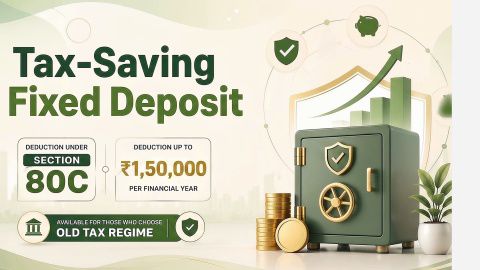
Tax Savings FD (Fixed Deposit)
-
In summary
Filing an ITR is not only about meeting your tax obligations. It can also help you:
- Claim a refund if excess Tax Deducted at Source (TDS) or advance tax has been paid.
- Carry forward eligible losses to future years, subject to applicable conditions and filing deadlines.
- Maintain documented evidence of your income and tax compliance.
- Support loan and credit applications where lenders ask for income records.
- Provide financial information for visa applications where the relevant embassy or consulate requests it.
- Keep a consistent record of your financial affairs.
Whether you must file a return depends on your income and other conditions specified under the applicable income tax law. Even if your income is below the basic exemption limit, certain circumstances may still require you to file an ITR.
What are the benefits of filing an ITR?

Avoid these mistakes while booking FD
-
An ITR records your income from different sources, eligible deductions and exemptions, and taxes paid during the financial year. Filing it accurately and within the applicable deadline can offer several practical benefits.
1. Claim a refund of excess tax deducted
-
Tax may be deducted at source from income such as salary, interest on deposits, rent and professional fees. However, the total tax deducted during the year may be higher than your final tax liability.
Filing an ITR allows you to report your total income, calculate your tax liability and claim a refund of eligible excess tax paid.
Example:
Suppose a bank or deposit-taking institution deducts Rs. 10,000 as TDS on your interest income during a financial year. After calculating your total taxable income and applicable tax liability, you find that your actual tax payable is Rs. 6,000.
You may claim a refund of Rs. 4,000 by filing an eligible ITR, provided the return and tax records support the claim.
The refund is not automatic merely because TDS was deducted. It depends on your final tax calculation, the tax credits reflected in your records and successful processing of the return. You must also complete the required verification of your ITR.
2. Carry forward eligible losses to future years
If you incur a loss under certain income categories, tax rules may allow you to carry it forward and adjust it against eligible income in subsequent years.
For example, capital losses may be adjusted against eligible capital gains, while business losses may be adjusted against eligible business income. The rules differ according to the type of loss.
In many cases, you must file your return within the prescribed due date to retain the right to carry forward the loss. Therefore, filing a return can be important even when you have no tax payable for that year.
Example:
Suppose you incur a short-term capital loss of Rs. 30,000 during a financial year, but you do not have sufficient eligible capital gains to adjust it against. Subject to the applicable rules, you may carry forward the unadjusted loss and set it off against eligible capital gains in a subsequent year.
The amount and period for which a loss can be carried forward depend on its category and the applicable tax provisions. Maintain the relevant records and file the return within the prescribed deadline.
3. Support loan and credit applications
Lenders may ask applicants to provide ITR acknowledgements or copies of filed returns as part of their income and financial assessment.
An ITR can help a lender understand:
- Income reported over previous financial years.
- The consistency of declared earnings.
- Income from different sources, such as salary, business, rent or investments.
- The applicant's reported financial position.
This documentation can be particularly useful for self-employed individuals, freelancers, consultants and business owners who may not have a regular salary slip or employer-issued income certificate.
However, an ITR does not guarantee loan approval. Lenders assess several other factors, including income stability, existing financial obligations, credit history, repayment capacity and their own eligibility criteria. The number of years of ITR records required also varies by lender and loan product.
Check out different FD Rates
4. Provide supporting financial records for visa applications
Some embassies and consulates may request ITR documents as part of a visa application. These records can help demonstrate your declared income, financial activity and tax compliance.
They may be relevant when applying for certain visitor, business or other visa categories, particularly where the applicant needs to establish their financial circumstances.
The documents required depend on the destination country, visa category and the applicant's circumstances. Some authorities may ask for ITR acknowledgements for specific previous years, while others may accept different financial documents.
An ITR does not guarantee visa approval. Applicants should check the latest document checklist issued by the relevant embassy, consulate or visa application centre before submitting their application.
5. Maintain an official record of your income
An ITR provides a consolidated record of the income you report to the Income Tax Department. Depending on your circumstances, it may include income from:
- Salary or pension.
- Business or professional activities.
- House property.
- Capital gains from the sale of eligible assets.
- Interest and other sources.
This record can be useful when you need to demonstrate your financial position for a loan, visa, rental arrangement or another transaction.
For salaried individuals, Form 16 provides details of salary paid and tax deducted by an employer. However, an ITR can provide a broader picture by bringing together income from multiple sources and reporting eligible deductions, exemptions and taxes paid.
The information in an ITR is based on what you report and should be supported by relevant records. It should not be treated as independent proof of every financial transaction.
Fixed Deposit variants
Get ROI up to
8.15% p.a.
Senior citizen
Starting with just Rs. 15,000
Get ROI up to
7.75% p.a.
Age below 60 years
Starting with just Rs. 15,000
Get ROI up to
7.75% p.a.
Minor
Starting with just Rs. 15,000
Get ROI up to
7.75% p.a.
HUF
Starting with just Rs. 15,000
Get ROI up to
7.75% p.a.
Sole proprietor
Starting with just Rs. 15,000
6. Help meet income tax compliance requirements
Filing an ITR within the prescribed timeline helps you meet your tax reporting obligations when a return is required under the applicable law.
It also allows you to report income accurately, reconcile tax deducted or paid during the year and disclose relevant financial information.
Filing on time can help you avoid certain consequences associated with late filing, such as applicable late fees and interest. It can also preserve benefits such as the ability to carry forward eligible losses, where timely filing is a statutory condition.
Even if no tax is payable after applying an eligible rebate or other provisions, you should separately check whether you are required to file a return. A nil tax liability does not automatically mean that filing is optional.
7. Help establish financial information for insurance applications
Insurance providers may ask for income-related documents when assessing an application, particularly where the proposed life cover or policy features require financial underwriting.
An ITR may be one of the documents requested to assess declared income and financial suitability. This can be relevant for self-employed applicants or individuals whose income is not fully represented by a salary slip.
The documents required depend on the insurer, policy, sum assured and underwriting requirements. An ITR is not a universal requirement for every insurance policy, and filing one does not guarantee policy approval or a particular sum assured.
Is filing an ITR mandatory for everyone?
No. The requirement to file an ITR depends on your income, taxpayer category and other conditions prescribed under the applicable income tax law.
For income earned during FY 2025–26, the return is filed for Assessment Year (AY) 2026–27 under the Income-tax Act, 1961. The basic exemption limit for an individual depends on the tax regime selected:
- New tax regime: The basic exemption limit is Rs. 4 lakh.
- Old tax regime: The basic exemption limit is Rs. 2.5 lakh for individuals below 60 years, Rs. 3 lakh for resident senior citizens aged 60 to below 80 years, and Rs. 5 lakh for resident super senior citizens aged 80 years or above.
These are basic exemption limits, not a complete list of return-filing conditions. Certain individuals may have to file a return even if their income is below the applicable limit. Such conditions can include specified foreign assets or financial interests, certain high-value transactions and other circumstances set out in the law.
A person may also choose to file a return to claim an eligible tax refund or meet another financial or documentation requirement.
Before deciding not to file, check the applicable filing conditions on the Income Tax Department's e-filing portal or consult a qualified tax professional.
What happens if you do not file an ITR when it is mandatory?
Not filing an ITR when you are legally required to do so can lead to consequences under the applicable tax provisions. Depending on the circumstances, these may include:
- Late filing fee: A fee may apply when a return is filed after the prescribed due date.
- Interest: Interest may be payable on outstanding tax, where applicable.
- Loss of certain benefits: You may lose the ability to carry forward specified losses if the law requires a timely return.
- Further tax proceedings: Continued non-compliance may lead to notices or other action by the Income Tax Department.
The consequences depend on the taxpayer's circumstances, the type of return and the relevant provisions. If you have missed a deadline, check whether a belated or updated return is available and what conditions apply.
Locate to your nearest FD branch

Related Articles


Frequently Asked Questions
Overview
Is filing an ITR mandatory for salaried individuals earning below Rs. 2.5 lakh?
No, ITR filing is not mandatory for those earning below Rs. 2.5 lakh annually. However, such assessees need to file ITR if they want to claim excess TDS refunds and carry forward losses.
Can I use my ITR as proof of address?
Yes, an ITR serves as an official and government-recognised proof of address. You can use it while applying for loans, an Aadhaar card, a passport, or a driving license.
Disclaimer
1. Bajaj Finance Limited (“BFL”) is a Non-Banking Finance Company (BAJAJ FINANCE) and Prepaid Payment Instrument Issuer offering financial services viz., loans, deposits, Bajaj Pay Wallet, Bajaj Pay UPI, bill payments and third-party wealth management products. The details mentioned in the respective product/ service document shall prevail in case of any inconsistency with respect to the information referring to BFL products and services on this page.
2. All other information, such as, the images, facts, statistics etc. (“information”) that are in addition to the details mentioned in the BFL’s product/ service document and which are being displayed on this page only depicts the summary of the information sourced from the public domain. The said information is neither owned by BFL nor it is to the exclusive knowledge of BFL. There may be inadvertent inaccuracies or typographical errors or delays in updating the said information. Hence, users are advised to independently exercise diligence by verifying complete information, including by consulting experts, if any. Users shall be the sole owner of the decision taken, if any, about suitability of the same.