Eligibility criteria and documents required
Anyone can apply for our loan against mutual funds online, as long as they meet the four basic criteria mentioned below. Also keep a few documents handy while applying for loan against mutual funds.
Eligibility criteria
- Nationality: Indian
- Minimum age:
Primary Borrower: 21 years
Co-Borrower/Security Provider: 18 years
- Maximum age:
Primary Borrower, Co-Borrower, and Security Provider: 90 years. A co-borrower is mandatory if the customer is more than 70 years of age.
- Employment: Salaried, self-employed
- Security value: Minimum Rs. 50,000
Documents
- PAN card
- KYC documents:
a. Passport
b. Driving License
c. Voter’s Identity Card
d. Aadhaar
e. Job Card issued by NREGA
f. Letter issued by the National Population Register - Consolidated Account Statement
Corporates/ HUF/ LLP/ Partnership/ Trust/ Sole Proprietorship can apply for loan against mutual funds of up to Rs. 1000 crore, by reaching us at las.support@bajajfinserv.in.
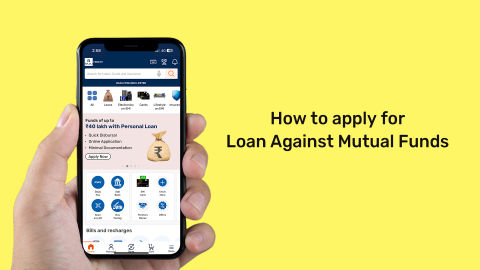
How to apply for a loan against mutual funds
 01:16
01:16
Frequently asked questions
The eligibility criteria to apply for a loan against mutual funds are:
- Securities: You should have a minimum share of Rs. 50,000.
- Ownership: You should be the owner of the securities and have clear and marketable title to them.
- Age: You should fall under the age bracket of 21 to 90 years.
- Type of mutual funds: Your funds should be under the approved list of 5000 + funds.
To avail a loan against mutual funds, an individual must be between 21 and 90 years of age.
The lender may charge a processing fee for the loan, which is usually a percentage of the loan amount. When availing a loan against mutual funds with Bajaj Finance Limited, you shall incur a processing fee of up to 4.72% of the loan amount (inclusive of applicable taxes).
You can avail a loan of upto Rs. 1000 crores against your mutual funds through Bajaj Finance.
Yes, you can apply for a loan against mutual funds online through a fully digital process on the Bajaj Finance website, ensuring quick approval and easy access to funds.
Yes, both equity and debt mutual funds are accepted as collateral, provided they are approved by the NBFC and held with supported AMCs and RTAs.
No, a Demat account is not required. Your mutual funds should be in a dematerialised form and registered with CAMS or KFintech to be eligible.
Mutual funds registered with supported AMCs and RTAs like CAMS or KFintech are accepted. These can include equity, debt, hybrid, or other approved categories.
Yes. PAN and full KYC compliance are mandatory because lenders must verify your identity before enabling the pledge of mutual fund units. Without KYC, units cannot be pledged or activated for a loan.
There is no universal minimum; each lender sets its own threshold. Generally, you must have sufficient fund value to meet the lender’s margin and LTV criteria so the loan amount can be adequately secured.
Yes. SIP investments are eligible as long as the underlying mutual fund scheme is on the lender’s approved list. Only the accumulated units not future SIP instalments can be pledged for the loan.
Yes, lenders may consider your credit score to assess risk, even though the loan is secured. A better score can support quicker approval and may help you access more favourable terms.
Yes. Mutual funds in both demat and statement of account (non-demat) form can be pledged, depending on the lender’s process. The pledge is created digitally through NSDL, CDSL, or RTAs.
No. ELSS funds are usually not eligible because they have a mandatory lock-in period of three years. Units cannot be pledged until the lock-in expires, so they fall outside lenders’ approved lists.
Typically, no. Since the loan is secured against mutual fund units, lenders usually do not ask for income proof. Verification focuses on KYC, ownership of units, and the scheme’s eligibility.
Loan amount depends on the lender’s loan-to-value (LTV) ratio commonly up to 90% of the fund’s NAV. Higher-value, lower-volatility debt funds may offer a slightly better LTV than equity funds.
Approval is generally quick often within a few hours once units are successfully pledged and KYC is validated. Digital pledge creation enables near-instant activation depending on RTA and depository turnaround.
