








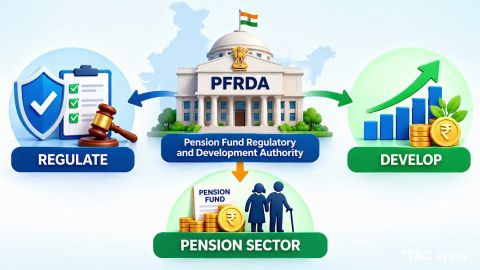
PFRDA - Pension Fund Regulatory and Development Authority
-
In Summary
The Unified Pension Scheme (UPS) became operational on 1 April 2025 as an option under NPS for eligible Central Government employees. It combines a contributory pension structure with an assured payout linked to an employee’s average basic pay before retirement. The amount payable depends on qualifying service, corpus conditions and whether the subscriber chooses a final withdrawal.
Key features of UPS include:
- Assured payout: 50% of the average basic pay for the last 12 months before superannuation, after at least 25 years of qualifying service, subject to the applicable conditions.
- Minimum payout: Rs. 10,000 per month after at least 10 years of qualifying service, subject to scheme conditions.
- Contributions: The employee contributes 10% of basic pay plus dearness allowance (DA). The Government contributes a matching 10% to the individual corpus and an estimated 8.5% to the pool corpus.
- Family payout: An eligible legally wedded spouse may receive 60% of the admissible payout after the subscriber’s death.
- Inflation relief: Dearness Relief is payable on eligible payouts in accordance with government notifications.
- Eligibility and deadlines: UPS is not open to everyone. Eligibility and the time allowed to exercise the option depend on whether the employee was already covered by NPS, joined Central Government service on or after 1 April 2025, or falls within the specified category of past retirees.
UPS is not identical to the Old Pension Scheme (OPS) or the standard NPS structure. Before choosing it, employees should understand how service length, corpus values, final withdrawal and resignation affect their benefits.
What is the Unified Pension Scheme?

Avoid these mistakes while booking FD
-
The Unified Pension Scheme (UPS) is a retirement-benefit option introduced by the Government of India within the existing NPS framework. It was designed to provide eligible Central Government employees with a more predictable retirement payout while retaining a contributory pension structure.
Under UPS, the employee and the Government make contributions during the employee’s service. At retirement, the eligible subscriber may receive an assured payout calculated using the prescribed formula. The final admissible amount can be affected by qualifying service, the value of the individual corpus compared with the benchmark corpus and any final withdrawal.
UPS became operational on 1 April 2025. It is regulated by the Pension Fund Regulatory and Development Authority (PFRDA) and is governed by the relevant notifications, regulations and Central Government service rules.
How does UPS work?
UPS combines contributions during employment with payout rules that apply when the employee retires.
The process broadly works as follows:
- Enrolment: An eligible employee exercises the UPS option within the applicable deadline.
- Regular contributions: The employee and Government contribute to the pension structure during service.
- Corpus accumulation: Contributions are invested according to the applicable investment arrangement.
- Retirement assessment: The qualifying service period and corpus values are assessed under the scheme rules.
- Payout calculation: The admissible payout is determined, taking account of the applicable formula and any final withdrawal.
- Post-retirement benefits: Eligible subscribers may receive Dearness Relief, and an eligible spouse may receive a family payout after the subscriber’s death.
The payout is therefore not simply a fixed percentage of the last salary for every person who opts for UPS. The applicable conditions must be met.
Who is eligible for the Unified Pension Scheme?
-
UPS is available to specified categories of Central Government employees and eligible past retirees under the applicable rules.
The main categories include:
- Existing Central Government employees covered by NPS on 1 April 2025: Eligible employees could exercise the UPS option within the prescribed period, subject to any extension notified by the Government.
- New Central Government recruits joining on or after 1 April 2025: Eligible recruits can exercise the option within the prescribed period, generally 30 days from joining.
- Specified past retirees covered by NPS: Certain employees who retired on or before 31 March 2025 may qualify if they meet the prescribed conditions, including the qualifying-service and retirement-related requirements.
Eligibility is not determined by service length alone. An employee must also fall within an eligible category and satisfy the relevant enrolment and service rules.
Can state government employees join UPS?
UPS was introduced for eligible Central Government employees. A state government employee should not assume that the Central Government scheme automatically applies to them.
State governments may consider adopting the scheme under their own arrangements. Employees should check the official notification issued by their state government and their department’s instructions before relying on UPS eligibility or benefits.
What is the deadline to opt for UPS?
The option deadline depends on the employee category.
- Existing NPS-covered Central Government employees and eligible past retirees: The original deadline was 30 November 2025, subject to any extension officially allowed by the Central Government.
- New recruits joining on or after 1 April 2025: The general option period is 30 days from joining, under the applicable rules.
Because deadlines may be extended or operational instructions may change, employees should confirm the current position through their department, nodal office or the official PFRDA website before taking action.
Official reference: PFRDA — Unified Pension Scheme.
Check out different FD Rates
What are the contribution rules under UPS?
UPS is a contributory pension arrangement. The employee and Government contribute during service, with a separate Government contribution made to the pool corpus.
| Contribution | Rate |
|---|---|
| Employee contribution | 10% of basic pay plus DA |
| Government contribution to individual corpus | 10% of basic pay plus DA |
| Estimated Government contribution to pool corpus | 8.5% of basic pay plus DA |
The employee’s contribution and the matching Government contribution are credited to the individual corpus. The additional Government contribution supports the pool corpus, which forms part of the scheme’s overall structure.
The additional 8.5% is an estimated contribution to the pool corpus; it should not be described as an amount credited directly to each employee’s individual account.
The value of the individual corpus can affect the final admissible payout. Regular and timely contributions are also relevant to the benefits available under UPS.
What are the benefits of the Unified Pension Scheme?
UPS provides several retirement-related benefits to eligible subscribers. The amount and availability of each benefit depend on the relevant conditions.
1. Assured retirement payout
An eligible subscriber with at least 25 years of qualifying service can receive an assured payout at the rate of 50% of the average basic pay for the 12 months immediately before superannuation.
This is not necessarily 50% of gross salary or take-home pay. The calculation uses the prescribed basic-pay figure and remains subject to the scheme’s corpus and withdrawal conditions.
2. Minimum payout
An eligible subscriber who superannuates after at least 10 years of qualifying service may receive a minimum payout of Rs. 10,000 per month, subject to the applicable conditions, including the rules on regular contributions and withdrawals.
The minimum payout is not an unconditional benefit for every employee who has been in government service for 10 calendar years.
3. Family payout
After a UPS subscriber’s death, an eligible legally wedded spouse may receive a family payout equal to 60% of the admissible payout drawn by the subscriber immediately before death, subject to the scheme rules.
The family payout is intended to provide continuing support to the eligible spouse. The applicable entitlement should be confirmed through the employee’s department and the scheme’s rules.
4. Dearness Relief
Eligible UPS payouts receive Dearness Relief in accordance with government notifications. Dearness Relief is intended to help account for changes in the cost of living.
The rate and revisions should be checked against current official notifications rather than assumed to be a fixed percentage.
5. Lump-sum payment at retirement
In addition to the admissible payout and applicable retirement gratuity, UPS provides a lump-sum payment calculated using the prescribed formula:
Lump-sum payment = 1/10 × (last drawn monthly basic pay + DA) × completed six-month periods of qualifying service
The exact entitlement depends on the applicable retirement event and service rules. This payment is distinct from the optional final withdrawal from the individual corpus.
6. Retirement and death gratuity
Eligible UPS subscribers may also receive retirement gratuity or death gratuity under the applicable Central Civil Services rules. These benefits are separate from the monthly pension payout and are subject to the relevant eligibility and calculation provisions.
How is the assured payout under UPS calculated?
The full assured payout is based on the average basic pay for the last 12 months before superannuation and the qualifying service period.
For eligible subscribers with 25 years or more of qualifying service, the full assured payout is 50% of that average basic pay, subject to the scheme’s other conditions. If qualifying service is between 10 and 25 years, the payout is proportionate.
The basic formula for the assured payout is:
Assured payout = ½ × Average monthly basic pay × (Qualifying service months ÷ 300)
For this formula:
- Average monthly basic pay: The average basic pay for the last 12 months immediately before superannuation.
- Qualifying service months: The completed months of qualifying service under the applicable rules.
- 300 months: The qualifying service period corresponding to 25 years. The service months used in the formula are capped at 300.
The formula describes the assured payout before any applicable reduction for corpus shortfall or final withdrawal.
Example of a UPS payout calculation
Suppose an eligible Central Government employee has:
| Particulars | Illustrative figure |
|---|---|
| Average basic pay for the last 12 months | Rs. 60,000 per month |
| Qualifying service | 25 years |
| Qualifying service in months | 300 months |
The full assured payout would be:
50% × Rs. 60,000 = Rs. 30,000 per month
This is an illustrative calculation, not a guaranteed amount for every employee with the same salary. The actual admissible payout may be lower if the individual corpus is below the benchmark corpus or if the subscriber takes a final withdrawal.
What happens if an employee has less than 25 years of service?
For an eligible subscriber with at least 10 years but fewer than 25 years of qualifying service, the payout is proportionate to the qualifying service period.
For example, if the average basic pay is Rs. 60,000 and qualifying service is 20 years, or 240 months, the formula gives:
50% × Rs. 60,000 × (240 ÷ 300) = Rs. 24,000 per month
This is the illustrative assured payout before any applicable corpus or withdrawal adjustment. The Rs. 10,000 minimum-payout provision and all other conditions must also be assessed under the scheme rules.
What is the individual corpus and benchmark corpus?
Two corpus values are relevant to UPS payout calculations.
- Individual corpus (IC): The accumulated amount in the subscriber’s individual pension account, including the applicable contributions and investment results.
- Benchmark corpus (BC): A notional reference amount calculated under the prescribed benchmark assumptions, including the default investment pattern and regular, timely contributions without partial withdrawals or voluntary corpus adjustments.
If the individual corpus is below the benchmark corpus, the admissible payout can be reduced proportionately under the scheme rules. This means that meeting the service requirement does not, by itself, establish the final amount payable in every case.
The subscriber’s actual corpus, benchmark corpus and any withdrawals must be considered when determining the admissible payout.
Can a UPS subscriber make a final withdrawal?
Yes. The scheme permits a final withdrawal of up to 60% of the individual corpus or benchmark corpus, whichever is lower, subject to the applicable rules.
However, the final withdrawal affects the monthly payout. If the subscriber opts for a final withdrawal, the admissible payout is proportionately reduced.
The subscriber should therefore compare the immediate lump sum with the reduction in regular retirement income before making a decision. The final withdrawal is different from the separate lump-sum payment calculated for each completed six-month period of qualifying service.
Fixed Deposit variants
Get ROI up to
8.15% p.a.
Senior citizen
Starting with just Rs. 15,000
Get ROI up to
7.75% p.a.
Age below 60 years
Starting with just Rs. 15,000
Get ROI up to
7.75% p.a.
Minor
Starting with just Rs. 15,000
Get ROI up to
7.75% p.a.
HUF
Starting with just Rs. 15,000
Get ROI up to
7.75% p.a.
Sole proprietor
Starting with just Rs. 15,000
What happens if a UPS subscriber resigns?
Resignation has important consequences under UPS. The UPS option ceases to apply when a subscriber resigns from service, subject to the relevant rules. This is different from superannuation, which is the normal retirement event covered by the scheme’s assured-payout framework.
An employee considering resignation should not assume that the assured monthly UPS payout will continue unchanged. The treatment of contributions and any benefits payable must be checked under the applicable rules for the employee’s circumstances.
Employees should consult their department’s nodal office and the Central Civil Services (Implementation of the Unified Pension Scheme under the National Pension System) Rules, 2025 before making a decision that may affect their pension entitlement.
How is UPS different from NPS?
UPS operates within the NPS framework but has a different payout structure. The choice involves more than comparing contribution percentages: employees should also consider how retirement income is determined and what conditions apply.
| Feature | Unified Pension Scheme (UPS) | National Pension System (NPS) |
|---|---|---|
| Structure | Option under NPS for eligible Central Government employees | Contributory, market-linked retirement savings system |
| Retirement income | Assured payout formula for eligible subscribers, subject to conditions | Retirement benefits depend on accumulated corpus and applicable exit and annuity rules |
| Employee contribution | 10% of basic pay plus DA for eligible Central Government employees | Contribution rules depend on the subscriber category |
| Government contribution | Matching 10% to the individual corpus, plus an estimated 8.5% to the pool corpus | Government contribution depends on the applicable employment and NPS rules |
| Payout calculation | Linked to average basic pay and qualifying service, with possible adjustments | Linked to accumulated pension wealth and applicable withdrawal or annuity rules |
| Family benefit | Eligible spouse may receive 60% of the subscriber’s admissible payout | Family benefits depend on the applicable NPS and annuity arrangements |
| Investment and corpus considerations | Individual corpus and benchmark corpus affect admissible payout | Investment performance directly affects the accumulated corpus |
UPS should not be described as universally better than NPS. The suitability of each option depends on eligibility, service history, retirement expectations, contribution rules and the value placed on a formula-based payout versus a market-linked retirement corpus.
How does UPS compare with the Old Pension Scheme?
The Old Pension Scheme (OPS) and UPS differ in their structure and eligibility rules.
OPS generally refers to the earlier defined-benefit pension arrangement applicable to specified government employees. UPS is a contributory scheme within the NPS framework, with contributions from the employee and Government and an assured payout formula subject to scheme conditions.
The key distinction is that UPS retains a contributory structure while providing an assured retirement payout for eligible subscribers. It should not be presented as a complete return to OPS, nor should the two schemes be treated as interchangeable.
Employees comparing these arrangements should review the service rules and official government notifications applicable to their employment rather than relying only on headline pension percentages.
How can an eligible employee opt for UPS?
The process depends on the employee’s category and the current instructions issued by the Government and the relevant department.
Broadly, eligible employees should:
- Confirm that their employment and NPS status fall within an eligible category.
- Check the applicable option deadline and any officially notified extension.
- Read the UPS rules, including the provisions on contributions, payout calculations, final withdrawal and resignation.
- Contact the department’s nodal office or designated authority for the prescribed option process.
- Retain the option acknowledgement and related records.
Existing employees and eligible past retirees should not assume that the original deadline remains open. New recruits should check the deadline applicable to their date of joining and the latest official instructions.
For current scheme details, refer to the PFRDA Unified Pension Scheme page and the relevant Central Government notifications.
Locate to your nearest FD branch

Is the Unified Pension Scheme taxable?
The tax treatment of UPS contributions, withdrawals and pension payouts depends on the applicable income-tax provisions and the nature of the transaction.
The Department of Financial Services has published FAQs on tax treatment under UPS, explaining how specified NPS tax provisions apply to UPS, subject to the prescribed limits and conditions.
Employees should distinguish between deductions for contributions, the tax treatment of lump-sum withdrawals and the tax treatment of periodic payouts. These are separate questions and may not receive identical treatment.
For current guidance, consult the official Department of Financial Services and government tax guidance or a qualified tax professional. Do not assume that every UPS payment is tax-free.
To conclude
The Unified Pension Scheme provides eligible Central Government employees with a formula-based assured retirement payout within the NPS framework. Its main features include a payout linked to average basic pay and qualifying service, a conditional minimum payout, family benefits, Dearness Relief and a separate lump-sum payment.
The final amount depends on eligibility, service length, corpus values and any final withdrawal. Employees should also understand the implications of resignation and the deadlines for exercising the UPS option. Checking the latest PFRDA guidance and applicable Central Government rules can help employees make an informed decision about their retirement benefits.
Related Articles

Frequently Asked Questions
Overview
What is the full form of UPS?
UPS stands for Unified Pension Scheme. It is a pension option under the National Pension System for eligible Central Government employees and specified past retirees.
When did the Unified Pension Scheme start?
UPS became operational on 1 April 2025. It was introduced as an option under the existing NPS framework.
How much pension does UPS provide?
The full assured payout is 50% of the average basic pay for the last 12 months before superannuation, after at least 25 years of qualifying service, subject to scheme conditions. Eligible subscribers with 10 to fewer than 25 years of service receive a proportionate payout.
Disclaimer
1. Bajaj Finance Limited (“BFL”) is a Non-Banking Finance Company (BAJAJ FINANCE) and Prepaid Payment Instrument Issuer offering financial services viz., loans, deposits, Bajaj Pay Wallet, Bajaj Pay UPI, bill payments and third-party wealth management products. The details mentioned in the respective product/ service document shall prevail in case of any inconsistency with respect to the information referring to BFL products and services on this page.
2. All other information, such as, the images, facts, statistics etc. (“information”) that are in addition to the details mentioned in the BFL’s product/ service document and which are being displayed on this page only depicts the summary of the information sourced from the public domain. The said information is neither owned by BFL nor it is to the exclusive knowledge of BFL. There may be inadvertent inaccuracies or typographical errors or delays in updating the said information. Hence, users are advised to independently exercise diligence by verifying complete information, including by consulting experts, if any. Users shall be the sole owner of the decision taken, if any, about suitability of the same.