How To Check Gold Purity at Home

How To Check Gold Purity at Home

How to check gold purity at home before investing or pledging gold at collateral for a gold loan.

Rs. 5,000 - Rs. 2 crore

To find the nearest gold loan branch,

Enter phone and OTP | Check amount you can get | Apply for quick funds


Key takeaways

Knowing how to check gold purity at home helps you assess your jewellery and make informed decisions before buying, selling or pledging gold.

  • Check the BIS hallmark, purity mark and six-digit Hallmark Unique Identification (HUID) code on your gold jewellery.
  • Verify the HUID using the BIS Care app to check the jewellery's hallmark details.
  • Simple checks, such as the magnet test, can offer initial clues but cannot confirm the exact purity of gold.
  • Gold purity is measured in karats. For example, 22K gold is marked 916, while 18K gold is marked 750.
  • For accurate confirmation, get your gold tested at a BIS-recognised Assaying and Hallmarking Centre.
  • Gold purity affects its valuation and the loan amount you may receive against eligible gold coins, jewellery or ornaments.

Check your gold's purity before making a financial decision, and rely on professional testing when you need a more accurate assessment.

How to check gold purity at home before investing or availing a loan

Gold has always been a favourite investment for many people in India. But before you put your money into gold, it is important to know exactly how pure it is. In this article, we will explain easy ways to check gold purity at home, which types of gold can be used for a gold loan, and other key things to know about gold quality.

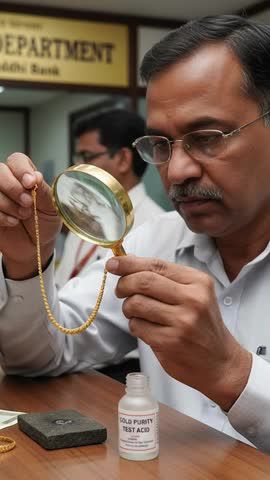
  1. Hallmarking:The easiest and most reliable way to identify the purity of gold is by checking its hallmark, specifically the BIS Hallmark . Gold Hallmarking is a process of certifying the purity of gold by the Bureau of Indian Standards (BIS). A hallmark consists of five components: the BIS logo, the fineness number in carat or percentage, the hallmarking year, the assaying, and the jeweller's identification mark. You can easily check the hallmark, including the BIS Hallmark of your gold at home by using a magnifying glass.
  2. Magnet test: A magnet test is a simple method to check whether your gold is pure or not. Pure gold is not magnetic, so if your gold attracts the magnet, it means it is not pure. However, this test is not very reliable as some fake gold items are also non-magnetic.
  3. Nitric acid test: This test is considered the most reliable way to check the purity of gold. However, it requires the use of nitric acid, which can be dangerous if not handled properly. To perform this test, you need to scratch the gold over a stone and apply a drop of nitric acid to the scratch. If the gold turns green, it means it is not pure.
  4. Density test: This test is based on the fact that pure gold has a higher density than fake gold. To perform this test, you need to weigh your gold item in air and in water. If the weight in water is less than the weight in air, it means that the gold is not pure.
  5. Colour test: This test is based on the fact that pure gold has a yellow colour, while other metals added to fake gold can change its colour. To perform this test, you need to compare the colour of your gold with a known pure gold item. However, this test is not very reliable as there are some other factors that can affect the colour of gold.

When it comes to gold loan, only gold of 18 karats or above can be used as collateral. Gold of lower purity is not accepted by banks or financial institutions. It is important to note that the loan amount will depend on the weight and purity of the gold. So, it is crucial to know the purity of your gold before taking a loan against it. 


Pro tip: Turn your gold into instant support—handle any expense with ease. Check your gold loan eligibility and access funds when you need them most.


DIY tests to check gold at home

In addition to the common methods like hallmarking, magnet tests, and nitric acid tests, here are some other ways you can test the purity of gold at home:

  1. Ceramic plate test: Rub the gold item on an unglazed ceramic plate. Real gold will leave a golden streak, while fake gold will leave a black or grey streak. This test is simple but may scratch the gold item, so use it with caution.
  2. Vinegar test: Place a few drops of vinegar on your gold item. Genuine gold will not react to the vinegar, maintaining its colour and shine, whereas fake gold may change colour or react visibly to the acid.
  3. Float test: Drop the gold item into a container of water. Pure gold is dense and will sink immediately. If the item floats or hovers, it is likely not pure gold. This method is quick and non-destructive.
  4. Sound test: Tap the gold item with a metal object and listen to the sound it produces. Real gold has a distinct, high-pitched ringing sound, while fake gold produces a duller, less resonant sound.
  5. Weight and size comparison: Compare the weight and size of your gold item with a piece of known pure gold of the same size. Pure gold is heavier and denser than most fake gold items, so a noticeable difference in weight may indicate lower purity.
  6. Loupe examination: Use a jeweller's loupe or magnifying glass to closely examine the gold item for any imperfections or signs of tarnishing. Pure gold is highly resistant to tarnishing and corrosion, so any signs of discolouration may suggest impurities.

By employing these methods, you can gain a better understanding of how to check gold purity at home, identify real gold from fake gold, and ensure the authenticity of your gold items. 


Tip: It takes just 2 steps to check your eligibility for a Bajaj Finance Gold Loan. Enter your mobile number now.

Show More Show Less

Calculate your gold loan

Things to know about gold purity

Things to know about gold purity

Here are the key things to know about gold purity:

  1. The purity of gold is measured in karats or percentage. 24 karats or 100% gold is the purest form of gold.


  2. Gold purity can be affected by the addition of other metals like copper, silver, or zinc.
  3. The right purity of gold can depend on the intended use of the gold. For example, gold used for jewellery is usually of 22 or 18 karats, while investment gold is usually of 24 karats.
  4. It is important to buy gold from a trusted seller to ensure its purity and avoid any fraudulent activity.
  5. Gold purity also affects its value when you use eligible gold coin, jewellery or ornaments as collateral for a gold loan. The lender assesses the gold's purity and net weight to determine its eligible value and the loan amount.
  6. As per the Reserve Bank of India's (RBI) gold loan guidelines, lenders must follow prescribed valuation and loan-to-value (LTV) limits. The valuation considers the intrinsic value of the gold, excluding stones, gems and other embellishments.

Before buying gold or using it as collateral for a loan, check its purity and hallmark details. Home tests, such as the magnet or colour test, may offer initial clues but cannot confirm purity accurately. For reliable results, get your gold tested by a qualified professional.


Please note: Bajaj Finance does not simply use today's headline rate. As per latest RBI guidelines, we use whichever is lower between the previous day's closing price or the 30-day average closing price published by IBJA or a SEBI-regulated commodity exchange to evaluate the gold’s value. This protects you from a sudden price spike inflating things unrealistically. You can pledge your 18-22 karat gold jewellery or ornaments, or gold coins up to 24 karat purity as collateral for our gold loan offering. 

The maximum LTV eligible for a loan depends on the loan amount and cannot be more than the limits given. To know more, click here.


Quick tip: Have idle gold lying at home? Turn it into instant funds with a Bajaj Finance Gold Loan today! Apply now

Show More Show Less

Frequently asked questions

Purity Test

Real Gold

How can you tell if gold is pure at home?

You can perform a simple acid test by rubbing the gold onto a black testing stone, applying a drop of testing acid of varying concentrations, and observing the reaction. Alternatively, you could use a magnet to check if the gold is attracted, as pure gold is non-magnetic. Another option is to measure its density by weighing it in air and then weighing it again while submerged in water, as pure gold has a density of 19.3g/cm3.

The easiest way is to use a gold testing kit that includes a testing stone, testing acids, and a user guide. This kit can be bought online or from a jewellery store. You can also perform a magnet test with a strong magnet to see if the gold is attracted to it, which would suggest that it may be fake or mixed with other metals.

Jewellers use a variety of methods to test gold purity, including acid tests, electronic gold testers, and X-ray fluorescence spectrometry. Acid tests involve using a testing kit with different strengths of nitric acid to determine the karat value of the gold. Electronic gold testers measure the conductivity of the metal to determine its purity. X-ray fluorescence spectrometry is a more advanced method that uses X-rays to analyse the chemical composition of the metal. Most jewellers use a combination of these methods to ensure accurate results.

To quickly test gold at home, you can use the magnet test, float test, or vinegar test. Hold a magnet near the gold item, if it’s attracted, it's not pure gold. Drop the gold item into water—pure gold will sink. Apply a few drops of vinegar on the gold, if the gold is genuine it won't react or change colour. These quick tests help you identify real gold without specialised equipment.

To check the purity of your gold coin at home, you can use the ceramic plate test, weight comparison, or a hallmark inspection. Rub the coin on an unglazed ceramic plate; pure gold leaves a golden streak. Weigh the coin and compare it to a known pure gold coin of the same size. Inspect for hallmarks under a magnifying glass to confirm its purity.

Real gold shows consistent colour, does not fade, and has proper hallmarking. You can try simple home tests such as magnet checks, water tests, or gentle scratch tests to understand how to check gold at home and how to identify gold at home.

Genuine gold will not attract magnets, tarnish, or show flaking. You can learn how to check gold purity at home with float tests, ceramic tests, or hallmark verification. These quick steps help you understand how to check pure gold without damaging the jewellery.

Show More Show Less

Disclaimer

Bajaj Finance Limited (BFL) has the sole and absolute discretion, without assigning any reason to accept or reject any application as per BFL policy. *