What Is the Difference between a Fridge and a Refrigerator?

Know the difference — compare fridges and refrigerators clearly, then shop on Easy EMIs with the Bajaj Finance Insta EMI Card.
What Is the Difference between a Fridge and a Refrigerator?
4 Min Read
May 19, 2026

The terms "fridge" and "refrigerator" are often used interchangeably in everyday conversation, but in the context of home appliances, they describe two distinct categories with meaningful differences in size, capacity, features, and use. A fridge typically refers to a compact or mini refrigerator — a small, portable cooling unit designed for personal use in limited spaces. A refrigerator, on the other hand, refers to a full-size cooling appliance built for households, with dedicated compartments, larger storage capacity, and advanced cooling technology. Understanding the difference helps you choose the right appliance for your space and lifestyle. 

The Bajaj Finance Insta EMI Card makes buying either appliance straightforward — convert the purchase into Easy EMIs and bring it home without paying the full amount upfront.
 

What is a fridge?

In everyday Indian usage, a fridge often refers to a compact or mini refrigerator — a small, single-door cooling unit typically ranging from 30 to 100 litres in capacity. A fridge is designed for personal or small-space use: a hostel room, a home office, a studio apartment bedroom, or a hotel minibar setup. It stores a limited selection of beverages, snacks, medicines, and skincare products. Most compact fridges use direct cool technology and operate on lower power consumption, making them portable, affordable, and easy to place without dedicated kitchen space.
 

What is a refrigerator?

A refrigerator is a full-size household cooling appliance, typically ranging from 150 litres to 700 litres or more in capacity, designed to meet the daily storage needs of individuals, small families, or large households. It features dedicated compartments — a fresh food section and a separate freezer — along with advanced technologies such as frost-free cooling, inverter compressors, multi-air flow systems, and adjustable temperature zones. Refrigerators from brands like LG, Samsung, Whirlpool, and Godrej are a standard fixture in Indian kitchens, offering reliable long-term food preservation for everyday cooking and grocery storage.
 

Top 10 differences between a fridge and a refrigerator

Both a fridge and a refrigerator keep food cold, but the similarities largely end there. The table below makes the key differences clear at a glance.

FeatureFridge (compact/mini)Refrigerator (full-size)
Size and footprintCompact and portable; fits on a countertop or in a cornerLarge and floor-standing; requires dedicated kitchen space
Capacity30–100 litres — suitable for personal storage150–700+ litres — suitable for families and households
Cooling technologyTypically direct cool; manual defrosting requiredUsually frost-free with inverter compressor; no manual defrosting needed
Freezer compartmentSmall or absent; limited ice-making abilityDedicated, large freezer compartment for frozen food and ice
Target userStudents, singles, hostel residents, office workersFamilies, working couples, households of all sizes
Energy consumptionLower absolute power draw; but often less efficient per litreHigher absolute consumption; but modern 5-star inverter models are highly efficient per litre
Price rangeRs. 6,000–Rs. 12,000 for most modelsRs. 12,000–Rs. 1,00,000+ depending on size and type
PortabilityLightweight; easy to move between rooms or carry when relocatingHeavy and fixed; requires professional assistance to move
Storage organisationBasic — one or two shelves and door racksAdvanced — multiple shelves, crisper drawers, chiller zones, door storage
Ideal placementBedroom, hostel room, office, studio apartmentKitchen; dedicated alcove or open kitchen counter space

Advantages and disadvantages of a fridge

A compact fridge suits specific living situations well, but it also comes with real limitations. Here is an honest look at both sides.

AdvantagesDisadvantages
Compact and space-saving — fits in rooms, offices, and dormsLimited storage capacity — not suitable for families or bulk groceries
Affordable upfront cost — most models under Rs. 12,000Less energy-efficient per litre compared to modern full-size inverter refrigerators
Easy to move — lightweight and portable for renters or studentsSmall or absent freezer — cannot store frozen food or make meaningful quantities of ice
Low noise — many models operate quietly, suitable for bedroomsRequires manual defrosting in most models, which adds periodic maintenance effort
Ideal for storing medicines, skincare, beverages, and snacksNot suitable for long-term storage of cooked meals or large quantities of fresh produce
No installation required — plug in and use immediatelyFewer features and no advanced cooling technology compared to full-size refrigerators

Advantages and disadvantages of a refrigerator

A full-size refrigerator is a household essential, but it comes with its own set of trade-offs. The table below covers both sides clearly.

AdvantagesDisadvantages
Large storage capacity — handles weekly grocery hauls with easeRequires significant kitchen floor space and proper ventilation clearance
Advanced cooling technology — frost-free, inverter compressor, multi-air flowHigher upfront cost compared to compact fridges
Dedicated freezer compartment for frozen food, ice, and long-term preservationHeavier and fixed — difficult to move without professional help
Energy-efficient — modern 4-star and 5-star inverter models save electricity over timeContinuous electricity consumption adds to monthly bills
Long appliance lifespan — quality models last 10 to 15 years with basic maintenancePeriodic cleaning, gasket checks, and occasional servicing required
Organised storage — multiple zones for vegetables, dairy, beverages, and frozen foodLarger models may generate a consistent operational hum in quiet homes

Price list of the top selling fridges and refrigerators in India (2026)

Here are five of the most popular compact fridges and full-size refrigerators available in India in 2026. All prices are indicative and subject to change based on retailer and availability.

Model nameKey featuresWhy should you get thisPrice
Blue Star MR60-GG 47 L 2 Star Mini Refrigerator47-litre capacity, direct cool, 2 Star rating, reversible door, LED lighting, inbuilt freezer, manual temperature controlThe most reliable compact fridge from a trusted Indian brand — ideal for bedrooms, offices, and hostel rooms requiring basic personal coolingRs. 7,788
Haier HRD-1252KSA 100 L 2 Star Single Door Mini Refrigerator100-litre capacity, direct cool, 2 Star rating, single door, bottle storage, manual temperature controlThe largest capacity in the mini fridge category — suits students and single professionals who need more storage than a basic 47-litre modelRs. 13,590
Godrej RD R190B TRF 180 L 2 Star Single Door Refrigerator180-litre capacity, direct cool, 2 Star rating, 10-year compressor warranty, single doorGodrej's trusted build quality and a 10-year compressor warranty make this the most dependable entry-level full-size refrigerator for small familiesRs. 12,590
Whirlpool NEO SP278 PRM 235 L 2 Star Double Door Refrigerator235-litre capacity, frost-free, 2 Star rating, adaptive cooling, double doorWhirlpool's adaptive cooling system handles India's frequent power fluctuations well — a practical and dependable pick for everyday household useRs. 21,990
LG GL-I292RPZX 260 L 3 Star Double Door Refrigerator260-litre capacity, frost-free, 3 Star rating, Smart Inverter compressor, multi-air flow, double doorLG's Smart Inverter compressor runs quietly and efficiently — this model offers long-term reliability with excellent energy savings for medium-sized familiesRs. 24,990

Disclaimer: Product features, availability, and prices may differ based on location and time. For the latest and most accurate details, visit a partner store. 
 

Which one should you choose?

The right choice between a fridge and a refrigerator depends entirely on your living situation, storage needs, and budget. Here is a practical guide to help you decide.

  • Choose a compact fridge if you live alone in a hostel, studio apartment, or paying guest accommodation. If you eat out frequently and only need to store a few beverages, snacks, medicines, or skincare products, a compact fridge at Rs. 7,000–Rs. 12,000 is the most cost-effective and space-appropriate solution.
  • Choose a full-size refrigerator if you cook regularly at home, live with family, or need to store weekly groceries, fresh vegetables, dairy, and cooked meals. A 180–300 litre single-door or double-door refrigerator handles everyday Indian household storage needs comfortably.
  • Choose a double-door refrigerator if you have a family of three or more, cook multiple meals daily, and want a separate freezer compartment for frozen food, ice cream, and long-term preservation.
  • Consider a fridge as a secondary appliance if you already own a full-size refrigerator but want convenient cooling in a bedroom, home office, or entertainment space without walking to the kitchen.
  • Prioritise energy rating regardless of type. A 4-star or 5-star rated appliance — whether a compact fridge or a full-size refrigerator — saves meaningfully on electricity costs over months and years of daily use.
     

What is a Bajaj Finance Insta EMI Card?

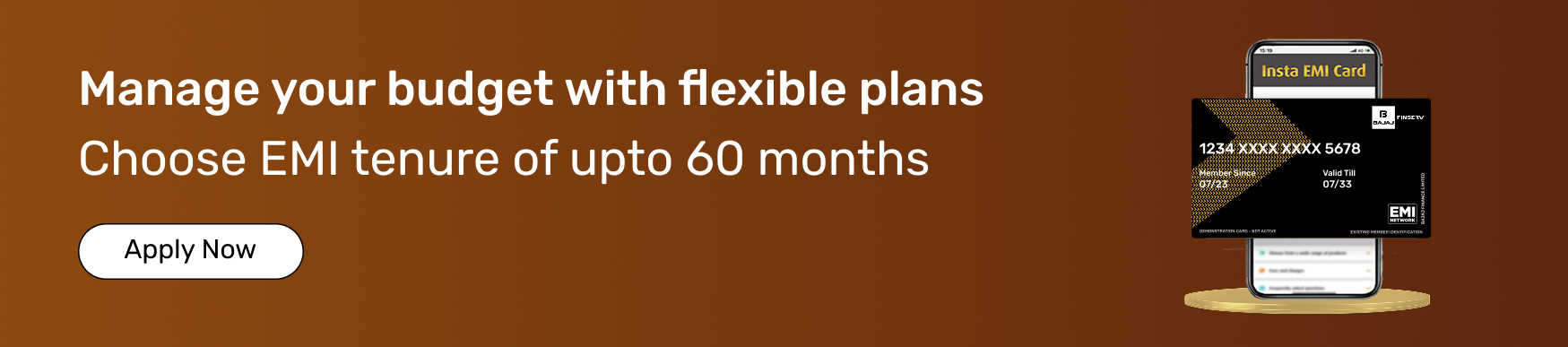
The Bajaj Finance Insta EMI Card is a pre-approved card loan offer that lets you shop for refrigerators, compact fridges, appliances, electronics, and more at over 1.5 lakh partner stores across 4,000 cities in India. It gives you a card loan offer of up to Rs. 3 lakh, which you can use to purchase your preferred fridge or refrigerator and pay for it in Easy EMIs over a repayment tenure of 3 to 60 months. The application process is fully digital and takes only a few minutes. 

Check your Insta EMI Card eligibility online using your mobile number and OTP. If eligible, you can apply instantly and start shopping for your preferred fridge or refrigerator easily and affordably.
 

How to buy a fridge or refrigerator on Easy EMIs using the Insta EMI Card

Buying a fridge or refrigerator on Easy EMIs with the Bajaj Finance Insta EMI Card is a quick, fully digital process. Follow these steps to get started:

  • Step 1 – Check your eligibility: Start by checking your Insta EMI Card eligibility online, enter your mobile number, and complete the OTP verification to find out instantly whether you qualify.
  • Step 2 – Apply for the card: If eligible, complete the quick digital application. The entire process takes only a few minutes with no paperwork required.
  • Step 3 – Choose your appliance: Browse the range of compact fridges and full-size refrigerators from brands like LG, Samsung, Whirlpool, Godrej, Blue Star, and Haier at over 1.5 lakh Bajaj Finance partner stores across India, both online and in person.
  • Step 4 – Select your EMI tenure: Pick a repayment tenure of 3 to 60 months that fits comfortably within your monthly budget.
  • Step 5 – Complete your purchase: Use your Insta EMI Card at checkout, confirm your Easy EMI plan, and your appliance is ready to go home with you.

Benefits of using the Insta EMI Card

FeatureDetails
Easy EMIsSplit the cost of your purchase into affordable monthly instalments with minimal interest, making it budget-friendly.
High pre-qualified limitGet up to Rs. 3 lakh card loan offer amount to buy multiple products without upfront stress.
Wide acceptance networkAccepted at over 1.5 lakh partner stores across 4,000 cities and major e-commerce platforms.
Flexible repayment tenureChoose a repayment period from 3 to 60 months based on your financial comfort.
Zero down payment offersAvail deals with no upfront payment requirement on select models.
No foreclosure chargesClose your loan early without any penalties or extra fees.
Credit score benefitTimely EMI payments may help strengthen your credit profile and financial health.


Also read: Features and benefits of the Bajaj Finance Insta EMI Card
 

Eligibility criteria for the Insta EMI Card

  • Nationality: Indian Citizen.
  • Age: 19 years to 70 years.
  • Credit score: A healthy credit score per Bajaj Finance policies.
  • Income: A steady, regular source of income.
  • Documents: PAN Card, Aadhaar Card, and a cancelled cheque for e-mandate.


Also read: Eligibility criteria for the Insta EMI Card
 

How to apply for an Insta EMI Card

  • Verify mobile number: Enter your 10-digit mobile number and verify the OTP sent to your phone to initiate the process.
  • Auto-fetch details: Provide your full name and select the option to auto-fetch your details for a faster application experience.
  • Confirm information: Verify your pre-filled personal details carefully and click on the continue button to move to the next stage.
  • Check offer: Review your pre-qualified card loan offer amount and select continue to proceed with the specified limit.
  • Set up wallet: Review your wallet setup details and verify the security OTP to integrate the card with your account.
  • Verify identity: Complete your identity verification process by confirming your current residential address as per the required official records.
  • Pay fee: Make the mandatory one-time joining fee payment of Rs. 530 through the secure digital payment gateway provided.
  • View card: Access and view your new digital card details instantly on the Bajaj Finance application after the successful payment.
     

Also read: How to apply for the Insta EMI Card
 

Explore more:

EMI full formBNPLPOS full form

List of the biggest upcoming sales:

Amazon Upcoming SaleFlipkart Upcoming Sale
Amazon Great Indian Festival 2026Croma Diwali Sale with Insta EMI Card
Diwali offers with Insta EMI CardAmazon fridge offers 2026
Amazon mobile offers 2026Reliance Digital Diwali offer 2026
Amazon Diwali offer sale 2026Sangeetha Mobiles Diwali offers 2026
Poorvika Mobiles Diwali offers 2026How to shop on Amazon without a credit card
Amazon Great Indian Festival 2026Flipkart Cooling Days
Amazon Prime Day SaleAmazon Electronics Sale

Frequently asked questions

Is a refrigerator the same as a fridge?

In casual everyday language, "fridge" and "refrigerator" refer to the same appliance. However, in the context of home appliances and product categories, "fridge" often refers to a compact or mini refrigerator — a smaller, portable unit for personal use — while "refrigerator" typically describes a full-size household appliance with greater capacity, a dedicated freezer compartment, and advanced cooling technology. The distinction is largely one of size and intended use rather than a fundamental difference in how either appliance works.

What is the difference between refrigerators and freezers?

A refrigerator maintains a temperature between 2 degree Celsius and 5 degree Celsius, slowing bacterial growth to keep fresh food, dairy, vegetables, and beverages in good condition for days. A freezer, by contrast, maintains a temperature below -18 degree Celsius, preserving food for weeks or months by suspending bacterial activity entirely. Most household refrigerators include a built-in freezer compartment. A standalone deep freezer offers a much larger dedicated freezing space for bulk storage of meat, fish, and frozen meals. Check your Insta EMI Card eligibility to buy either appliance on Easy EMIs.

Does "refrigerate" mean fridge or freezer?

"Refrigerate" specifically means to chill in the refrigerator section — typically between 2 degree Celsius and 5 degree Celsius — not to freeze. When a recipe or food label instructs you to refrigerate a product, place it in the main cooling compartment of your fridge or refrigerator, not in the freezer. Instructions that require freezing will explicitly say "freeze" or "store in freezer." The distinction matters practically — items refrigerated instead of frozen will spoil far sooner than intended.

Which is better — a deep freezer or a refrigerator?

The answer depends entirely on your use case. A deep freezer is better if you need to store large quantities of frozen food — such as bulk meat, fish, or ice cream — for extended periods. A refrigerator is better for everyday use, keeping fresh vegetables, dairy, cooked meals, and beverages at the right temperature. Most Indian households need a refrigerator for daily use. A deep freezer suits larger families, catering businesses, or those who buy groceries in bulk and need long-term frozen storage capacity.

What are the types of fridges?

In the compact fridge category, you can find several distinct types in India: single-door direct cool mini fridges (30–100 litres) for personal use; thermoelectric fridges that operate silently without a compressor, ideal for bedrooms; portable car fridges that run on a 12V car socket; cosmetics and skincare fridges designed specifically for beauty products; and minibar fridges suited for offices or hotel-style setups. Each type serves a specific purpose and space, so choosing the right one depends on what you need to store and where you plan to place it.

Are refrigerators larger than fridges?

Yes, in the appliance context, a full-size refrigerator is significantly larger than a compact fridge. Compact fridges typically range from 30 to 100 litres in capacity and stand between 50 and 85 cm tall. A standard full-size refrigerator starts at around 150 litres and can extend to 700 litres or more for large family models, standing 150 to 180 cm tall. The size difference directly reflects the difference in storage capacity, cooling technology, and the number of users each appliance is designed to serve.

How do I choose the right refrigerator size for my family?

A general guideline for Indian households: 80–150 litres suits a single person or a couple who eats out frequently; 150–250 litres works for a family of two to three who cook regularly; 250–350 litres covers a family of three to five with daily cooking and weekly grocery storage needs; and 350 litres or more suits larger families or those who store bulk groceries and need a large freezer section. Always choose a capacity at least 20 to 30 litres larger than your current estimate to allow for future growth in storage needs. Your Insta EMI Card eligibility can help you afford a higher-capacity model on Easy EMIs without stretching your immediate budget.

What is the ideal temperature setting for a refrigerator and freezer?

For safe food storage in an Indian home, set your refrigerator section between 2 degree Celsius and 4 degree Celsius. This range keeps fresh food, dairy, cooked meals, and beverages safe without freezing them. Your freezer section should stay at -18 degree Celsius or below to keep frozen food preserved safely for weeks or months. Most modern refrigerators display the temperature digitally; older dial-controlled models typically work best at the middle to upper-middle setting. Adjust slightly cooler during summer months when ambient kitchen temperatures are higher.

Do inverter refrigerators save more electricity?

Yes, significantly. A conventional refrigerator compressor switches fully on and off repeatedly to maintain temperature, which is energy-intensive. An inverter compressor, by contrast, runs continuously at variable speeds depending on the cooling load — using only as much energy as required at any given moment. This results in 15 to 40% lower electricity consumption over time, quieter operation, and a longer compressor lifespan. In Indian conditions — with warm ambient temperatures and frequent door openings — the energy savings from an inverter refrigerator are particularly meaningful across a year of daily use.

Which refrigerator offers the best value for money in 2026?

For most Indian households in 2026, LG and Samsung consistently offer the best value across price segments. LG's inverter compressor models in the 235–260 litre double-door range around Rs. 24,000–Rs. 27,000 deliver excellent energy efficiency, reliable cooling, and a strong 10-year compressor warranty. Samsung models in the same range offer Digital Inverter Technology and convertible freezer modes. Whirlpool and Godrej are strong value picks in the budget segment under Rs. 20,000, particularly for single-door direct-cool models for small families or individuals.

Show more Show less

Bajaj Finance App for all your financial needs and goals

Trusted by 50 million+ customers in India, Bajaj Finance App is a one-stop solution for all your financial needs and goals. 

You can use the Bajaj Finance App to: 

  • Apply for loans online, such as Instant Personal Loan, Home Loan, Business Loan, Gold Loan, and more. 
  • Explore and apply for co-branded credit cards online. 
  • Invest in fixed deposits and mutual funds on the app. 
  • Choose from multiple insurance for your health, motor and even pocket insurance, from various insurance providers. 
  • Pay and manage your bills and recharges using the BBPS platform. Use Bajaj Pay and Bajaj Wallet for quick and simple money transfers and transactions. 
  • Apply for Insta EMI Card and get a pre-approved limit on the app. Explore over 1 million products on the app that can be purchased from a partner store on Easy EMIs. 
  • Shop from over 100+ brand partners that offer a diverse range of products and services.
  • Use specialised tools like EMI calculators, SIP Calculators 
  • Check your credit score, download loan statements and even get quick customer support—all on the app.

Download the Bajaj Finance App today and experience the convenience of managing your finances on one app.

Do more with the Bajaj Finserv App!

UPI, Wallet, Loans, Investments, Cards, Shopping and more

Disclaimer

1. Bajaj Finance Limited (“BFL”) is a Non-Banking Finance Company (NBFC) and Prepaid Payment Instrument Issuer offering financial services viz., loans, deposits, Bajaj Pay Wallet, Bajaj Pay UPI, bill payments and third-party wealth management products. The details mentioned in the respective product/ service document shall prevail in case of any inconsistency with respect to the information referring to BFL products and services on this page.

2. All other information, such as, the images, facts, statistics etc. (“information”) that are in addition to the details mentioned in the BFL’s product/ service document and which are being displayed on this page only depicts the summary of the information sourced from the public domain. The said information is neither owned by BFL nor it is to the exclusive knowledge of BFL. There may be inadvertent inaccuracies or typographical errors or delays in updating the said information. Hence, users are advised to independently exercise diligence by verifying complete information, including by consulting experts, if any. Users shall be the sole owner of the decision taken, if any, about suitability of the same.
For customer support, call Personal Loan IVR: 7757 000 000