








₹ 2 lakh – ₹ 80 lakh
Check your pre-approved business loan
Enter mobile and OTP | Check offer | Know your exact loan terms
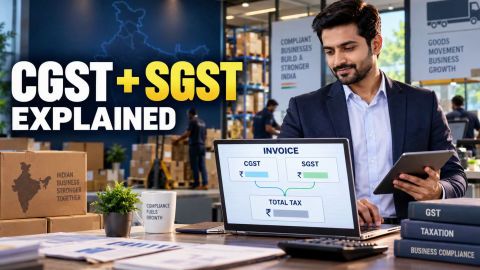
Intra State Supply in GST
-
In summary
The meaning of intra-State supply in GST is determined by comparing the location of the supplier with the applicable place of supply. The customer being in the same State does not, by itself, settle the classification. Section 8 of the Integrated Goods and Services Tax Act, 2017 provides the statutory framework, subject to the relevant place-of-supply provisions and exclusions.
- A taxable intra-State supply ordinarily attracts Central Goods and Services Tax (CGST) and State Goods and Services Tax (SGST), or CGST and Union Territory Goods and Services Tax (UTGST), as applicable.
- Specified supplies to or by a Special Economic Zone (SEZ) developer or SEZ unit are excluded from intra-State treatment.
- Imported goods before they cross the customs frontier and specified supplies to a tourist are also excluded from intra-State treatment.
- Businesses should determine the place of supply, apply the correct tax head, issue the prescribed invoice and reconcile the transaction with GST records.
The GST portal similarly uses the place of supply and supplier State to classify relevant outward transactions as intra-State for return reporting.
What is the meaning of intra-State supply in GST?
-
The meaning of intra-State supply in GST is set out in Section 8 of the Integrated Goods and Services Tax Act, 2017. For goods, a supply is intra-State when the location of the supplier and the place of supply are in the same State or same Union territory, subject to Section 10 and the exclusions in Section 8.
For services, the same-location principle applies subject to Section 12 and the exclusion for supplies to or by an SEZ developer or SEZ unit. Therefore, identifying the place of supply is essential before deciding whether a transaction is intra-State.
For example, if a registered supplier in Maharashtra sells goods to a registered customer in Maharashtra and the applicable place of supply is Maharashtra, the transaction is ordinarily an intra-State supply. The supplier charges CGST and SGST at the applicable rate.
How do you identify an intra-State supply?
-
You can identify an intra-State supply by following four checks. The first three establish the nature of supply; the fourth checks whether a statutory exclusion applies.
Step Check What it establishes 1 Supplier location The location of the supplier for the transaction. 2 Place of supply The location determined under the applicable goods or services rule. 3 Compare locations The same State or Union territory supports intra-State classification. 4 Check exclusions SEZ supplies, specified imported goods and other statutory exclusions can change the result. For GST return reporting, the GST portal states that when the place of supply is the same State as the supplier, the transaction is treated as intra-State and the Central Tax and State/Union Territory Tax fields are used
Which transactions are treated as intra-State supplies?
The statutory meaning of intra-State supply covers same-State or same-Union-territory supplies, but Section 8 contains specific exclusions. These exclusions should be checked before charging CGST and SGST or UTGST.
| Transaction | Treatment under Section 8 |
| Goods: supplier and place of supply in the same State | Ordinarily intra-State, subject to exclusions. |
| Goods: supplier and place of supply in the same Union territory | Ordinarily intra-State, subject to exclusions. |
| Goods supplied to or by an SEZ developer or SEZ unit | Not treated as intra-State. |
| Imported goods before crossing the customs frontier | Not treated as intra-State. |
| Goods supplied to a tourist covered by Section 15 | Not treated as intra-State. |
| Services: supplier and place of supply in the same State or Union territory | Ordinarily intra-State, subject to exclusions. |
| Services supplied to or by an SEZ developer or SEZ unit | Not treated as intra-State. |
Check your pre-approved business loan offer
How does GST apply to intra-State supplies?
For a taxable intra-State supply, CGST and SGST generally apply in a State. In a Union territory, CGST and UTGST can apply where the relevant UTGST framework applies. The combined tax rate is the rate notified for the goods or services.
| Nature of supply | Tax treatment | Illustration |
| Taxable intra-State supply in a State | CGST + SGST | Supplier in Maharashtra; place of supply in Maharashtra. |
| Taxable intra-State supply in a Union territory | CGST + UTGST, where applicable | Supplier and place of supply in a qualifying Union territory. |
| Taxable inter-State supply | IGST | Supplier in Maharashtra; place of supply in Karnataka. |
The tax rate and the nature of supply are separate questions. An 18% GST rate does not, by itself, make a transaction intra-State. The supplier location, place of supply, and statutory exclusions determine the nature of supply.
What are the place-of-supply rules for intra-State goods?
-
The meaning of intra-State supply for goods depends on the place of supply determined under Section 10. The relevant rule varies with the transaction.
Situation Place-of-supply rule Goods involving movement The location where the movement of goods terminates for delivery to the recipient. Goods supplied without movement The location of the goods at the time of delivery to the recipient. Goods assembled or installed at a site The place where the goods are assembled or installed. Goods supplied on board a conveyance The location where the goods are taken on board the conveyance. Certain B2C supplies of goods Section 10(1)(ca) applies to supplies to an unregistered person, using the invoice address recorded for that person and, where that address is not recorded, the supplier’s location, subject to the statutory provision. Section 10(1)(ca) was inserted with effect from 1 October 2023. Businesses should therefore apply the specific B2C rule where it is relevant instead of assuming that the customer’s physical location determines the place of supply.
Get business loan for your needs

Women Business Loan
Get Women Business Loan upto 80 Lakh

Medical Store Business Loan
Get Medical Store Business Loan upto 80 Lakh

Manufacturer Business Loan
Get Manufacturer Business Loan upto 80 Lakh
What are the place-of-supply rules for intra-State services?
-
For services supplied where the supplier and recipient are in India, Section 12 provides the domestic place-of-supply rules. Specific provisions apply to several service categories.
Service category Key place-of-supply principle Service supplied to a registered person Recipient’s location, subject to specific provisions. Service supplied to an unregistered person Recipient’s location where the address is available; otherwise supplier’s location, subject to specific provisions. Services related to immovable property Location of the immovable property. Restaurant and catering services Location where the service is actually performed. Training or performance appraisal Specific rules apply based on the recipient’s registration status. Passenger transportation Specific rules apply based on registration status and the journey. Transportation of goods Specific rules apply based on registration status and the applicable statutory provision. The same-State test should therefore be applied after the relevant service category and place-of-supply provision have been identified.
What is the difference between intra-State and inter-State supply?
| Parameter | Intra-State supply | Inter-State supply |
| Core test | Supplier location and place of supply are in the same State or Union territory, subject to exclusions. | Supplier location and place of supply are in different States, different Union territories, or a State and a Union territory, subject to the Act. |
| Tax on taxable supply | CGST + SGST or CGST + UTGST | IGST |
| Typical example | Supplier in Maharashtra; place of supply in Maharashtra. | Supplier in Maharashtra; place of supply in Karnataka. |
| SEZ treatment | Specified SEZ supplies are excluded from intra-State treatment. | Specified supplies to or by an SEZ developer or unit are treated as inter-State. |
| Return reporting | Reported using the applicable intra-State fields. | Reported using the applicable inter-State fields. |
The GST portal also distinguishes the transaction types by comparing the place of supply with the supplier’s State for relevant return fields.
How is GST calculated on an intra-State supply?
Calculate the total GST by applying the applicable GST rate to the taxable value, then split the tax into CGST and SGST or UTGST as applicable.
Example
ABC Traders in Jaipur, Rajasthan sells taxable goods worth Rs. 2,00,000 to a customer in Udaipur, Rajasthan. Assume the applicable GST rate is 18% and the place of supply is Rajasthan.
| Calculation | Amount |
| Taxable value | Rs. 2,00,000 |
| GST rate | 18% |
| Total GST | Rs. 36,000 |
| CGST at 9% | Rs. 18,000 |
| SGST at 9% | Rs. 18,000 |
| Invoice value before other adjustments | Rs. 2,36,000 |
The example assumes the full Rs. 2,00,000 is taxable and that no exemption, discount, credit note, or other adjustment changes the taxable value. The 9% + 9% split is illustrative of an 18% rate; the actual rate and tax components depend on the applicable notification.
What documents should businesses maintain for intra-State supplies?
Businesses should maintain records that support the nature of supply, taxable value, tax calculation, place of supply and input tax credit claims. The exact records depend on the transaction.
| Record | Purpose |
| Tax invoice | Records supplier, recipient, taxable value, tax rate, CGST, SGST/UTGST and other prescribed particulars. |
| GST registration details | Supports identification of registered parties where applicable. |
| Sales and purchase records | Supports return reconciliation and input tax credit review. |
| E-way bill, where applicable | Supports movement of goods when an e-way bill is required. |
| Delivery and transport records | Supports facts about movement and delivery. |
| Purchase order, contract or service agreement | Supports the commercial terms and nature of the supply. |
| Credit or debit notes, where applicable | Records later adjustments to value or tax. |
| GST returns and tax payment records | Supports reporting and reconciliation. |
What does intra-State GST compliance cost?
There is no single fixed cost for an intra-State supply. The GST liability depends on the taxable value and applicable GST rate. Separate business costs can arise from accounting, invoicing systems, logistics, professional support and other compliance activities.
| Cost component | How it is determined |
| CGST and SGST/UTGST liability | Taxable value multiplied by the applicable GST rate, split into the relevant components. |
| Accounting and return preparation | Depends on transaction volume, systems and external professional support. |
| Invoicing and record-keeping | Depends on the software, systems and internal processes used. |
| Transport and logistics | Depends on goods, route, carrier and delivery terms. |
| Financing cost | Depends on the loan amount, interest rate, tenure and applicable charges if external finance is used. |
GST collected from a customer is a tax liability and should not be presented as the same type of cost as inventory or freight. Eligible input tax credit remains subject to the conditions under GST law.
How can businesses manage expenses related to intra-State operations?
Businesses handling intra-State supplies may need funds for inventory, working capital, equipment, technology, logistics and other operating requirements. Eligible businesses can consider a Bajaj Finance Business Loan for permitted business expenses, subject to applicable business loan eligibility, verification, credit assessment and sanctioned terms.
| Business Loan feature | Current details |
| Loan amount | Rs. 2 lakh to Rs. 80 lakh |
| Interest rate | 14% to 23.50% per annum |
| Repayment tenure | 12 months to 96 months |
| Processing fee | Up to 4.72% of the loan amount, inclusive of applicable taxes |
| Collateral | No collateral or security is required |
For example, consider a hypothetical 32-year-old retailer in Jaipur with monthly business income of Rs. 1,30,000 and a CIBIL score of 735. If the retailer requires Rs. 6 lakh for inventory and store equipment, the funding requirement should be compared with expected cash flows and total borrowing cost before applying.
How do you apply for a Bajaj Finance Business Loan?
The application can be initiated online by entering the required personal, business, banking, and funding details and completing the verification process.
- Start the application: Visit the Business Loan page, select ‘Check Loan Offer’, and verify your mobile number using an OTP.
- Provide your details: Enter your name, PAN, date of birth, PIN code, business information and banking details.
- Choose your loan requirement: Enter the required amount and select Term Loan, Flexi Dropline or Flexi Hybrid Term Loan.
- Select the repayment tenure: Choose a tenure from 12 months to 96 months.
- Review and submit: Check the information and submit the application for assessment.
Our loan variants






Loans for business needs















Select loan by amount
Business loan in different cities

Business loan in bangalore

Business loan in mumbai

Business loan in pune

Business loan in Jaipur

Business loan in Kerala

Business Loan in Telangana

Business Loan in Surat

Business Loan in Ranchi

Business Loan in Odisha

Business Loan in Noida

Business Loan in Kolkata

Business Loan in Karnataka

Business Loan in Hyderabad

Business Loan in Gujarat

Business Loan in Coimbatore

Business Loan in Assam

Business Loan in Ahmedabad
Business loan for different budgets

2 lakh business loan
3 lakh business loan
5 lakh business loan
10 lakh business loan

15 lakh business loan
20 lakh business loan
25 lakh business loan
30 lakh business loan
50 lakh business loan
Types of business loan
Unsecured Business Loan
Secured Business Loan
Term Loan
Cash Credit
Working Capital Loan
Machinery Loan
Line of Credit
Micro Loan
Merchant cash Loan
Frequently Asked Questions
Overview
What is intra-State meaning in GST?
Intra-State meaning in GST refers to a supply where the supplier’s location and the applicable place of supply are in the same State or Union territory, subject to statutory exclusions. A taxable intra-State supply ordinarily attracts CGST and SGST, or CGST and UTGST where applicable. The recipient being in the same State is not, by itself, the complete legal test.
Which GST is applicable to intra-State supply?
A taxable intra-State supply ordinarily attracts CGST and SGST in a State, or CGST and UTGST where applicable in a Union territory. The total GST rate depends on the goods or services supplied.
What is the difference between intra-State and inter-State supply?
An intra-State supply ordinarily has the supplier’s location and place of supply in the same State or Union territory, subject to exclusions. An inter-State supply has those locations in different States or specified State and Union territory combinations. Taxable intra-State supplies ordinarily attract CGST with SGST or UTGST, while taxable inter-State supplies attract IGST.
Are all same-State transactions intra-State supplies?
No. The supplier’s location and place of supply must both be considered, and Section 8 contains exclusions. For example, specified supplies to or by an SEZ developer or SEZ unit are not treated as intra-State. Imported goods before crossing the customs frontier are also excluded from intra-State treatment. Apply the relevant statutory rule to the transaction.
Can a business claim input tax credit on intra-State purchases?
Eligible input tax credit can be claimed on qualifying purchases, including CGST and SGST or UTGST, when the conditions under GST law are satisfied. The business should hold prescribed records, ensure the transaction is correctly reported and reconcile purchase records with relevant GST data. Credit utilisation remains subject to the order and conditions prescribed under GST law.
More articles




Disclaimer
Bajaj Finance Limited has the sole and absolute discretion, without assigning any reason to accept or reject any application. Terms and conditions apply*.