








₹ 2 lakh – ₹ 80 lakh
Check your pre-approved offer and other benefits
Enter mobile and OTP | Check offer | Know your exact loan terms
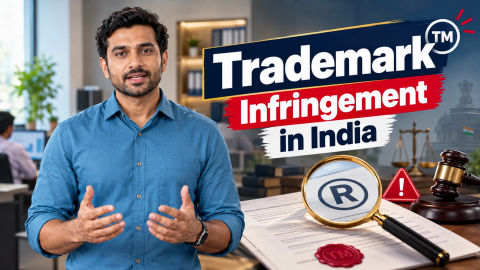
Trademark Infringement in India
-
In summary
Trademark infringement generally concerns unauthorised use of a registered mark in circumstances covered by the Trade Marks Act, 1999. Whether a name, logo, label, or other use infringes depends on the registered rights, goods or services, and the manner of use.
- Infringement and passing off are different claims; an unregistered brand may still have passing-off protection.
- A spelling change or a different product does not automatically remove infringement risk.
- Civil relief can include an injunction and, at the claimant’s option, damages or an account of profits, with delivery-up where appropriate.
- Specified false-trademark offences under Sections 103 and 104 generally carry six months to three years’ imprisonment and a fine of Rs. 50,000 to Rs. 2 lakh, subject to statutory defences and exceptions.
Check the registration, preserve evidence, and obtain legal advice before making allegations or admissions. The facts, trading history, and exact use determine the appropriate response.
What is trademark infringement?
-
Trademark infringement occurs when a person who is not the registered proprietor or an authorised user uses an identical or deceptively similar mark in the course of trade in circumstances covered by Section 29 of the Trade Marks Act, 1999. The section addresses different situations involving identical or similar marks and goods or services.
For identical marks and identical goods or services, the Act contains a presumption of likelihood of confusion in the circumstances specified by Section 29. Other cases require assessment of factors such as similarity, the goods or services involved, the manner of use, and the likelihood of confusion or association.
Start with three questions: What mark is registered? What goods or services does the registration cover? How is the disputed mark being used? A shared word does not automatically establish infringement, while changing one letter does not automatically make a competing name safe.
What forms can trademark infringement take?
-
Potential infringement can arise through product branding, packaging, business names, online listings, advertising, or other commercial use of a registered mark. The legal assessment depends on the particular use rather than the label attached to it.
Use What to examine Product branding Similar or identical mark on competing goods or services Packaging Labels, get-up, or presentation suggesting a trade connection Business identity Trading or business name resembling a registered mark Online selling Marketplace listings, product pages, domain use, or promotional content Advertising Promotions suggesting endorsement, affiliation, or association Different goods or services do not always remove risk. Section 29(4) addresses specified uses involving dissimilar goods or services where the registered mark has a reputation in India and the statutory conditions concerning due cause, unfair advantage, or harm to distinctiveness or reputation are met.
For sellers, distributors, manufacturers, and online platforms, examine each party’s actual conduct and the applicable statutory provisions. Calling someone an 'indirect infringer' does not, by itself, establish legal responsibility.
How does passing off differ from trademark infringement?
Trademark infringement is based on rights in a registered trademark. Passing off is a common-law remedy that can protect an unregistered brand where the claimant can establish the required elements. Section 27 of the Trade Marks Act, 1999 preserves passing-off actions while generally preventing infringement proceedings for an unregistered mark.
| Point | Trademark infringement | Passing off |
| Core basis | Registered trademark rights | Goodwill and protection against misrepresentation |
| Registration | Generally requires a registered mark for an infringement action | Registration is not required |
| Key question | Whether the disputed use falls within the registered proprietor’s statutory rights | Whether the conduct misrepresents a connection and causes or is likely to cause damage |
| Evidence | Registration, goods/services, disputed use, and relevant statutory conditions | Goodwill, misrepresentation, damage or likely damage, and supporting use evidence |
For example, if customers recognise a business’s packaging and another seller presents its goods in a way that suggests they come from that business, the absence of registration does not automatically remove every remedy. However, years of trading alone do not prove passing off; evidence must support the legal elements.


What evidence should you collect?
Preserve records showing the trademark rights, business history, and disputed use before sending a complaint or responding to one. Evidence should be dated where possible and kept in its original form.
| Evidence | What it can help establish |
| Registration details | Owner, status, mark, and covered goods or services |
| Invoices and packaging | When and how the brand was used |
| Product samples and photographs | The disputed branding or presentation |
| Dated screenshots and web addresses | Online listings, advertisements, or pages |
| Customer messages | Reports of confusion or mistaken enquiries |
| Seller and supplier details | Who appears responsible for the disputed use |
Keep original files and note where each record came from. If you purchase a disputed product, retain the invoice, packaging, and product itself where practical. Evidence helps a lawyer assess the matter but does not guarantee that a claim will succeed.
Can another business lawfully use your trademark?
Some uses can fall outside infringement because the Trade Marks Act contains limits and statutory protections. Sections 30, 34, and 35 address circumstances including honest or descriptive use, vested prior-use rights, and bona fide use of a person’s own name, place of business, or descriptions of goods or services.
- Descriptive use can be protected where the statutory conditions are satisfied.
- A person with qualifying continuous prior use can have vested rights under Section 34.
- Bona fide use of a person’s own name or business name can be protected under Section 35.
- Use of a mark to identify goods or services can be subject to the conditions in Section 30.
Do not assume that labels such as 'fair use', 'parody', or 'non-commercial use' create automatic exemptions. The actual conduct and statutory conditions must be assessed.
What civil remedies are available for trademark infringement?
Section 135 provides civil relief in infringement and passing-off suits. Depending on the case, a court can grant an injunction and, at the claimant’s option, damages or an account of profits, with delivery-up of infringing labels and marks for destruction or erasure where appropriate.
| Remedy | Purpose |
| Injunction | Restrains or stops the disputed conduct, subject to the court’s order |
| Damages | Compensates for loss established in the case |
| Account of profits | Addresses profits attributable to the wrongdoing |
| Delivery-up | Requires relevant infringing labels or marks to be handed over for destruction or erasure |
Damages and an account of profits are alternatives at the claimant’s option rather than automatic combined awards. A cease-and-desist letter may seek resolution before litigation. It is not itself a court order, but its allegations and response deadline should be reviewed promptly.
What criminal penalties can apply?
The criminal provisions should be distinguished from a civil infringement claim. Sections 103 and 104 address specified offences involving false trademarks or false trade descriptions, including falsifying or falsely applying a trademark and selling goods or providing services to which a false trademark is applied.
For offences under Sections 103 and 104, the prescribed punishment generally includes imprisonment of six months to three years and a fine of Rs. 50,000 to Rs. 2 lakh. The Act provides statutory defences and permits a court, for adequate and special reasons recorded in the judgment, to impose a sentence below the stated minimum.
Section 105 provides enhanced punishment for a second or subsequent conviction under Sections 103 or 104: imprisonment of one year to three years and a fine of Rs. 1 lakh to Rs. 2 lakh, subject to the statutory provisos.
A disagreement over similar branding does not automatically amount to a criminal offence. The conduct must fall within the relevant criminal provision and the required facts and evidence must be established.
What should you do if you suspect trademark infringement?
Confirm your rights and preserve evidence before contacting the other business. Avoid public accusations until the relevant registration, use, and legal position have been reviewed.
- Confirm the registered owner, registration status, and covered goods or services.
- Save dated evidence of the disputed use before it is changed or removed.
- Gather your own brand-use records, invoices, packaging, advertising, and sales evidence.
- Identify the seller, manufacturer, distributor, advertiser, or other relevant party.
- Ask a trademark lawyer to assess the claim and suitable remedies.
- Retain correspondence, settlement proposals, and any agreed terms.
If an online listing or advertisement is involved, preserve a copy before requesting removal. Otherwise, potentially useful evidence may disappear. The complaint should identify the particular use challenged and the trademark rights relied upon.
What if you receive a trademark infringement notice?
Read the notice promptly, preserve relevant records, and arrange a legal review of the allegations. Do not assume the complaint is valid simply because it arrives on legal letterhead, but do not ignore a stated deadline.
- Identify the mark claimed, its registration details, and the goods or services covered.
- Determine exactly which name, logo, packaging, listing, advertisement, or other use is challenged.
- Check the action demanded and the deadline for response.
- Gather naming history, designs, supplier records, invoices, permissions, and prior-use evidence.
- Do not make admissions or accept broad demands before understanding their consequences.
- Keep copies of the notice, your response, and all supporting records.
A proposed brand change can affect packaging, signage, online listings, existing inventory, and customer communications. Establish the practical scope before committing to changes or settlement terms.
How can you reduce trademark risk before launching a brand?
Search a proposed name or logo before spending heavily on packaging, signage, inventory, and promotion. Use the official IP India trademark resources to investigate identical and similar marks, including spelling and pronunciation variations.
- Search the proposed mark and relevant similar marks.
- Review the relevant classes of goods and services.
- Check the owner, application or registration status, and available records.
- Keep evidence of the search and the date it was conducted.
- Document the development of the brand, including design work and first use.
- Repeat the review before adding major product categories or entering new markets.
Trademark applications and registrations are linked to specified goods or services. Registration is generally valid for ten years and can be renewed for further ten-year periods under the Trade Marks Act. A search can identify issues worth investigating, but it does not guarantee that a brand cannot be challenged.
Can a Bajaj Finance Business Loan help with brand protection costs?
Trademark searches, legal advice, packaging changes, brand redevelopment, and other business expenses can create costs for an established business. Where a genuine funding requirement arises, an eligible business can consider a Bajaj Finance Business Loan for legitimate business expenses, subject to applicable eligibility and loan terms.
It offers:
- Loan amounts from Rs. 2 lakh to Rs. 80 lakh.
- Repayment tenures from 12 months to 96 months.
- Interest rates from 14% to 23.50% per annum, subject to applicable terms.
- Processing fee up to 4.72%, inclusive of applicable taxes.
Business loan eligibility includes Indian self-employed applicants, business vintage of at least 3 years, a CIBIL score of 650 or higher, and an age range of 21 to 80 years subject to applicable maturity conditions. It does not require collateral or security.
A trademark dispute does not create loan eligibility. Before borrowing, assess the actual expense, repayment capacity, cash flow, and total borrowing cost. Do not take financing simply because a legal dispute exists.
How do you apply for a Bajaj Finance Business Loan?
- Click the 'Check Loan Offer' button to open the online application form.
- Enter basic details, including Name, PAN, Date of Birth, PIN Code, and Business details, and click 'CONTINUE'.
- Complete banking verification and continue.
- View your offer details, select the loan type — Term Loan, Flexi Dropline Loan, or Flexi Hybrid Loan — and choose the repayment tenure.
- Review the details and submit the business loan application.
Check your pre-approved business loan offer








Select loan by amount
Applicable fees and charges on our business loan

Loans for business needs













Get business loan for your needs

Women Business Loan
Get Women Business Loan upto 80 Lakh

Medical Store Business Loan
Get Medical Store Business Loan upto 80 Lakh

Manufacturer Business Loan
Get Manufacturer Business Loan upto 80 Lakh
Business loan in different cities

Business loan in bangalore

Business loan in mumbai

Business loan in pune

Business loan in Jaipur

Business loan in Kerala
Business loan for different budgets

2 lakh business loan
3 lakh business loan
5 lakh business loan
10 lakh business loan

15 lakh business loan
20 lakh business loan
25 lakh business loan
30 lakh business loan
50 lakh business loan
Types of business loan
Unsecured Business Loan
Secured Business Loan
Term Loan
Cash Credit
Working Capital Loan
Machinery Loan
Line of Credit
Micro Loan
Merchant cash Loan
Frequently asked questions
Overview
Is a different spelling enough to avoid trademark infringement?
No. A spelling change can still leave two marks deceptively similar depending on their appearance, sound, meaning, goods or services, and overall commercial use. Compare how customers would encounter the marks rather than focusing on one changed letter. A trademark professional should review potentially conflicting marks before launch.
Can an unregistered trademark be protected in India?
Yes, an unregistered brand can potentially be protected through a passing-off action, provided the required legal elements are established. Section 27 preserves passing-off actions while generally preventing an infringement action for an unregistered mark. Evidence of goodwill, misrepresentation, and damage or likely damage can be important.
What should a trademark licence cover?
A trademark licence should clearly identify the mark, permitted goods or services, territory, duration, approved uses, quality-control requirements, promotional approvals, payment terms, and what happens when the permission ends. Written terms can reduce uncertainty over how the mark may be used.
Can a trademark infringement dispute be settled without going to court?
Potentially, depending on the facts and the parties’ willingness to resolve the matter. A cease-and-desist letter, negotiated restrictions, a coexistence arrangement, a licence, or another settlement structure may be considered. Obtain legal advice before accepting terms that affect existing stock, packaging, listings, or future use.
How much does a trademark infringement dispute cost?
There is no single cost. Legal advice, correspondence, negotiation, evidence gathering, court proceedings, and operational changes can involve different expenses. Ask the adviser what each quoted fee covers, which costs are additional, and when further approval may be needed.
How long does a registered trademark last in India?
A trademark registration is generally valid for ten years from the date of application and can be renewed for further ten-year periods. Keep track of renewal requirements and maintain accurate ownership and contact records so that the registration can continue to be maintained.
More articles

Top 6 Government Loan Schemes for Businesses
Read More

Top 7 Government Business Loan Schemes in India (2026)
Read More

MSME Loan Scheme in 2025 - Types, Interest Rate, Eligibility, and How to Apply Online
Read More

MSME Loan vs MUDRA Loan
Read More
Disclaimer
Bajaj Finance Limited has the sole and absolute discretion, without assigning any reason to accept or reject any application. Terms and conditions apply*.