








₹ 2 lakh – ₹ 80 lakh
Check your pre-approved business loan
Enter mobile and OTP | Check offer | Know your exact loan terms
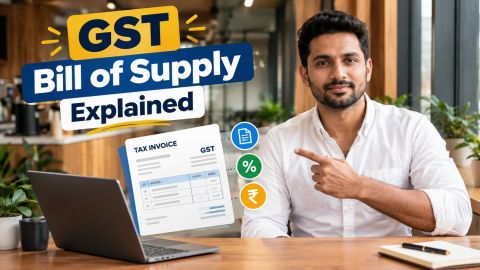
GST Bill of Supply Explained
-
In summary
A bill of supply is a GST document used instead of a tax invoice in specified cases, including exempt supplies made by a registered person and supplies made by a registered person paying tax under the composition scheme. It records the supply without charging GST separately.
- Section 31(3)(c) of the Central Goods and Services Tax Act, 2017 provides for a bill of supply in the specified cases.
- Rule 49 of the CGST Rules, 2017 prescribes the main particulars, including supplier details, serial number, issue date, recipient details where applicable, description, value, and signature requirements.
- A composition taxpayer cannot collect GST separately from the recipient and must use the prescribed composition declaration.
- Exports are zero-rated, not exempt. An export made under a Letter of Undertaking (LUT) is not converted into a bill of supply merely because IGST is not charged.
- For a supply valued at less than Rs. 200 to an unregistered recipient, an individual bill may be omitted when the recipient does not require one, subject to the applicable conditions.
Accurate billing helps maintain GST records and explain why GST has not been charged separately.
What is a bill of supply under GST?
-
A bill of supply is a document issued by a registered supplier instead of a tax invoice for an exempt supply. A registered person paying tax under the composition scheme also issues a bill of supply. These cases are covered by Section 31(3)(c) of the CGST Act.
For example, if a composition taxpayer sells goods for Rs. 1,000, the bill can show Rs. 1,000 as the value payable without adding GST as a separate charge. The document records the transaction but does not show GST charged to the recipient.
A bill of supply should not be used simply because no GST is charged in a particular circumstance. The supplier should first determine whether the supply is exempt, whether the composition scheme applies, or whether another GST rule governs the document.
When should you issue a bill of supply?
-
The appropriate document depends on the GST treatment of the supply and the supplier's tax status. A regular registered supplier can issue a tax invoice for a taxable supply and a bill of supply for an exempt supply.
Transaction Document Why Exempt goods or services supplied by a regular registered supplier Bill of supply GST is not charged on the exempt supply. Supply made by a registered composition taxpayer Bill of supply GST cannot be collected separately from the recipient. Taxable supply made by a regular registered supplier Tax invoice The supply follows the applicable tax-invoice requirements. Export of goods or services Export invoice under applicable rules Exports are zero-rated and follow applicable export-invoice provisions. For exports made under an LUT without payment of IGST, the absence of IGST does not make the transaction an exempt supply. Use the applicable export invoice and endorsement requirements.
What details must a bill of supply contain?
Rule 49 of the CGST Rules, 2017 prescribes the particulars for a bill of supply. Use the applicable requirements as a checklist when creating the document in an accounting system.
| Particular | What to record |
| Supplier | Name, address and Goods and Services Tax Identification Number (GSTIN) |
| Serial number | Consecutive serial number, within the prescribed character limit and unique for the financial year |
| Issue date | Date of issue |
| Recipient | Name, address and GSTIN or Unique Identity Number (UIN), where the recipient is registered |
| Goods or services | Applicable HSN/SAC or other prescribed code and description |
| Value | Value of the supply after accounting for applicable discount or abatement |
| Signature | Supplier's or authorised representative's signature or digital signature, subject to the electronic-bill exception |
Rule 49 prescribes a serial number of not more than 16 characters, in one or more series, unique for the financial year. Check the applicable coding requirement for the goods or services supplied.
A signature or digital signature is not required for an electronic bill of supply issued in accordance with the Information Technology Act, 2000, subject to the applicable rule.
Check your pre-approved business loan offer
What should a bill of supply look like?
The following is an illustrative example of a bill of supply issued by a composition taxpayer. Please note that the supplier, recipient, and transaction are fictional.
| Illustrative field | Example |
| Required composition declaration | Composition taxable person, not eligible to collect tax on supplies |
| Supplier | Example Traders, 10 Market Road, Pune |
| Supplier GSTIN | [Supplier's GSTIN] |
| Bill number | BOS/2026-27/001 |
| Date | 25 September 2026 |
| Recipient | Walk-in customer, not registered under GST |
| Item | One notebook |
| Supply value | Rs. 100 |
| GST charged separately | Rs. 0 |
| Total payable | Rs. 100 |
| Signature | Authorised signature, unless the electronic-bill exception applies |
The Rs. 100 amount is only an illustration of document format. It does not establish a market price or GST rate. Apply the GST treatment applicable to the actual supply.
When can you omit a bill for a sale below Rs. 200?
-
An individual bill of supply may be omitted for a transaction valued at less than Rs. 200 when the recipient is unregistered and does not require the bill, subject to the applicable conditions. A transaction of exactly Rs. 200 does not fall within a 'less than Rs. 200' threshold.
For example, an unregistered walk-in customer purchasing goods worth Rs. 100 may not require an individual bill. If the customer asks for a bill, the supplier should issue it. Even when an individual bill is not issued under the applicable exception, the transaction must still be properly accounted for in the business records.
Get business loan for your needs

Women Business Loan
Get Women Business Loan upto 80 Lakh

Medical Store Business Loan
Get Medical Store Business Loan upto 80 Lakh

Manufacturer Business Loan
Get Manufacturer Business Loan upto 80 Lakh
Can taxable and exempt supplies share one document?
-
Yes, in specified circumstances. Rule 46A allows a registered person supplying taxable and exempt goods or services to an unregistered person to issue a single invoice-cum-bill of supply.
The taxable supply should show the applicable tax information, while the exempt supply should be identified separately. Do not extend Rule 46A to every transaction without checking the recipient's registration status and the applicable conditions.
What is the difference between a bill of supply and a tax invoice?
A tax invoice documents a taxable supply by a registered supplier, while a bill of supply is used for specified exempt supplies or supplies made by a registered composition taxpayer. The documents differ in whether GST is charged separately and how the recipient can use the document for an ITC claim.
| Feature | Tax invoice | Bill of supply |
| Typical use | Taxable supply by a regular registered supplier | Exempt supply or supply by a registered composition taxpayer |
| GST charged separately | Yes, where applicable | No |
| Recipient's ITC | May support a claim if all statutory conditions are met | Does not support an ITC claim for GST on that purchase because GST is not charged separately |
| Primary rule | Rule 46 | Rule 49 |
A tax invoice does not automatically establish eligibility for input tax credit (ITC). The recipient must satisfy all applicable conditions under GST law. A bill of supply remains an important purchase record even though it does not show GST charged to the recipient.
Why is a bill of supply important for a business?
A bill of supply provides a transaction record where GST law requires this document instead of a tax invoice. It also helps the supplier and recipient understand why GST has not been charged separately.
- It records the value and description of the supply.
- It helps distinguish an exempt supply or composition-scheme supply from a taxable supply requiring a tax invoice.
- It supports consistent accounting and GST records.
- It communicates that GST has not been charged separately to the recipient.
- It provides documentary evidence for the underlying business transaction.
The document should match the actual GST treatment of the transaction. Issuing the wrong document can create accounting, reconciliation, and compliance issues.
What should you check before issuing a bill of supply?
- Confirm the GST treatment of the supply and whether it is exempt or otherwise covered by the bill-of-supply provisions.
- Check whether the supplier is registered under the composition scheme.
- Determine whether a tax invoice, bill of supply, export invoice, or invoice-cum-bill of supply is required.
- Check supplier and recipient details, including GSTIN or UIN where applicable.
- Assign the required serial number and issue date.
- Enter the applicable description, HSN/SAC or prescribed code, and value.
- Apply the required composition declaration where the supplier is a composition taxpayer.
- Check the signature requirement for the chosen method of issuing the document.
- Retain the document and corresponding transaction records in accordance with applicable GST record-keeping requirements.
What GST compliance mistakes should you avoid?
| Mistake | Why it matters | Better approach |
| Using a bill of supply for a taxable supply that requires a tax invoice | The document may not meet the applicable invoicing requirement | Determine the tax treatment before billing |
| Treating zero-rated exports as exempt supplies | Zero-rated and exempt supplies have different GST treatment | Follow applicable export invoice and endorsement rules |
| Adding GST separately to a composition bill | A composition taxpayer cannot collect GST separately | Issue the bill of supply with the prescribed composition declaration |
| Using the Rs. 200 exception at exactly Rs. 200 | The relevant threshold is less than Rs. 200 | Apply the exception only when its conditions are satisfied |
| Assuming a bill of supply supports ITC | It does not show GST charged to the recipient | Retain the document as a transaction record and follow applicable ITC rules for purchases |
How can a Bajaj Finance Business Loan support business expenses?
Businesses managing GST-compliant sales can also incur eligible operating expenses such as inventory purchases, equipment, technology, and working capital requirements. A Bajaj Finance Business Loan can support eligible business expenses related to these activities, subject to applicable business loan eligibility criteria, verification, credit assessment, and loan terms.
Bajaj Finance offers funding ranging from Rs. 2 lakh to Rs. 80 lakh, repayment tenures from 12 to 96 months, and business loan interest rates of 14%–23.50% per annum.
How do you apply for a Bajaj Finance Business Loan?
- Start the application: Open the Business Loan page and select ‘Check Loan Offer’. Enter your mobile number and verify it using the OTP.
- Provide details: Enter your personal and business information, including your name, PAN, date of birth, PIN code, and relevant banking information.
- Choose your loan requirement: Select the required loan amount and choose Term Loan, Flexi Dropline, or Flexi Hybrid Term Loan.
- Select the repayment tenure: Choose a tenure between 12 and 96 months, subject to applicable loan terms.
- Review and submit: Check the information provided, complete the required verification and KYC process, and submit the application.
Our loan variants






Loans for business needs















Select loan by amount
Business loan in different cities

Business loan in bangalore

Business loan in mumbai

Business loan in pune

Business loan in Jaipur

Business loan in Kerala

Business Loan in Telangana

Business Loan in Surat

Business Loan in Ranchi

Business Loan in Odisha

Business Loan in Noida

Business Loan in Kolkata

Business Loan in Karnataka

Business Loan in Hyderabad

Business Loan in Gujarat

Business Loan in Coimbatore

Business Loan in Assam

Business Loan in Ahmedabad
Business loan for different budgets

2 lakh business loan
3 lakh business loan
5 lakh business loan
10 lakh business loan

15 lakh business loan
20 lakh business loan
25 lakh business loan
30 lakh business loan
50 lakh business loan
Types of business loan
Unsecured Business Loan
Secured Business Loan
Term Loan
Cash Credit
Working Capital Loan
Machinery Loan
Line of Credit
Micro Loan
Merchant cash Loan
Frequently Asked Questions
Overview
Can a composition taxpayer charge GST separately on a bill of supply?
No. A registered composition taxpayer cannot collect GST separately from the customer. The taxpayer issues a bill of supply and must include the prescribed declaration stating that the supplier is a composition taxable person and is not eligible to collect tax on supplies.
Should you issue a bill of supply for an export under an LUT?
No, not simply because the export is made without payment of IGST under a Letter of Undertaking (LUT). Exports are zero-rated rather than exempt. The supplier should follow the applicable export-invoice requirements and include the required endorsement for an export made under an LUT.
Can a bill of supply be issued for a taxable supply?
A bill of supply should not replace a tax invoice for a taxable supply made by a regular registered supplier when the tax-invoice rules apply. The supplier should first determine whether the transaction is taxable, exempt, zero-rated, or covered by the composition scheme and then select the document required by GST law.
Does an electronic bill of supply need a signature?
Rule 49 provides an exception to the signature or digital-signature requirement for an electronic bill of supply issued in accordance with the Information Technology Act, 2000. For other bills, Rule 49 includes the supplier's or authorised representative's signature or digital signature among the prescribed particulars.
More articles




Disclaimer
Bajaj Finance Limited has the sole and absolute discretion, without assigning any reason to accept or reject any application. Terms and conditions apply*.