








₹ 2 lakh – ₹ 80 lakh
Check your pre-approved offer and other benefits
Enter mobile and OTP | Check offer | Know your exact loan terms
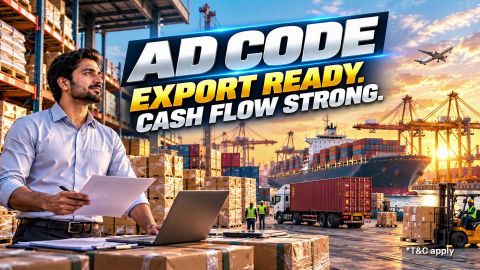
AD Code Registration Guide
-
In summary
An Authorised Dealer (AD) code is issued by a bank authorised to handle foreign exchange transactions. Exporters may need to register or link the code through the Indian Customs Electronic Commerce Gateway (ICEGATE) for applicable goods-export customs workflows.
- The AD code is different from the Importer Exporter Code (IEC): the IEC identifies the exporter, while the AD code identifies the authorised dealer bank relationship.
- Banks commonly ask for the IEC, business PAN, bank-account proof, and a prescribed request or authorisation form. GST details and other documents may also be required.
- The code and its registration status can affect shipping-bill processing and the documentation used to track export proceeds.
Requirements depend on the bank, customs workflow, and port. Confirm the current instructions before filing a shipping bill; do not assume one timeline or fee applies to every exporter.
What is an AD code in customs?
-
An AD code, or Authorised Dealer code, is a code issued by a bank authorised to deal in foreign exchange. In applicable export customs processes, it links the exporter’s bank details with customs records.
The AD code is not the same as an Importer Exporter Code (IEC). The IEC identifies the importing or exporting business, while the AD code identifies the authorised dealer bank associated with relevant foreign exchange transactions.
What is AD code registration on ICEGATE?
-
AD code registration is the process of obtaining the bank’s code or authorisation and completing the applicable customs registration or bank-account linking steps through ICEGATE. The required workflow depends on the export transaction and the current portal process.
Before submitting a registration, check that the exporter name, IEC, PAN, bank-account details, and port information match the records used in the shipping documentation.
Why do exporters need AD code registration with customs?
AD code registration helps connect an exporter’s bank details with the customs records used in applicable export-shipping workflows. Where the process requires the code, missing or incorrect registration can prevent the shipping bill from being processed as expected.
- ICEGATE supports electronic customs filing, including shipping-bill workflows. Check the current requirements for your export and port before filing.
- Correct bank details help keep customs records aligned with the account used to receive export proceeds.
- The exporter must separately meet applicable Foreign Exchange Management Act (FEMA) requirements and follow relevant Directorate General of Foreign Trade (DGFT) rules. AD code registration alone does not guarantee compliance or payment.
Do not assume that AD code registration automatically secures a tax refund, export incentive, or payment. Eligibility and processing depend on the applicable scheme, transaction, and supporting records.


Who can apply for AD code registration?
An exporter with a valid IEC can contact the bank authorised to handle its foreign exchange transactions and ask for an AD code. The bank may require the exporter to maintain an eligible account and provide business, account, and export details before issuing its authorisation.
Confirm the account requirements with the bank. Ensure that the legal business name and other details match across the IEC, PAN, bank records, and application.
Which documents are required for AD code registration?
The exact checklist varies by bank and workflow. Ask the issuing bank for its current form and document requirements before applying.
- AD code request letter or bank-prescribed application form
- Importer Exporter Code (IEC) certificate or IEC details
- Business PAN card or PAN details
- Cancelled cheque or other proof of the relevant bank account
- GST registration certificate or GST details, where applicable
- ICEGATE or customs authorisation forms, where required
- Customs broker authorisation or other supporting documents, if requested
Check every document for matching business, IEC, PAN, and bank-account details. Inconsistent records can trigger clarification requests and delay the process.
How do you complete AD code registration on ICEGATE?
Start with the bank where the exporter holds the account used for the relevant foreign exchange transactions. Then follow the current ICEGATE instructions for the applicable registration or linking process.
- Contact the bank’s authorised dealer or foreign exchange team and request its AD code process.
- Complete the prescribed application with the business, IEC, and bank-account details.
- Submit the supporting documents and respond to any verification questions.
- Receive the code or bank authorisation after the bank completes its checks.
- Sign in to ICEGATE and complete the applicable AD code or bank-account registration steps for the relevant export workflow.
- Check the registration status and verify the details before relying on them for a shipping bill.
Portal screens and document requirements can change. Use the bank’s latest checklist and the current instructions on ICEGATE rather than relying on an old walkthrough.
How long does AD code registration take?
The SEO brief lists an indicative timeline of 1–3 working days for bank issuance after document verification and 1–2 working days for ICEGATE approval after submission. These timelines are not confirmed as universal service standards and can vary with bank checks, incomplete documents, portal issues, and the relevant workflow. Confirm the expected turnaround with your bank before scheduling a shipment.
What are the fees for AD code registration?
The SEO brief targets the keyword “AD code registration fees”, but it does not provide an official, universally applicable fee. Charges, if any, depend on the bank’s current policy and related services. Ask the issuing bank for its current fee schedule before submitting the application.
What happens if an AD code is not registered?
If an AD code required for an export workflow is not registered, customs processing and the documentation trail for export proceeds can be disrupted. The exact consequence depends on the shipment, port, and applicable process.
- ICEGATE or the relevant customs workflow may not accept or process the shipping bill as expected if required bank details or registration are missing.
- A shipment may be delayed while the exporter obtains bank authorisation or corrects registration details.
- The exporter may face delays reconciling export proceeds with shipping-bill and bank records.
- GST refund or export-benefit claims, where applicable, may be delayed if the supporting export records are incomplete or inconsistent.
Do not treat every consequence as an automatic statutory penalty. Verify the requirement for the specific transaction and resolve registration issues before filing.
How does AD code affect export payment realisation?
AD code registration supports the link between export customs records and the authorised dealer bank associated with the exporter’s foreign exchange transactions. It does not itself cause the overseas buyer to pay or guarantee that proceeds will be realised.
- Accurate bank details help the exporter and bank connect shipping documentation with the relevant export transaction.
- Shipping-bill and bank records may be used during export-proceeds tracking, reconciliation, and reporting.
- For electronic Bank Realisation Certificate (eBRC) workflows, exporters must enter and reconcile the relevant AD code, shipping-bill, port, and realised-value details as required by the current DGFT process.
Track invoices, shipping bills, remittance advice, and bank credits together. Contact the authorised dealer bank if the amount received does not match the expected export proceeds.
Which transactions require an AD code?
AD code requirements should be checked for the specific goods-export customs workflow. Do not assume that the same registration rules apply to every export of goods, export of services, import, port, or foreign exchange receipt.
Before dispatch, confirm the applicable customs requirement with your authorised dealer bank, customs broker, or ICEGATE guidance. Separate foreign exchange reporting and export-proceeds obligations may apply even where a particular customs registration step is not relevant.
What benefits does AD code registration provide?
- Helps connect bank details with customs records in applicable export workflows.
- Supports shipping-bill filing when the registration is required for the transaction.
- Helps maintain consistent records for export-proceeds tracking and reconciliation.
- Can support the documentation needed for relevant export reporting or claims, subject to each scheme’s rules and eligibility.
Registration is one part of export compliance. It does not independently guarantee faster customs clearance, GST refunds, incentives, or receipt of payment.
Check your pre-approved business loan offer
How can exporters plan for wider business expenses?
Exporters may need working capital for inventory, packaging, freight, customs-broker services, insurance, and the gap between dispatch and payment by overseas buyers. Plan these costs against expected collections and existing repayment commitments.
If your business has a broader requirement for working capital, equipment, or expansion, you can assess a Bajaj Finance Business Loan, subject to eligibility and applicable terms. Compare the total borrowing cost and repayment schedule with expected business cash flows before taking on debt.
Bajaj Finance Business Loan offers eligible businesses funding for requirements such as working capital, machinery purchases, expansion, and digitisation, subject to business loan eligibility and applicable terms.
It offers loan amounts from Rs. 2 lakh to Rs. 80 lakh, repayment tenures from 12 months to 96 months, and business loan interest rates from 14% to 23.50% per annum. Processing fees can be up to 4.72% of the loan amount, inclusive of applicable taxes. Confirm the current offer and applicable terms before accepting it.
How do you apply for a Bajaj Finance Business Loan?
- Click the ‘Check Loan Offer’ button to open the online application form.
- Enter your name, PAN, date of birth, PIN code, and business details, then click ‘CONTINUE’.
- Complete the banking verification process.
- Review the available offer and select the loan type and repayment tenure.
- Check the application details and complete the required KYC process.
Approval and the final offer depend on applicant details, verification, eligibility, and applicable terms.







Select loan by amount
Applicable fees and charges on our business loan

Loans for business needs












Get business loan for your needs

Women Business Loan
Get Women Business Loan upto 80 Lakh

Medical Store Business Loan
Get Medical Store Business Loan upto 80 Lakh

Manufacturer Business Loan
Get Manufacturer Business Loan upto 80 Lakh
Business loan in different cities

Business loan in bangalore

Business loan in mumbai

Business loan in pune

Business loan in Jaipur

Business loan in Kerala
Business loan for different budgets

2 lakh business loan
3 lakh business loan
5 lakh business loan
10 lakh business loan

15 lakh business loan
20 lakh business loan
25 lakh business loan
30 lakh business loan
50 lakh business loan
Types of business loan
Unsecured Business Loan
Secured Business Loan
Term Loan
Cash Credit
Working Capital Loan
Machinery Loan
Line of Credit
Micro Loan
Merchant cash Loan
Frequently asked questions
Overview
Why do exporters need AD code registration with customs?
AD code registration is required for applicable export customs workflows to link an exporter’s authorised bank details with customs records and support shipping-bill processing. ICEGATE handles electronic customs filing, and a missing required registration can interrupt the shipping-bill process. Exporters must also follow applicable FEMA requirements and relevant DGFT rules for export transactions and proceeds. Registration helps maintain the documentation trail, but does not guarantee payment realisation or export benefits.
How long does AD code registration take?
The SEO brief suggests 1–3 working days for the bank to issue an AD code after document verification and 1–2 working days for ICEGATE approval after submission. These are indicative figures, not confirmed universal service timelines. Ask your bank to confirm the current turnaround and allow extra time for document corrections or portal issues.
Can I apply for an AD code online?
You may be able to start the process online if your bank provides a digital application route. The bank issues the code or authorisation, after which you must follow the applicable ICEGATE registration steps. Confirm the current process with your bank and check that the registration is complete before filing the relevant shipping bill.
Does AD code registration apply to every port?
Do not assume that one AD code registration automatically covers every port or export workflow. Follow the current ICEGATE process and verify the registration status for the port and transaction relevant to your shipment. Your authorised dealer bank or customs broker can help you check the applicable requirements before the shipping bill is filed.
More articles

Top 6 Government Loan Schemes for Businesses
Read More

Top 7 Government Business Loan Schemes in India (2026)
Read More

MSME Loan Scheme in 2025 - Types, Interest Rate, Eligibility, and How to Apply Online
Read More
MSME Loan vs MUDRA Loan
Read More
Disclaimer
Bajaj Finance Limited has the sole and absolute discretion, without assigning any reason to accept or reject any application. Terms and conditions apply*.