













An OTP will be sent to this number for verification

You may have a pre-approved offer
Enter required loan against property amount
In summary
Agriculture Marketing Information, Importance, Benefits
Agriculture marketing covers the activities involved in moving agricultural produce from farmers to consumers, processors, traders and other buyers.
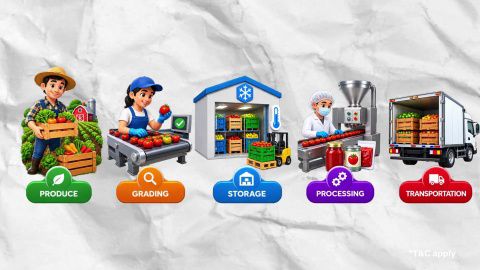
- It includes assembling, grading, storage, transportation, processing and selling agricultural produce
- Farmers can use channels such as local markets, APMC mandis, direct marketing and electronic trading platforms
- APMCs regulate the marketing of notified agricultural produce in designated market areas
- e-NAM connects existing APMC markets through an electronic trading platform
- Proper marketing can improve market access, price discovery and movement of produce
Agriculture marketing therefore connects agricultural production with markets and helps coordinate the movement and sale of farm produce.
What is agricultural marketing?
Agriculture marketing refers to the activities involved in taking agricultural produce from the farm to the final buyer. It includes functions such as assembling, grading, sorting, packaging, storage, transportation, processing, pricing and selling.
The process connects farmers with traders, processors, retailers, institutions and consumers. It can take place through physical markets, direct sales, cooperatives, farmer-producer organisations and electronic trading platforms.
In India, agricultural marketing has traditionally involved regulated markets and APMCs. e-NAM provides an electronic platform that connects existing APMC markets and supports transparent trading and price discovery.
Why is agriculture marketing important?
Agriculture marketing plays an important role in ensuring that farm produce reaches buyers efficiently. Its importance includes:
- Better market access: It connects farmers with different categories of buyers and markets.
- Price discovery: Competitive buying and transparent trading can help establish market prices.
- Efficient movement: Transportation, storage and other marketing activities help move produce from farms to consumption centres.
- Quality management: Grading and quality assessment help buyers and sellers determine the characteristics of produce.
- Reduced wastage: Appropriate storage, transportation and processing can help minimise post-harvest losses.
- Value addition: Processing and packaging can increase the usefulness and marketability of agricultural products.
- Market information: Farmers can use available price and market information when deciding where and when to sell.
The e-NAM platform specifically aims to streamline procedures, reduce information asymmetry and facilitate real-time price discovery through transparent trading.
What are the functions of agriculture marketing?
Agriculture marketing involves several functions between production and final consumption.
- Assembling
Produce from individual farmers is collected and brought together at markets, collection centres or other aggregation points. This allows larger quantities to be offered to buyers.
- Transportation
Agricultural produce often needs to travel from farms to mandis, warehouses, processing units, retailers or other destinations. Transportation helps connect production areas with consumption and processing centres.
- Grading and standardisation
Produce can be sorted and graded according to characteristics such as quality, size, weight and other applicable standards. This helps buyers assess produce more consistently.
- Storage
Storage allows produce to be held after harvesting instead of requiring immediate sale. Warehouses, cold storage facilities and other suitable facilities can support the preservation of agricultural commodities.
- Processing
Some agricultural commodities undergo processing before reaching consumers. Examples include milling grains, processing oilseeds and converting fruits or vegetables into processed products.
- Packaging
Packaging protects produce during storage and transportation and can make handling and distribution easier.
- Pricing and selling
Marketing involves determining or discovering prices and completing transactions between sellers and buyers. Electronic trading platforms such as e-NAM are designed to support transparent price discovery.
Show More
Show Less
What are the types of agriculture marketing?
Agriculture marketing can take different forms depending on how and where agricultural produce is sold.
- Local marketing
Farmers may sell produce in nearby local markets to traders, retailers or consumers. This can be suitable for produce intended for nearby consumption.
2. Wholesale marketing
Large quantities of agricultural produce are sold to wholesalers or other bulk buyers. Wholesale markets help aggregate produce and distribute it to different locations.
3. Direct marketing
Farmers can sell produce directly to consumers, retailers, processors or other buyers, subject to applicable rules. Direct marketing can reduce the number of intermediaries involved in a transaction.
4. Contract marketing
Under a contract arrangement, farmers and buyers may agree on certain terms relating to production and purchase of agricultural produce. Applicable contractual and agricultural marketing regulations should be considered.
5. Cooperative marketing
Farmers may work through cooperatives or other collective organisations to aggregate produce and access markets.
6. Electronic marketing
Electronic platforms allow agricultural commodities to be traded through digital systems. e-NAM is a pan-India electronic trading platform that networks existing APMC markets.
Show More
Show Less
What is e-NAM in agriculture marketing?
e-NAM, or National Agriculture Market, is a pan-India electronic trading portal that networks existing APMC mandis to create a unified national market for agricultural commodities. It aims to promote transparent trading, reduce information gaps and facilitate real-time price discovery.
The platform provides market-related information and supports online trading. Its current network includes markets across multiple states and Union Territories.
Farmers, traders and FPOs can participate subject to the applicable registration and market requirements. e-NAM's registration guidelines provide separate processes for farmers, traders, commission agents and FPOs/FPCs.
What are the channels of agriculture marketing?
Agricultural produce can reach buyers through different channels.
A typical marketing chain may look like:
Farmer → local trader → wholesaler → retailer → consumer
Other channels can include:
Farmer → APMC market → wholesaler → retailer → consumer
Farmer/FPO → processor → retailer → consumer
Farmer → direct buyer → consumer
Farmer/FPO → e-NAM market → buyer
The appropriate channel depends on the commodity, location, quantity, quality, storage facilities, buyer requirements and applicable regulations.
In India, farmers can use different marketing channels, including local markets, APMC mandis, direct marketing, cooperatives, FPOs and electronic platforms. e-NAM connects participating APMC markets through an electronic trading platform and aims to support transparent trading and real-time price discovery.
However, challenges such as inadequate storage, transportation costs, price fluctuations, post-harvest losses and limited market information can affect agricultural marketing. Strengthening infrastructure, improving access to market information and adopting digital solutions can help address these challenges. Understanding the available marketing channels can help farmers make informed decisions about selling their produce.
Frequently Asked Questions
Overview
What is the purpose of the scheme?
The purpose of the scheme is to enhance agricultural marketing by providing better infrastructure and services to farmers. It aims to promote fair, transparent, and competitive marketing environments, ensuring better price realisation for farmers. The scheme also seeks to minimise post-harvest losses, improve the supply chain, and enable direct linkages between producers and consumers. It facilitates reforms in agricultural marketing, focusing on modernisation and technology adoption. Ultimately, the scheme helps in improving the income of farmers by providing them with access to a wider market with better terms of trade.
What products are covered under the scheme?
The scheme typically covers a wide range of agricultural products, including cereals, pulses, oilseeds, fruits, vegetables, and other horticultural crops. Livestock and dairy products may also fall under the scheme depending on its specific provisions. By including diverse agricultural commodities, the scheme aims to support farmers in multiple sectors, helping them market their produce more effectively. Certain schemes also include processed agricultural goods to enhance value addition in the supply chain. This broad coverage ensures that both staple and perishable items benefit from improved marketing infrastructure and practices.
What are the alternative channels available for agricultural marketing?
Alternative channels for agricultural marketing include direct sales to consumers via farmers’ markets or retail outlets, online platforms or e-marketplaces, and contract farming agreements with companies. Cooperatives and producer organisations also serve as important alternatives, offering collective marketing solutions to small farmers. Government-run regulated markets (mandis), private wholesale markets, and auction systems remain significant as well. Other options include agribusiness companies and processors who buy directly from farmers. These channels help farmers bypass intermediaries, potentially increasing their income by reducing transaction costs and offering better price transparency.
Is there any contribution from the applicant?
Yes, in most agricultural schemes, applicants (such as farmers, farmer producer organisations, or cooperatives) are typically required to contribute a portion of the project cost. This contribution may vary depending on the nature of the scheme and the applicant’s profile. In some cases, the government provides substantial subsidies, and the applicant's contribution can be as low as 10% to 25%. However, for certain schemes aimed at larger infrastructure development, a higher share may be required. The contribution helps ensure the applicant’s commitment to the success of the project while enabling efficient resource utilisation.
How do cooperatives help in agricultural marketing?
Cooperatives empower farmers by pooling resources, enabling collective bargaining, reducing dependence on middlemen, facilitating access to larger markets, ensuring fair prices, and promoting the sale of diverse, high-quality produce.
What role do middlemen play in agriculture marketing?
Middlemen act as intermediaries between farmers and consumers, facilitating transportation, storage, and distribution. They bridge market gaps but may also increase costs and reduce direct profits for farmers.
What are some best practices in sustainable agriculture marketing?
Best practices include adopting eco-friendly production, ensuring transparency, using technology for traceability, promoting direct-to-consumer sales, reducing waste through efficient logistics, and fostering partnerships with local and global markets.
What are futures and forward contracts in agriculture marketing?
Futures and forward contracts allow farmers and buyers to lock in prices for agricultural products in advance, reducing risks from price volatility and ensuring stable income or supply agreements.
Loan Against Property for different budget
Check your pre-approved offer now
Loan Against Property for Professionals




Find your nearest branch

What do our customers say about us
customers
Play Store rating
reviews
Anita Das
04 March 2026
The loan against property process was smooth and transparent. Interest rates were competitive, and the documentation requirements were minimal. The team provided clear guidance at every step, making the entire experience hassle-free. Highly recommended for quick approvals and reliable support.
Aashish
04 March 2026
The loan disbursal was quick, and the customer support team handled all my queries with patience and clarity. Flexible EMIs made it easy to manage monthly expenses. Overall, a great experience, especially for salaried individuals seeking a loan against property.
Prakash
04 March 2026
I had a great experience transferring my existing loan against property. The process was quick and hassle-free, and I saved significantly with the lower interest rate. The customer service team was supportive throughout. Highly recommended for anyone considering a balance transfer.
Yogesh Singh
04 March 2026
Clear guidance, quick approval, and flexible repayment options made purchasing my new house much easier than expected. The team managed the entire process professionally and ensured smooth coordination at every stage. Overall, a very satisfying experience, and I would recommend their home loan services to others.
Related articles


Watch our videos

Know the tax benefits on your loan against property

What are the documents required for a Loan Against Property?

What are the types of property eligible for Loan Against Property

What is the eligibility criteria for a Loan Against Property
Disclaimer
1. Bajaj Finance Limited (“BFL”) is a Non-Banking Finance Company (NBFC) and Prepaid Payment Instrument Issuer offering financial services viz., loans, deposits, Bajaj Pay Wallet, Bajaj Pay UPI, bill payments and third-party wealth management products. The details mentioned in the respective product/ service document shall prevail in case of any inconsistency with respect to the information referring to BFL products and services on this page.
2. All other information, such as, the images, facts, statistics etc. (“information”) that are in addition to the details mentioned in the BFL’s product/ service document and which are being displayed on this page only depicts the summary of the information sourced from the public domain. The said information is neither owned by BFL nor it is to the exclusive knowledge of BFL. There may be inadvertent inaccuracies or typographical errors or delays in updating the said information. Hence, users are advised to independently exercise diligence by verifying complete information, including by consulting experts, if any. Users shall be the sole owner of the decision taken, if any, about suitability of the same.