







An OTP will be sent to this number for verification

You may have a pre-approved offer
Enter required home loan amount
In summary
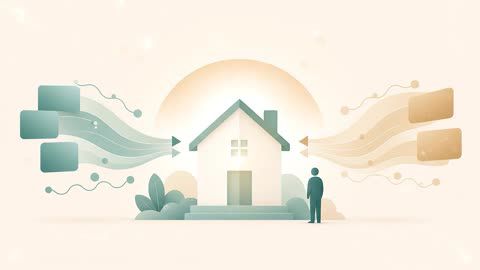
Understanding Awas: PMAY Eligibility, Subsidy & Application Explained
- Official definition source: PMAY-U 2.0 FAQ at pmaymis.gov.in
- Pucca house: Roof and walls both made of durable modern materials (burnt bricks, cement concrete, GI sheets, asbestos, timber, machine-made tiles)
- Ineligibility rule: Owning even one pucca house anywhere in India disqualifies the entire family
- Kutcha house: Temporary materials — mud, bamboo, thatch, unburnt bricks — does not count as pucca
- Semi-pucca: Mixed materials — one element pucca and one kutcha — typically does not meet the full pucca definition
- Key check: The entire family's ownership across all of India is assessed, not just the applicant's
The exact definition from the official PMAY-U 2.0 FAQ
The official PMAY-U 2.0 FAQ at pmaymis.gov.in defines a pucca house as:
"A 'Pucca' house is defined as an all-weather dwelling unit having roof and wall are made up of sturdy, modern, and durable materials like burnt bricks, stones packed with cement or lime, cement concrete, timber, Galvanized Iron (GI) sheets, asbestos sheets, machine-made tiles etc."
This definition has two equally important elements:
- Roof made of durable materials
- Wall made of durable materials
Both must be present for a dwelling to qualify as pucca. A house with a pucca roof but mud walls — or pucca walls but a thatched roof — is typically classified as semi-pucca and may not count as a pucca house for PMAY eligibility purposes.
Why the pucca house definition matters for PMAY-U 2.0
The "no pucca house" condition is a foundational eligibility requirement for PMAY-U 2.0. The official eligibility criteria states:
"Families belonging to EWS/LIG/MIG segments, living in urban areas, having no pucca house either in his/her name or in the name of any member of his/her family anywhere in the country are eligible to purchase/construct or rent a house under PMAY-U 2.0."
This means:
Anywhere in India: If you or any family member owns a pucca house in any city or village anywhere in the country — not just in your current city — your family is ineligible for PMAY-U 2.0.
Any family member: The check covers the entire beneficiary family — husband, wife, and unmarried children. If an adult unmarried son owns a pucca house in his name, it disqualifies the family from PMAY-U 2.0.
Past benefits: Applicants who have received housing assistance from any Central, State, or local government housing scheme in the past 20 years are also not eligible — even if the original house has been sold or the benefit was partially utilised.
Pucca vs Kutcha vs Semi-pucca — what counts?
| House type | Roof material | Wall material | PMAY eligibility |
|---|---|---|---|
| Pucca | Concrete/GI/asbestos/machine tiles | Burnt brick/concrete/stone with cement | Not eligible — already has pucca house |
| Kutcha | Grass/thatch/bamboo/mud | Mud/unburnt brick/bamboo | Eligible — no pucca house |
| Semi-pucca | Pucca roof | Mud/kutcha walls | May be eligible — verify with ULB |
| Semi-pucca | Kutcha roof | Pucca walls | May be eligible — verify with ULB |
For semi-pucca houses, the eligibility determination is done by the Urban Local Body during field verification. The ULB physically inspects the house to confirm whether it meets the full pucca standard or qualifies as semi-pucca.
What counts as pucca material — detailed breakdown
Roof materials that make a house pucca:
- Reinforced cement concrete (RCC) slab
- Galvanized Iron (GI) sheets
- Asbestos cement sheets
- Machine-made tiles (clay or concrete)
- Stone slabs with cement finishing
- Timber with weatherproof covering
Wall materials that make a house pucca:
- Burnt bricks with cement or lime mortar
- Reinforced cement concrete (RCC)
- Stone packed with cement or lime
- Timber frame with permanent cladding
Materials that do NOT make a house pucca:
- Unburnt mud bricks
- Bamboo or wooden poles
- Mud or clay walls
- Grass, thatch, or plastic sheets as roofing
- Tin or temporary metal sheets without permanent foundation
The self-declaration requirement
When applying for PMAY-U 2.0, beneficiaries must submit an undertaking (affidavit or self-declaration) confirming that neither they nor any family member owns a pucca house anywhere in India. This is one of the mandatory documents specified in the official scheme guidelines.
If the self-declaration is found to be false at any stage — including during field verification by the ULB or post-sanction audit — the allotment can be cancelled and the beneficiary may be required to return any central assistance already received.
How this connects to upgrading a kutcha house
PMAY-U 2.0 also supports the upgrading of kutcha or semi-pucca houses into fully pucca dwellings through the BLC (Beneficiary-Led Construction) vertical — where central assistance of up to ₹1.5 lakh (BLC) or ₹2.5 lakh (ISS subsidy on loan) can be used to construct or renovate into a pucca standard.
For the BLC vertical, the beneficiary must own the land, and the house being constructed must meet the pucca material specifications after completion.
Connection to home loans
For beneficiaries eligible for PMAY-U 2.0 — who currently live in a kutcha or semi-pucca house or in rented accommodation and do not own a pucca house — the ISS vertical provides an interest subsidy on home loans to purchase or construct a pucca dwelling.
Bajaj Finance Home Loans offer competitive rates from 7.50% p.a.*, loan amounts up to Rs. 15 crore*, and tenure up to 32 years. Loans sanctioned on or after 1 September 2024 qualify for ISS subsidy under PMAY-U 2.0.
Check your home loan eligibility and apply or check eligibility today.
Frequently Asked Questions
Checking your status and list
About subsidy and eligibility
What is the definition of a pucca house under PMAY-U 2.0?
A pucca house is defined as an all-weather dwelling where both the roof and walls are made of durable materials — burnt bricks, cement concrete, stone with cement/lime, timber, GI sheets, asbestos sheets, or machine-made tiles.
If I live in a rented flat, can I apply for PMAY-U 2.0?
Yes. Living in rented accommodation is not a barrier. The disqualification applies only to owning a pucca house. Renters who meet income and other eligibility criteria can apply.
Does a government-allotted flat count as a pucca house?
Yes. If you or a family member owns or has received a government-allotted flat (pucca dwelling) under any central or state housing scheme in the past 20 years, you are not eligible for PMAY-U 2.0.
What happens if my self-declaration about no pucca house is found false?
The sanction can be cancelled and you may be required to return the central assistance received. Providing a false declaration is a serious violation of PMAY-U 2.0 terms.
Can I apply for PMAY-U 2.0 to upgrade my semi-pucca house?
Eligibility depends on field verification by the ULB. If the ULB determines your house does not qualify as pucca, you may be eligible under the BLC vertical to construct a new pucca house on your land.
Home Loan in Different Cities

Home Loan in Mumbai

Home Loan in Ahmedabad

Home Loan in Bangalore

Home Loan in Chennai

Home Loan in Delhi

Home Loan in Hyderabad

Home Loan in Cochin

Home Loan in Noida

Home Loan in Pune
Home Loan for different budget
Check your pre-approved offer now
Our Calculators


Home loan for professionals




What do our customers say about us
customers
Play Store rating
reviews
Amit Shiva
Reviewed on 04 Mar 2025
Smooth and transparent home loan process. The interest rates were competitive, and documentation was minimal. The team guided me clearly at every step, making my first home purchase stress-free. Highly recommended for quick approvals.
Sandeep Kulkarni
Reviewed on 24 Feb 2025
The loan disbursal was fast, and the customer support team was extremely patient with all my queries. Flexible EMIs helped me manage my monthly expenses easily. A great experience for salaried homebuyers.
Ritika Agarwal
Reviewed on 12 Apr 2025
I had a great experience while transferring my existing home loan. The process was quick, and I saved significantly with the lower interest rate. Customer service was helpful throughout. Highly recommended for balance transfers.
Manoj Verghese
Reviewed on 08 Dec 2024
Clear guidance, quick approval, and flexible repayment options made buying my new house easier than expected. The team handled everything professionally. Very satisfied and would definitely recommend their home loans
Find your nearest branch

More Articles to Read


Watch our videos
Documents required to get a Bajaj Finserv Home Loan

Tips to increase your Home Loan eligibility
Things you need to know about pre-approved home loan
Things you need to know before applying for a Home Loan

How does Repo Rate affect your Home Loan

Download App
Now request money from your friends and family and make instant payments.

- Choose from personal, business, gold loans and more
- Pay utility bills, use UPI, get FASTag and more
- Buy over 1 million products on No Cost EMI
- Buy stocks, mutual funds and invest in FD
Disclaimer
1. Bajaj Finance Limited (“BFL”) is a Non-Banking Finance Company (NBFC) and Prepaid Payment Instrument Issuer offering financial services viz., loans, deposits, Bajaj Pay Wallet, Bajaj Pay UPI, bill payments and third-party wealth management products. The details mentioned in the respective product/ service document shall prevail in case of any inconsistency with respect to the information referring to BFL products and services on this page.
2. All other information, such as, the images, facts, statistics etc. (“information”) that are in addition to the details mentioned in the BFL’s product/ service document and which are being displayed on this page only depicts the summary of the information sourced from the public domain. The said information is neither owned by BFL nor it is to the exclusive knowledge of BFL. There may be inadvertent inaccuracies or typographical errors or delays in updating the said information. Hence, users are advised to independently exercise diligence by verifying complete information, including by consulting experts, if any. Users shall be the sole owner of the decision taken, if any, about suitability of the same.