








Loans from ₹20,000 to ₹40 Lakh
Loans from ₹20,000 to ₹40 Lakh
T&C apply. ECS/NACH return charges applicable on bounced payments.
What is the Cheque Truncation System (CTS) and how does it work
The Cheque Truncation System, or CTS, is the RBI's image-based cheque clearing system. Under CTS, when a cheque is deposited at a bank, the presenting bank captures a high-resolution electronic image of the cheque along with the MICR data. This image, and not the physical cheque, is transmitted through the clearing system to the drawee bank for payment.
The physical cheque stops at the presenting bank and does not move further in the clearing process. This is what "truncation" means: stopping the flow of the physical cheque and replacing it with an electronic image. CTS was implemented in phases across India starting in 2008. With effect from October 13, 2023, the three earlier CTS grids covering New Delhi, Chennai, and Mumbai were merged into a single National Grid managed by the National Grid Clearing House in Chennai. All banks across the country are required to be connected to CTS, as stated by the RBI.
How continuous clearing works under the updated RBI guidelines
In August 2025, the RBI issued a circular dated 13 August 2025, transitioning CTS from a batch processing model to a Continuous Clearing and Settlement on Realisation framework. This change was implemented in two phases, with Phase 1 from 4 October 2025 and Phase 2 from 3 January 2026.
Under the new system:
- Cheques are presented to the clearing house continuously between 10:00 AM and 4:00 PM on working days
- Drawee banks have a continuous confirmation window from 10:00 AM to 7:00 PM to process and confirm or dishonour cheques
- Each cheque has an Item Expiry Time, which is the latest time by which the drawee bank must respond. If no response is received by this time, the cheque is considered deemed approved and included in the next settlement
- Settlement happens hourly from 11:00 AM onwards, based on positive confirmations
- Once settlement is posted, the presenting bank releases payment to the customer within one hour, subject to usual safeguards
This replaced the earlier batch processing model where clearing could take up to two working days. Cheques are now typically cleared within a few hours of presentation on the same working day.
What is the Positive Pay System and when does it apply
The Positive Pay System, or PPS, is an additional fraud prevention mechanism introduced by the RBI under CTS. It requires the person issuing a cheque to electronically submit key details of that cheque to their own bank before it is presented for clearing. The clearing house then cross-checks these details against the actual cheque image when it arrives. Key details submitted under Positive Pay typically include the cheque date, payee name, and the amount. Any discrepancy between the submitted details and the presented cheque is flagged to both the drawee bank and the presenting bank.
The RBI has advised banks to enable the Positive Pay facility for all account holders issuing cheques of Rs. 50,000 and above. While using PPS is at the discretion of the account holder for cheques up to Rs. 5,00,000, banks may make it mandatory for cheques of Rs. 5,00,000 and above.
If you are issuing a cheque of Rs. 50,000 or more for EMI or any other payment, check whether your bank has enabled and requires Positive Pay registration for that amount before the cheque is deposited.
Rules for filling cheques correctly under CTS guidelines
Cheques with alterations or corrections are not accepted under CTS. The RBI has specified that no changes or corrections can be made on a cheque after it has been written, except for date validation in certain cases. If you need to change the payee name, the amount in figures, or the amount in words, you must use a fresh cheque leaf.
Key rules for filling a cheque correctly under CTS:
- Use image-friendly coloured ink that produces a clear scan. The RBI has not prescribed a specific ink colour but recommends colours that show up clearly in both greyscale and black and white images
- Use permanent ink to prevent fraudulent alteration of the contents
- Do not use correction fluid or make any overwriting on the cheque
- Ensure the payee name, amount in figures, and amount in words are all legible and match exactly
- Banks are required to provide an acknowledgement if you request one when depositing a cheque at a branch counter
Three images of each cheque are captured in CTS: front greyscale, front black and white, and back black and white. All written content on the cheque must be clearly visible in each of these image types.
What happens if a cheque bounces or is lost in clearing
If a cheque is dishonoured or returned:
The drawee bank returns the cheque image data to the clearing house during the confirmation session. The clearing house routes the return data to the presenting bank, which then informs the depositing customer. The cheque is treated as unpaid, and any credit held pending clearance is reversed.
If a cheque is lost in transit or during clearing:
The RBI has specified that if a cheque is lost in the clearing process, the bank must immediately inform the presenting customer. The customer should then ask the drawer to stop payment on the lost cheque and also be aware that other cheques issued anticipating the credit from the lost cheque may be dishonoured due to the non-credit of that amount.
If you have a grievance about a cheque:
If a bank fails to pay or delays clearing a cheque without valid reason, you can first raise a complaint with the bank. If the bank does not respond within 30 days, you may file a complaint under the RBI Integrated Ombudsman Scheme at cms.rbi.org.in or call the toll-free number 14448, available between 9:30 AM and 5:15 PM.
Essential Bajaj Finance Service Guides & Support
Frequently Asked Questions
Cheque Clearing Basics
Cheque Bounce & EMI
Digital Repayment
What are the RBI cheque clearing guidelines?
RBI cheque clearing guidelines govern how cheques are processed in India through the Cheque Truncation System, or CTS. Under CTS, physical cheques are not moved between banks. Instead, an electronic image is captured and transmitted for clearing. All banks across India are required to be connected to CTS, as per RBI guidelines.
How long does cheque clearing take as per RBI rules?
Under the updated CTS continuous clearing system, cheques presented between 10:00 AM and 4:00 PM on working days are typically cleared within a few hours of presentation on the same day. This replaced the earlier batch processing model where clearing could take up to two working days.
What are the new RBI rules for cheque clearing?
In August 2025, RBI issued circular RBI/2025-26/73 dated 13 August 2025, transitioning CTS to continuous clearing with settlement on realisation. Cheques are now presented continuously from 10:00 AM to 4:00 PM and cleared within a few hours. This replaced batch processing, which previously took up to two working days to complete.
What is MICR and CTS cheque clearing?
MICR stands for Magnetic Ink Character Recognition. It is the printed code at the bottom of every cheque that contains the bank and branch details. CTS, or Cheque Truncation System, uses MICR data along with a digital image of the cheque to process clearing electronically, without physically moving the cheque between banks.
What happens if a cheque takes more than 2 days to clear?
Under the current CTS continuous clearing system, cheques should typically clear within a few hours, not two days. If your cheque has not cleared after a reasonable period, contact your bank with the cheque details. If unresolved within 30 days, you may file a complaint at cms.rbi.org.in.
What are the cheque return charges per RBI guidelines?
The RBI has specified that there is no service charge for savings account customers for cheque collection up to Rs. 1,00,000. For amounts above this and for other account types, charges are determined by individual banks and must be communicated to customers as part of the bank's Cheque Collection Policy.
How does a returned cheque create an overdue EMI?
When a cheque submitted for EMI repayment is returned unpaid by the drawee bank, the EMI is not credited to your loan account. The payment is treated as not made, and your account becomes overdue from the due date. Overdue EMI charges and penal interest may then apply as per your loan agreement.
Will cheque bounce affect my CIBIL score?
Yes. A returned EMI cheque means the payment was not made on the due date. The lender reports this to credit bureaus including CIBIL as a missed payment or Days Past Due entry in the monthly reporting cycle. The longer the overdue remains uncleared, the greater the negative impact on your CIBIL score.
What is ECS return charge and who bears it?
An ECS return charge is a fee applied when an automatic payment debit through the Electronic Clearing Service fails, typically due to insufficient funds. This charge is levied by the bank on the account holder whose account was debited. The exact charge depends on your bank's policy and must be disclosed in their schedule of charges.
How do I pay overdue EMI after a cheque return?
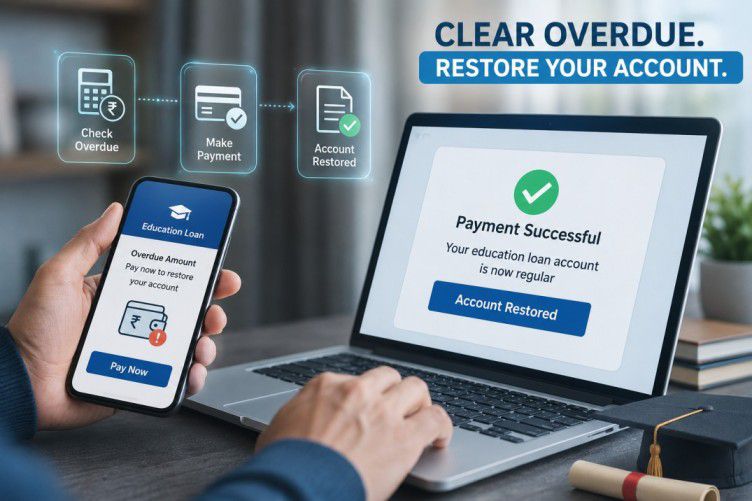
Log in to My Account on the Bajaj Finance website or app using your registered mobile number and OTP. Go to the Services section, select your loan, click on Make Loan Payments, and choose the Missed Instalments or Other Overdues option. Pay the full overdue amount using UPI, net banking, or debit card and save your confirmation.
What is NACH and how does it prevent cheque bounce?
NACH stands for National Automated Clearing House. It is an electronic mandate system that authorises your bank to automatically debit your EMI on the due date each month. Since the debit happens automatically, there is no physical cheque to bounce. A NACH mandate eliminates the risk of a missed EMI due to a cheque not being submitted on time.
Can I set up auto-debit to avoid cheque returns?
Yes. You can set up a NACH or eNACH mandate, which authorises your bank to automatically debit your EMI on the due date each month. This removes the need to submit a physical cheque for each EMI payment. Log in to My Account on the Bajaj Finance website or app to register or update your NACH mandate.
What is the penalty for repeated EMI bounces?
Repeated EMI bounces result in overdue EMI charges and penal interest accumulating on your loan account as per your loan agreement. Each missed payment is also reported to credit bureaus, reducing your CIBIL score. The exact charges depend on your loan type and agreement terms. Check your loan documents or contact Bajaj Finance customer care for details specific to your account.
How do I set up a NACH mandate for my Bajaj Finance loan?
Log in to My Account on the Bajaj Finance website or app using your registered mobile number and OTP. Go to the Services section and select your loan account. Choose the Update Mandate option and follow the on-screen steps to register your bank account details and authenticate the mandate for automatic monthly EMI debits.
More Articles

Disclaimer
While care is taken to update the information, products, and services included in or available on our website and related platforms/websites, there may be inadvertent inaccuracies or typographical errors or delays in updating the information. The material contained in this site, and on associated web pages, is for reference and general information purpose and the details mentioned in the respective product/service document shall prevail in case of any inconsistency. Subscribers and users should seek professional advice before acting on the basis of the information contained herein. Please take an informed decision with respect to any product or service after going through the relevant product/service document and applicable terms and conditions. In case any inconsistencies observed, please click on reach us.
*Terms and conditions apply.