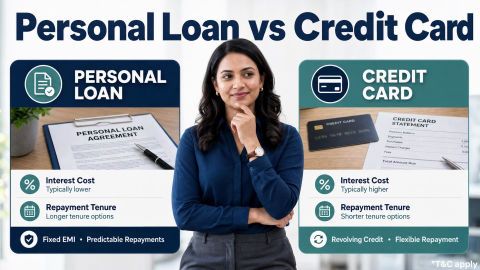
Personal Loan or Credit Card Loan: Which Fits Your Need

Personal Loan or Credit Card Loan: Which Fits Your Need

A credit card loan draws on your existing card limit, while a personal loan is a separate amount repaid in fixed equated monthly instalments (EMIs). Need, tenure and total cost decide which fits.

Rs. 40,000 - Rs. 75 lakh

You may be eligible for a pre-approved offer

Enter mobile and OTP | Check offer | No branch visit needed


In summary

A credit card loan can mean a cash advance, a loan against your available card limit or an EMI conversion of an eligible purchase. Each route has its own charges and repayment terms set by the card issuer.


  • Borrowing limit: Card-based borrowing depends on your available card limit and the issuer's terms. A personal loan has a separate approved amount.
  • Cost: Compare interest, processing fees and other applicable charges for the same amount and repayment period.
  • Repayment: A personal loan has a defined EMI and tenure. Card borrowing terms depend on the facility you use.
  • Available credit: A loan against your card limit reduces the credit available for other purchases. A personal loan does not use your card limit.

To make the comparison relevant to your own needs, start by checking the amount and repayment tenure available to you. Check your loan offer in just 2 steps then compare the quoted terms with your card issuer's charges.

What are the 3 ways to borrow on a credit card?

Credit card borrowing takes three main forms: cash advances, loans against the card limit, and EMI conversions. The amount available, charges, and repayment terms depend on the facility and the card issuer.


Card borrowing optionHow it worksWhat to check
Cash advanceWithdraw cash against your credit cardWithdrawal fees and interest from the date of withdrawal
Loan against the card limitBorrow a lump sum within your available limit and repay it in instalmentsAmount blocked against the limit, interest and fees
EMI conversionConvert an eligible purchase into instalmentsProcessing fee, interest rate and repayment tenure

Last reviewed: 23 October, 2026


Check your card issuer's schedule of charges before choosing an option. A cash advance, a loan against the card limit and an EMI conversion are different facilities, with different costs and uses.

Show More Show Less

How does a credit card loan compare with a personal loan?

The main differences are the borrowing limit, total cost, repayment tenure, and effect on your available card credit. A personal loan provides a separate borrowing facility, while credit card borrowing remains subject to the issuer's limit and terms.


Comparison factorCredit card loanBajaj Finance Personal Loan
Borrowing amountDepends on the available card limit and issuer's termsRs. 40,000 to Rs. 75 lakh, subject to eligibility
Interest rateSet by the card issuer and borrowing option10% to 30.5% per annum, subject to applicable terms and customer eligibility
Repayment tenureSet by the card issuer and borrowing option12 months to 108 months months
Effect on card limitA loan against the limit reduces available creditDoes not use your credit card limit
Cost disclosureIssuer's schedule of charges and applicable loan termsKey Fact Statement (KFS) and applicable loan documents

Last reviewed: 23 October, 2026


Compare the total amount payable for the same principal and repayment period. Include interest and applicable fees rather than deciding on the advertised rate or EMI alone.

Show More Show Less

When does each borrowing option make sense?

A credit card loan can suit a requirement that fits within your available limit, particularly when you need cash or want to convert an eligible purchase into instalments. A personal loan is worth comparing when you need a larger amount, want a defined repayment schedule or prefer to keep your card limit available for other spending.


Worked Example: Pallavi in Thane

Pallavi is a 32-year-old salaried pharmaceutical regulatory affairs executive in Thane. She takes home Rs. 76,000 per month and has a CIBIL score of 762. She needs Rs. 1,80,000 for a certification course and a new laptop, but her available credit card limit is Rs. 1,50,000.


Her card limit falls short by Rs. 30,000. She compares a personal loan at an illustrative interest rate of 14% per annum across two repayment periods.


EMI formula: EMI = P × R × (1 + R)^N ÷ [(1 + R)^N − 1]

Where:

  • P = principal borrowed
  • R = monthly interest rate
  • N = number of monthly instalments

For Pallavi, P = Rs. 1,80,000, R = 14 ÷ 1,200 and N is the selected tenure in months.


Repayment tenureMonthly EMI (Rs.)Total interest (Rs.)EMI as a share of monthly salary
24 months8,64227,41611.4%
36 months6,15241,4718.1%

Last reviewed: 22nd October, 2026


The 36-month option reduces Pallavi's EMI by Rs. 2,490 per month but adds Rs. 14,055 in total interest compared with the 24-month option. The processing fee, subject to the applicable terms, would add to the borrowing cost.


Pallavi chooses the 24-month option because the higher EMI fits her budget and costs less in total interest under this illustration. She also keeps her credit card available for other spending.


The choice would differ if the higher EMI left too little money for essential expenses. Compare the instalment with your take-home income, existing EMIs and planned spending before settling on a tenure.


What could affect a loan application?

A CIBIL score below 650 or existing EMIs that consume a substantial share of your income can affect the lender's assessment. Inconsistent personal details or addresses across documents can delay verification. Multiple loan applications within a short period can also affect how lenders assess your credit profile.


Review the applicable criteria and required documents before proceeding with an application.

Show More Show Less

What should you know about a Bajaj Finance Personal Loan?

A Bajaj Finance Personal Loan provides a separate borrowing facility with a defined repayment tenure. The following details cover eligibility, documents, charges and the application process.


What are the eligibility criteria?


CriterionRequirement
NationalityIndian
Age21 years to 80 years.
Employed withPublic, private, or multinational companies (MNCs).
CIBIL Score650 or higher.
Customer profileSelf-employed or Salaried

*You should be 80 years or younger, at the end of the loan tenure.

Last reviewed: 22nd October, 2026


Meeting these criteria does not guarantee approval or a particular loan amount. The lender assesses each application through eligibility checks, verification and credit evaluation. No collateral or guarantor is required.


Which documents may you need?

The documents required depend on your profile and the lender's verification process.

  • KYC documents: Aadhaar/ passport/ voter's ID/ driving license/ Letter of National Population Register/ NREGA job card
  • PAN card
  • Employee ID card
  • Salary slips of the last 3 months
  • Bank account statements of the previous 3 months
  • Piped gas bill
  • Pension order
  • Letter of Allotment of Accommodation Issued by Employer
  • Property / Municipal tax receipt
  • Utility bill
  • Phone bill
  • Real-time image / photograph

Not every applicant needs every document. Confirm the final list of required personal loan documents during your application. 

Which personal loan charges should you compare?

Compare the interest rate and applicable fees to understand the borrowing cost beyond the monthly EMI. The charges below are subject to the applicable loan terms.


ChargeAmount or applicable terms
Interest rate10% to 30.5% per annum, subject to applicable terms and customer eligibility
Processing feeUp to 4.13% of the loan amount, inclusive of applicable taxes
Bounce chargesRs. 700 to Rs. 1,200 per bounce
Penal chargeUp to 36% per annum on the overdue instalment
Part-prepayment, Term LoanUp to 4.72% of the principal prepaid, inclusive of applicable taxes
Foreclosure, Term LoanUp to 4.72% of the outstanding principal, inclusive of applicable taxes
Part-prepayment, Flexi Dropline and Flexi Hybrid LoansNo charge
Flexi facility chargeRs. 11, inclusive of applicable taxes

Last reviewed: 23 October, 2026


Check the Key Fact Statement (KFS) and applicable loan documents for the charges that apply to your offer. See the personal loan interest rates and charges page for further details.


How do you apply for a personal loan?

You apply for a Bajaj Finance Personal Loan online in five steps:

  1. Check your loan offer: Enter the required loan amount and preferred repayment tenure, then click “CHECK LOAN OFFER”.
  2. Enter your details: Provide the requested personal, financial and employment information.
  3. Review the offer: Check the available amount and tenure. Compare two or three repayment periods to see how each changes the EMI and total interest.
  4. Complete verification: Complete the Know Your Customer (KYC) process and verify your bank details.
  5. Discuss the next steps: After you submit the application, a loan executive will contact you about the next steps.

The process can differ for new and existing customers, and additional documents may be required in some cases. Before accepting an offer, check that the EMI fits your monthly budget and that the repayment tenure suits your needs.

Show More Show Less

Key offerings: 3 loan types

Personal loan interest rate and applicable charges

Type of fee

Applicable charges

Rate of interest per annum

10% to 30.5% p.a.

Processing fees

Up to 4.13% of the loan amount (inclusive of applicable taxes).

Flexi Facility Charge

Term Loan – Not applicable

Flexi Loans –Up To Rs 1,999 To Up To Rs 18,999/- (Inclusive Of Applicable Taxes)

Will be deducted upfront from loan amount.

Bounce charges

Rs. 700 to Rs. 1,200/- per bounce

“Bounce charges” shall mean charges for (i) dishonor of any payment instrument; or (ii) non-payment of instalment (s) on their respective due dates due to dishonor of payment mandate or non-registration of the payment mandate or any other reason.

Part-prepayment charges

Full Pre-payment:

  • Term Loan: Up to 4.72% (Inclusive of applicable taxes) on the outstanding loan amount as on the date of full pre-payment

  • Flexi Term (Dropline) Loan: Up to 4.72% (Inclusive of applicable taxes) on the outstanding loan amount, as on the date of full prepayment.

  • Flexi Hybrid Term Loan: Up to 4.72% (Inclusive of applicable taxes) on the outstanding loan amount, as on the date of full prepayment.

Part Pre-payment

  • Up to 4.72% (Inclusive of applicable taxes) of the principal amount of Loan prepaid on the date of such part Pre-Payment.

  • Not Applicable for Flexi Term (Dropline) Loan and Flexi Hybrid Term Loan.

Penal charge

Delay in payment of instalment(s) shall attract Penal Charge at the rate of up to 36% per annum per instalment from the respective due date until the date of receipt of the full instalment(s) amount.

Stamp duty (as per respective state)

Payable as per state laws and deducted upfront from loan amount.

Annual maintenance charges

Term Loan: Not applicable

Flexi Term (Dropline) Loan:

Up to 0.295% (Inclusive of applicable taxes) of the Dropline limit (as per the repayment schedule) on the date of levy of such charges.


Flexi Hybrid Term Loan:

Up to 0.472% (Inclusive Of Applicable Taxes) Of The Dropline Limit During Initial Tenure. Up to 0.295% (Inclusive Of Applicable Taxes) Of Dropline Limit During Subsequent Tenure

Credit guarantee scheme feeUp to 1.18% p.a. (pro-rated daily till 31st March) (inclusive of all applicable taxes) of the loan amount
Credit guarantee scheme renewal feeUp to 1.18% p.a. (inclusive of all applicable taxes) on the outstanding loan amount as on April 01 of the subsequent Financial Year.
*Renewal Fee to be collected only for 3 subsequent financial years.
 
**If the Remaining Tenure is less than 12 months, the CG Fee in subsequent years shall be charged prorated.

Frequently asked questions

Cost and limits

Credit record

Is a personal loan cheaper than a credit card loan?

The lower-cost option depends on the interest rate, fees and repayment terms offered to you. Compare the total amount payable for the same principal and tenure, including processing fees and other charges. A cash advance can attract fees and interest from the date of withdrawal, so it can become costly when repayment is delayed. Review your card issuer's schedule of charges alongside the personal loan's Key Fact Statement before deciding.

Yes. A loan against your credit card limit uses part of the available credit until the amount is repaid. This leaves less room for purchases and unexpected expenses. A personal loan is a separate borrowing facility and does not use your credit card limit. If you need to keep your card available for regular spending, compare a personal loan with the terms of borrowing against your card.

Both types of borrowing can affect your credit record. A personal loan is recorded as a separate loan account, while credit card borrowing is associated with your card account and its reported balance. Repayment history matters for both. Missed payments can affect your credit score, so make sure the EMI or card payment fits your budget and that you can meet each due date.

A personal loan can be worth considering if its total cost is lower and you qualify for the required amount. Compare the interest and fees on your existing card balance with the personal loan's charges and repayment schedule. Also check whether any charges apply to settling the card balance. If you transfer the debt, avoid accumulating new card balances while repaying the personal loan, as that could leave you managing both obligations. Check your loan offer to review the available amount and tenure, then compare the quoted terms with the cost of carrying your card balance.

Show More Show Less

Disclaimer

Bajaj Finance Limited has the sole and absolute discretion, without assigning any reason to accept or reject any application. Terms and conditions apply*.

For customer support, call Personal Loan IVR: 7757 000 000