











An OTP will be sent to this number for verification

You may have a pre-approved offer
Enter required home loan amount
In summary
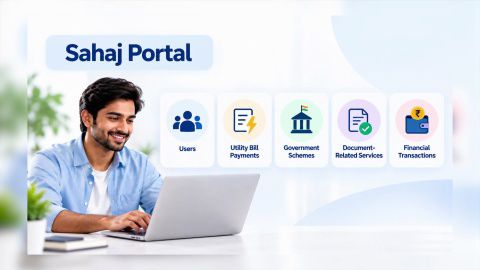
Streamline Services with the Sahaj Portal Online
- "Sahaj" refers to ITR-1, the Income Tax Department's simplified return form — accessed at incometax.gov.in, not a separate third-party portal
- Eligibility: resident individuals with total income up to Rs. 50 lakh, from salary, one house property, and other specified sources
- Not eligible for ITR-1: those with capital gains, income from more than one house property, foreign income or assets, or business/professional income
- Verification methods: Aadhaar OTP, net banking EVC, or physical ITR-V by post
- Late filing under Section 234F can attract a penalty of Rs. 5,000 to Rs. 10,000, depending on timing
- ITR filing history is commonly used as income proof for home loan applications, alongside Form 16.
What is ITR-1 (Sahaj)?
ITR-1, commonly called "Sahaj," is the simplest of the Income Tax Department's return forms, designed for resident individual taxpayers with straightforward income sources. It is filed through the official e-filing portal — there is no separate "Sahaj portal" distinct from this.
| Attribute | Detail |
|---|---|
| Official access point | incometax.gov.in (Income Tax Department e-filing portal) |
| Full name | ITR-1 (Sahaj) |
| Who it's for | Resident individuals, income up to Rs. 50 lakh |
| Not for | Capital gains, multiple house properties, business income, foreign assets |
"Sahaj" means "simple" in Hindi, reflecting the form's design intent — a streamlined return for taxpayers whose income situation doesn't require the more detailed disclosures other ITR forms demand.
The confusion around "the Sahaj portal" as if it were a separate destination likely stems from how often the name is used on its own, without the "ITR-1" prefix, in everyday conversation and even in some informal guidance — but there is only one official e-filing portal for all ITR forms, ITR-1 included, and no separate government website exists specifically under the "Sahaj" name. Anyone directing you to a different "Sahaj portal" URL should be treated with caution, since the only legitimate destination is the Income Tax Department's own e-filing site.
Show more
Show less
Who is eligible to file ITR-1?
ITR-1 is designed specifically for straightforward income profiles, and filing it when you don't actually qualify results in a defective return notice.
| Eligible for ITR-1 | Not eligible for ITR-1 |
|---|---|
| Resident individual, income up to Rs. 50 lakh | Income above Rs. 50 lakh |
| Salary or pension income | Capital gains (use ITR-2) |
| Income from one house property | Income from more than one house property |
| Interest, dividend, and other specified income | Business or professional income (use ITR-3 or ITR-4) |
| Agricultural income up to Rs. 5,000 | Foreign income or foreign assets |
If you're unsure which form applies to your specific situation, the e-filing portal offers a "Help me decide which ITR form to file" tool that walks through a short set of questions to confirm the correct form before you begin.
Getting this wrong in either direction causes real friction: filing ITR-1 when you're not eligible results in a defective return notice requiring correction, while filing a more complex form than necessary when ITR-1 would have sufficed simply means more data entry than your situation actually required. Neither is a serious problem, but confirming eligibility upfront saves the back-and-forth either mistake creates.
Show more
Show less
How to access and file ITR-1 online
- Log in to the Income Tax e-filing portal at incometax.gov.in using your PAN and password.
- Navigate to e-File > Income Tax Returns > File Income Tax Return.
- Select the relevant Assessment Year and choose Online as your filing mode.
- Select ITR-1 (Sahaj) as your form, after confirming your eligibility.
- Review your pre-filled data — salary details, TDS, and other information auto-populated from Form 26AS and AIS.
- Enter any additional income, deductions, and exemptions not already pre-filled.
- Preview your computed tax liability or refund, and proceed to Preview and Submit.
- Submit your return, then e-Verify it using Aadhaar OTP, net banking EVC, or another available method.
Filing is not complete until verification — an unverified return, even if successfully submitted, is treated as if it was never filed once the verification window closes.
Show more
Show less
Verifying your ITR-1 after filing
Submission alone doesn't complete the process — every filed return must be verified within the specified window, and there are a few ways to do this.
- Aadhaar OTP: Near-instant, provided your Aadhaar is linked to your registered mobile number.
- Net banking EVC (Electronic Verification Code): Generate a verification code through your bank's net banking portal, if your bank supports this integration.
- Bank account or demat account EVC: An alternative EVC generation route through a pre-validated bank or demat account.
- Physical ITR-V by post: Send a signed physical copy of the acknowledgement to the Centralised Processing Centre in Bengaluru, for those who cannot use an electronic method.
Electronic verification is near-instantaneous once completed, while physical ITR-V verification takes considerably longer given postal transit time — use an electronic method wherever your situation allows it, to avoid unnecessary delay in your return being processed. The Centralised Processing Centre's address and the exact requirements for a valid physical ITR-V are published on the e-filing portal itself, and a return sent without following the specified format or within the deadline risks being treated as unverified regardless of when it was posted.
Show more
Show less
Home loan for professionals
A worked example: a salaried employee filing ITR-1
Consider Meenal, a 27-year-old marketing executive in Ahmedabad earning Rs. 62,000 a month (roughly Rs. 7.4 lakh annually), with a CIBIL score of 719, filing her return for the first time independently after a few years of her employer's HR team handling it for her.
| Step | What Meenal did |
|---|---|
| Eligibility check | Salary income only, no capital gains, income well under Rs. 50 lakh — confirmed ITR-1 |
| Pre-filled data | Salary and TDS details matched her Form 16, so she confirmed rather than re-entered |
| Verification | Aadhaar OTP, same-day confirmation |
| Record-keeping | Saved the filed return and acknowledgement as PDFs to her own cloud storage |
Meenal keeps her own copy readily accessible, since it saves a portal login the next time a lender or another institution asks for proof of a specific year's filing — a document she'll likely need again when she applies for a home loan in the coming year. This small habit of self-archiving each year's filing, rather than depending entirely on the portal's own record retention, is a low-effort step that pays off whenever a document request comes up unexpectedly.
Show more
Show less
Why your ITR-1 filing history matters for a home loan
| Loan feature | Detail |
|---|---|
| Interest rate | From 7.50% p.a.* p.a.* |
| Loan amount | Up to Rs. Rs. 15 crore* |
| Tenure | Up to 40 years* years |
A consistent ITR filing history, alongside Form 16, strengthens your income documentation for a home loan application — lenders often reference the last two to three years of filed returns as part of income verification. Check your Home Loan Eligibility once your filings are in order.
Show more
Show less
Frequently Asked Questions
Eligibility and filing
Verification and next steps
Can I file ITR-1 if I sold shares and made a capital gain this year?
No. Any capital gains income, regardless of amount, makes you ineligible for ITR-1 — you would need to file ITR-2 instead. Filing ITR-1 despite having capital gains income results in a defective return notice from the department, requiring you to refile correctly.
Is ITR-1 mandatory for all salaried employees, or can I choose a different form?
ITR-1 is available to eligible salaried employees, but it's not mandatory to use it if you'd prefer a more detailed form — you can file ITR-2 even if you qualify for ITR-1. What you cannot do is file ITR-1 if your income situation doesn't actually meet its eligibility criteria.
What happens if I file ITR-1 but forget to verify it?
An unverified return is treated as not filed once the verification window (30 days from filing, in most cases) closes, which can trigger the same consequences as not filing at all, including late-filing penalties if the original due date has also passed. Verify immediately after submission, ideally using Aadhaar OTP, rather than leaving it for later.
Does my ITR-1 filing directly affect my home loan interest rate?
Not directly — your filed ITR is primarily used as income documentation, not as a factor in the interest rate calculation itself. Your rate depends on your income level, credit score, loan amount, and tenure, with your ITR serving as one of the documents confirming the income figures used in that assessment
Home Loan in Different Cities

Home Loan in Mumbai

Home Loan in Ahmedabad

Home Loan in Bangalore

Home Loan in Chennai

Home Loan in Delhi

Home Loan in Hyderabad

Home Loan in Cochin

Home Loan in Noida

Home Loan in Pune
Home Loan for different budget
Check your pre-approved offer now
Our Calculators




What do our customers say about us
customers
Play Store rating
reviews
Amit Shiva
Reviewed on
Smooth and transparent home loan process. The interest rates were competitive, and documentation was minimal. The team guided me clearly at every step, making my first home purchase stress-free. Highly recommended for quick approvals.
Sandeep Kulkarni
Reviewed on
The loan disbursal was fast, and the customer support team was extremely patient with all my queries. Flexible EMIs helped me manage my monthly expenses easily. A great experience for salaried homebuyers.
Ritika Agarwal
Reviewed on
I had a great experience while transferring my existing home loan. The process was quick, and I saved significantly with the lower interest rate. Customer service was helpful throughout. Highly recommended for balance transfers.
Manoj Verghese
Reviewed on
Clear guidance, quick approval, and flexible repayment options made buying my new house easier than expected. The team handled everything professionally. Very satisfied and would definitely recommend their home loans
Find your nearest branch

More Articles




Watch our videos

Documents required to get a Bajaj Finserv Home Loan

Tips to increase your Home Loan eligibility
Things you need to know about pre-approved home loan

Things you need to know before applying for a Home Loan

How does Repo Rate affect your Home Loan

Download App
Now request money from your friends and family and make instant payments.

- Choose from personal, business, gold loans and more
- Pay utility bills, use UPI, get FASTag and more
- Buy over 1 million products on No Cost EMI
- Buy stocks, mutual funds and invest in FD
Disclaimer
1. Bajaj Finance Limited (“BFL”) is a Non-Banking Finance Company (NBFC) and Prepaid Payment Instrument Issuer offering financial services viz., loans, deposits, Bajaj Pay Wallet, Bajaj Pay UPI, bill payments and third-party wealth management products. The details mentioned in the respective product/ service document shall prevail in case of any inconsistency with respect to the information referring to BFL products and services on this page.
2. All other information, such as, the images, facts, statistics etc. (“information”) that are in addition to the details mentioned in the BFL’s product/ service document and which are being displayed on this page only depicts the summary of the information sourced from the public domain. The said information is neither owned by BFL nor it is to the exclusive knowledge of BFL. There may be inadvertent inaccuracies or typographical errors or delays in updating the said information. Hence, users are advised to independently exercise diligence by verifying complete information, including by consulting experts, if any. Users shall be the sole owner of the decision taken, if any, about suitability of the same.