








Safe Investments with High Returns in India 2026
-
In summary
A safe investment with high returns generally refers to an investment that offers predictable returns with relatively low risk of capital loss. Government-backed schemes provide sovereign backing, while bank and corporate deposits involve different forms of credit and deposit risk.
- PPF, SCSS, NSC, SSY and Post Office schemes are government-backed small savings options with prescribed interest rates and defined rules.
- Bank fixed deposits offer predictable returns and are covered by DICGC insurance up to Rs. 5 lakh per depositor per bank, subject to applicable rules.
- Corporate fixed deposits are not covered by DICGC insurance. Their risk assessment depends on the issuer's financial position, regulatory framework, credit rating and deposit terms.
- Bajaj Finance Fixed Deposit currently offers interest rates of up to 7.40% p.a. for non-senior citizens and up to 7.75% p.a. for senior citizens, for applicable tenures and deposit amounts.
- The latest available August 2026 CPI inflation was 4.82%, so the real return from any fixed-income investment depends on its interest rate, taxation and future inflation.
- No investment can simultaneously offer guaranteed high returns, complete liquidity and zero risk. Comparing these factors helps identify an option that fits a particular financial requirement.
What does a safe investment with high returns mean?
There is no single investment that can be described as both completely risk-free and capable of delivering exceptionally high returns.
For conservative investors, safety generally means lower probability of losing the invested principal, predictable income and clearly defined withdrawal or maturity rules. Returns then need to be considered alongside inflation and taxation.
For example, a fixed deposit paying 7% may provide a predictable nominal return. However, the investor's real return will be lower after considering income tax and inflation.
A useful way to think about this is:
Real return ≈ Interest rate − inflation − tax impact
The calculation is only an approximation because taxation and compounding vary across investments.
The latest available CPI reading for August 2026 was 4.82%, according to the Ministry of Statistics and Programme Implementation. Therefore, an investment offering 7% before tax does not automatically provide a 7% increase in purchasing power.
Which safe investment options are available in India in 2026?
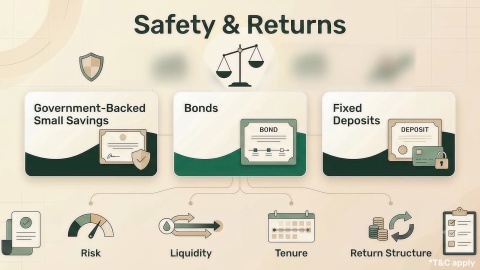
The main options include government-backed small savings schemes, bank fixed deposits and highly rated corporate fixed deposits.
| Investment option | Indicative interest rate | Tenure / lock-in | Tax treatment | Risk / protection |
|---|---|---|---|---|
| Senior Citizen Savings Scheme (SCSS) | 8.20% p.a. | 5 years, subject to extension rules | Interest taxable; deductions may depend on applicable tax regime | Government-backed |
| Sukanya Samriddhi Yojana (SSY) | 8.20% p.a. | Long-term account linked to girl child's eligibility | Generally eligible for specified tax benefits under applicable rules | Government-backed |
| National Savings Certificate (NSC) | 7.70% p.a. | 5 years | Interest taxable under applicable rules; reinvested interest may qualify for Section 80C subject to conditions | Government-backed |
| Public Provident Fund (PPF) | 7.10% p.a. | 15 years, with withdrawal/extension provisions | Interest and qualifying maturity proceeds are generally tax-exempt under applicable rules | Government-backed |
| Post Office Monthly Income Scheme (POMIS) | 7.40% p.a. | 5 years | Interest taxable under applicable rules | Government-backed |
| Bank fixed deposits | Varies by bank and tenure | Generally 7 days to 10 years | Interest taxable; TDS may apply | DICGC cover up to Rs. 5 lakh per depositor per bank, subject to rules |
| Bajaj Finance Fixed Deposit | Up to 7.40% p.a.; 7.75% for senior citizens | 12 to 60 months | Interest taxable; TDS may apply | Corporate credit risk; CRISIL AAA/Stable and ICRA AAA (Stable); no DICGC cover |
Small savings rates are prescribed by the Government and can be revised periodically. Investors should check the applicable rate for the quarter in which they invest.
Which government-backed investments may suit conservative investors?
Public Provident Fund
PPF is a long-term government-backed savings scheme with a 15-year tenure. It may be considered for long-term goals because of its defined maturity structure and tax treatment.
The annual contribution limit is Rs. 1.5 lakh. Because of the long tenure, PPF is less suitable for money that may be required in the near term.
Senior Citizen Savings Scheme
SCSS is designed for eligible senior citizens and provides a government-backed source of interest income.
The current interest rate is 8.20% p.a., with a maximum investment limit of Rs. 30 lakh, subject to applicable rules.
The scheme has a five-year tenure, with extension provisions. Interest is taxable, although eligible taxpayers may claim applicable deductions under the relevant tax regime.
National Savings Certificate
NSC has a five-year maturity period and currently carries an interest rate of 7.70% p.a.
It can be considered by investors looking for a government-backed fixed-income instrument with a defined maturity period.
Sukanya Samriddhi Yojana
SSY is intended for eligible girl children and has specific account-opening, contribution and withdrawal conditions.
Its current interest rate is 8.20% p.a. The scheme is designed for long-term savings rather than short-term liquidity.
Post Office Monthly Income Scheme
POMIS is structured to provide periodic interest income over a five-year tenure.
The current rate is 7.40% p.a., subject to the applicable government notification. The investment limits and rules differ for single and joint accounts.
How does a corporate fixed deposit compare with a government-backed scheme?
A corporate fixed deposit is different from a government-backed savings scheme.
A government-backed small savings scheme derives its credit backing from the Government of India. A corporate FD represents a deposit obligation of the issuing company.
For example, Bajaj Finance Limited's fixed deposits currently carry CRISIL AAA/Stable and [ICRA]AAA (Stable) ratings. CRISIL reaffirmed the AAA/Stable rating on Bajaj Finance's fixed deposits in 2026, while ICRA also reaffirmed its [ICRA]AAA (Stable) rating for fixed deposits.
However, a credit rating is not the same as a government guarantee or deposit insurance.
The distinction is important:
| Factor | Government-backed scheme | Corporate FD |
|---|---|---|
| Credit backing | Government of India | Issuing company |
| Return structure | Prescribed by government | Set by issuer |
| Market-linked? | Generally no | No for a fixed-rate FD |
| DICGC insurance | Not applicable | Not applicable to NBFC deposits |
| Credit risk | Sovereign framework | Issuer-specific |
| Liquidity | Depends on scheme rules | Depends on FD terms and premature withdrawal rules |
RBI states that deposits accepted by NBFCs are not covered by DICGC insurance, and RBI registration does not amount to a guarantee of repayment.
What are the current Bajaj Finance Fixed Deposit rates?
For deposits applicable from 1 May 2026, Bajaj Finance lists rates of up to 7.40% p.a. for customers below 60 and up to 7.75% p.a. for senior citizens.
The highest rates shown on the current rate table apply to the 31–60 month tenure range.
| Customer category | 12–17 months | 18–30 months | 31–60 months |
|---|---|---|---|
| Non-senior citizens | 6.60% | 6.85% | 7.40% |
| Senior citizens | 6.95% | 7.20% | 7.75% |
The current published deposit range is Rs. 15,000 to Rs. 3 crore for the applicable categories. Interest can be received through cumulative or non-cumulative options, depending on the selected deposit structure
How does inflation affect returns from safe investments?
A fixed interest rate does not automatically mean that purchasing power is protected.
Suppose an investment earns 7.40% before tax and inflation averages 5%. The approximate pre-tax real return would be:
7.40% − 5% = 2.40%
If inflation rises, the real return falls. If inflation declines, the real return can increase.
Tax also affects the final outcome. Interest from many fixed-income investments is taxable according to the applicable tax provisions and the investor's circumstances.
Therefore, comparing investments only on their advertised interest rates can give an incomplete picture.
A more useful comparison considers:
- Interest rate
- Tax treatment
- Inflation
- Investment tenure
- Liquidity
- Credit risk
- Premature withdrawal conditions
- Maximum investment limits
How much can Rs. 10 lakh grow over five years?
The following is an illustrative calculation using annual compounding, not a representation of the exact maturity amount of a particular FD.
| Assumed annual return | Value after 5 years on Rs. 10 lakh | Approximate interest earned |
|---|---|---|
| 3.00% | Rs. 11,59,274 | Rs. 1,59,274 |
| 6.80% | Rs. 13,89,493 | Rs. 3,89,493 |
| 7.40% | Rs. 14,28,958 | Rs. 4,28,958 |
| 7.75% | Rs. 14,52,284 | Rs. 4,52,284 |
Actual FD maturity values can differ because financial institutions may use different compounding and payout conventions.
This example also demonstrates why the advertised interest rate should not be treated as the final investment return. Tax, compounding frequency and investment tenure affect the amount ultimately received.
What is FD laddering and how can it improve liquidity?
FD laddering means dividing a lump sum across deposits with different maturity dates instead of placing the entire amount into one deposit.
For example, Rs. 10 lakh could theoretically be divided as:
- Rs. 2 lakh — 12-month FD
- Rs. 2 lakh — 24-month FD
- Rs. 2 lakh — 36-month FD
- Rs. 2 lakh — 48-month FD
- Rs. 2 lakh — 60-month FD
As each deposit matures, the proceeds can be used for planned expenses or reinvested based on the interest rates and liquidity requirements available at that time.
What are the potential benefits of laddering?
Staggered liquidity: A deposit may mature periodically rather than the entire investment remaining locked until one date.
Reinvestment flexibility: Each maturity creates an opportunity to reassess prevailing interest rates.
Tenure diversification: The entire corpus is not committed to a single maturity period.
Interest-rate management: If rates change, only the maturing portion needs to be reinvested at the new rate.
Laddering does not remove credit risk or guarantee a particular future return. Its primary purpose is to manage liquidity and reinvestment timing.
How can investors compare government schemes, bank FDs and corporate FDs?
A simple comparison framework can help:
For sovereign backing
Government-backed schemes such as PPF, SCSS, NSC, SSY and POMIS may be considered where capital protection under the applicable government framework is the primary consideration.
For bank deposit insurance
Bank FDs have DICGC protection of up to Rs. 5 lakh per depositor per bank, including principal and interest, subject to the rules governing insurance cover.
For amounts above the insured limit, investors may consider spreading deposits across banks after evaluating each institution and the applicable terms.
For corporate deposits
Corporate FDs require an assessment of the issuer. Credit ratings can provide an independent view of credit quality, but they do not constitute DICGC insurance or a sovereign guarantee.
For example, Bajaj Finance's current fixed-deposit ratings are CRISIL AAA/Stable and [ICRA]AAA (Stable).
Which safe investment options may suit senior citizens?
Senior citizens may have different priorities, particularly regular income, capital preservation and liquidity.
SCSS currently offers 8.20% p.a. under the government-backed small savings framework, subject to its eligibility and investment limits.
A corporate FD can provide another fixed-income option, with Bajaj Finance currently offering up to 7.75% p.a. for senior citizens for applicable tenures.
The two instruments differ materially in their backing, limits, liquidity and tax treatment. Therefore, the interest rate alone does not determine which option is appropriate for a particular investor.
Check out different FD Rates
Fixed Deposit variants
Get ROI up to
8.15% p.a.
Senior citizen
Starting with just Rs. 15,000
Get ROI up to
7.75% p.a.
Age below 60 years
Starting with just Rs. 15,000
Get ROI up to
7.75% p.a.
Minor
Starting with just Rs. 15,000
Get ROI up to
7.75% p.a.
HUF
Starting with just Rs. 15,000
Get ROI up to
7.75% p.a.
Sole proprietor
Starting with just Rs. 15,000
Locate to your nearest FD branch

Related Articles



Frequently Asked Questions
Overview
What is a safe investment with high returns in India?
Safe investments with relatively predictable returns include government-backed schemes such as PPF, SCSS, NSC, SSY and POMIS, along with bank and highly rated corporate fixed deposits. Their interest rates, taxation, liquidity and risk protections differ, so the highest advertised rate is not the only factor to consider.
Which investment gives the highest safe return?
There is no universally applicable investment that can be described as offering the highest safe return. Government schemes and fixed deposits have different eligibility rules, limits and risk structures. For example, SCSS currently offers 8.20% p.a., while Bajaj Finance FD offers up to 7.75% p.a. for senior citizens for applicable tenures.
Is a corporate fixed deposit as safe as a government-backed scheme?
No. The two have different risk structures. Government-backed schemes operate under the applicable sovereign framework, while a corporate FD depends on the issuing company's ability to meet its repayment obligations. A high credit rating indicates strong assessed credit quality but is not equivalent to a government guarantee.
Are Bajaj Finance Fixed Deposits covered by DICGC insurance?
No. DICGC insurance applies to eligible deposits with insured banks, subject to the applicable Rs. 5 lakh limit. Deposits with NBFCs are not covered by DICGC insurance.
What is FD laddering?
FD laddering involves dividing a lump sum across multiple fixed deposits with different maturity dates. It can provide periodic access to maturing deposits and allow investors to reinvest portions of their money at prevailing rates.
What is the current interest rate on Bajaj Finance Fixed Deposit?
Bajaj Finance currently lists FD rates of up to 7.40% p.a. for non-senior citizens and 7.75% p.a. for senior citizens, depending on the applicable tenure and deposit terms. The current published deposit range is Rs. 15,000 to Rs. 3 crore.
Does a higher interest rate always mean a better investment?
No. A higher rate may come with different credit, liquidity, taxation or tenure considerations. Investors can compare the interest rate with the issuer's credit quality, applicable protection, withdrawal rules, tax impact and investment horizon.
How does DICGC insurance protect bank fixed deposits?
DICGC insures eligible deposits in insured banks up to Rs. 5 lakh per depositor per bank, including principal and interest, subject to the applicable rules and the same-right-and-same-capacity basis.
Disclaimer
1. Bajaj Finance Limited (“BFL”) is a Non-Banking Finance Company (BAJAJ FINANCE) and Prepaid Payment Instrument Issuer offering financial services viz., loans, deposits, Bajaj Pay Wallet, Bajaj Pay UPI, bill payments and third-party wealth management products. The details mentioned in the respective product/ service document shall prevail in case of any inconsistency with respect to the information referring to BFL products and services on this page.
2. All other information, such as, the images, facts, statistics etc. (“information”) that are in addition to the details mentioned in the BFL’s product/ service document and which are being displayed on this page only depicts the summary of the information sourced from the public domain. The said information is neither owned by BFL nor it is to the exclusive knowledge of BFL. There may be inadvertent inaccuracies or typographical errors or delays in updating the said information. Hence, users are advised to independently exercise diligence by verifying complete information, including by consulting experts, if any. Users shall be the sole owner of the decision taken, if any, about suitability of the same.