








Types of Fixed Deposit: Features, Options & Comparison
-
In Summary
A recurring deposit allows you to build savings through regular instalments rather than investing a large sum at the beginning. Banks and other eligible financial institutions may offer different RD options based on the depositor’s age, residency and preferred deposit structure.
- Regular RD: A standard option for people who want to save a fixed amount periodically.
- Minor RD: An account that may be opened for a child and operated according to the provider’s rules.
- Senior-citizen RD: Available from some providers, with eligibility and any additional interest depending on the scheme.
- NRI RD: Available through eligible bank account structures, subject to applicable rules and conditions.
- Flexi RD: Offered by some institutions to provide greater flexibility in deposit amounts.
- Post Office RD: A government small-savings scheme with its own eligibility, deposit and withdrawal rules.
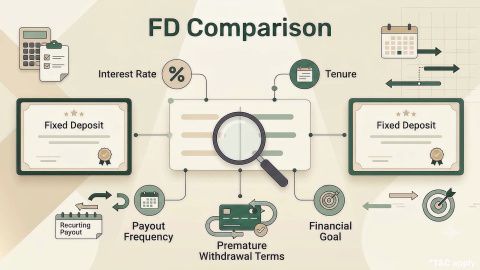
Before opening an RD, compare the interest rate, tenure, instalment requirements, premature closure rules and tax treatment. Not every provider offers every type of RD.
What is a recurring deposit account?
-
A recurring deposit account is a savings arrangement in which you deposit an agreed amount at regular intervals for a selected tenure. The deposit earns interest according to the scheme’s terms.
For example, if you deposit Rs. 2,000 every month for 12 months, your total contributions will be Rs. 24,000. The maturity amount will include the applicable interest, calculated according to the provider’s method.
Unlike a fixed deposit (FD), which generally requires a lump-sum deposit at the start, an RD spreads contributions over time. This can make regular saving more manageable for people who receive a monthly salary or have a predictable income.
What are the main features of an RD?
The features depend on the institution and scheme, but an RD generally includes:
- Regular instalments: You deposit an agreed amount according to the payment schedule.
- Fixed tenure: The account runs for the selected period, subject to the provider’s terms.
- Interest earnings: Interest is calculated according to the applicable rate and method.
- Maturity proceeds: The deposited amount and interest are payable under the scheme’s maturity rules.
- Instalment obligations: Missing or delaying payments may attract penalties or other consequences, depending on the provider.
- Premature closure rules: Accessing the money before maturity may be restricted or may reduce the interest payable.
What are the different types of recurring deposit accounts?
-
RD accounts can be grouped by the depositor’s circumstances, the institution offering the account or the flexibility of the deposit arrangement. The categories below are not available universally; eligibility and features must be checked with the relevant provider.
1. Regular recurring deposit account
A regular RD is a standard option for people who want to save a predetermined amount at regular intervals.
The depositor selects an instalment amount and tenure from the options available with the institution. Interest is calculated according to the applicable RD terms, and the maturity proceeds are paid as specified in the account conditions.
A regular RD may suit you if you:
- Receive a regular salary or predictable income.
- Want to save towards a planned expense.
- Prefer scheduled contributions over a lump-sum investment.
- Can set aside the agreed instalment without affecting essential expenses.
Check the minimum deposit, available tenures, interest rate, late-payment rules and premature closure conditions before opening the account.
2. Recurring deposit account for minors
Some institutions allow an RD to be opened in a minor’s name, subject to their account-opening and operating rules. A parent or legal guardian may need to open or operate the account on the child’s behalf.
Such an account can help families set aside money gradually for future expenses, including education or other planned needs.
Before opening a minor RD, check:
- Whether the account can be held in the minor’s name.
- Who is permitted to operate the account.
- What documentation is required from the minor and guardian.
- How the account will be operated when the minor reaches adulthood.
- The applicable interest rate, tenure and withdrawal conditions.
The eligibility rules and account operation process differ across providers. A minor RD should not automatically be assumed to offer a higher interest rate than a regular RD.
3. Recurring deposit account for senior citizens
Some banks and financial institutions provide RD options for eligible senior citizens. The age requirement and any additional interest depend on the specific scheme.
A senior-citizen RD may help an eligible depositor save a fixed amount regularly. However, the availability of a separate senior-citizen RD and its interest rate should be confirmed with the provider.
Before choosing this option, compare the rate with the standard RD rate, the minimum and maximum tenure, payment requirements and early-closure rules.
Senior-citizen benefits offered on fixed deposits should not be assumed to apply to recurring deposits. For example, Bajaj Finance Fixed Deposits have their own eligibility and rate conditions; these are separate from the terms of an RD offered by a bank or another institution.
4. NRI recurring deposit account
Eligible non-resident Indians (NRIs) may be able to open recurring deposit accounts through permitted bank account structures, subject to the applicable rules and the bank’s terms.
The two account categories commonly relevant to NRIs are:
- Non-Resident External (NRE) account: An Indian-rupee account that can receive eligible funds from abroad and other permitted credits. Interest may be exempt from Indian income tax when the applicable conditions are met.
- Non-Resident Ordinary (NRO) account: An Indian-rupee account used for permitted transactions involving income and funds in India. Interest is generally subject to Indian tax rules.
The exact availability of an RD, permitted funding sources, interest rates, taxation and repatriation rules depend on the account type and the depositor’s circumstances. An FCNR(B) account, by contrast, is a foreign-currency term deposit and does not permit recurring deposits.
NRIs should check the bank’s current eligibility criteria and the Reserve Bank of India’s guidance on accounts maintained by non-residents before opening an account.
5. Flexi recurring deposit account
A Flexi RD is an option offered by some providers that allows more flexibility in the amount deposited than a conventional RD. The precise arrangement varies: some schemes may allow additional contributions, while others may permit variable instalments within specified limits.
This flexibility may be useful for people whose income changes from month to month, such as certain self-employed individuals or freelancers.
Before choosing a Flexi RD, confirm:
- The minimum required contribution.
- Whether additional or variable deposits are permitted.
- How interest is calculated on different contributions.
- Whether each contribution has a separate tenure.
- Whether missed instalments or withdrawals attract charges.
Do not assume that all Flexi RDs follow the same interest calculation or provide the same level of flexibility. Refer to the specific provider’s terms.
6. Post Office recurring deposit account
The National Savings Recurring Deposit Account offered through India Post is a government small-savings scheme with its own prescribed rules. It is distinct from an RD offered by a commercial bank or another financial institution.
The scheme has defined requirements for opening and operating an account, making deposits, handling defaults and withdrawing money. Its interest rate is notified under the applicable small-savings framework and can change over time.
The India Post savings schemes page provides information on the National Savings RD and other Post Office schemes. Check the latest official scheme rules and rate before opening an account.
A Post Office RD may be worth comparing with a bank RD if you prefer a government small-savings scheme. Compare the applicable rate, tenure, access to the account, deposit process and withdrawal rules rather than relying on the scheme name alone.
Is there a tax-saving recurring deposit account?
A tax-saving RD should not be treated as a standard category of recurring deposit that automatically qualifies for an income-tax deduction.
The tax treatment of an RD depends on the applicable tax law, the account structure and the depositor’s circumstances. Interest earned on a regular RD is generally taxable under the relevant income-tax provisions. Any tax deducted at source (TDS) is a collection mechanism and does not, by itself, determine the final tax liability.
Before opening an account for tax planning, verify:
- Whether the specific scheme qualifies for any deduction under the applicable tax rules.
- Whether the interest earned is taxable.
- Whether TDS applies and whether a return must be filed.
- Which tax-year rules apply to your circumstances.
Do not assume that a tax-saving fixed deposit and a recurring deposit have the same eligibility, lock-in period or tax benefits. For current rules, refer to the Income Tax Department’s official portal.
What are the benefits of a recurring deposit account?
An RD can be useful for people who want a structured way to save without investing a large amount upfront. Its main benefits include:
- Disciplined saving: Regular instalments can help establish a consistent savings habit.
- Goal-based contributions: You can select an instalment and tenure aligned with a planned expense.
- Lower initial outlay: You contribute over time instead of depositing the entire target amount at once.
- Predictable terms: The applicable interest rate and maturity conditions are set out under the scheme’s terms.
- Reduced direct market exposure: RD returns are not directly linked to daily equity-market movements.
- Convenient payments: Some providers support standing instructions or other automatic payment facilities.
These benefits do not mean that every RD is identical or that money is always available on demand. Late instalments, early closure and other conditions can affect the amount received.
How should you choose between different types of RDs?
Start by identifying your savings goal and the amount you can contribute regularly. Then compare the features of the accounts available to you.
| Factor | What to check |
|---|---|
| Eligibility | Age, residency and any account-specific requirements |
| Instalment amount | Minimum contribution and whether the amount can vary |
| Interest rate | Applicable rate for your chosen tenure and customer category |
| Tenure | Available term and whether it matches your savings goal |
| Payment rules | Due dates, missed-instalment penalties and automatic payment options |
| Withdrawal conditions | Whether premature closure is permitted and how interest may change |
| Tax treatment | Tax on interest and any applicable TDS requirements |
| Provider | Bank, Post Office or other eligible financial institution, and its scheme terms |
If you have a lump sum available at the outset, you may also compare an RD with a fixed deposit. An FD places the full amount into the deposit at the beginning, whereas an RD builds the balance through regular contributions. As a result, the interest earned can differ even when the nominal rates and overall periods are similar.
You can review fixed deposit interest rates and use a fixed deposit calculator to understand the terms and illustrative returns for an FD. Rates and conditions should be checked before making a decision.
Recurring deposits provide a structured way to save through regular contributions. The available options may include regular RDs, accounts for minors or senior citizens, eligible NRI arrangements, Flexi RDs and the Post Office RD scheme. Their features and eligibility requirements vary by provider.
Before opening an account, compare the interest rate, tenure, instalment rules, withdrawal conditions and tax treatment. Choose an arrangement that fits your savings capacity and intended use of the money, and confirm the latest terms with the institution offering it.
Check out different FD Rates
Fixed Deposit variants
Get ROI up to
8.15% p.a.
Senior citizen
Starting with just Rs. 15,000
Get ROI up to
7.75% p.a.
Age below 60 years
Starting with just Rs. 15,000
Get ROI up to
7.75% p.a.
Minor
Starting with just Rs. 15,000
Get ROI up to
7.75% p.a.
HUF
Starting with just Rs. 15,000
Get ROI up to
7.75% p.a.
Sole proprietor
Starting with just Rs. 15,000
Locate to your nearest FD branch

Related Articles


Frequently Asked Questions
Overview
What are the main types of recurring deposit accounts?
Common categories include regular RDs, minor RDs, senior-citizen RDs, eligible NRI RDs, Flexi RDs and Post Office RDs. Not every provider offers all these options, and their features depend on the applicable scheme rules.
Which type of RD is suitable for a beginner?
A regular RD may suit someone who wants to save a fixed amount at regular intervals. The right choice depends on the person’s income, savings goal, preferred tenure and ability to make each instalment on time.
Can a minor open a recurring deposit account?
Some banks and financial institutions allow RDs to be opened for minors under their account-opening rules. A parent or legal guardian may need to open or operate the account. Check the provider’s eligibility and documentation requirements.
Can senior citizens get a higher interest rate on an RD?
Some providers may offer additional interest to eligible senior citizens, but this is not universal. Check the RD’s published rate card and eligibility conditions rather than assuming that a senior-citizen FD benefit also applies to an RD.
Is the interest earned on an RD taxable?
RD interest is generally taxable under the applicable income-tax rules. Whether TDS applies depends on the relevant provisions and circumstances. TDS, when deducted, does not necessarily equal the final tax payable.
Can NRIs open recurring deposit accounts in India?
Eligible NRIs may be able to open RDs through permitted NRE or NRO account arrangements, subject to the bank’s terms and applicable regulations. Taxation, funding and repatriation conditions differ between account types.
Disclaimer
1. Bajaj Finance Limited (“BFL”) is a Non-Banking Finance Company (BAJAJ FINANCE) and Prepaid Payment Instrument Issuer offering financial services viz., loans, deposits, Bajaj Pay Wallet, Bajaj Pay UPI, bill payments and third-party wealth management products. The details mentioned in the respective product/ service document shall prevail in case of any inconsistency with respect to the information referring to BFL products and services on this page.
2. All other information, such as, the images, facts, statistics etc. (“information”) that are in addition to the details mentioned in the BFL’s product/ service document and which are being displayed on this page only depicts the summary of the information sourced from the public domain. The said information is neither owned by BFL nor it is to the exclusive knowledge of BFL. There may be inadvertent inaccuracies or typographical errors or delays in updating the said information. Hence, users are advised to independently exercise diligence by verifying complete information, including by consulting experts, if any. Users shall be the sole owner of the decision taken, if any, about suitability of the same.