Medical Emergency Loans: How to Get Funds Fast

Medical Emergency Loans: How to Get Funds Fast

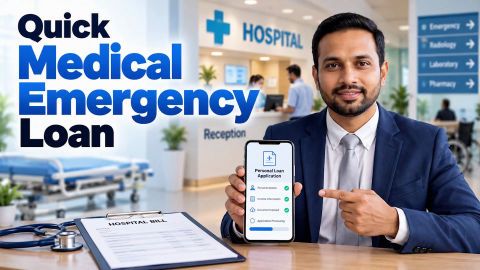
A medical emergency loan covers hospital costs that your savings and health insurance do not. With a Bajaj Finance Insta Personal Loan, funds may be credited within 30 minutes** after approval, for eligible offers.

Rs. 40,000 - Rs. 75 lakh

You may be eligible for a pre-approved offer

Enter mobile and OTP | Check offer | No branch visit needed


In summary

A medical emergency brings 2 money problems at once: a deposit at admission, and a final bill that insurance pays only in part. Cashless claims spare you the full bill, but non-payable items, room rent limits and co-payment still leave a share for you. Knowing these in advance, and having a funding plan, lets you focus on the patient rather than the paperwork.


  • Hospitals ask for a deposit at admission.
  • Cashless claims need pre-authorisation.
  • Insurance excludes consumables and some costs.
  • Room rent above the limit cuts the claim.


Facing a hospital bill? Check your loan offer with your phone number and a one-time password (OTP) → apply online → receive funds within 24 hours* of approval.

What happens at the hospital desk?

In a medical emergency, admission and money arrive together. Expect these steps at the desk, in this order:

  • Admission deposit: Private hospitals ask for an advance at admission, which is adjusted against the final bill. The amount depends on the treatment and room type.
  • Insurance details: If the patient of a medical emergency has health insurance, give the policy number or health card to the hospital's insurance desk, called the TPA desk in most hospitals.
  • Pre-authorisation request: For a cashless claim, the hospital sends the insurer an estimate. The insurer approves an amount, which can be raised later if treatment costs more.
  • Interim bills: For longer stays, the hospital shares running bills, and can ask for more deposit if costs rise past the approved amount.

Keep the patient's ID, the policy document and recent medical records in one folder on your phone for a medical emergency, so the desk does not have to wait for them.

Show More Show Less

How do cashless and reimbursement claims differ?

The route your claim takes decides how much cash you need on the day of a medical emergency:

  • Cashless: At a hospital in the insurer's network, the insurer pays the hospital directly for approved costs. Under IRDAI rules, insurers must decide on cashless authorisation within 1 hour of a request and on final discharge within 3 hours. You pay only what the insurer does not cover.
  • Reimbursement: At a hospital outside the network, you pay the full bill and claim it back with the bills, reports and discharge summary. The money returns after the insurer processes the claim, which can take weeks.

For a medical emergency, choose a network hospital where you can. A reimbursement claim means finding the whole amount first, not only the gap.

Show More Show Less

Why doesn't insurance cover the whole bill?

Even a cashless claim leaves part of the bill unpaid. These are the deductions that catch families out:

  • Non-payable items: Gloves, masks, admission kits and some consumables are excluded by most policies. On a long stay, these add up.
  • Room rent limits: If the room in a medical emergency costs more than the policy allows, the insurer cuts more than the room charge. Related charges, such as doctors' fees, are cut in the same proportion.
  • Co-payment: Some policies, especially for senior citizens, make you pay a fixed share of every claim.
  • Sub-limits: Some policies cap what they pay for specific treatments, such as cataract or knee surgery.


The table shows how these played out on one knee replacement bill.


Hospital bill for a knee replacementAmount (Rs.)
Total hospital bill4,80,000
Paid by insurer (cashless)3,20,000
Non-payable items: consumables, gloves, admission kit38,000
Proportionate deduction for a room above the policy limit72,000
Co-payment of 10% under the policy32,000
Pharmacy and tests outside the bill18,000
Gap paid by the family1,60,000

Last updated: 26th October, 2026


The room rent deduction was the largest single cut. Choosing a room within the policy limit would have saved most of it. Read your policy's room rent clause before a medical emergency, not during one, so you can choose the right room on admission.


Arvind's family bill

Arvind, 44, keeps the books at a Lucknow sugar mill as a salaried chartered accountant. His pay is Rs. 52,000 a month, and he holds a 763 CIBIL score. The knee replacement above was his father's medical emergency. When the insurer's payment left a Rs. 1.6 lakh gap at discharge, he borrowed it at an illustrative 15.75% per annum before weighing a 1-year equated monthly instalment (EMI) against a 2-year one.

EMI = P × R × (1 + R)^N ÷ [(1 + R)^N − 1]. Here P = Rs. 1,60,000, R = 15.75 ÷ 1,200 and N = months.

TenureMonthly EMI (Rs.)Total interest (Rs.)EMI as share of salary (%)
12 months (1 year)14,49813,97627.9
24 months (2 years)7,81527,56015.0

Last updated: 26th October, 2026


The 1-year EMI would take 28% of his salary, too much alongside household costs. Over 2 years, the EMI falls by Rs. 6,683 and interest rises by Rs. 13,584. A processing fee of no more than Rs. 6,608 applies. Arvind chose 24 months, spreading the medical emergency cost over 2 years.


What can delay approval: a CIBIL score below 650 or existing EMIs that take up a large share of your income. Names or addresses that do not match across documents, and more than one loan application in the same month, can also slow it down.

Short of money for a hospital bill? With a Bajaj Finance Personal Loan, you can borrow Rs. 40,000 to Rs. 75 lakh, subject to eligibility. Check your loan offer with your phone number and a one-time password (OTP) → apply online → receive funds within 24 hours* of approval.

Show More Show Less

What should you do in the first 24 hours?

A medical emergency leaves little time to think, so a short order of tasks helps:

  • Get the patient admitted first: Treatment comes before paperwork. Hospitals can start emergency care while the insurance desk works on the claim.
  • Inform the insurer: For a planned stay, insurers ask for notice in advance; for a medical emergency, within a set time after admission, stated in the policy.
  • Ask for the estimate in writing: It shows the room type, expected stay and treatment cost, so you can plan the gap.
  • Check the room against the policy limit: If the only room free is above the limit, ask the hospital to shift the patient when one opens.
  • Line up the gap: Work out what savings, family and credit can cover before discharge, when the bill falls due.
Show More Show Less

How can you prepare before an emergency?

Most of the cost of a medical emergency is decided by choices made long before it:

  • Buy enough cover: A sum insured that matched a treatment 5 years ago may not cover it today. Review the cover as hospital costs rise.
  • Add a super top-up: A super top-up policy pays above a set threshold and costs far less than raising the base cover.
  • Keep an emergency fund: For a medical emergency, 3 to 6 months of expenses in a savings account or liquid fund covers deposits and gaps without borrowing.
  • Know your network hospitals: Note 2 or 3 network hospitals near home, so a cashless claim is possible in a hurry.


Show More

Can a personal loan cover a hospital bill?

Yes. You can pay hospital and treatment costs with a Bajaj Finance Personal Loan, with funds credited to your account within 24 hours* of approval. It ranges from Rs. 40,000 to Rs. 75 lakh over 12 months to 108 months, for Indian nationals aged 21 years to 80 years with a CIBIL score of 650 or higher. Borrow only the gap left after insurance and savings in a medical emergency.

Show More

Key offerings: 3 loan types

Personal loan interest rate and applicable charges

Type of fee

Applicable charges

Rate of interest per annum

10% to 30.5% p.a.

Processing fees

Up to 4.13% of the loan amount (inclusive of applicable taxes).

Flexi Facility Charge

Term Loan – Not applicable

Flexi Loans –Up To Rs 1,999 To Up To Rs 18,999/- (Inclusive Of Applicable Taxes)

Will be deducted upfront from loan amount.

Bounce charges

Rs. 700 to Rs. 1,200/- per bounce

“Bounce charges” shall mean charges for (i) dishonor of any payment instrument; or (ii) non-payment of instalment (s) on their respective due dates due to dishonor of payment mandate or non-registration of the payment mandate or any other reason.

Part-prepayment charges

Full Pre-payment:

  • Term Loan: Up to 4.72% (Inclusive of applicable taxes) on the outstanding loan amount as on the date of full pre-payment

  • Flexi Term (Dropline) Loan: Up to 4.72% (Inclusive of applicable taxes) on the outstanding loan amount, as on the date of full prepayment.

  • Flexi Hybrid Term Loan: Up to 4.72% (Inclusive of applicable taxes) on the outstanding loan amount, as on the date of full prepayment.

Part Pre-payment

  • Up to 4.72% (Inclusive of applicable taxes) of the principal amount of Loan prepaid on the date of such part Pre-Payment.

  • Not Applicable for Flexi Term (Dropline) Loan and Flexi Hybrid Term Loan.

Penal charge

Delay in payment of instalment(s) shall attract Penal Charge at the rate of up to 36% per annum per instalment from the respective due date until the date of receipt of the full instalment(s) amount.

Stamp duty (as per respective state)

Payable as per state laws and deducted upfront from loan amount.

Annual maintenance charges

Term Loan: Not applicable

Flexi Term (Dropline) Loan:

Up to 0.295% (Inclusive of applicable taxes) of the Dropline limit (as per the repayment schedule) on the date of levy of such charges.


Flexi Hybrid Term Loan:

Up to 0.472% (Inclusive Of Applicable Taxes) Of The Dropline Limit During Initial Tenure. Up to 0.295% (Inclusive Of Applicable Taxes) Of Dropline Limit During Subsequent Tenure

Credit guarantee scheme feeUp to 1.18% p.a. (pro-rated daily till 31st March) (inclusive of all applicable taxes) of the loan amount
Credit guarantee scheme renewal feeUp to 1.18% p.a. (inclusive of all applicable taxes) on the outstanding loan amount as on April 01 of the subsequent Financial Year.
*Renewal Fee to be collected only for 3 subsequent financial years.
 
**If the Remaining Tenure is less than 12 months, the CG Fee in subsequent years shall be charged prorated.

Frequently asked questions

Getting funds

Insurance and cost

How fast can I get a medical emergency loan?

For eligible offers, funds may be credited within 30 minutes** after approval, subject to terms and verification. Timing is not guaranteed for every customer. Keep your KYC details and bank account current, and apply as soon as you have the cost estimate, so verification of your medical emergency loan is not held up.

Not always. A pre-assigned limit needs no additional eligibility check for that limit, but some customers may be asked for income proof, KYC documents or bank statements. New customers may need a CIBIL check. Keep these ready, so a medical emergency loan is not delayed while you are at the hospital.

Use health insurance first. Ask the hospital desk to start a cashless claim, or keep every bill for reimbursement. Then use savings, and borrow only the remaining gap. A medical emergency loan costs interest and a processing fee, so use it as the last layer of funding, after insurance and savings.
At an illustrative 16.5% per annum, Rs. 1.2 lakh costs Rs. 10,916 a month over 12 months or Rs. 5,904 over 24 months, with total interest of Rs. 10,993 or Rs. 21,703. The processing fee is up to Rs. 4,956. Your rate depends on your profile, so check the medical emergency loan offer.

Show More Show Less

Disclaimer

Bajaj Finance Limited has the sole and absolute discretion, without assigning any reason to accept or reject any application. Terms and conditions apply*.
For customer support, call Personal Loan IVR: 7757 000 000