













An OTP will be sent to this number for verification

You may have a pre-approved offer
Enter required loan against property amount
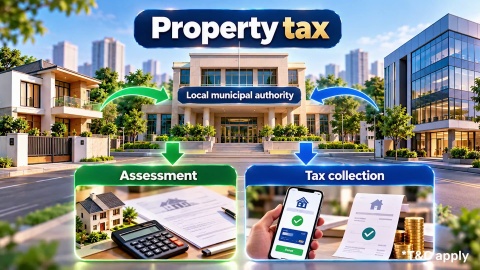
Property tax in your city
In summary
Haryana levies property tax on eligible properties recorded with the relevant municipal authority. Check your property details, assessment record and current tax demand before making a payment.
- The Urban Local Bodies Haryana (ULB Haryana) system provides online property-tax services for properties within applicable municipal areas.
- Property owners can use the relevant Property ID/Unique Property Identification Number (PID) to access property and tax details.
- Property tax is generally assessed based on the applicable property category, location, use and other prescribed factors.
- Taxpayers should check the current demand shown against their property record before making a payment.
- Applicable rebates, penalties and interest may vary depending on the payment period and government notifications.
- A property-tax receipt confirms payment of the assessed tax but does not independently establish ownership of the property.
Use the current demand and property details displayed in the official municipal record while paying property tax in Haryana. If the property information, tax amount or payment status appears incorrect, resolve the discrepancy with the concerned municipal authority before making another payment.
Last updated: October 2026
What is Haryana property tax?
Haryana property tax is a municipal tax on buildings and land within the jurisdiction of Haryana's urban local bodies. The Department of Urban Local Bodies, Haryana provides property-tax services through its online system, including property-tax payment, property searches, No Dues Certificate services and correction-related services. The online system allows users to search property information using details such as Property ID, plot number, owner or occupier name and mobile number. The applicable assessment differs according to the municipal corporation or other urban local body, property category and the rules applicable to the property.
For FY 2026-27, properties within municipal corporation limits are covered by the new property-tax notification issued by the Haryana Urban Local Bodies Department. The department lists this notification as published on 31 July 2026.
What are the Haryana property tax dates for 2026-27?
For Haryana property tax, the applicable payment and rebate dates can vary depending on the local urban local body and government notifications. Property owners should check the latest dates applicable to their property before making a payment.
The key dates for the 2026-27 property tax cycle can be presented as follows:
| Event | 2026-27 date |
|---|---|
| Financial year begins | 1 April 2026 |
| Property tax payment period | From 1 April 2026 |
| Rebate deadline | As notified by the Haryana Government/local urban local body |
| Interest or late-payment charges | As applicable after the prescribed due date |
| Penalty for delayed payment | As applicable under the prevailing property tax rules |
The Haryana Government or the concerned municipal authority may announce extensions, rebates or changes to payment deadlines. Therefore, property owners should verify the latest notification before making a payment.
How is Haryana property tax calculated?
Property tax in Haryana depends on the property details recorded with the relevant local authority rather than a single tax rate applicable to every property.
The property tax calculation may consider information such as:
- Property type and category
- Location and municipal zone
- Year of construction
- Built-up or covered area
- Vacant or open area, where applicable
- Self-occupied area
- Rented or tenanted area
Consider Riya, aged 35, who owns a 1,200 sq. ft. self-occupied residential property in Haryana. Her previous property-tax receipt shows Rs. 18,500, while the current property-tax demand shows Rs. 20,200. The difference is: Rs. 20,200 − Rs. 18,500 = Rs. 1,700
This change may result from updated property details, revised assessment, applicable municipal rates, or other changes recorded in the property-tax assessment.
| Calculation detail | Value |
|---|---|
| Property location | Gurugram, Haryana |
| Built-up area | 1,200 sq. ft. |
| Previous property tax receipt | Rs. 18,500 |
| Current property tax demand | Rs. 20,200 |
| Difference | Rs. 1,700 |
Riya should not assume that the additional Rs. 1,700 is incorrect simply because the previous property tax receipt was lower.
She should compare:
- The assessment year on both records.
- The built-up area recorded as 1,200 sq. ft.
- The property category and applicable assessment details.
- The self-occupied or tenanted status, wherever applicable.
- Any earlier unpaid property tax dues.
- Any interest, penalty or other charges included in the current demand.
If the current property tax assessment details are correct, the latest verified municipal demand should guide her payment. If the property details or assessment information are incorrect, Priya should get the record corrected before relying on the current demand. The decision rule is simple: use the previous receipt for comparison, but use the verified current property record and demand for payment.
How can you pay Haryana property tax online?
The Haryana Urban Local Bodies Department provides an online property-tax system for checking property details, calculating tax and paying property-tax dues. The current portal also provides access to No Dues Certificate-related services and property-data correction functions.
You can follow these steps:
- Visit the official ULB Haryana property-tax portal.
- Use the property search or property-tax service.
- Enter the required Property ID or other available property details.
- Review the property information and tax assessment.
- Check outstanding dues, interest and applicable rebates.
- Proceed with the online payment.
- Save the payment receipt or transaction details for your records.
The current portal also provides a tax calculator based on the new policy dated 30 July 2026.
What if your Haryana property tax payment is wrong?
Check the transaction status before paying again if money has been debited but the property-tax portal does not show a successful payment.
Different issues need different actions:
| Issue | First action |
|---|---|
| Amount debited but payment not updated | Check the online payment status and transaction details |
| Payment awaiting clearance | Check the bank or challan status shown through the property-tax system |
| Duplicate payment | Keep both transaction references and raise a grievance with the concerned municipal authority |
| Incorrect receipt | Raise a payment or receipt-related grievance with the concerned municipality |
| Wrong owner name | Use the municipal property-record correction route with supporting documents |
| Incorrect property details | Compare the tax record with the property documents and request correction if required |
| Unexpected earlier dues | Compare the demand with previous receipts and property-tax assessments |
Consider Rohan, aged 42, who pays Rs. 24,000 online towards his Haryana property tax. His bank account is debited, but the property-tax portal does not immediately show the payment. Rohan should not make another Rs. 24,000 payment immediately.
He should first retain the bank debit confirmation and transaction reference, check the payment status and contact the concerned municipal authority if the transaction remains unresolved.
Paying twice could result in Rs. 48,000 being debited before the original transaction is resolved.
The Haryana property-tax system provides online services for property-tax payments and related property or payment queries. If a payment, receipt or property record shows incorrect information, the taxpayer should use the applicable grievance or correction route provided by the concerned municipal authority.
Does Haryana property tax prove ownership?
A Haryana property-tax receipt records municipal tax payment but does not independently establish legal ownership.
Consider Meera, aged 38, who purchased a residential property in Haryana for Rs. 80 lakh. Her registered sale deed records the transfer in her name, but the municipal property-tax record still carries the previous owner's details. Paying the tax does not replace Meera's registered ownership document. She should also complete the applicable municipal record-update or property-tax record correction process to reflect the current ownership details.
| Record | Main purpose |
|---|---|
| Property-tax receipt | Records municipal tax payment |
| Municipal tax record | Identifies and assesses the property for tax |
| Registered ownership document | Establishes the documented ownership rights |
The distinction matters when you sell, inherit, transfer or use the property for financing.
Can Haryana property tax records affect a loan against property?
Updated Haryana property-tax records can support the documentation trail for a loan against property, but a tax receipt alone does not determine loan eligibility or the sanctioned amount.
A lender reviews the applicant and property through separate checks.
| Assessment area | What may be reviewed |
|---|---|
| Ownership | Property rights and supporting documents |
| Property records | Municipal and property information |
| Legal assessment | Title and legal aspects |
| Technical assessment | Property type, location and condition |
| Valuation | Property value for lending purposes |
| Applicant profile | Income, credit profile and repayment capacity |
Consider Arjun, aged 42, who lives in Haryana, earns Rs. 1.50 lakh per month and has a Credit Information Bureau (India) Limited (CIBIL) Score of 760.
Arjun is considering a Rs. 50 lakh loan against property for a business requirement.
Assume an illustrative interest rate of 10% per annum over 15 years.
The Equated Monthly Instalment (EMI) formula is: EMI = [P × R × (1 + R)^N] ÷ [(1 + R)^N - 1]
Where:
- P = Rs. 50 lakh
- R = 10% ÷ 12 ÷ 100
- N = 180 monthly instalments
The approximate EMI is: Rs. 53,730 per month
If Arjun increases the loan amount to Rs. 60 lakh, while the rate and tenure remain unchanged, the approximate EMI rises to: Rs. 64,476 per month
| Illustrative loan amount | Rate | Tenure | Approximate EMI |
|---|---|---|---|
| Rs. 50 lakh | 10% per annum | 15 years | Rs. 53,730 |
| Rs. 60 lakh | 10% per annum | 15 years | Rs. 64,476 |
The additional Rs. 10 lakh increases the approximate monthly EMI by: Rs. 64,476 - Rs. 53,730 = Rs. 10,746
Arjun's income, CIBIL Score and property records form part of the wider assessment. None of them independently guarantees loan approval.
Frequently Asked Questions
Rebate and late payment
Payment records and dues
Property tax and borrowing
Can you claim the 2026-27 Haryana property tax rebate after 31 May 2026?
The availability and deadline for any Haryana property tax rebate depend on the applicable municipal authority and its notified payment schedule. If the applicable rebate window has closed, do not deduct the rebate from the outstanding amount yourself. Check the current demand displayed against your property before making the payment.
What happens if you pay Haryana property tax late?
Late payment of Haryana property tax may result in applicable interest, penalties or other charges, depending on the municipal authority and prevailing rules. Check the latest demand against your property to determine the amount payable instead of estimating the late-payment charge using an assumed percentage.
Which records should you keep after paying Haryana property tax?
Keep the property-tax receipt, transaction reference and bank payment record with your property documents. If you raise a payment grievance, also retain the acknowledgement or grievance reference. These records can help trace a payment if the portal later shows an incorrect status, an earlier due remains visible, or a duplicate transaction needs to be investigated.
Why do old dues appear on your Haryana property tax demand?
Old dues can appear when unpaid tax, interest, penalties or assessment differences remain linked to the property. Compare the demand with earlier receipts and check the assessment year, property information and occupancy details. If an amount you already paid still appears outstanding, verify the original transaction and use the applicable municipal payment or grievance route.
What should you check before using a Haryana property for borrowing?
Check that the owner's name, property identifier and key property details are consistent across your tax and ownership records. Investigate unexplained dues or mismatches before applying. The lender separately reviews ownership documents, legal and technical aspects, property valuation, income, repayment capacity and credit profile, so a current property-tax receipt does not by itself establish loan eligibility.
Does a higher loan amount increase your EMI?
Yes. If the interest rate and tenure stay unchanged, a higher principal generally increases your EMI. At an illustrative 10% per annum for 15 years, a Rs. 50 lakh loan has an approximate EMI of Rs. 53,730, while Rs. 60 lakh increases it to about Rs. 64,476. The Rs. 10 lakh increase raises the illustrative monthly EMI by about Rs. 10,746.
Loan Against Property for different budget
Check your pre-approved offer now
Loan Against Property for Professionals




Find your nearest branch

What do our customers say about us
customers
Play Store rating
reviews
Anita Das
04 March 2026
The loan against property process was smooth and transparent. Interest rates were competitive, and the documentation requirements were minimal. The team provided clear guidance at every step, making the entire experience hassle-free. Highly recommended for quick approvals and reliable support.
Aashish
04 March 2026
The loan disbursal was quick, and the customer support team handled all my queries with patience and clarity. Flexible EMIs made it easy to manage monthly expenses. Overall, a great experience, especially for salaried individuals seeking a loan against property.
Prakash
04 March 2026
I had a great experience transferring my existing loan against property. The process was quick and hassle-free, and I saved significantly with the lower interest rate. The customer service team was supportive throughout. Highly recommended for anyone considering a balance transfer.
Yogesh Singh
04 March 2026
Clear guidance, quick approval, and flexible repayment options made purchasing my new house much easier than expected. The team managed the entire process professionally and ensured smooth coordination at every stage. Overall, a very satisfying experience, and I would recommend their home loan services to others.
Related articles


Watch our videos

Know the tax benefits on your loan against property

What are the documents required for a Loan Against Property?

What are the types of property eligible for Loan Against Property

What is the eligibility criteria for a Loan Against Property
Bajaj Finance app for all your financial needs and goals
Trusted by 50 million+ customers in India, Bajaj Finance App is a one-stop solution for all your financial needs and goals.
You can use the Bajaj Finance App to:
- Apply for loans online, such as Instant Personal Loan, Home Loan, Business Loan, Gold Loan, and more.
- Invest in fixed deposits and mutual funds on the app.
- Choose from multiple insurance for your health, motor and even pocket insurance, from various insurance providers.
- Pay and manage your bills and recharges using the BBPS platform. Use Bajaj Pay and Bajaj Wallet for quick and simple money transfers and transactions.
- Apply for Insta EMI Card and get a pre-qualified limit on the app. Explore over 1 million products on the app that can be purchased from a partner store on Easy EMIs.
- Shop from over 100+ brand partners that offer a diverse range of products and services.
- Use specialised tools like EMI calculators, SIP Calculators
- Check your credit score, download loan statements and even get quick customer support—all on the app.
Download the Bajaj Finance App today and experience the convenience of managing your finances on one app.
Disclaimer
1. Bajaj Finance Limited (“BFL”) is a Non-Banking Finance Company (NBFC) and Prepaid Payment Instrument Issuer offering financial services viz., loans, deposits, Bajaj Pay Wallet, Bajaj Pay UPI, bill payments and third-party wealth management products. The details mentioned in the respective product/ service document shall prevail in case of any inconsistency with respect to the information referring to BFL products and services on this page.
2. All other information, such as, the images, facts, statistics etc. (“information”) that are in addition to the details mentioned in the BFL’s product/ service document and which are being displayed on this page only depicts the summary of the information sourced from the public domain. The said information is neither owned by BFL nor it is to the exclusive knowledge of BFL. There may be inadvertent inaccuracies or typographical errors or delays in updating the said information. Hence, users are advised to independently exercise diligence by verifying complete information, including by consulting experts, if any. Users shall be the sole owner of the decision taken, if any, about suitability of the same.