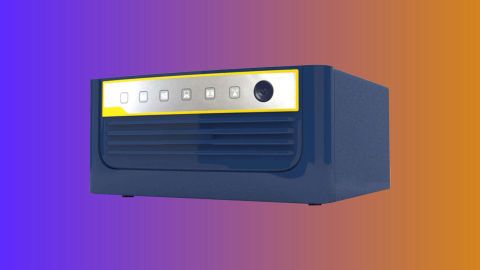
An inverter is a power backup device that converts 12V or 24V DC power stored in a battery into 230V AC power for running household appliances during a power cut. A home inverter can support lights, fans, TVs, routers, and other compatible appliances, depending on its VA capacity and battery size. UPS inverter systems can also provide backup power with a quick changeover when the mains supply fails.
How does an inverter work?
When grid power is available, the inverter charges the connected battery. During an outage, it draws DC power from the battery, converts it into usable 230V AC power, and supplies electricity to the connected appliances until mains power returns or the battery runs low.
If you are looking for a new inverter, visit any of Bajaj Finance's 1.5 lakh partner stores — like Vijay Sales, Croma, Reliance Digital, and more — across 4,000 cities, including Tier 2 cities like Jaipur, Lucknow, Kochi, Bhopal, and more in India. Choose your preferred model, then use the Bajaj Finance Insta EMI Card or Bajaj Finance Easy EMI Loan to finance it. Convert the cost into Easy EMIs that suit your monthly budget and enjoy zero down payment on select models — take it home without any upfront payment. Check your loan eligibility online in minutes so you know exactly what you can get before you step into the store.
Also read: Benefit of 10kVA off grid solar inverter
What are the different types of inverters?
The five common types of inverters are pure sine wave, modified sine wave, square wave, solar, and lithium-ion inverters, each differing in power output, appliance compatibility, battery setup, and price.
Type
| How it works
| Output quality
| Best for
| Price range
|
Pure sine wave inverter
| Produces smooth AC power similar to grid supply
| Clean, stable waveform
| TVs, refrigerators, fans, computers
| Rs. 4,000–Rs. 15,000
|
Modified sine wave inverter
| Produces stepped AC output
| Less smooth than pure sine wave
| Lights, fans, basic appliances
| Rs. 2,500–Rs. 8,000
|
Square wave inverter
| Produces basic square-wave AC output
| Basic output with limited compatibility
| Simple resistive loads
| Rs. 2,500–Rs. 5,000
|
Solar inverter
| Converts solar-panel DC power into usable AC
| Varies by inverter technology
| Homes with rooftop solar systems
| Rs. 6,000–Rs. 25,000
|
Lithium-ion inverter
| Uses an integrated or compatible lithium-ion battery
| Clean output on compatible models
| Compact home power backup
| Rs. 15,000–Rs. 50,000
|
Disclaimer: Each model's features, availability, and pricing are subject to change and may vary. For the most accurate and up-to-date information, please visit the official website.
Also read: Types of inverters
Key features and specifications of home inverters
The three most important home inverter specifications to check are VA capacity, efficiency, and battery voltage, as these determine the supported load, power conversion, and backup setup.
Feature
| Spec to look for
| Why it matters
|
VA capacity
| 600VA–5000VA
| Determines how much appliance load the inverter can support
|
Efficiency
| Around 85–95%, model-dependent
| Higher efficiency reduces power lost during DC-to-AC conversion
|
Battery voltage
| 12V, 24V, or 48V
| Determines the required battery configuration
|
Input voltage range
| Around 90V–280V in wide-input models
| Helps the inverter operate during voltage fluctuations
|
Backup duration
| Around 3–10 hours
| Depends on battery capacity and connected load
|
Output
| 230V AC, 50Hz
| Matches standard household appliance requirements
|
Compare these specifications with your total appliance load and required backup time before choosing a home inverter.
Benefits of home inverters
- Uninterrupted power supply: Provides backup during power outages, ensuring continuous power.
- Energy efficiency: Converts stored battery power efficiently for home use.
- Protects devices: Safeguards electronics from power surges and fluctuations.
- Eco-friendly: Reduces reliance on diesel generators, promoting cleaner energy use.
- Cost-effective: Lowers electricity bills by optimizing energy usage.
Also read: Home inverters
Choose the best inverters for home and offices
To ensure a seamless power supply, here are some essential tips for choosing the right inverter for your home or office.
Determine the total power load by calculating the wattage of all the appliances you plan to connect to the inverter.
Choose the appropriate inverter type for your needs. A pure sine wave inverter is ideal for sensitive electronics like laptops and televisions, while a modified sine wave inverter works well for simpler devices.
Check the inverter's capacity and efficiency to ensure it can handle your power requirements.
Look for an inverter that offers smart features such as an LCD display and app-based monitoring, which provide you with real-time updates and control.
Consider the battery compatibility to ensure that the inverter works perfectly with the battery you choose, providing reliable and long-lasting performance.
Top inverters for home in India
For everyday home backup, the Luminous EVO S 1250 offers 1100VA pure sine wave output at Rs. 7,999, while higher-capacity, solar-hybrid, and lithium-ion models cater to heavier loads and specialised backup needs.
Model
| VA capacity
| Waveform/type
| Battery setup
| Price
| Best for
|
Luminous EVO S 1250
| 1100VA
| Pure sine wave
| 1 × 12V battery
| Rs. 7,999
| Everyday home backup
|
Luminous Zolt 1100
| 900VA
| Pure sine wave
| 1 × 12V battery
| Rs. 8,199
| Lights, fans, TV, and electronics
|
Luminous Zelio+ 1700
| 1500VA
| Pure sine wave
| 2 × 12V batteries
| Rs. 8,735
| Higher household loads
|
Luminous Shakti Charge Neo 1450 Pro
| 1100VA
| Square wave
| 1 × 12V battery
| Rs. 6,971
| Frequent power cuts
|
Luminous Solar Hybrid TX 3.75kVA
| 3750VA
| Pure sine wave, solar hybrid
| Multi-battery setup
| Rs. 49,299
| Solar-powered home backup
|
Luminous Li-On 1250
| 1100VA
| Pure sine wave, lithium-ion
| Built-in 1280Wh Li-ion battery
| Rs. 39,999
| Compact, low-maintenance backup
|
The Luminous Zelio+ 1700 supports two batteries, which can provide greater backup capacity but also increases the battery investment. Compare the connected load, battery capacity, waveform, and required backup duration before choosing an inverter.
Also explore: V-Guard inverters and Luminous inverters
Price list of inverters in India
Inverter prices in this list start at Rs. 5,599 for the Luminous NXG 850e 500VA solar inverter, with home and solar options available across different capacities and backup requirements.
Model
| Type
| VA capacity
| Approx. price
| Best for
|
Luminous NXG 850e
| Solar, pure sine wave
| 500VA
| Rs. 5,599
| Basic solar backup
|
Luminous Eco Volt Neo 1050
| Pure sine wave
| 900VA
| Rs. 6,199
| Everyday home backup
|
Luminous EVO S 1050
| Pure sine wave
| 900VA
| Rs. 6,899
| Homes and small offices
|
Luminous NXG 1150e
| Solar, pure sine wave
| 850VA
| Rs. 7,199
| Small solar setups
|
Luminous NXG 1450e
| Solar, pure sine wave
| 1100VA
| Rs. 8,699
| Higher solar backup loads
|
Luminous Zelio+ 1700
| Sine wave
| 1500VA
| Rs. 8,735
| Higher household loads
|
Luminous NXG 1850e
| Solar, pure sine wave
| 1500VA
| Rs. 10,199
| Larger solar backup needs
|
Disclaimer: Each model's features, availability, and pricing are subject to change and may vary. For the most accurate and up-to-date information, please visit the official website.
Before you decide, explore the latest offers. You may find a great deal on a model that matches your needs.
Factors to consider before buying an inverter
Before buying an inverter, calculate your appliance load, required backup time, VA capacity, battery size, and waveform type so the system can handle your household needs without unnecessary overspending.
Factor
| What to check
|
VA capacity
| Around 600VA–5000VA, depending on the total connected load
|
Efficiency
| Around 85–95% on applicable models
|
Waveform
| Pure sine wave for TVs, computers, refrigerators, and other sensitive electronics
|
Battery capacity
| Match the Ah rating and voltage to your required backup duration
|
Backup load
| Add the wattage of appliances running together and allow around 20–25% headroom
|
Trade-off: A higher VA capacity supports more load but may require a larger, more expensive battery setup, so plan the inverter and battery together.
How to find the right UPS inverter for home?
Choose a UPS when computers or sensitive electronics need near-instant backup, while a home inverter is more suitable for running lights, fans, TVs, and other appliances for several hours.
Factor
| UPS
| Inverter
|
Switchover time
| Less than 10ms
| Around 10–500ms
|
Backup duration
| Around 15–30 minutes
| Around 3–10 hours
|
Best for
| Computers, routers, CCTV, sensitive electronics
| Lights, fans, TVs, and home appliances
|
Typical price range
| Rs. 2,000–Rs. 15,000
| Rs. 5,000–Rs. 15,000, excluding battery
|
For home use, choose based on whether you need uninterrupted power for sensitive devices or longer backup for multiple household appliances.
Top inverter brands for home in India
Luminous is a widely available home inverter brand in India, with 600VA to higher-capacity models across square wave, pure sine wave, and solar ranges. Other established inverter brands in India include Microtek, V-Guard, Livguard, Amaron, Exide, and Genus.
Brand
| Known for
| Approx. price range
|
Luminous
| Pure sine wave, square wave, and solar options
| Rs. 5,099–Rs. 20,549
|
Microtek
| Pure sine wave and higher-capacity options
| Rs. 4,150–Rs. 52,990
|
V-Guard
| Pure sine wave and smart inverter models
| Rs. 6,079–Rs. 8,599
|
Livguard
| Sine wave, square wave, and AI charging models
| Rs. 4,593–Rs. 9,079
|
Amaron
| Sine wave models and battery compatibility
| Rs. 6,200–Rs. 10,500
|
Exide
| Home UPS and pure sine wave options
| Rs. 6,948–Rs. 22,296
|
Genus
| Pure sine wave and solar inverter ranges
| Rs. 5,999–Rs. 35,555
|
The best inverter for home depends on your appliance load, required backup time, waveform, VA capacity, and battery setup, so compare individual models rather than choosing by brand alone.
Best inverters with different price ranges
- Budget-friendly: Luminous Zelio 1100 – An affordable option with 900W output, perfect for basic home needs.
- Mid-range: Microtek UPS 24A – Offers a good balance of performance and features, suitable for running multiple appliances.
- Premium: Sukam Solar Inverter 3kW – Ideal for solar setups, providing high efficiency and reliability for larger homes.
- High-end: Amara Raja 1500VA – Offers advanced technology and exceptional performance for power-hungry households.
Why you need a home inverter
A home inverter keeps essential appliances running during power cuts, making it useful in areas with frequent or longer electricity outages.
- Longer backup: A suitable inverter and battery combination can provide around 3–10 hours of backup, depending on the connected load.
- Efficient power conversion: Home inverter efficiency can reach around 85–95% on applicable models, reducing energy lost during conversion.
- Supports daily essentials: A 900VA inverter can handle basic loads such as lights, fans, a TV, and a router within its rated capacity.
- Solar compatibility: A solar inverter can use rooftop solar power, potentially reducing grid electricity consumption and associated bills depending on system size and usage.
Choosing the right VA capacity and battery size helps you get reliable backup without paying for more capacity than your home needs.
What are my financing options to buy an inverter?
Bajaj Finance offers two ways to convert your inverter purchase into affordable monthly payments. Both options are available at over 1.5 lakh partner stores across 4,000 cities in India. Here is a comparison of both options to help you choose the right one before visiting a partner store:
Option
| Limit
| Key features
|
Bajaj Finance Insta EMI Card
| Pre-approved card limit up to Rs. 6 lakh
| 3 to 60 months; works at 1.5 lakh partner outlets; 1 million eligible products
|
Bajaj Finance Easy EMI Loan
| Loan limit up to Rs. 5 lakh
| Quick loan approval; 3 to 60 months; basic KYC documents needed; ideal for higher-value purchases
|
How to choose? Both options require you to be physically present at a partner store. The Insta EMI Card is ideal for shoppers who want to purchase across multiple categories over time — and carries zero annual fee. The Easy EMI Loan suits buyers looking to finance a higher-value inverter.
With over 1.5 lakh partner stores across 4,000 cities, Bajaj Finance's network means you can finance this purchase whether you are in a metro or a Tier 2 city like Lucknow or Coimbatore.
How do I buy an inverter on EMI at a Bajaj Finance partner store?
Buying a new inverter is simple with Bajaj Finance’s in-store financing options. The process usually takes around 10–15 minutes once you are at the partner store.
- Browse inverters on Bajaj Mall: Explore inverter models and compare VA capacity, waveform type, battery compatibility, efficiency, and expected backup time based on your household power needs.
- Find a partner store near you: Use the Bajaj Finance store locator to find a nearby partner outlet such as Croma, Vijay Sales, or Reliance Digital.
- Check the inverter in person: Confirm the VA capacity, battery voltage, waveform, supported load, and battery requirements. Ask the store executive which setup can support the appliances you plan to run during a power cut.
- Choose a suitable EMI option: At checkout, ask about the Bajaj Finance Insta EMI Card or Easy EMI Loan. Confirm the available tenure and whether your chosen inverter is available with a zero down payment offer.
- Complete the purchase: Once approved, complete the payment and arrange delivery or installation of your inverter and battery setup, where applicable.
You can also check your loan eligibility online in advance by entering your mobile number and OTP, helping you plan your purchase better before visiting a partner store.
Why use the Smart Savings Calculator
Bajaj Finance’s Smart Savings Calculator helps you unlock maximum savings every time you shop at partner stores. It brings together all available brand, dealer, and scheme offers—so you can see your total savings instantly and shop smarter with Easy EMIs.
- Dealer offers - Grab exclusive in-store deals at over 1.5 lakh partner stores across India. Enjoy local discounts and special prices you will not find online.
- Brand offers - Access limited-time discounts from top brands across electronics, appliances, and more. Discover brand-specific savings selected just for you.
- Bajaj offers - Unlock exclusive Bajaj Finance deals on popular products—available only to our customers. More rewards, more value.
- Scheme offers - Take advantage of time-sensitive offers on select EMI schemes. Get extra benefits after paying just 3 EMIs—visible during EMI selection at checkout.
Calculate your extra savings today!