











An OTP will be sent to this number for verification

You may have a pre-approved offer
Enter required home loan amount
In summary
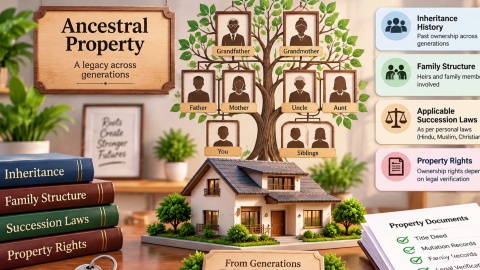
All You Need to Know About Ancestral Property Laws in India
Last updated: Sept 2026
The word "ancestral" gets applied loosely to any inherited family property in casual conversation, but the legal definition is genuinely narrower and carries specific consequences for who can claim a share.
- Legal definition: property inherited undivided through four generations of male lineage, under Hindu law specifically
- Right by birth: a coparcener's claim exists automatically, not granted by the current holder's discretion
- Distinct from self-acquired property: property a person bought or earned themselves, which they can dispose of freely
- The Hindu Succession (Amendment) Act, 2005 gave daughters equal coparcenary rights, matching sons
Not every inherited property qualifies as "ancestral" in the strict legal sense — a father's self-acquired property inherited by a son is not automatically ancestral for the son's own children
Confirm whether a specific property genuinely meets the legal definition of ancestral property before assuming automatic claim rights apply.
Does inheriting property from my father automatically make it ancestral?
Not necessarily, and this is the most common misunderstanding in this area. If your father inherited the property from his own father (undivided, through the male line), it remains ancestral in your hands too. If your father bought or earned the property himself, it's his self-acquired property — even after you inherit it, it becomes your self-acquired property, not ancestral, for the purposes of your own children's claims.
The realistic categories a piece of family property might fall into are:
- Genuinely ancestral: passed undivided through four generations of male lineage, carrying coparcenary rights
- Inherited but not ancestral: self-acquired property of a parent or grandparent that passed to you through inheritance or a Will
Self-acquired: property you or a family member bought, built, or earned independently
The distinction matters directly for who has an automatic claim — ancestral property carries coparcenary rights by birth; inherited-but-not-ancestral property is subject to the previous owner's Will or standard succession rules instead.
Show more
Show less
Who counts as a coparcener with automatic rights?
| Relationship | Coparcener status |
|---|---|
| Sons | Yes, by birth |
| Daughters (post-2005 amendment) | Yes, equal to sons, by birth |
| Grandsons/ granddaughters (through a predeceased coparcener) | Yes, in specific succession scenarios |
| Wife | No — a wife is not a coparcener, though she has other rights (maintenance, residence) |
| Great-grandchildren (beyond the fourth generation from the common ancestor) | Depends on the specific generational count from the property's origin |
The 2005 amendment specifically changed daughters' status — before this, only sons held coparcenary rights by birth, with daughters having more limited claims. This retroactive equalisation is one of the most significant modern changes to this area of law.
Show more
Show less
How do I determine if a specific property is legally ancestral?
- Trace the property's ownership history — was it acquired by an ancestor, or inherited undivided across generations without ever being partitioned?
- Confirm it passed through the male line without an intervening self-acquisition or independent purchase breaking the chain.
- Check whether any partition has already occurred — once formally partitioned, a coparcener's share becomes their separate, self-acquired property going forward.
Where the history is unclear or disputed, consult a property lawyer to review the specific title chain and documentation.
Family property with a genuinely unclear or disputed history is common enough that professional legal review, rather than assumption based on family stories alone, is often the only reliable way to confirm ancestral status.
Show more
Show less
A worked example: resolving a coparcenary claim
Consider Sunita, a 42-year-old shop owner with a household income of Rs. 1.3 lakh a month and a CIBIL Score of 751, whose brothers assumed she had no claim to their grandfather's undivided property following their father's passing.
| Step | What Sunita did |
|---|---|
| Confirmed the property's history | Verified it passed undivided from grandfather to father, qualifying as genuinely ancestral |
| Confirmed her coparcener status | Established her equal right under the 2005 amendment, regardless of her brothers' assumption |
| Consulted a lawyer | Formalised her claim to an equal share alongside her brothers |
| Resolution | Family agreed to a formal partition, with Sunita receiving her legally entitled share |
Sunita's brothers' initial assumption — that daughters didn't have equal claim — reflected outdated understanding rather than current law, which her lawyer helped clarify and formally resolve.
Show more
Show less
Home loan for professionals
Why clear ancestral property status matters for a home loan
| Loan feature | Detail |
|---|---|
| Interest rate | From 7.25% p.a.* |
| Loan amount | Up to Rs. 15 Crore* |
| Tenure | Up to 32 years |
Bajaj Finance requires clear, undisputed title before disbursing a home loan against any property, including confirming all coparceners' consent where a property carries ancestral status. Check your home loan eligibility once your property's ownership status is clearly resolved.
Show more
Show less
Frequently Asked Questions
Understanding coparcenary rights
Resolving a claim
Can a father sell ancestral property without his children's consent?
Not entirely freely — since children have a coparcenary right by birth, a father's ability to sell ancestral property without consent is more limited than for self-acquired property, though specific circumstances (legal necessity, for instance) can permit certain transactions. Consult a property lawyer for the specific rules applicable to your situation.
Do daughters born before the 2005 amendment also get coparcenary rights?
Yes — the Supreme Court has clarified that the 2005 amendment's coparcenary rights apply to daughters regardless of their birth date, provided the father was alive when the amendment came into force, as established through subsequent judicial interpretation.
What's the difference between a coparcener's right and a Will overriding that right?
A coparcener's right in genuinely ancestral property exists by birth and cannot be overridden by a Will covering that specific ancestral share in most cases, since the current holder doesn't have full independent ownership of a share that legally belongs to coparceners by right. Self-acquired property, by contrast, can be freely willed away.
How is a formal partition of ancestral property carried out?
Through mutual agreement among coparceners (a partition deed, registered), or through a court partition suit if agreement can't be reached. Once formally partitioned, each coparcener's share becomes their own separate, self-acquired property going forward.
Home Loan in Different Cities

Home Loan in Mumbai

Home Loan in Ahmedabad

Home Loan in Bangalore

Home Loan in Chennai

Home Loan in Delhi

Home Loan in Hyderabad

Home Loan in Cochin

Home Loan in Noida

Home Loan in Pune
Home Loan for different budget
Check your pre-approved offer now
Our Calculators






What do our customers say about us
customers
Play Store rating
reviews
Amit Shiva
Reviewed on
Smooth and transparent home loan process. The interest rates were competitive, and documentation was minimal. The team guided me clearly at every step, making my first home purchase stress-free. Highly recommended for quick approvals.
Sandeep Kulkarni
Reviewed on
The loan disbursal was fast, and the customer support team was extremely patient with all my queries. Flexible EMIs helped me manage my monthly expenses easily. A great experience for salaried homebuyers.
Ritika Agarwal
Reviewed on
I had a great experience while transferring my existing home loan. The process was quick, and I saved significantly with the lower interest rate. Customer service was helpful throughout. Highly recommended for balance transfers.
Manoj Verghese
Reviewed on
Clear guidance, quick approval, and flexible repayment options made buying my new house easier than expected. The team handled everything professionally. Very satisfied and would definitely recommend their home loans
Find your nearest branch

More Articles




Watch our videos

Documents required to get a Bajaj Finserv Home Loan

Tips to increase your Home Loan eligibility

Things you need to know about pre-approved home loan

Things you need to know before applying for a Home Loan

How does Repo Rate affect your Home Loan

Download App
Now request money from your friends and family and make instant payments.

- Choose from personal, business, gold loans and more
- Pay utility bills, use UPI, get FASTag and more
- Buy over 1 million products on No Cost EMI
- Buy stocks, mutual funds and invest in FD
Disclaimer
1. Bajaj Finance Limited (“BFL”) is a Non-Banking Finance Company (NBFC) and Prepaid Payment Instrument Issuer offering financial services viz., loans, deposits, Bajaj Pay Wallet, Bajaj Pay UPI, bill payments and third-party wealth management products. The details mentioned in the respective product/ service document shall prevail in case of any inconsistency with respect to the information referring to BFL products and services on this page.
2. All other information, such as, the images, facts, statistics etc. (“information”) that are in addition to the details mentioned in the BFL’s product/ service document and which are being displayed on this page only depicts the summary of the information sourced from the public domain. The said information is neither owned by BFL nor it is to the exclusive knowledge of BFL. There may be inadvertent inaccuracies or typographical errors or delays in updating the said information. Hence, users are advised to independently exercise diligence by verifying complete information, including by consulting experts, if any. Users shall be the sole owner of the decision taken, if any, about suitability of the same.