













An OTP will be sent to this number for verification

You may have a pre-approved offer
Enter required loan against property amount
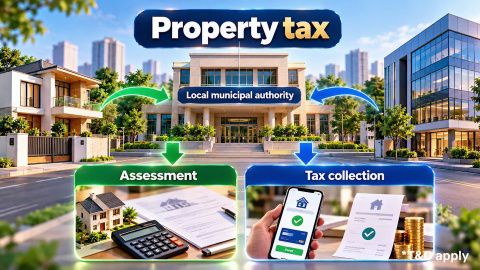
Property tax in your city
In summary
Ludhiana property tax is an annual municipal tax payable on eligible properties within the city. Check the property details and current demand on the Municipal Corporation Ludhiana portal before making a payment.
- The Municipal Corporation Ludhiana manages property-tax assessment and collection.
- The 2026-27 financial-year tax could be paid with a 10% rebate until 30 September 2026.
- The current MCL portal states that payment by 31 December 2026 avoids penalty and interest.
- Property owners can file a Property Tax Return (PTR), self-assess their property and calculate tax online.
- The portal supports credit cards, debit cards and net banking; payment is also available through zonal Suwidha centres.
- The municipal system requires taxpayers to map their UID number with the Property Tax Return to access services using a single UID.
- A property-tax receipt records tax payment but does not independently establish legal ownership.
Use the current demand shown against your property record. If the property details, tax amount or payment status appear incorrect, resolve the mismatch before making another payment.
Show More
Show Less
What is Ludhiana property tax?
Ludhiana property tax is an annual municipal tax levied on eligible properties within the jurisdiction of the Municipal Corporation Ludhiana.
The MCL property-tax system allows property owners to file a Property Tax Return, self-assess their properties, calculate the tax, print a statement or challan and pay outstanding dues. The municipal record contains property and assessment details used to determine the tax payable.
Property-tax payment keeps the municipal tax account current. Legal ownership, however, depends on title and registered ownership documents rather than the tax receipt alone.
Source: Municipal Corporation Ludhiana Property Tax Portal
Show More
Show Less
What are the Ludhiana property tax dates for 2026-27?
The Municipal Corporation Ludhiana offered a 10% rebate on property tax for 2026-27 if the payment was made by 30 September 2026. The current MCL property-tax portal states that property owners should pay the tax by 31 December 2026 to avoid penalty and interest.
| Event | 2026-27 date |
| Financial year begins | 1 April 2026 |
| 10% rebate deadline | 30 September 2026 |
| Payment without penalty and interest, as stated on the current portal | 31 December 2026 |
| Financial year ends | 31 March 2027 |
The 10% rebate applied to payments made within the permitted period. If you are paying now, use the current demand shown against your property rather than manually deducting the expired rebate. According to reports on the Municipal Corporation's payment instructions, payments made from 1 October to 31 December do not attract a penalty. A 10% penalty is reported for payments made from 1 January to 31 March. If the current financial year's tax remains unpaid after 31 March, the reported penalty increases to 20%, along with 18% annual interest.
How is Ludhiana property tax calculated?
Ludhiana property tax is calculated using the property information submitted during self-assessment. The MCL portal states that the taxpayer is responsible for entering accurate details relevant to the calculation of the property's Annual Value and selecting the applicable tax rate.
The assessment may consider:
- Covered area
- Property category
- Property type and use
- Occupancy status
- Age of the property
- Applicable rebate or exemption
- Applicable tax rate
The portal provides an online tax calculator. The amount is calculated according to the property assessment and the details selected by the taxpayer.
Consider Gurpreet, aged 40, who owns a residential property in Ludhiana.His previous property-tax receipt shows Rs. 8,500, while the current portal displays a demand of Rs. 9,200. The difference is: Rs. 9,200 - Rs. 8,500 = Rs. 700
| Calculation detail | Value |
| Property location | Ludhiana |
| Property category | Residential |
| Previous tax receipt | Rs. 8,500 |
| Current portal demand | Rs. 9,200 |
| Difference | Rs. 700 |
Gurpreet should not assume that the additional Rs. 700 is incorrect simply because the previous receipt showed a lower amount.
He should compare:
- The assessment year on both records.
- The covered area entered in the current assessment.
- The property category and type.
- The use and occupancy status.
- The age of the property.
- Any applicable rebate, exemption or outstanding dues.
If the current property details are correct, the verified municipal demand should guide his payment.
If the property information itself is incorrect, Gurpreet should use the MCL correction service or contact the relevant zonal office before relying on the demand. The decision rule is simple: use an old receipt for comparison, but use the verified current property record for payment.
How do you pay Ludhiana property tax online?
You can check the current Ludhiana property-tax demand and complete payment through the Municipal Corporation Ludhiana's online property-tax system.
Follow these steps:
- Open the MCL Property Tax Portal.
- Select the option to log in or register.
- Enter the requested property and taxpayer details.
- Complete the Property Tax Return and self-assessment, where required.
- Check the property details and calculated tax demand.
- Review any outstanding dues or applicable charges.
- Select an available payment method.
- Complete the transaction.
- Save the payment receipt or challan and transaction reference.
The MCL portal supports payment through credit cards, debit cards and net banking. You can also pay through a zonal Suwidha centre.
After payment, check that the transaction appears against the correct property. Keep the receipt and transaction reference with your property records.
Show More
Show Less
What do UID and PTR mean for Ludhiana property tax?
A Unique Identification (UID) number is used to link a taxpayer's details with the Property Tax Return. The Municipal Corporation Ludhiana instructs taxpayers to map their UID number with the PTR to access different services using a single UID. A Property Tax Return (PTR) records the property and assessment information submitted for municipal tax purposes.
You may encounter the following details while using the MCL property-tax system:
| Identifier or record | What it relates to |
| UID number | Taxpayer identification mapped with the Property Tax Return |
| Property Tax Return (PTR) | Property and assessment information submitted for tax purposes |
| Property details | Information such as covered area, category, type, use and occupancy |
| Property Tax Statement | Statement showing the assessed tax amount |
| Challan | Payment document generated for the property-tax transaction |
| Previous tax receipt | Record of an earlier property-tax payment |
Older property-tax receipts and assessment records can help you locate the details associated with your property. Use the identifier requested by the MCL portal rather than substituting another property or ownership reference number.
What if your Ludhiana property tax payment is wrong?
Check the transaction status before paying again if money has been debited but the MCL property-tax portal does not show a successful payment.
Different issues need different actions:
| Issue | First action |
| Amount debited but payment not updated | Check the transaction status and retain the bank reference |
| Payment awaiting confirmation | Check the payment status before attempting another transaction |
| Duplicate payment | Keep both transaction references and contact MCL about the excess payment |
| Incorrect receipt | Contact the municipal corporation with the receipt and payment details |
| Wrong owner name | Use the municipal correction service with supporting documents |
| Incorrect property details | Compare the assessment with the relevant property documents |
| Unexpected earlier dues | Compare the current demand with previous receipts and assessment records |
Consider Harpreet, aged 42, who pays Rs. 18,000 online. His bank account is debited, but the property-tax portal does not immediately show the payment.
Harpreet should not make another Rs. 18,000 payment immediately.
He should first retain the bank debit and transaction reference, check the payment status and contact the Municipal Corporation Ludhiana if the transaction remains unresolved. Paying twice could result in Rs. 36,000 being debited before the original transaction is resolved.
Does Ludhiana property tax prove ownership?
A Ludhiana property-tax receipt records municipal tax payment but does not independently establish legal ownership.
Consider Meera, aged 38, who purchases a property in Ludhiana. Her registered sale deed records the transfer in her name, but the municipal property-tax record still carries the previous owner's details. Paying the tax does not replace Meera's registered ownership document. She should also use the MCL ownership-change or property-record correction service to update the municipal record, where applicable.
| Record | Main purpose |
| Property-tax receipt | Records municipal tax payment |
| Property Tax Return | Records property and assessment details submitted to the municipal corporation |
| Municipal property record | Identifies and assesses the property for municipal tax |
| Registered sale deed | Records the registered transfer of property ownership |
| Conveyance deed | Records the transfer of title, where applicable |
| Encumbrance Certificate | Shows registered transactions or encumbrances recorded against the property for the period covered |
The distinction matters when you sell, inherit, transfer or use the property for financing.
Can Ludhiana property tax records affect a loan against property?
Updated Ludhiana property-tax records can support the documentation trail for a loan against property, but a tax receipt alone does not determine loan eligibility or the sanctioned amount. A lender reviews the applicant and property through separate checks.
| Assessment area | What may be reviewed |
| Ownership | Property rights and supporting documents |
| Property records | Municipal assessment and property information |
| Legal assessment | Title and legal aspects |
| Technical assessment | Property type, location and condition |
| Valuation | Property value for lending purposes |
| Applicant profile | Income, credit profile and repayment capacity |
Consider Arjun, aged 42, who lives in Ludhiana, earns Rs. 1.50 lakh per month and has a Credit Information Bureau (India) Limited (CIBIL) Score of 760.
Arjun is considering a Rs. 50 lakh loan against property for a business requirement.
Assume an illustrative interest rate of 10% per annum over 15 years.
The Equated Monthly Instalment (EMI) formula is: EMI = [P × R × (1 + R)^N] ÷ [(1 + R)^N - 1]
Where:
- P = Rs. 50 lakh
- R = 10% ÷ 12 ÷ 100
- N = 180 monthly instalments
The approximate EMI is: Rs. 53,730 per month
If Arjun increases the loan amount to Rs. 60 lakh, while the rate and tenure remain unchanged, the approximate EMI rises to Rs. 64,476 per month.
| Illustrative loan amount | Rate | Tenure | Approximate EMI |
| Rs. 50 lakh | 10% per annum | 15 years | Rs. 53,730 |
| Rs. 60 lakh | 10% per annum | 15 years | Rs. 64,476 |
The additional Rs. 10 lakh increases the approximate monthly EMI by: Rs. 64,476 - Rs. 53,730 = Rs. 10,746
Arjun's income, CIBIL Score and property records form part of the wider assessment. None of them independently guarantees loan approval.
Bajaj Finance offers Loan Against Property amounts of up to ₹15.50 crore with repayment tenure of up to 15 years, subject to eligibility and property assessment. Bajaj Finance loan against property interest rates currently range from 7.5% per annum to 14.25% per annum.
Borrow according to the amount you need and the EMI you can manage rather than selecting the maximum available amount.
You can compare loan against property interest rates and use a loan against property EMI calculator to test different loan amounts, rates and repayment tenures. Planning to use your property for financing? Check eligibility for a loan against property with Bajaj Finance.
Frequently Asked Questions
Rebate and late payment
Payment records and dues
Property tax and borrowing
Can you claim the 2026-27 Ludhiana property tax rebate after 30 September 2026?
No. The 10% rebate deadline for Ludhiana property tax in 2026-27 was 30 September 2026. If you are paying after this date, check the current amount shown against your property instead of deducting 10% from the demand.
What happens if you pay Ludhiana property tax late?
No penalty applies to payments made between 1 October and 31 December 2026. A 10% penalty applies from 1 January to 31 March 2027. If the tax remains unpaid after 31 March 2027, the penalty increases to 20%, with 18% annual interest.
Is there a rebate on Ludhiana property tax?
The Municipal Corporation offered a 10% rebate for 2026-27 on payments made by 30 September 2026. Other exemptions or concessions may apply to eligible categories. Check the current municipal rules and supporting-document requirements before claiming an exemption.
Which records should you keep after paying Ludhiana property tax?
Keep the tax receipt, transaction reference and bank payment record with your property documents. If you raise a payment grievance, also retain the acknowledgement or grievance reference. These records help you trace a payment if the portal later shows an incorrect status, an earlier due remains visible or a duplicate transaction needs investigation.
Why do old dues appear on your Ludhiana property tax demand?
Old dues can appear when unpaid tax, penalties, interest or assessment differences remain linked to the property. Compare the demand with earlier receipts and check the assessment year, property information and occupancy details. If an amount you already paid still appears outstanding, verify the original transaction and contact the Municipal Corporation.
How can you find your UID or PTR details in Ludhiana?
Check your previous property-tax receipt or municipal records for the UID and PTR details. You can also use the official property-tax portal or contact the Municipal Corporation if you cannot locate the required identifier. The Corporation advises property owners to map their UID with their PTR to access various services.
Can you pay Ludhiana property tax offline?
Yes. You can file your PTR and pay property tax at a Sewa Kendra or designated zonal Suwidha Centre. The four zonal offices are located at Mata Rani Chowk, Shingar Cinema area, Gill Chowk and Sarabha Nagar.
What should you check before using a Ludhiana property for borrowing?
Check that the owner's name, property details and municipal records are consistent with the ownership documents. Investigate unexplained dues or mismatches before applying. The lender separately reviews ownership documents, legal and technical aspects, property valuation, income, repayment capacity and credit profile. A current property-tax receipt does not by itself establish loan eligibility.
Does a higher loan amount increase your EMI?
Yes. If the rate and tenure stay unchanged, a higher principal increases your EMI. At an illustrative 10% per annum for 15 years, a Rs. 50 lakh loan has an approximate EMI of Rs. 53,730, while Rs. 60 lakh increases it to about Rs. 64,476. The Rs. 10 lakh increase raises the illustrative monthly EMI by about Rs. 10,746.
Loan Against Property for different budget
Check your pre-approved offer now
Loan Against Property for Professionals




Find your nearest branch

What do our customers say about us
customers
Play Store rating
reviews
Anita Das
04 March 2026
The loan against property process was smooth and transparent. Interest rates were competitive, and the documentation requirements were minimal. The team provided clear guidance at every step, making the entire experience hassle-free. Highly recommended for quick approvals and reliable support.
Aashish
04 March 2026
The loan disbursal was quick, and the customer support team handled all my queries with patience and clarity. Flexible EMIs made it easy to manage monthly expenses. Overall, a great experience, especially for salaried individuals seeking a loan against property.
Prakash
04 March 2026
I had a great experience transferring my existing loan against property. The process was quick and hassle-free, and I saved significantly with the lower interest rate. The customer service team was supportive throughout. Highly recommended for anyone considering a balance transfer.
Yogesh Singh
04 March 2026
Clear guidance, quick approval, and flexible repayment options made purchasing my new house much easier than expected. The team managed the entire process professionally and ensured smooth coordination at every stage. Overall, a very satisfying experience, and I would recommend their home loan services to others.
Related articles


Watch our videos

Know the tax benefits on your loan against property

What are the documents required for a Loan Against Property?

What are the types of property eligible for Loan Against Property

What is the eligibility criteria for a Loan Against Property
Bajaj Finance app for all your financial needs and goals
Trusted by 50 million+ customers in India, Bajaj Finance App is a one-stop solution for all your financial needs and goals.
You can use the Bajaj Finance App to:
- Apply for loans online, such as Instant Personal Loan, Home Loan, Business Loan, Gold Loan, and more.
- Invest in fixed deposits and mutual funds on the app.
- Choose from multiple insurance for your health, motor and even pocket insurance, from various insurance providers.
- Pay and manage your bills and recharges using the BBPS platform. Use Bajaj Pay and Bajaj Wallet for quick and simple money transfers and transactions.
- Apply for Insta EMI Card and get a pre-qualified limit on the app. Explore over 1 million products on the app that can be purchased from a partner store on Easy EMIs.
- Shop from over 100+ brand partners that offer a diverse range of products and services.
- Use specialised tools like EMI calculators, SIP Calculators
- Check your credit score, download loan statements and even get quick customer support—all on the app.
Download the Bajaj Finance App today and experience the convenience of managing your finances on one app.
Disclaimer
1. Bajaj Finance Limited (“BFL”) is a Non-Banking Finance Company (NBFC) and Prepaid Payment Instrument Issuer offering financial services viz., loans, deposits, Bajaj Pay Wallet, Bajaj Pay UPI, bill payments and third-party wealth management products. The details mentioned in the respective product/ service document shall prevail in case of any inconsistency with respect to the information referring to BFL products and services on this page.
2. All other information, such as, the images, facts, statistics etc. (“information”) that are in addition to the details mentioned in the BFL’s product/ service document and which are being displayed on this page only depicts the summary of the information sourced from the public domain. The said information is neither owned by BFL nor it is to the exclusive knowledge of BFL. There may be inadvertent inaccuracies or typographical errors or delays in updating the said information. Hence, users are advised to independently exercise diligence by verifying complete information, including by consulting experts, if any. Users shall be the sole owner of the decision taken, if any, about suitability of the same.