What are the most common myths about gold loans and what do the facts say?
Here are the top most common myths about gold loans:
Myth 1- Gold loans carry very high interest rates
✗ MYTH Gold loans are expensive because they charge high interest rates. | ✓ FACT Gold loans are typically cheaper than unsecured loans. Because the loan is secured by physical gold, lenders carry lower risk and can offer more competitive rates. Bajaj Finance gold loan interest rates start from 9.50% per annum. — significantly lower than personal loan rates, which can start from 10% p.a. and go higher. |
Interest rates on gold loans at Bajaj Finance range from 9.50% per annum to 24.25% per annum, depending on the loan amount, gold purity, loan-to-value (LTV) ratio, and tenure. In comparison, unsecured personal loans typically carry higher interest rates because there is no collateral to reduce lender risk. For borrowers who need funds and own gold, a gold loan is often the more cost-effective option.
Myth 2- Getting a gold loan involves a lot of paperwork
✗ MYTH A gold loan requires extensive documentation and is difficult to process. | ✓ FACT Gold loans require only basic KYC documents — typically an identity proof and address proof such as Aadhaar, Voter ID, passport, driving licence, NREGA job card, or a letter from the NPR. Once your gold is assessed for purity and weight, the loan can be disbursed quickly. Bajaj Finance also offers digital documentation options for added convenience. |
The documentation simplicity of a gold loan is one of its most significant advantages. Because the loan is backed by physical collateral, lenders do not need to verify income, employment, or repayment history in the same way unsecured lenders do. The gold valuation itself is the primary assessment, making the process faster and less document-intensive than most other loan types.
Myth 3- Gold loans are only for people in rural areas or small-scale borrowers
✗ MYTH Gold loans are a last resort meant for rural or lower-income borrowers. | ✓ FACT Gold loans are available to any individual — salaried, self-employed, or pensioner — with eligible gold jewellery, ornaments or coins. Loan amounts range from Rs. 5,000 up to Rs. 2 crore, making them suitable for both small financial needs and large funding requirements across all income groups and geographies. |
Bajaj Finance offers gold loans across 1900+ branches in India, serving urban, semi-urban, and rural customers alike. The loan amount is determined entirely by the weight and purity of the gold pledged — not by income level or geography. A borrower in Mumbai pledging high-value jewellery can access the same product under the same terms as a borrower in a smaller town.
Myth 4- Old or damaged gold jewellery cannot be pledged for a gold loan
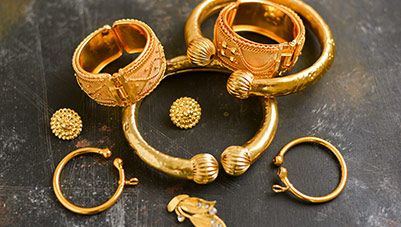
✗ MYTH Only new jewellery can be pledged. Old or antique gold has no loan value. | ✓ FACT Gold loan eligibility depends on purity. Gold jewellery or coins of 18-22 karat are acceptable. Gold coins up to 24 karat purity are also accepted. The age, design, or condition of the gold does not define the eligiblility. Even old, plain, or antique pieces can be pledged as long as they meet the minimum purity standard. Note: Gems, stones, and embellishments are excluded from the gold valuation. |
Many borrowers own heirloom or older pieces of jewellery that they assume are ineligible for a gold loan. In practice, Bajaj Finance and most regulated lenders assess gold strictly on its intrinsic gold content — the weight and purity of the gold itself. Decorative elements do not count towards the loan value, but the gold content in any piece of eligible purity is fully assessed.
Myth 5- Only jewellers and informal lenders provide gold loans
✗ MYTH To get a gold loan, you have to go to a jeweller or pawnbroker. | ✓ FACT Gold loans are a formal, regulated financial product offered by banks, NBFCs, and licensed financial institutions. Bajaj Finance, an RBI-registered NBFC, offers gold loans with transparent terms, free insurance on pledged gold, secure vault storage, and structured repayment options — unlike informal or unregulated lenders. |
Borrowing against gold through an unregulated lender carries risks that formal institutions eliminate. With Bajaj Finance, your gold is stored in secure vaults under 24/7 surveillance, covered by free insurance against theft, burglary, fire at branch, and misplacement, and returned to you in the same condition after full repayment. The entire process — from application to repayment — operates under RBI-regulated guidelines.
Does a gold loan affect my CIBIL score?
Yes, a gold loan affects your CIBIL score in both directions. Taking a gold loan triggers a hard credit inquiry, which may cause a small, temporary dip in your score. Once the loan is active, every on-time repayment is reported to credit bureaus and helps build or improve your credit profile. Missed payments or default, on the other hand, will negatively impact your score. For borrowers with a low or thin credit file, a gold loan with disciplined repayment is one of the more accessible ways to build a positive credit history.
Is a gold loan better than a personal loan? A direct comparison
Neither is universally better — the right choice depends on your situation. Here is how a gold loan and a personal loan compare across the parameters that matter most to borrowers:
| Parameter | Gold Loan | Personal Loan |
| Eligibility | Own eligible gold (18-22 carat). No minimum credit score. | Credit score, income, and employment profile assessed. |
| Interest rates (Bajaj Finance) | From 9.50% per annum | Typically from 10% p.a. |
| Loan amount | Rs. 5,000 to Rs. 2 crore (based on gold value) | Typically from Rs. 40,000 to Rs. 55 lakh (based on income and eligibility) |
| Tenure | 1 day to 12 months | Usually range from 12 months to 96 months |
| Documentation | Basic KYC only. No income proof. | KYC + income proof + employment documents. |
| Processing speed | Fast — gold valuation done at branch | Varies — income and credit assessment required |
| Collateral required | Yes — gold jewellery pledged | No — unsecured loan |
| Risk to assets | Pledged gold can be auctioned on default | No asset at risk — but credit score impacted on default |
| Repayment flexibility | Multiple options: monthly, quarterly, annual interest + bullet principal | Fixed EMIs over tenure |
When a gold loan is better: If you own gold, need funds quickly, or need a short-term loan with convenient repayment, a gold loan is typically the more accessible and cost-effective option.
When a personal loan is better: If you do not own gold, need a longer repayment tenure (up to 8 years), require a larger loan amount beyond your gold's value, or prefer not to pledge an asset, a personal loan is the appropriate choice.
Quik tip: Planning to use your gold for quick funds? Check your gold loan eligibility now and see how much you can borrow instantly.