













An OTP will be sent to this number for verification

You may have a pre-approved offer
Enter required loan against property amount
In summary
Mortgage Loan Interest Rates
- A mortgage loan interest rate is the cost of borrowing against a mortgaged property
- Interest rates may be fixed, floating, or a combination of both
- The applicable rate depends on the borrower's eligibility, property, and lender's assessment
Comparing interest rates can help reduce the total cost of borrowing
Show More
Show Less
What are mortgage loan interest rates?
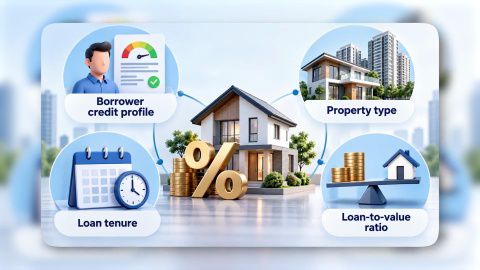
Mortgage loan interest rates are the percentage charged by a lender on the amount borrowed against a property. The interest forms part of the borrower's EMI or repayment obligation and affects the total cost of the loan. The applicable rate depends on factors such as the lender's pricing policy, borrower's credit profile, income, loan amount, tenure, property and repayment capacity. Different lenders may offer different rates to borrowers with similar loan requirements.
Show More
Show Less
What types of mortgage loan interest rates are available?
Mortgage loans can generally have fixed or floating interest rates. The availability and terms depend on the lender and loan agreement.
| Rate type | How it works | Impact on repayment |
|---|---|---|
| Fixed rate | The interest rate remains fixed for the applicable fixed-rate period | EMI or interest obligation is more predictable |
| Floating rate | The interest rate can change based on the applicable benchmark or reference rate | EMI or tenure may change when the rate is revised |
Show More
Show Less
What factors affect mortgage loan interest rates?
Lenders consider several factors when determining the applicable interest rate. These may include:
- Credit profile: A stronger repayment history may influence the lender's assessment of credit risk.
- Income and repayment capacity: Stable income and sufficient repayment capacity can affect the loan assessment.
- Loan amount: The amount borrowed may form part of the lender's pricing and risk assessment.
- Loan tenure: The selected repayment period can affect the overall interest cost.
- Property: The property's type, value, location and legal status may be considered.
- Employment or business profile: Salaried and self-employed applicants may have different pricing criteria.
- Existing relationship: Some lenders may consider the borrower's existing relationship and repayment record.
- Market conditions: Changes in benchmark rates and the lender's cost of funds can influence lending rates.
Show More
Show Less
How does the interest rate affect your EMI?
The interest rate directly affects the EMI and total amount payable over the loan tenure. For the same loan amount and tenure, a higher interest rate generally results in a higher EMI and greater total interest outgo. For example, consider a Rs. 20 lakh mortgage loan for 15 years. The EMI at 8% interest will be lower than the EMI for the same loan at 10%, assuming all other factors remain unchanged.
Use a loan against property EMI calculator to compare different interest rates, loan amounts and tenures before applying. This can help you estimate the monthly repayment and total interest payable.
Show More
Show Less
How can you compare mortgage loan interest rates?
Compare the following factors before selecting a mortgage loan:
- Check the applicable interest rate – Identify whether the quoted rate is fixed or floating.
- Compare the rate range – Check the lender's published rate range and the rate applicable to your profile.
- Calculate the EMI – Estimate the monthly repayment for your required loan amount and tenure.
- Check total interest payable – Compare the total interest over the selected tenure.
- Review fees and charges – Check processing, documentation, prepayment, foreclosure and other applicable charges.
- Understand rate-reset terms – For floating-rate loans, check the benchmark, spread and reset frequency.
- Compare the overall cost – Consider all applicable costs rather than comparing the interest rate alone.
Show More
Show Less
How to get a competitive interest rate on a mortgage loan?
You can take the following steps to improve your chances of getting a competitive mortgage loan interest rate:
- Maintain a healthy credit profile: Timely repayment of existing loans and credit card dues can support your creditworthiness.
- Compare lenders: Check interest rates, processing fees, prepayment charges and other costs offered by different lenders.
- Choose an appropriate loan amount: Borrow an amount that matches your requirement and repayment capacity.
- Opt for a suitable tenure: Compare different tenures because a longer tenure can reduce the EMI but may increase the total interest payable.
- Maintain stable income: Lenders may consider your income and repayment capacity while determining the applicable rate.
- Negotiate where possible: If your credit profile and financial position are strong, you can ask the lender whether better pricing is available.
Bajaj Finance offers mortgage loans of up to Rs. 15.50 crore* at interest rates starting from 7.5% p.a. Check your eligibility and access funds for various personal or business needs. A competitive mortgage loan interest rate can help manage your EMI and overall borrowing cost. Compare interest rates, fees and repayment terms across lenders, and choose a loan amount and tenure that suit your financial requirements. Reviewing the total cost of borrowing can help you make an informed decision.
Show More
Show Less
Frequently Asked Questions
Overview
Interest Rates and Eligibility
Loan Repayment
What is a mortgage loan interest rate?
A mortgage loan interest rate is the annual percentage charged by a lender on the loan amount borrowed against a residential or commercial property. It represents the cost of borrowing and determines the Equated Monthly Instalment (EMI) and the total repayment amount. The applicable rate varies based on the borrower's eligibility, property details, and the lender's lending policies.
What types of mortgage loan interest rates are available?
Mortgage loans generally come with fixed, floating, or hybrid interest rates. A fixed rate remains constant for a specified period or the entire tenure, while a floating rate changes according to market conditions. A hybrid rate combines both by offering a fixed rate initially and a floating rate later.
Why do mortgage loan interest rates differ between lenders?
Mortgage loan interest rates differ because each lender evaluates borrower eligibility, credit score, repayment capacity, property value, loan amount, tenure, and internal risk assessment differently. Market conditions, benchmark lending rates, operational costs, and business policies also influence the interest rates offered by different financial institutions.
What factors affect mortgage loan interest rates?
Several factors influence mortgage loan interest rates, including the applicant's credit score, monthly income, employment or business stability, loan amount, repayment tenure, loan-to-value ratio, property type, market value, existing financial obligations, and prevailing economic conditions. Each lender also applies its own internal policies while determining the final rate.
Can I negotiate my mortgage loan interest rate?
Yes. Borrowers with a strong credit history, stable income, low debt obligations, and good repayment capacity may be able to negotiate a better mortgage loan interest rate. Existing relationships with the lender and favourable property valuations may also improve the chances of obtaining a competitive interest rate.
Does my credit score affect the mortgage loan interest rate?
Yes. A higher credit score generally reflects responsible credit behaviour and lower lending risk, increasing the likelihood of obtaining a competitive mortgage loan interest rate. Borrowers with lower credit scores may receive higher interest rates or additional lending conditions depending on the lender's credit assessment policies.
How does a floating mortgage loan interest rate work?
A floating mortgage loan interest rate changes periodically based on the lender's benchmark rate or prevailing market conditions. As interest rates rise or fall, the borrower's EMI or loan tenure may be revised accordingly. This means the total borrowing cost may change during the repayment period.
Which is better: fixed or floating mortgage loan interest rate?
The choice depends on your financial preferences and market outlook. A fixed interest rate offers stable EMIs and predictable repayments, while a floating rate may initially be lower but can increase or decrease based on market movements. Borrowers should evaluate their repayment capacity before making a decision.
How is mortgage loan interest calculated?
Mortgage loan interest is generally calculated on the outstanding principal amount using the reducing balance method. As borrowers repay their EMIs, the outstanding principal decreases, reducing the interest charged over time. Floating-rate loans may undergo periodic recalculations whenever the applicable benchmark interest rate changes.
How can I reduce the total interest paid on a mortgage loan?
Borrowers can reduce the total interest by maintaining a good credit score, choosing a shorter loan tenure where affordable, making timely EMI payments, opting for partial prepayments when permitted, comparing lenders before applying, and selecting a competitive interest rate that suits their financial requirements.
Loan Against Property for different budget
Check your pre-approved offer now
Loan Against Property for Professionals




Find your nearest branch

What do our customers say about us
customers
Play Store rating
reviews
Anita Das
04 March 2026
The loan against property process was smooth and transparent. Interest rates were competitive, and the documentation requirements were minimal. The team provided clear guidance at every step, making the entire experience hassle-free. Highly recommended for quick approvals and reliable support.
Aashish
04 March 2026
The loan disbursal was quick, and the customer support team handled all my queries with patience and clarity. Flexible EMIs made it easy to manage monthly expenses. Overall, a great experience, especially for salaried individuals seeking a loan against property.
Prakash
04 March 2026
I had a great experience transferring my existing loan against property. The process was quick and hassle-free, and I saved significantly with the lower interest rate. The customer service team was supportive throughout. Highly recommended for anyone considering a balance transfer.
Yogesh Singh
04 March 2026
Clear guidance, quick approval, and flexible repayment options made purchasing my new house much easier than expected. The team managed the entire process professionally and ensured smooth coordination at every stage. Overall, a very satisfying experience, and I would recommend their home loan services to others.
Related articles


Watch our videos

Know the tax benefits on your loan against property

What are the documents required for a Loan Against Property?

What are the types of property eligible for Loan Against Property

What is the eligibility criteria for a Loan Against Property
Disclaimer
1. Bajaj Finance Limited (“BFL”) is a Non-Banking Finance Company (NBFC) and Prepaid Payment Instrument Issuer offering financial services viz., loans, deposits, Bajaj Pay Wallet, Bajaj Pay UPI, bill payments and third-party wealth management products. The details mentioned in the respective product/ service document shall prevail in case of any inconsistency with respect to the information referring to BFL products and services on this page.
2. All other information, such as, the images, facts, statistics etc. (“information”) that are in addition to the details mentioned in the BFL’s product/ service document and which are being displayed on this page only depicts the summary of the information sourced from the public domain. The said information is neither owned by BFL nor it is to the exclusive knowledge of BFL. There may be inadvertent inaccuracies or typographical errors or delays in updating the said information. Hence, users are advised to independently exercise diligence by verifying complete information, including by consulting experts, if any. Users shall be the sole owner of the decision taken, if any, about suitability of the same.