











An OTP will be sent to this number for verification

You may have a pre-approved offer
Enter required home loan amount
In summary
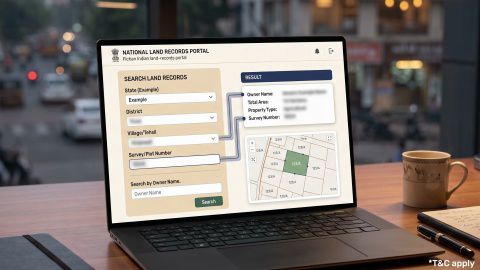
Simplifying Land Record Searches A Comprehensive Guide to Accessing Records by Name
Last updated: Sept 2026
A survey number search returns one record. A land record search by name can return one record. It can also return five, fifteen, or none at all. This depends on how common the name is and how it was transliterated into the state's own script decades ago.
- Core limitation: one name can match multiple unrelated landowners, especially common names
- Transliteration risk: names in regional scripts often have 2 to 4 valid English spelling variants
- Best used for: an initial search when you lack a survey number, not as final confirmation
- More reliable alternative: survey number, Khasra number, or Khata number search, where available
Most state portals offer name search as one option alongside number-based search, not as the primary method
Treat a name-search result as a lead to verify against the survey number, not as confirmed ownership on its own.
Why is name-based search less reliable?
A land record search by name works against a much fuzzier match than a survey number search. A survey number identifies one specific parcel. A name can belong to many people, and can appear differently across records depending on who transcribed it and when.
Three specific problems explain why a name search returns noisy results even on a well-digitised portal. The three problems are:
- Common names return too many results, particularly in states or districts where certain surnames or given names are widely shared
- Transliteration from a regional script into English produces multiple valid spellings for the identical name
Older records may list a deceased or previous owner's name, while current ownership has changed through inheritance or sale not yet reflected in the digitised system
None of these problems mean the portal is broken. They reflect genuine limitations of matching a person's name against millions of individually-recorded parcels built up over decades.
Show more
Show less
When does a name search actually work well?
Name search is genuinely useful in specific, narrower situations, even though it is not the most precise method overall.
| Situation | How well name search works |
|---|---|
| Uncommon name in a smaller village | Works well — fewer records to search against |
| Confirming your own name appears correctly on a record you already located | Works well — you already know which specific record you expect |
| First-pass search with no other identifying detail | Reasonable starting point, to be verified further |
| Common name in a large district or city | Poor — expect many irrelevant matches |
| Verifying a seller's claimed ownership before a purchase | Poor as the sole method — cross-check against the survey number |
For anything involving money changing hands, treat a name-search match as the beginning of verification, not the end of it.
Show more
Show less
How do I narrow down too many name-search results?
Four steps narrow a noisy name-search result down to the one record that actually matters.
- Note every candidate result the name search returns, rather than assuming the first match is correct.
- Cross-check each candidate against any other detail you have — village, taluka, or an approximate area figure.
- Where possible, obtain the survey number or Khata number from the seller, a family member, or an old physical document, and repeat the search using that instead.
If the record remains ambiguous, visit the local revenue office (Tehsildar, Talathi, or equivalent) with whatever partial information you have. Staff can often narrow results using local knowledge a portal search cannot.
Moving from name to survey number as soon as any survey number becomes available is the single most effective way to resolve an ambiguous name search.
Show more
Show less
A worked example: narrowing an ambiguous name search
Consider Rajesh, a 41-year-old shop owner in a mid-sized town with a household income of Rs. 95,000 a month and a CIBIL Score of 736, searching for his late uncle's land using only the name on an old family document.
| Step | What Rajesh found |
|---|---|
| First search | 14 results for the same name across the district |
| Narrowed by village | 3 results remained, all in the correct village |
| Cross-checked ages and relations | 1 result matched his uncle's known landholding pattern |
| Confirmed via Tehsildar | Local office confirmed the survey number for the correct parcel |
Rajesh's name search alone could not resolve which of 14 same-named owners was his uncle. Only combining it with village-level detail and local office confirmation produced a reliable result.
Show more
Show less
Home loan for professionals
Financing a property once ownership is confirmed with Bajaj Finance
| Loan feature | Detail |
|---|---|
| Interest rate | From 7.25% p.a.*, subject to credit assessment |
| Loan amount | Up to Rs. 15 Crore* |
| Tenure | Up to 32 years |
Bajaj Finance verifies land records using survey number, Khata number, or equivalent precise identifiers, not name search alone, as part of standard legal due diligence. This step can delay approval where a name-match ambiguity needs manual resolution. The typical delay varies by district, based on how completely that area's records have been digitised. Check your home loan eligibility once your property's specific survey number is confirmed.
Show more
Show less
Frequently Asked Questions
Understanding the limitation
Practical searching
Why does my name search show a completely different owner than I expected?
In most cases, this means either you are looking at a different property with a similarly-named owner, or the record has not yet been updated to reflect a sale or inheritance that already occurred. Cross-check the survey number, village, and approximate area against what you already know before concluding the record is wrong.
Can I rely on a name search alone to confirm I am buying from the actual legal owner?
No, not on its own. A name match tells you a person by that name is associated with a record. It does not independently confirm that person is the current, legal owner with the right to sell. Cross-check with the survey number, the registered sale deed, and an encumbrance search before finalising any transaction.
What should I do if I only have a very common name to search with?
Gather any additional detail you can before searching. This includes the village, taluka, approximate plot size, or a neighbour's name for reference. A common name combined with even one additional detail narrows the result far more effectively than the name alone. If the portal still returns too many matches, a village-level visit to the local revenue office resolves most remaining ambiguity.
Do all Indian states offer name-based land record search online?
Most major states offer some form of name-based search alongside number-based search, though the specific interface, terminology, and reliability vary by state and even by district within a state. Confirm your specific state's portal name and search options before assuming a generic search engine query will find the right system.
Home Loan in Different Cities

Home Loan in Mumbai

Home Loan in Ahmedabad

Home Loan in Bangalore

Home Loan in Chennai

Home Loan in Delhi

Home Loan in Hyderabad

Home Loan in Cochin

Home Loan in Noida

Home Loan in Pune
Home Loan for different budget
Check your pre-approved offer now
Our Calculators



What do our customers say about us
customers
Play Store rating
reviews
Amit Shiva
Reviewed on
Smooth and transparent home loan process. The interest rates were competitive, and documentation was minimal. The team guided me clearly at every step, making my first home purchase stress-free. Highly recommended for quick approvals.
Sandeep Kulkarni
Reviewed on
The loan disbursal was fast, and the customer support team was extremely patient with all my queries. Flexible EMIs helped me manage my monthly expenses easily. A great experience for salaried homebuyers.
Ritika Agarwal
Reviewed on
I had a great experience while transferring my existing home loan. The process was quick, and I saved significantly with the lower interest rate. Customer service was helpful throughout. Highly recommended for balance transfers.
Manoj Verghese
Reviewed on
Clear guidance, quick approval, and flexible repayment options made buying my new house easier than expected. The team handled everything professionally. Very satisfied and would definitely recommend their home loans
Find your nearest branch

More Articles




Watch our videos

Documents required to get a Bajaj Finserv Home Loan

Tips to increase your Home Loan eligibility
Things you need to know about pre-approved home loan

Things you need to know before applying for a Home Loan

How does Repo Rate affect your Home Loan

Download App
Now request money from your friends and family and make instant payments.

- Choose from personal, business, gold loans and more
- Pay utility bills, use UPI, get FASTag and more
- Buy over 1 million products on No Cost EMI
- Buy stocks, mutual funds and invest in FD
Disclaimer
1. Bajaj Finance Limited (“BFL”) is a Non-Banking Finance Company (NBFC) and Prepaid Payment Instrument Issuer offering financial services viz., loans, deposits, Bajaj Pay Wallet, Bajaj Pay UPI, bill payments and third-party wealth management products. The details mentioned in the respective product/ service document shall prevail in case of any inconsistency with respect to the information referring to BFL products and services on this page.
2. All other information, such as, the images, facts, statistics etc. (“information”) that are in addition to the details mentioned in the BFL’s product/ service document and which are being displayed on this page only depicts the summary of the information sourced from the public domain. The said information is neither owned by BFL nor it is to the exclusive knowledge of BFL. There may be inadvertent inaccuracies or typographical errors or delays in updating the said information. Hence, users are advised to independently exercise diligence by verifying complete information, including by consulting experts, if any. Users shall be the sole owner of the decision taken, if any, about suitability of the same.