









Rs. 100- Rs. 10 crore
Start investing with Rs. 100 | Easy KYC | Expert-managed funds
In summary
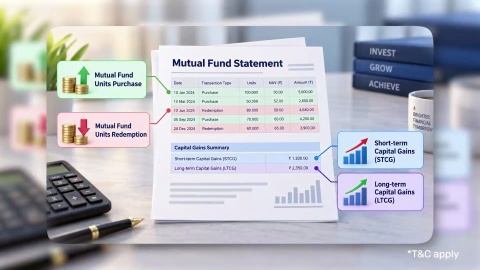
Capital Gain Statement
A capital gains statement helps you understand the gains or losses arising from mutual fund transactions such as redemptions. It can also help you organise information needed when preparing your income tax return.
The key points to remember are:
- A capital gains statement records relevant purchase, redemption, and gain or loss details.
- You can obtain the statement through your investment platform, mutual fund registrar and transfer agent (RTA), or the relevant fund house.
- CAMS and KFin Technologies Limited can provide consolidated information for eligible mutual fund investments handled through them.
- A Consolidated Account Statement (CAS) is different from a capital gains statement. CAS provides a consolidated view of transactions across mutual funds and certain securities.
- Your tax treatment depends on factors such as the type of mutual fund, acquisition date, redemption date, and applicable tax rules.
From 1 April 2026, the definition of a specified mutual fund under the revised tax framework includes funds investing more than 65% of their total proceeds in debt and money market instruments, subject to the applicable conditions.
You should check the statement against your own transaction records before using the information for tax reporting. The applicable tax rules can also change, so use the rules relevant to the financial year and transaction dates involved.
What is a capital gains statement?
A capital gains statement is a record of gains and losses arising from transactions in investments. For mutual funds, it can show information relating to purchases and redemptions during a particular period.
The statement can help you identify the purchase cost, redemption value, transaction dates, and resulting capital gain or loss. The exact format and fields can vary between providers.
If you are new to investing, it is useful to understand the difference between the statement and the investment itself. A capital gains statement is a record of transactions and gains or losses. It is not a mutual fund account or a separate investment product.
You can also learn more about mutual funds if you want to understand how these investments work before reviewing their tax records.
How to get a capital gains statement for mutual funds
You can usually obtain a capital gains statement from the platform through which you invested, an RTA, or the relevant mutual fund house. The route you use depends on where your investments are held.
Through the Bajaj Broking website
If you hold mutual fund investments through the Bajaj Broking website, you can access your account statement from the platform.
Follow these steps:
- Open the Bajaj Broking website or app.
- Go to the ‘Mutual Funds’ section under ‘Investments’.
- Open the ‘Account’ section.
- Select ‘Reports & Statement’.
- Select ‘Account Statement’ and choose the relevant period, such as ‘All’, ‘Current Financial Year’, or ‘Previous Financial Year’.
Select ‘Download’.
The exact menu names or location of a feature can change when a platform is updated. Check the current interface when you access your statement.
Through an RTA
An RTA, or Registrar and Transfer Agent, provides administrative services for mutual fund transactions and investor records. You can learn more about the role of a Registrar and Transfer Agents before using an RTA to obtain your statement.
If you have investments across multiple platforms, an RTA may help you obtain a consolidated statement for the mutual fund schemes it services.
Through KFin Technologies Limited
You can obtain a capital gains statement through KFin Technologies Limited for eligible mutual fund investments serviced by it.
Follow these steps:
- Visit the KFin Technologies Limited website and select ‘Mutual Fund Investors’.
- Create an account if required.
- Open ‘Statements and Reports’ and select ‘Capital Gains Statements’.
- Select ‘Capital Gain Consolidated Statement’.
- Choose the relevant financial year and fund options, then provide the required details.
The statement is sent to your registered email address.
The exact navigation can change, so check the current KFin Technologies Limited interface when downloading the statement.
Through CAMS
CAMS is another RTA through which eligible investors can obtain capital gains information.
Follow these steps:
- Open the CAMS website and accept the applicable terms and conditions.
- Select ‘Statements’ and then ‘Capital Gain/Loss Statement’.
- Enter the required details and select the financial year.
- Provide the email address registered with your mutual fund investments and select ‘All Funds’ where applicable.
- Choose the option to receive an encrypted attachment and set the required password.
Open the statement from the email using the password.
If you are unfamiliar with CAMS, you can read more about CAMS and its role before using its services.
Through the mutual fund company
You can also check the website of the mutual fund company where you hold units. Depending on the fund house and the way your investment is held, you may be able to download transaction or capital gains information from your account.
An asset management company (AMC) manages a mutual fund scheme and its portfolio. You can learn more about an AMC to understand its role.
Capital gains statement vs Consolidated Account Statement
A capital gains statement and a Consolidated Account Statement (CAS) serve different purposes.
A capital gains statement focuses on information used to identify gains and losses from relevant investment transactions. A CAS provides a consolidated view of transactions across mutual funds and, where applicable, other securities held in demat accounts.
SEBI states that a CAS shows transactions made during a month across mutual funds and other securities held in an investor's demat account. For mutual fund transactions during a month, SEBI's current framework provides for the CAS to be sent by email on or before the 12th of the following month, with physical copies generally sent by the 15th where applicable.
This dated regulatory detail is useful when checking whether you have received your regular statement. It does not mean that a CAS and a capital gains statement contain identical information.
What information does a capital gains statement contain?
The information can vary by provider, but a capital gains statement may include details such as:
- Purchase or acquisition date.
- Redemption or sale date.
- Purchase cost.
- Redemption or sale value.
- Capital gain or loss.
- Details of the mutual fund scheme.
Information used to determine the applicable holding period.
The statement may separate gains into short-term and long-term categories where the applicable tax rules require this classification.
If you are checking your statement for tax purposes, pay particular attention to the transaction dates. The tax treatment can depend on when you acquired and redeemed the units.
Capital gains tax on mutual funds
Tax on mutual fund gains depends on the type of fund, the acquisition date, the transfer or redemption date, and the tax provisions applicable to the transaction.
For example, qualifying equity-oriented mutual fund transactions can be subject to specific short-term and long-term capital gains rules. You can read about long-term capital gains to understand the broader concept.
Debt-oriented mutual funds require particular care because the rules have changed over time. From 1 April 2026, the revised definition of a specified mutual fund includes a mutual fund that invests more than 65% of its total proceeds in debt and money market instruments, or certain funds investing in units of such funds. Gains covered by the relevant provision are treated according to the specified mutual fund rules.
This means you should not rely on older statements that all debt mutual funds receive a long-term tax treatment after a fixed holding period or that indexation automatically applies.
The tax treatment can also differ between Equity Mutual Funds, Debt Mutual Funds, Hybrid Mutual Funds, ELSS Mutual Funds, etc. Check the rules applicable to the particular fund and transaction before calculating tax.
For example, the tax treatment of a fund cannot be determined only from its name. You should consider its classification and the applicable law for the relevant transaction.
How to check your capital gains statement
Once you download the statement, review it before using the information for tax reporting.
Check your transaction dates
Compare the purchase and redemption dates in the statement with your own records. The dates can affect how a gain or loss is classified.
Check the transaction values
Check whether the purchase cost and redemption value match your transaction records. If you find a difference, contact the relevant platform, RTA, or fund house.
Check gains and losses
Review the gains and losses shown in the statement. Do not assume that every figure is taxable in the same way. The applicable treatment depends on the type of investment and relevant tax provisions.
Keep supporting records
Keep your statements, transaction confirmations, and other relevant records. These can help you check your figures if you need to clarify a transaction later.
How to use your capital gains statement for tax filing
Your capital gains statement can help you organise information needed when preparing your income tax return.
Start by checking which mutual fund units you redeemed during the relevant financial year. Then review the purchase date, purchase cost, redemption date, redemption value, and reported gain or loss.
You should also check whether the statement's classification matches the tax rules applicable to your particular fund and transaction. Do not copy figures into your ITR without checking the relevant tax treatment.
If you are preparing your return yourself, use the applicable income tax return instructions and current tax provisions. If your transactions are complex, a tax professional can help you determine the appropriate reporting treatment.
Your investment strategy should not be changed only to reduce a tax amount shown in a statement. Tax is one factor to consider alongside your investment objectives, risk, and holding period.
What if you have mutual funds across multiple platforms?
If you have mutual funds across different platforms, you may receive information from more than one source. You may need to review statements from the relevant platforms, RTAs, or fund houses.
A CAS can also provide a consolidated view of mutual fund transactions and applicable demat holdings. SEBI explains that the CAS is designed to provide a combined statement of transactions across mutual funds and other securities held in demat accounts.
However, a CAS should not automatically be treated as a replacement for every capital gains report. Check which transactions and details are included before using a statement for tax calculations.
If you hold mutual fund investments through different routes, keep the relevant records together for the financial year.
Capital gains statement and your financial planning
A capital gains statement is primarily a record of investment transactions and gains or losses. It can also help you understand how redemptions have affected your portfolio.
For example, if you redeemed units during the year, the statement can help you identify the amount realised and the corresponding gain or loss. You can then consider this information alongside your financial objectives.
Do not treat the statement as a recommendation to buy, sell, or switch a mutual fund. Those decisions should be based on your investment goal, time horizon, risk tolerance, and the characteristics of the scheme.
Explore Investment Tools
Articles and Insights




Frequently Asked Questions
Understanding capital gains statements
Getting and checking the statement
Using the statement for tax filing
What is a capital gains statement?
A capital gains statement is a record of gains and losses arising from relevant investment transactions. For mutual funds, it can show details such as purchase and redemption transactions and the resulting gain or loss for the relevant period.
Is a capital gains statement the same as a CAS?
No. A capital gains statement focuses on information relevant to gains and losses, while a Consolidated Account Statement provides a consolidated view of transactions across mutual funds and, where applicable, securities held in demat accounts.
What details are included in a capital gains statement?
The statement can include purchase and redemption dates, transaction values, scheme details, and capital gains or losses. The exact information and format can vary between platforms, RTAs, and fund houses.
How do I download my capital gains statement from Bajaj Broking?
Open the Bajaj Broking website or app, go to the Mutual Funds section under Investments, and open Reports & Statement from your Account section. Select Account Statement and the required period, then download the statement.
How do I get a capital gains statement from CAMS?
You can access the CAMS website, select Statements, and choose Capital Gain/Loss Statement. Enter the required details, select the relevant financial year, and follow the instructions to receive the statement.
What should I do if there is an error in my capital gains statement?
Compare the statement with your transaction records first. If you find a genuine discrepancy, contact the relevant platform, RTA, or mutual fund house and provide the supporting transaction details needed to investigate it.
How do I use a capital gains statement for filing my ITR?
Use the statement to review the purchase and redemption details and the gains or losses arising from relevant transactions. Then report the applicable figures under the relevant section of your ITR after checking the tax rules for your fund and transaction.
Is it mandatory to report mutual fund capital gains in an ITR?
If you have taxable capital gains that are required to be reported under the applicable income tax rules, they need to be disclosed in your ITR. The exact reporting requirement depends on your circumstances and the nature of the income.
How often should I review my capital gains statement?
Review it at least when preparing your tax return and whenever you need to check a redemption or other taxable transaction. Reviewing it against your own records can help you identify discrepancies before filing.
Disclaimer
Bajaj Finance Limited ("BFL") is registered with the Association of Mutual Funds in India ("AMFI") as a distributor of third party Mutual Funds (shortly referred as 'Mutual Funds) with ARN No. 90319
BFL does NOT:
(i) provide investment advisory services in any manner or form.
(ii) carry customized/personalized suitability assessment.
(iii) carry independent research or analysis, including on any Mutual Fund schemes or other investments; and provide any guarantee of return on investment.
In addition to displaying the Mutual fund products of Asset Management Companies, some general information is sourced from third parties, is also displayed on As-is basis, which should NOT be construed as any solicitation or attempt to effect transactions in securities or the rendering any investment advice. Mutual Funds are subject to market risks, including loss of principal amount and Investor should read all Scheme/Offer related documents carefully. The NAV of units issued under the Schemes of mutual funds can go up or down depending on the factors and forces affecting capital markets and may also be affected by changes in the general level of interest rates. The NAV of the units issued under the scheme may be affected, inter-alia by changes in the interest rates, trading volumes, settlement periods, transfer procedures and performance of individual securities forming part of the Mutual Fund. The NAV will inter-alia be exposed to Price/Interest Rate Risk and Credit Risk. Past performance of any scheme of the Mutual fund do not indicate the future performance of the Schemes of the Mutual Fund. BFL shall not be responsible or liable for any loss or shortfall incurred by the investors. There may be other/better alternatives to the investment avenues displayed by BFL. Hence, the final investment decision shall at all times exclusively remain with the investor alone and BFL shall not be liable or responsible for any consequences thereof.
Investment by a person residing outside the territorial jurisdiction of India is not acceptable nor permitted.
Disclaimer on Risk-O-Meter:
Investors are advised before investing to evaluate a scheme not only on the basis of the Product labeling (including the Riskometer) but also on other quantitative and qualitative factors such as performance, portfolio, fund managers, asset manager, etc, and shall also consult their Professional advisors, if they are unsure about the suitability of the scheme before investing.
Disclosure: Bajaj Finance Limited (BFL) is a distributor of Mutual Funds with ARN - 90319 and distributes mutual funds of Bajaj Finserv Asset Management Limited (BFSAMC). BFL receives commission towards distribution of mutual fund products. BFSAMC is a group company of BFL, carrying business on arm’s length basis without any conflict of interest and in accordance with the prevailing law / regulation.
Disclaimer
Bajaj Finance Limited ("BFL") is an NBFC offering loans, deposits and third-party wealth management products.
The information BFL contained in this article is for general informational purposes only and does not constitute any financial advice. The content herein has been prepared by BFL on the basis of publicly available information, internal sources and other third-party sources believed to be reliable. However, BFL cannot guarantee the accuracy of such information, assure its completeness, or warrant such information will not be changed.
This information should not be relied upon as the sole basis for any investment decisions. Hence, User is advised to independently exercise diligence by verifying complete information, including by consulting independent financial experts, if any, and the investor shall be the sole owner of the decision taken, if any, about suitability of the same.
Disclaimer
Mutual Fund SIP calculator may provide potential investors an approximate estimate on the maturity amount of the monthly SIP, purely based on mathematical calculation of the projected annual return rate selected by investor. However, such calculation does not factor the actual performance by the Asset Management Company (AMC) and should not be treated as any advice or assurance about the actual return of investment. Mutual Funds do not have a fixed rate of return and it is not possible to predict the rate of return. Please note that the SIP calculator are for illustrations only and do not represent actual returns which may vary depending on various factors including but not limited to actual performance, expense ratio, taxation, exit load (if any), etc.