





















































































































































































































































































How to Check if Your Aadhaar Card Is Real or Fake

How to Check if Your Aadhaar Card Is Real or Fake

You can verify an Aadhaar card using UIDAI's official verification services, including the online Aadhaar verification facility, mAadhaar app and Secure QR Code. These methods help confirm whether the Aadhaar details and digitally signed information are genuine.

Rs. 40,000 - Rs. 55 lakh

You may be eligible for a pre-approved personal loan offer

Enter mobile and OTP | Check offer | No branch visit needed


Key takeaways


You should verify an Aadhaar card through UIDAI rather than relying only on its appearance, print quality or Aadhaar number. UIDAI provides online and offline methods to check the authenticity of Aadhaar details.


  • Verify your Aadhaar number on the official UIDAI portal.
  • Scan the secure QR code to confirm the card's authenticity.
  • Keep your registered mobile number updated for OTP verification.
  • Never share your Aadhaar details with unauthorised individuals.
  • Use a valid Aadhaar card to complete KYC for services such as personal loan applications.

Regularly learning how to identify fake Aadhaar card documents and verifying your Aadhaar details can improve security, prevent identity misuse, and support a smooth experience when accessing financial and government services.

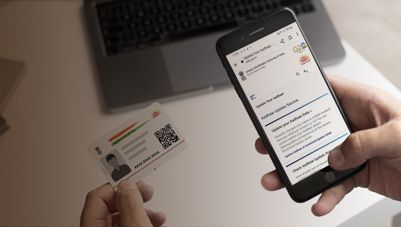
How can you check whether an Aadhaar number is genuine?

You can verify an Aadhaar number through UIDAI's official online Aadhaar verification service. UIDAI's 2026 Aadhaar Handbook states that the service can confirm whether the Aadhaar number exists and provides limited details such as age band, gender, state of residence and masked mobile information.


You should use this method when someone gives you an Aadhaar number and you want to check whether it is a valid Aadhaar number.


A valid Aadhaar number alone does not establish that the person presenting the document is its legitimate holder. For identity verification, you should also compare the verified information with the document and use the appropriate authentication or offline verification process.

Show More Show Less

How do you verify Aadhaar using the QR Code?

You can scan the Secure QR Code printed on an Aadhaar letter, e-Aadhaar, Aadhaar PVC card or mAadhaar. UIDAI states that the QR Code is digitally signed and can be used for offline identity verification.


Follow these steps:

  1. Open the mAadhaar app or UIDAI's Aadhaar QR Scanner.
  2. Scan the QR Code displayed on the Aadhaar document.
  3. Allow the application to read the code.
  4. Check the information displayed after verification.
  5. Compare the displayed details and photograph with the Aadhaar presented.
  6. Check whether the application confirms that the QR Code has been digitally verified.

UIDAI states that its QR Code reader can display demographic details and photograph after the QR Code is digitally verified. If the digital signature cannot be verified, the reader displays that the QR Code is not verified.

Show More Show Less

How to identify a fake Aadhaar card: Step-by-step methods

To understand how to check fake aadhar card, start with UIDAI’s online verification service, then use its secure QR code tools and check the physical security features of an Aadhaar PVC card. Visual checks alone should not be treated as proof of authenticity.


1. Verify Aadhaar online through UIDAI

Visit the official UIDAI website and use the Aadhaar verification service. Enter the required Aadhaar details to check whether the number can be verified through UIDAI’s system. This is a more reliable method than relying only on the card’s appearance.


2. Scan the secure QR code

Use the official Aadhaar App or Aadhaar QR Code Scanner to scan the secure QR code. UIDAI digitally signs the QR code, allowing the information to be verified offline.


3. Check PVC card security features

For an Aadhaar PVC card, check features such as the tamper-proof QR code, microtext, ghost image and guilloche pattern. These checks can support verification but should not replace official verification.


To verify Aadhaar, use official UIDAI services and keep your details secure. If you need supporting documents, refer to the documents required for a personal loan.

Show More Show Less

Why it is important to identify a fake Aadhaar card

Identifying a fake Aadhaar card is important because it helps prevent identity misuse, financial fraud and unauthorised access to services. A fraudulent Aadhaar may contain altered personal details or may be used to impersonate another person.


Key reasons include:

  • Prevent identity theft: Fraudsters may use fake identity documents to impersonate you.
  • Protect financial accounts: False Aadhaar details could be used in unauthorised loan, banking or payment-related activities.
  • Avoid fraudulent transactions: Verifying identity documents can reduce the risk of transactions being carried out using false information.
  • Meet KYC requirements: Banks and financial institutions need valid identity documents for customer verification.
  • Protect government benefits: A fraudulent identity may be used to access services or benefits unlawfully.
  • Avoid legal and financial complications: Using or accepting a forged document can create serious consequences.

You can verify an Aadhaar's validity through UIDAI's official verification services rather than relying only on the appearance of the card.

Show More Show Less

What are the security features of a genuine Aadhaar card?

A genuine Aadhaar document includes several features that help you verify its authenticity and protect the identity information it contains. Key security features include:


  • Secure QR code: Aadhaar letters and e-Aadhaar PDFs contain a digitally signed QR code that can be scanned using UIDAI-approved methods.
  • Digitally signed information: The QR code contains demographic details that are digitally signed by UIDAI, helping detect unauthorised alterations.
  • Masked Aadhaar option: Masked Aadhaar displays only the last four digits of the Aadhaar number, providing an additional privacy measure.
  • Secure e-Aadhaar: Downloaded e-Aadhaar is digitally signed by UIDAI and can be verified electronically.
  • Hologram and security printing: Physical Aadhaar documents may include security-printing features, but visual appearance alone should not be treated as proof of authenticity.
  • Offline verification: Aadhaar can be verified through UIDAI's official authentication and verification mechanisms.

Important: Do not rely only on the photograph, logo, hologram or printed appearance to identify a genuine Aadhaar. For reliable verification, use UIDAI's official verification methods.

Show More Show Less

Benefits of verifying your Aadhaar card

Verifying your Aadhaar helps confirm that the document and identity details being presented are valid. It can help you:


  • Prevent identity misuse: Confirm that the Aadhaar details belong to the person presenting them.
  • Detect alterations: Identify changes or tampering with Aadhaar information.
  • Complete KYC safely: Support identity verification for eligible financial and other services.
  • Reduce fraud risk: Help prevent the use of fraudulent Aadhaar documents.
  • Protect your identity: Detect discrepancies that may require further action.
  • Use reliable information: Ensure that the Aadhaar details being used for verification are authentic.

For the most reliable check, use UIDAI's official Aadhaar verification services rather than relying only on the appearance of the document.

Show More Show Less

How can organisations prevent misuse of fake Aadhaar cards?

Organisations must take proactive measures to prevent the misuse of fake Aadhaar cards. Here are key steps to ensure security:


  • Use UIDAI’s Aadhaar verification portal – Employers and financial institutions should verify Aadhaar details through UIDAI’s official website to check authenticity.
  • Validate QR codes – Every Aadhaar card has a QR code that can be scanned using the UIDAI QR code scanner to confirm its legitimacy.
  • Check digital signatures – The e-Aadhaar version is digitally signed by UIDAI. Organisations should verify this signature to ensure authenticity.
  • Conduct periodic audits – Regularly reviewing Aadhaar-linked records can help detect anomalies and prevent fraudulent activities.
  • Implement Aadhaar-based KYC – Organisations should integrate Aadhaar-based e-KYC for secure verification and prevent identity fraud.
Show More Show Less

What common mistakes to avoid when identifying a fake Aadhaar card?

The most common mistakes to avoid when learning how to check fake Aadhaar card details are relying only on the card's appearance, skipping official verification methods, and ignoring security features.


  • Do not judge authenticity based only on the card's design, print quality, or lamination.
  • Always scan the secure QR code to verify the Aadhaar holder's details.
  • Use the official UIDAI portal to verify the Aadhaar number instead of relying on third-party sources.
  • Check that the demographic details match the cardholder's identity and supporting records.
  • Avoid sharing Aadhaar details with unauthorised individuals or using unofficial verification tools.
  • Verify the digital signature on an e-Aadhaar whenever applicable to confirm authenticity.

Following these steps can help prevent identity fraud and ensure that Aadhaar verification is completed securely using official UIDAI methods.

Show More Show Less

In conclusion, performing an Aadhaar card check regularly is important to protect your personal information and reduce the risk of identity fraud. Using official UIDAI services to verify Aadhaar number details helps ensure your records are accurate and up to date. This step becomes especially important when applying for a personal loan, where valid identity proof is required for faster approval. Keeping your Aadhaar details verified not only safeguards your identity but also supports a smooth and secure application process for financial services.

Show More Show Less

Key offerings: 3 loan types

Personal loan interest rate and applicable charges

Type of fee

Applicable charges

Rate of interest per annum

10% to 30.5% p.a.

Processing fees

Up to 4.13% of the loan amount (inclusive of applicable taxes).

Flexi Facility Charge

Term Loan – Not applicable

Flexi Loans –Up To Rs 1,999 To Up To Rs 18,999/- (Inclusive Of Applicable Taxes)

Will be deducted upfront from loan amount.

Bounce charges

Rs. 700 to Rs. 1,200/- per bounce

“Bounce charges” shall mean charges for (i) dishonor of any payment instrument; or (ii) non-payment of instalment (s) on their respective due dates due to dishonor of payment mandate or non-registration of the payment mandate or any other reason.

Part-prepayment charges

Full Pre-payment:

  • Term Loan: Up to 4.72% (Inclusive of applicable taxes) on the outstanding loan amount as on the date of full pre-payment

  • Flexi Term (Dropline) Loan: Up to 4.72% (Inclusive of applicable taxes) on the outstanding loan amount, as on the date of full prepayment.

  • Flexi Hybrid Term Loan: Up to 4.72% (Inclusive of applicable taxes) on the outstanding loan amount, as on the date of full prepayment.

Part Pre-payment

  • Up to 4.72% (Inclusive of applicable taxes) of the principal amount of Loan prepaid on the date of such part Pre-Payment.

  • Not Applicable for Flexi Term (Dropline) Loan and Flexi Hybrid Term Loan.

Penal charge

Delay in payment of instalment(s) shall attract Penal Charge at the rate of up to 36% per annum per instalment from the respective due date until the date of receipt of the full instalment(s) amount.

Stamp duty (as per respective state)

Payable as per state laws and deducted upfront from loan amount.

Annual maintenance charges

Term Loan: Not applicable

Flexi Term (Dropline) Loan:

Up to 0.295% (Inclusive of applicable taxes) of the Dropline limit (as per the repayment schedule) on the date of levy of such charges.


Flexi Hybrid Term Loan:

Up to 0.472% (Inclusive Of Applicable Taxes) Of The Dropline Limit During Initial Tenure. Up to 0.295% (Inclusive Of Applicable Taxes) Of Dropline Limit During Subsequent Tenure

Credit guarantee scheme feeUp to 1.18% p.a. (pro-rated daily till 31st March) (inclusive of all applicable taxes) of the loan amount
Credit guarantee scheme renewal feeUp to 1.18% p.a. (inclusive of all applicable taxes) on the outstanding loan amount as on April 01 of the subsequent Financial Year.
*Renewal Fee to be collected only for 3 subsequent financial years.
 
**If the Remaining Tenure is less than 12 months, the CG Fee in subsequent years shall be charged prorated.

Frequently asked questions

Overview

Verification and validation

Contact details

Aadhaar Authentication

Can someone misuse my Aadhaar card?

Yes, if someone gains access to your Aadhaar details, they could potentially misuse it for identity theft or fraudulent activities. It's essential to safeguard your personal information.

You can check your Aadhaar authentication history on the UIDAI website to see if any unauthorised usage has occurred.

Visit the UIDAI portal and use the “Lock/Unlock Aadhaar” service to restrict access, ensuring your Aadhaar number cannot be used without your consent.

Money can only be withdrawn using Aadhaar if it's linked to your bank account and verified with biometric authentication—ensuring added security.

Report a fake Aadhaar card by contacting UIDAI through their toll-free number or lodging a complaint on their website with relevant details.

To report a fake Aadhaar card, contact UIDAI’s helpline or visit the official website. Provide details and any evidence you have, allowing them to investigate and take necessary action.

Original Aadhaar cards issued by UIDAI are digitally signed and considered valid. Printed Aadhaar cards lack this digital signature but can be used for identification.

To verify someone's Aadhaar card, use the UIDAI website or mAadhaar app. Enter the Aadhaar number to verify its authenticity.

Yes, you can authenticate your Aadhaar online through the official UIDAI website. Simply enter your Aadhaar number in the verification section to confirm its validity and status.

Visit the UIDAI website, enter your Aadhaar number, and complete OTP-based authentication to verify your registered mobile number and email address.

Go to the nearest Aadhaar enrolment centre with valid documents and request reactivation by updating or correcting your Aadhaar details.

Yes, Aadhaar verification is completely free. You can verify it anytime online through the official UIDAI portal without paying any charges.

It’s recommended to verify Aadhaar details every few months or after updating key information to ensure accuracy and prevent misuse.

Yes, Aadhaar card validity can be checked on mobile using the UIDAI website or mAadhaar app. Enter the Aadhaar number to verify details securely and instantly.

Foreign citizens residing in India can apply through UIDAI enrolment centres using valid documents. Avoid fake Aadhaar card online services and rely only on official channels for authenticity.

The official way to identify a fake Aadhaar card online is by using the UIDAI Aadhaar verification service. Enter the 12-digit Aadhaar number on the official UIDAI portal or scan the secure QR code using the UIDAI QR scanner app to verify the card's authenticity and confirm the registered details.

Using or creating a fake Aadhaar card can attract legal action, including imprisonment or a fine, depending on the offence and applicable law.

To verify an Aadhaar card using its QR code, scan it with the official mAadhaar app or UIDAI QR code scanner to authenticate its details.

Show More Show Less

Disclaimer

Bajaj Finance Limited has the sole and absolute discretion, without assigning any reason to accept or reject any application. Terms and conditions apply*.
For customer support, call Personal Loan IVR: 7757 000 000