













An OTP will be sent to this number for verification

You may have a pre-approved offer
Enter required home loan amount
In summary
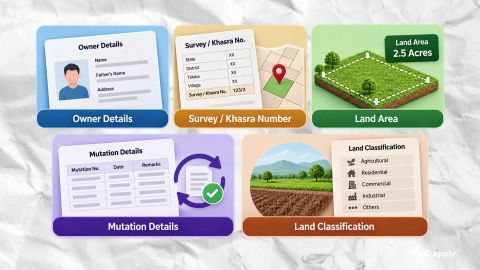
Land Records Guide
Goa's land record system traces back to Portuguese rule, which ended in 1961. It still uses Form I and Form XIV, not the Khatauni or Record of Rights terminology common elsewhere in India. Buyers checking a Goa property need to understand this system specifically, since assuming mainland terminology or portals applies here leads nowhere.
- Form I: the primary ownership record, listing owner name, survey number, area, and land type
- Form XIV: the mutation register, tracking ownership changes over time
- Form D: the tenancy register, recording mundkar (cultivator) rights that survive a sale
- Portal: egov.goa.gov.in, covering Goa's 2 districts and 12 talukas
- Encumbrance check: a separate step, done at igrgoa.gov.in
Verify all three forms before any purchase. Tenancy rights under Form D can bind a buyer regardless of what Form I shows.
Should you worry about buying Goa property with an unfamiliar record system?
This is the real hesitation most non-Goan buyers have: the unfamiliar terminology (Form I, Form XIV, Mamlatdar, mundkar) feels like a genuine barrier compared to buying in a state where Khatauni or RoR terminology is already familiar. The honest answer is that the underlying due diligence goals are identical — confirm ownership, confirm no adverse claims, confirm no third-party rights — only the specific document names and portal differ.
The realistic alternative categories a Goa buyer weighs are:
- Doing the verification independently using the portal and Mamlatdar's office directly
- Engaging a local property lawyer to run the full Form I/XIV/D and encumbrance check on your behalf
- Relying solely on the seller's and broker's representations
The third option carries meaningfully more risk than the first two, given how much Goa-specific nuance (CRZ zones, mundkar tenancy, sub-division numbers) an outside buyer is unlikely to know to ask about unprompted.
Show more
Show less
Why does Goa use Form I and XIV instead of Khatauni?
Goa was under Portuguese administration until 1961, and its land record system retained the Portuguese cadastral framework rather than adopting the British-era revenue terminology (Khatauni, Jamabandi, RoR) used across most of mainland India after independence.
| Attribute | Detail |
|---|---|
| Form I | Ownership record — survey number, area, land type, owner name |
| Form XIV | Mutation register — tracks ownership changes |
| Form D | Tenancy register — records mundkar (cultivator) rights |
| Portal | egov.goa.gov.in |
| Coverage | 2 districts (North Goa, South Goa), 12 talukas |
A buyer relying on Khatauni-based due diligence habits from another state risks missing Goa-specific requirements — particularly Form D, which has no direct equivalent in most other states' systems.
Two districts and 12 talukas cover the whole state, which sounds simple compared to a mainland state's dozens of districts. In practice, the smaller scale means the Mamlatdar's office structure is easier to navigate in person than a larger state's revenue bureaucracy, but the Portuguese-derived terminology still requires deliberate learning rather than assuming it maps directly onto Khatauni-based experience from elsewhere.
Show more
Show less
How do I search Goa land records online?
- Visit egov.goa.gov.in and navigate to Land Records or Department of Settlement and Land Records services.
- Select the service type — Form I, Form XIV, or survey number search.
- Choose your taluka from Goa's 12 (Panaji, Tiswadi, Bardez, Pernem, Bicholim, Satari, Ponda, Mormugao, Salcete, Quepem, Sanguem, Canacona).
- Select the village (Ganv/Cidade).
- Enter the survey number, including any sub-division ("Pt.") number, or search by owner name.
- View and download the Form I record.
- Cross-check the downloaded record's survey number against your sale agreement before proceeding further.
Goa's digitisation is incomplete in some talukas — where the portal returns no result for a property you know exists, the Mamlatdar's office (the taluka-level revenue officer) can search physical records directly.
Show more
Show less
What is Form D, and why does it matter before you buy?
Form D is Goa's tenancy register, recording mundkar and cultivator rights under the Goa, Daman and Diu Agricultural Tenancy Act. This is the specific document most buyers overlook, since it addresses a right separate from ownership itself.
| Attribute | Detail |
|---|---|
| Governing law | Goa, Daman and Diu Agricultural Tenancy Act |
| Records | Mundkar and cultivator occupancy rights |
| Survives a sale? | Yes — a registered tenant's rights bind the new owner |
| Most relevant for | Agricultural or older residential land |
A registered tenant's occupancy rights survive a sale — a property with an active Form D entry cannot be delivered vacant to a new buyer, regardless of what the sale agreement states. Check Form D for any survey number before finalising a purchase, particularly for agricultural or older residential land where tenancy arrangements are more common than in newly developed plots.
Show more
Show less
Home loan for professionals
How do I check for mortgages or claims on a Goa property?
Form I and Form XIV establish ownership and mutation history, but neither confirms whether a mortgage or other registered claim exists against the property — that check happens separately.
| Check | Where |
|---|---|
| Ownership and mutation | egov.goa.gov.in (Form I, Form XIV) |
| Tenancy rights | Form D, same portal |
| Registered mortgages/ claims | igrgoa.gov.in (Inspector General of Registration, Goa) |
Treating the Form I/XIV check as complete due diligence on its own is a common gap — the encumbrance search at igrgoa.gov.in is a separate, necessary step covering a different category of risk entirely. A property can show perfectly clean ownership history on Form I while still carrying an active mortgage that only the encumbrance search reveals.
Show more
Show less
A worked example: verifying a coastal Goa plot
Consider Fernando, a 42-year-old hospitality business owner in Panaji with a household income of Rs. 1.6 lakh a month and a CIBIL Score of 758, evaluating a plot near Goa's coast for Rs. 95 lakh.
| Check completed | Result |
|---|---|
| Form I (egov.goa.gov.in) | Confirmed current owner matches seller |
| Form XIV | Confirmed mutation from previous sale is complete |
| Form D | No registered tenancy found |
| Encumbrance (igrgoa.gov.in) | No registered mortgage found |
| CRZ status | Confirmed with local Town and Country Planning office |
Because the plot sits near the coast, Fernando additionally confirms Coastal Regulation Zone (CRZ) classification separately, since CRZ status affects what can be built regardless of what the land records show. Fernando's total verification took under a week, spread across two portal sessions and one in-person visit to the Town and Country Planning office for the CRZ confirmation specifically.
Show more
Show less
Financing your Goa property with Bajaj Finance
| Loan feature | Detail |
|---|---|
| Interest rate | From 7.25% p.a.* |
| Loan amount | Up to Rs. 15 crore* |
| Tenure | Up to 32 years |
Bajaj Finance verifies Form I, Form XIV, Form D, and encumbrance status as part of standard legal due diligence before disbursing a home loan against Goa property, with CRZ classification checked separately for coastal parcels. Check your home loan eligibility once your property's records clear verification.
Show more
Show less
Frequently Asked Questions
About Goa's land record system
Due diligence before buying
Does Mahabhulekh or any Maharashtra portal cover Goa property?
No. Goa is a separate state with its own record system — Form I and XIV under the Portuguese-era survey framework. Mahabhulekh (mahabhulekh.maharashtra.gov.in) covers Maharashtra only. For Goa, use egov.goa.gov.in or the local Mamlatdar's office.
What happens if my property search shows a sub-division number I don't recognise?
Goa survey numbers commonly include a sub-division marked "Pt." (short for the Portuguese "Parte," meaning part) — search using this exact sub-division number, since omitting it can retrieve the wrong parcel's record entirely.
Can a seller deliver vacant possession if Form D shows a registered tenant?
No, not without resolving the tenancy first. A registered mundkar or cultivator's occupancy rights under Form D survive a sale, meaning the buyer inherits a property with an existing occupant they cannot simply remove. Resolve any Form D entry before finalising a purchase, not after.
Is a coastal Goa property's CRZ status shown on Form I?
No. Form I confirms ownership and land classification but not Coastal Regulation Zone status specifically. Check CRZ classification separately with the local Town and Country Planning office for any coastal or near-coastal parcel, since this affects construction permissions independent of the ownership record.
Home Loan in Different Cities

Home Loan in Mumbai

Home Loan in Ahmedabad

Home Loan in Bangalore

Home Loan in Chennai

Home Loan in Delhi

Home Loan in Hyderabad

Home Loan in Cochin

Home Loan in Noida

Home Loan in Pune
Home Loan for different budget
Check your pre-approved offer now
Our Calculators






What do our customers say about us
customers
Play Store rating
reviews
Amit Shiva
Reviewed on
Smooth and transparent home loan process. The interest rates were competitive, and documentation was minimal. The team guided me clearly at every step, making my first home purchase stress-free. Highly recommended for quick approvals.
Sandeep Kulkarni
Reviewed on
The loan disbursal was fast, and the customer support team was extremely patient with all my queries. Flexible EMIs helped me manage my monthly expenses easily. A great experience for salaried homebuyers.
Ritika Agarwal
Reviewed on
I had a great experience while transferring my existing home loan. The process was quick, and I saved significantly with the lower interest rate. Customer service was helpful throughout. Highly recommended for balance transfers.
Manoj Verghese
Reviewed on
Clear guidance, quick approval, and flexible repayment options made buying my new house easier than expected. The team handled everything professionally. Very satisfied and would definitely recommend their home loans
Find your nearest branch

More Articles




Watch our videos

Documents required to get a Bajaj Finserv Home Loan

Tips to increase your Home Loan eligibility

Things you need to know about pre-approved home loan

Things you need to know before applying for a Home Loan

How does Repo Rate affect your Home Loan

Download App
Now request money from your friends and family and make instant payments.

- Choose from personal, business, gold loans and more
- Pay utility bills, use UPI, get FASTag and more
- Buy over 1 million products on No Cost EMI
- Buy stocks, mutual funds and invest in FD
Disclaimer
1. Bajaj Finance Limited (“BFL”) is a Non-Banking Finance Company (NBFC) and Prepaid Payment Instrument Issuer offering financial services viz., loans, deposits, Bajaj Pay Wallet, Bajaj Pay UPI, bill payments and third-party wealth management products. The details mentioned in the respective product/ service document shall prevail in case of any inconsistency with respect to the information referring to BFL products and services on this page.
2. All other information, such as, the images, facts, statistics etc. (“information”) that are in addition to the details mentioned in the BFL’s product/ service document and which are being displayed on this page only depicts the summary of the information sourced from the public domain. The said information is neither owned by BFL nor it is to the exclusive knowledge of BFL. There may be inadvertent inaccuracies or typographical errors or delays in updating the said information. Hence, users are advised to independently exercise diligence by verifying complete information, including by consulting experts, if any. Users shall be the sole owner of the decision taken, if any, about suitability of the same.