








Rs. 2 lakh – Rs. 30 crore
Check your pre-approved medical equipment loan
Enter mobile and OTP | Check offer | Know your exact loan terms
In summary
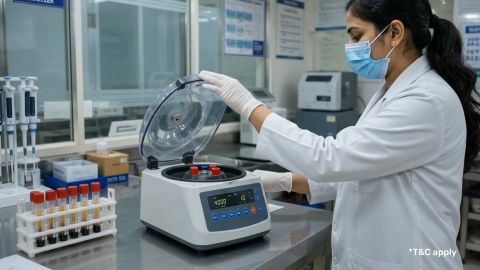
Centrifuge Machine for Labs
A centrifuge machine is used to separate components of laboratory samples by spinning them at controlled speeds.
- A centrifuge separates substances based on differences in density
- It uses centrifugal force to separate components within a sample
- Centrifuges are commonly used in hospitals, diagnostic laboratories, blood banks and research facilities
- Different types are available for applications such as blood separation, sample preparation and specialised laboratory testing
- Centrifuges vary in capacity, maximum speed, rotor configuration and temperature-control capabilities
- The price depends on the type, capacity, speed, rotor, features, brand and other specifications
- Medical Equipment Finance may help eligible healthcare facility promoters to fund the purchase of laboratory equipment
Selecting the right centrifuge involves considering the type of samples, required speed, capacity, temperature requirements, laboratory workflow and long-term ownership costs.
Last updated: September 2026
What is a centrifuge machine?
-
A centrifuge machine is laboratory equipment that uses centrifugal force to separate components of a sample based on their density. During operation, samples placed in tubes or containers are rotated at a controlled speed. The spinning motion causes denser components to move towards the outer or bottom portion of the sample container, while less-dense components remain closer to the centre or upper portion. The resulting separation allows laboratory professionals to collect and analyse specific components. Centrifuges are available in different configurations depending on their speed, capacity, rotor design, temperature control and intended application.
How does a centrifuge machine work?
A centrifuge separates sample components by rotating them at high speed. The centrifugal force generated during rotation causes particles or substances with different densities to separate.
A typical centrifugation process involves:
- Preparing the samples: Laboratory samples are placed into suitable centrifuge tubes.
- Balancing the load: Tubes are positioned appropriately to maintain balance during rotation.
- Selecting the settings: The operator selects the required speed, time and other settings based on the sample and procedure.
- Starting the centrifuge: The rotor spins at the selected speed, generating centrifugal force.
- Separating the sample: Components move according to their density, creating distinct layers or a separated pellet and liquid phase.
- Collecting the separated components: After the cycle is complete, the operator removes the samples and proceeds with the required laboratory analysis.
The appropriate speed, rotor and operating conditions depend on the sample and laboratory procedure.
What are the types of centrifuge machines?
Centrifuges can be classified based on their design, speed, temperature-control capabilities and intended application.
| Type | What it means | Common application |
|---|---|---|
| Benchtop centrifuge | Compact centrifuge designed to fit on a laboratory workbench | Routine sample processing in clinics and laboratories |
| Microcentrifuge | Designed for small-volume samples and microtubes | Molecular biology and laboratory research |
| Refrigerated centrifuge | Maintains a controlled temperature during centrifugation | Temperature-sensitive samples and specialised laboratory applications |
| High-speed centrifuge | Operates at high rotational speeds for specialised separation | Research and advanced laboratory applications |
| Ultracentrifuge | Designed for extremely high centrifugal forces | Advanced research and specialised biological applications |
| Blood bank centrifuge | Designed for processing blood and blood components | Blood banks and transfusion-related laboratories |
The appropriate centrifuge depends on sample volume, required separation, operating speed, temperature requirements and laboratory workflow.
Check your pre-approved medical equipment loan offer
What are the uses of a centrifuge machine?
Centrifuges are used across several medical, laboratory and research applications.
- Blood component separation
Centrifuges can be used to separate blood into components such as plasma, serum and cellular fractions, depending on the procedure.
- Sample preparation
Laboratories use centrifugation to prepare samples before further testing or analysis.
- Cell separation
Centrifugation can help separate cells or cellular components from liquid samples.
- Molecular and biological research
Specialised centrifuges are used in research procedures involving DNA, RNA, proteins, organelles and other biological materials.
- Pharmaceutical applications
Centrifuges may be used during various laboratory and pharmaceutical processes involving sample separation and analysis.
- Diagnostic laboratory testing
Diagnostic laboratories use centrifuges as part of sample-processing workflows before conducting different tests.
Centrifuge machine rotors
The price of a centrifuge machine in India varies depending on its type, capacity, maximum speed, rotor configuration, temperature-control capabilities, brand and additional features.
Here are the top-selling centrifuge machine models along with their prices:
| No. | Product | Price |
| 1 | HoverLabs HV-10M Laboratory Centrifuge Machine | Rs. 36,700 |
| 2 | Remi R8C Centrifuge Machine | Rs. 49,863 |
| 3 | MLabs Bench Top Doctor Centrifuge Machine | Rs. 2,650 |
| 4 | Remi C-852 Laboratory PRP Centrifuges Machine | Rs. 7,403 |
| 5 | Remi R-303 8×15 ml Capacity Doctor Centrifuge | Rs. 9,056 |
Healthcare and laboratory facilities should compare the equipment's specifications and total ownership cost rather than selecting a centrifuge based only on its initial price.
Get professional loan for your needs

Personal loan for doctors for wedding
Get doctor loan for for wedding

Chartered accountant loan
Get CA loan with minimal documents

CA loan for setting practice
Get CA loan for setting up your practice

CA loan for office renovation
Get CA loan for renovating office

Business loan for lawyer
Get business loan for lawyer today

Business loan for CA
Get business loan for CA today
Medical equipment finance for diagnostic centre
Setup diagnostic centre with medical equipment finance

Personal loan for lawyer
Get a personal loan for lawyer

Personal loan for doctors for wedding
Get a personal loan for wedding

Personal loan for doctors
Get a personal loan for doctor

Personal loan for CA
Get a personal loan for CA
Medical equipment finance
Get a medical equipment finance

Lawyer loan to start firm
Get a lawyer loan to start firm

Lawyer loan for Chamber
Get a lawyer loan for Chamber

Lawyer loan
Get a lawyer loan

Hospital loan
Get a hospital loan

Doctor loan for setting up practice
Get a doctor loan for setting up practice
Doctor loan for clinic renovation
Get a doctor loan for clinic renovation

Doctor loan
Get a doctor loan
How can you finance a centrifuge machine?
Purchasing laboratory equipment can require a significant investment, particularly for diagnostic centres, hospitals and laboratory settings up new facilities or expanding their testing capabilities. Medical Equipment Finance can help eligible doctors and healthcare facility promoters fund the purchase of medical equipment. Bajaj Finance offers Medical Equipment Finance from Rs. 2 lakh to Rs. 30 crore, with repayment tenures ranging from 3 months to 120 months, subject to applicable eligibility criteria and terms.
Why consider medical equipment finance for a centrifuge machine?
Depending on eligibility and applicable terms, financing may help healthcare providers:
- Purchase a centrifuge without paying the entire equipment cost upfront
- Equip a new diagnostic or pathology laboratory
- Upgrade outdated laboratory equipment
- Expand sample-processing capacity
- Purchase multiple pieces of medical or laboratory equipment
- Plan equipment expenditure through structured repayments
Preserve available funds for other operational requirements
Bajaj Finance Medical Equipment Finance is available to doctors and healthcare facility promoters, subject to applicable eligibility criteria and documentation. Check your eligibility for Medical Equipment Finance from Bajaj Finance and fund your DEXA scanner purchase with a suitable financing option.
Our loan variants
Use our popular calculators






Types of medical equipment loan

Business loan for doctors

Business loan for chartered accountants

Set up a diagnostic centre with medical equipment finance

How to start a law firm in India

Doctor loan for clinic renovation
Frequently asked questions
Overview
What is the use of a centrifuge machine?
A centrifuge machine is used to separate substances of different densities within a liquid or suspension. It finds extensive applications in various industries, including healthcare, biotechnology, pharmaceuticals, and research laboratories. In healthcare, centrifuges are commonly used for separating blood components, isolating DNA, and preparing samples for diagnostic testing.
What is the working principle of centrifuge?
The working principle of a centrifuge is based on centrifugal force, which causes denser substances to move outward and settle at the bottom of a rotating container while lighter substances move towards the center. This rapid spinning motion separates components based on their density, enabling efficient isolation and analysis of different substances.
What is a centrifuge and its types?
A centrifuge is a laboratory device that utilizes centrifugal force to separate substances suspended in a liquid. There are several types of centrifuges, including laboratory centrifuges used for routine laboratory tasks, clinical centrifuges designed for medical and diagnostic purposes, and refrigerated centrifuges equipped with cooling systems to maintain sample integrity during separation.
Are centrifuge machines expensive?
Centrifuge machines vary in price based on type and capacity. Basic models can cost a few thousand INR, while high-end ultracentrifuges can range from 800,000 INR to 4,000,000 INR.
What is the cost of a 16-tube centrifuge machine?
A 16-tube digital laboratory centrifuge typically costs around 22,000 INR. Prices can vary based on features and specifications.
Who should buy a centrifuge machine for their clinic or hospital?
Clinics and hospitals that regularly process blood, urine, tissue or other laboratory samples may benefit from a centrifuge machine. Diagnostic centres, pathology labs, blood banks and research facilities can also consider one based on their testing volume and sample-processing requirements.
Can you buy a centrifuge machine using a medical equipment loan?
Yes, eligible healthcare professionals and healthcare facility promoters may be able to finance a centrifuge machine through Medical Equipment Finance, subject to applicable eligibility criteria, documentation, loan amount, tenure and lender terms. This can help manage the equipment purchase cost through structured repayments.
When should a hospital upgrade or replace its centrifuge machine?
A hospital should consider upgrading or replacing its centrifuge when it becomes outdated, requires frequent repairs, shows inconsistent performance, has limited capacity or speed, lacks essential safety features, or no longer meets the laboratory’s sample-processing requirements and workflow needs.
Which factors should you check before buying a centrifuge machine?
Before buying a centrifuge machine, check its type, maximum speed, capacity, rotor configuration, temperature-control features, safety mechanisms, ease of operation, maintenance requirements, service support, space requirements, compatibility with laboratory procedures, and total cost of ownership.
What do our customers say about us
Dr. Rohan Mehta
Reviewed on
I applied for a doctor loan to upgrade my clinic infrastructure, and the experience was excellent. The application process was simple, the documentation was minimal, and the approval came through quickly. The team guided me throughout the process and ensured a seamless experience. I would highly recommend this financing option to medical professionals looking for reliable funding support.
Dr. Priya Sharma
Reviewed on
The doctor loan helped me manage my professional expenses without any financial stress. The loan disbursal was fast, and the customer support team was always available to answer my questions. The repayment options were flexible and suited my financial requirements perfectly. Overall, I am very satisfied with the service and support provided.
Dr. Arvind Nair
Reviewed on
I availed a doctor loan to purchase advanced medical equipment for my practice. The entire process was smooth, transparent, and completed within a short time. The competitive interest rates and hassle-free documentation made the experience even better. The support team remained helpful at every stage, making the loan journey convenient and stress-free.
Dr. Neha Kapoor
Reviewed on
I needed financial assistance to expand my healthcare practice, and this doctor loan proved to be the right solution. The approval process was quick, and the team provided clear guidance from application to disbursal. The flexible repayment tenure helped me plan my finances effectively. I am pleased with the overall experience and would recommend it to fellow doctors.
More articles


Disclaimer
Bajaj Finance Limited has the sole and absolute discretion, without assigning any reason to accept or reject any application. Terms and conditions apply*.