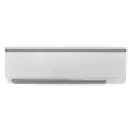
An AC with a built-in air purifier cools the room while simultaneously passing indoor air through filtration layers that capture pollutants — delivering two functions from a single appliance without the space or cost of a standalone purifier.
- Multi-stage filtration during every cooling cycle: The AC's blower circulates room air through a pre-filter, a PM2.5 or PM0.1 filter, and an anti-bacterial layer during each cooling cycle — passively purifying the air continuously without requiring separate activation from the user.
- Active purification technologies go beyond trapping: Panasonic's nanoe-X releases hydroxyl radicals that break down bacteria, viruses, and odours in the air. LG's Cationic Silver ion HD Filter actively inactivates pathogens on the filter surface — offering stronger protection than passive particle trapping alone.
- Air quality sensors on select models: LG ThinQ and Panasonic MirAIe-enabled models include indoor PM2.5 sensors that display real-time air quality readings on the indoor unit panel or app — allowing you to verify that purification is functioning effectively during daily cooling operation.
Benefits of using an air conditioner with a built-in air purifier
ACs with built-in purification actively improve the air you breathe during cooling — a meaningful daily health benefit for Indian households in cities with consistently elevated AQI throughout the year.
- Removes PM2.5 and fine airborne pollutants: Built-in PM2.5 and PM0.1 filters capture vehicle exhaust particles, construction dust, and smoke during every cooling cycle — reducing daily pollutant exposure in sealed indoor environments where most urban Indian households spend 8 to 12 hours each summer day.
- Reduces allergens for sensitive household members: Anti-dust and anti-bacterial filter layers capture pollen, pet dander, mould spores, and dust mite particles — meaningfully reducing airborne allergen concentrations for household members with asthma, rhinitis, or seasonal allergies during sustained indoor daily AC use.
- Eliminates the need for a separate standalone purifier: A combined AC with air purifier removes the cost, floor space, and electricity of running a dedicated purifier alongside a standard AC — a practical consolidation that simplifies daily appliance management and reduces total household energy use during summer.
- Continuous passive purification without user effort: Unlike a standalone purifier that requires separate activation, an AC with built-in filtration cleans the air automatically every time the cooling cycle runs — delivering consistent daily purification without any additional monitoring or switching on from household members.
- Self-cleaning maintains filter effectiveness: Auto-clean functions on Panasonic DustBuster and LG models dry the filter and coil after each session — preventing mould growth and maintaining purification efficiency across the full operating season without frequent manual cleaning effort.
Types of ACs with air purifiers: Split, window, and inverter models
ACs with air purification are available across all major configurations in India — each suited to a different room type, installation setting, and air quality requirement.
- Split inverter AC with air purifier: The most capable and widely available format — models such as the LG US-Q19YNZE3 with HD Anti-Virus Filter, Panasonic CS/CU-NU18BKY5WX with PM0.1 filtration, and Blue Star IC518YTUU with PM2.5 filter combine inverter efficiency with multi-layer purification for standard Indian rooms of 120 to 180 sq ft.
- Window AC with air purifier: Select Voltas and Blue Star window models include anti-dust and anti-microbial filter layers — practical for renters and institutional spaces where split installation is not feasible. Purification capability is more basic than premium split models but provides meaningful improvement over standard dust-only window AC filtration.
- Cassette AC with air purifier: Blue Star and Daikin cassette ACs combine multi-directional airflow with PM2.5 filtration — suited to large offices, clinics, and open-plan spaces where a wall-mounted split AC cannot cover the full floor area from a single installation point.
Top features to look for in an AC with an air purifier
The right combination of filter grade, active purification, and smart monitoring determines whether an AC genuinely improves indoor air quality or simply markets basic dust filtration as a premium feature.
- PM0.1 filter for the finest particle capture: PM0.1 filters — available on Panasonic's 2026 range — capture particles as small as 0.1 micrometres, significantly finer than standard PM2.5 filters. This captures ultrafine pollutants including nano-particles and fine bacterial aerosols that standard 2.5-micrometre filters allow to pass through entirely.
- Anti-viral and anti-bacterial filter coating: LG's Cationic Silver ion HD Filter actively inactivates bacteria and viruses on the filter surface rather than simply trapping them — a meaningful distinction for households in high-density Indian urban environments where airborne pathogen load is a genuine daily health concern for children and elderly members.
- HEPA-grade filtration (H11 to H13): True HEPA filters capture 99.97% of particles at 0.3 micrometres or larger. While most AC-integrated filters do not reach full H13 standard, Panasonic's PM0.1 models approach this level of performance — making filter specification one of the most important comparison points when evaluating air purifying ACs.
- Active purification beyond passive trapping: Panasonic's nanoe-X releases hydroxyl radicals that actively break down pollutants, bacteria, viruses, and odours in the room air — going beyond passive particle capture to deliver purification across the full room volume throughout every cooling session.
- Real-time air quality monitoring: Select LG and Panasonic models include indoor PM2.5 sensors with real-time AQI display on the indoor panel or app — allowing you to monitor air quality and verify purification effectiveness during daily operation across Indian summer months.
AC with air purifier vs standalone air purifier: Which one should you choose
Choosing between an integrated AC with purification and a dedicated standalone purifier comes down to whether you are buying a new AC or adding purification to an existing one.
An AC with a built-in air purifier is the right choice if you are purchasing a new AC — consolidating two functions in one appliance, eliminating the need for additional floor space, and avoiding the running cost of a second electrical appliance. Purification happens passively during every cooling cycle at no additional effort.
A dedicated standalone HEPA H13 purifier is the better choice if you already own a functional AC. True HEPA H13 units capture 99.97% of particles at 0.3 micrometres — stronger than most AC-integrated PM2.5 filters — and operate independently year-round, including during cooler months when the AC is off. For households with severe allergies or asthma in high-AQI cities, combining a standard AC with a dedicated H13 purifier delivers stronger total air quality results than an AC with a basic PM2.5 filter alone.
Best ACs with air purifiers for Indian homes (2026 guide)
Indian AQI data for 2026 confirms consistently poor air quality across Delhi, Mumbai, Gurugram, and Bengaluru — making built-in air purification a practically relevant feature for most urban Indian households rather than a premium add-on.
| Model | Capacity | Filtration | Air purification technology | Price |
|---|
| LG US-Q19YNZE3 5 Star | 1.5 ton | HD Anti-Virus filter | Cationic Silver ion anti-bacterial and anti-viral coating | Rs. 37,990 approx. |
| Panasonic CS/CU-NU18BKY5WX 5 Star | 1.5 ton | PM0.1 ultrafine filter | nanoe-X active purification + DustBuster auto-clean | Rs. 47,990 |
| Blue Star IC518YTUU 5 Star | 1.5 ton | PM2.5 filter | Multi-layer anti-microbial filtration + auto-clean | Rs. 39,990 – Rs. 43,990 |
| Daikin MTKM50UV16VA 5 Star | 1.5 ton | Blue Fin anti-corrosive filter | Dew Clean auto-clean, DNNS self-healing coil | Rs. 38,990 – Rs. 41,500 |
| Samsung WindFree AR18BYFCAWK 5 Star | 1.5 ton | DuraFin Ultra | WindFree micro-hole purification + AI Energy Mode | Rs. 40,990 – Rs. 47,990 |
| LG RS-Q13BNZE 5 Star | 1 ton | HD Anti-Virus filter | Cationic Silver ion coating, Ocean Black Protection | Rs. 30,990 approx. |
Disclaimer: Product features, availability, and prices may differ based on location and time. For the latest and most accurate details, visit a partner store.
Energy efficiency and power consumption of ACs with air purifiers
ACs with built-in purification consume marginally more electricity than standard ACs — but the difference is negligible relative to the compressor's operating load during daily Indian summer use.
- Purification mode adds minimal power draw: Running air through the filter during a normal cooling cycle adds no additional motor consumption — the fan and compressor costs remain identical. Active technologies like Panasonic's nanoe-X draw approximately 1 to 3 Watt continuously — equivalent to Rs. 2 to Rs. 6 extra per month, which is functionally insignificant.
- 5 Star ISEER rating is unaffected by filtration: BEE ISEER ratings measure cooling efficiency only — a 5 Star AC with PM0.1 filtration delivers identical electrical efficiency to a 5 Star standard AC under the same operating conditions, meaning purification does not reduce the energy efficiency advantage of choosing a higher-rated model.
- Filter replacement is the main ongoing cost: PM2.5 and PM0.1 filter replacements cost approximately Rs. 500 to Rs. 2,500 annually depending on brand and filter grade — a modest ongoing expense significantly lower than annual filter replacement for a dedicated standalone HEPA purifier running at equivalent daily purification capacity.
Maintenance tips for ACs with built-in air purification systems
Consistent filter maintenance is more critical in a purifying AC than a standard model — a neglected filter reduces both cooling efficiency and air quality simultaneously.
- Clean PM2.5 or PM0.1 filters every two weeks: Purification filters accumulate pollutants faster in high-AQI Indian cities. Clean every two weeks during active summer use. In cities with AQI consistently above 150 — such as Delhi or Gurugram — increase cleaning frequency to weekly to maintain effective particle capture throughout the daily cooling season.
- Run the auto-clean function after extended cooling sessions: Activate DustBuster (Panasonic) or Auto-Clean (LG, Blue Star) after each long daily use period to dry the coil and filter — preventing mould and bacterial growth that reduces purification effectiveness and indoor air quality during subsequent cooling cycles throughout summer.
- Replace filters at manufacturer intervals, not by appearance: A visually clean PM0.1 or anti-viral filter may still be fully saturated at the microscopic particle capture level. Replace at the recommended interval regardless of appearance — using a saturated filter delivers near-zero purification while creating the false impression that the system is still functioning correctly.
- Schedule annual professional coil cleaning: Urban particulate matter penetrates beyond filter media over time, coating evaporator coils and reducing both cooling capacity and airflow volume through the filter. Annual professional coil cleaning restores full purification performance alongside cooling efficiency before each Indian summer season begins.
- Monitor the app AQI reading after each filter clean: On LG ThinQ and Panasonic MirAIe models, check the indoor AQI reading after each filter cleaning to confirm purification is restored — a sustained elevated reading after cleaning indicates the filter media requires replacement rather than another cleaning cycle.
Is an AC with an air purifier worth it in cities with high pollution?
In Indian cities where indoor AQI regularly exceeds safe thresholds, a purifying AC delivers genuine health value that justifies the Rs. 3,000 to Rs. 8,000 price premium over equivalent standard models for most urban households.
The case is strongest for households with young children, elderly members, or anyone with asthma, rhinitis, or cardiovascular conditions — groups for whom sustained PM2.5 exposure carries measurable health consequences during the 8 to 12 hours an AC typically runs indoors each summer day. For these households, a Panasonic PM0.1 model with nanoe-X or an LG model with Cationic Silver ion HD Filter delivers daily health protection that no standard AC filter provides. For households in moderate-AQI cities or those spending limited time indoors during cooling hours, a standard 5 Star inverter AC with a basic anti-microbial filter provides adequate protection at a lower upfront cost.
How to choose the right AC with an air purifier for your room size
Choosing correctly requires aligning room size, filter grade, and purification technology — rather than selecting the model with the most prominent air purifier claim on the product listing.
- Match AC tonnage to room size first: Cooling capacity determines airflow volume through the filter — an undersized AC that cannot maintain room temperature will not circulate enough air through the purification media effectively. Choose 1 ton for rooms up to 120 sq ft, 1.5 ton for 120 to 180 sq ft, and 2 ton for 180 to 250 sq ft before considering filter specifications.
- Choose PM0.1 or HEPA-grade filtration for high-AQI cities: For Delhi, Gurugram, Noida, Lucknow, and other consistently high-AQI locations, choose PM0.1 filtration (Panasonic) or HEPA-grade media rather than standard PM2.5 — the difference in capture performance at the 0.1 to 0.3 micrometre range is significant for the ultrafine pollutants that dominate India's most polluted urban air environments year-round.
- Prioritise active purification for allergy-prone households: Choose a model with active purification technology — Panasonic's nanoe-X, LG's Cationic Silver ion coating — rather than a passive filter-only model for households with allergy or asthma sufferers. Active purification inactivates allergens and bacteria rather than simply capturing them, delivering more thorough daily protection for sensitive occupants during cooling.
- Verify filter replacement availability before purchasing: A premium AC with PM0.1 filtration only delivers long-term value if replacement filter media is readily available in India. Panasonic, LG, and Blue Star have confirmed authorised filter availability across major Indian cities — verify this for your specific model before committing to a purchase to avoid filter availability issues after the first operating season ends.
Thinking of buying a new AC?
Before you do that, explore the latest offers from Bajaj Finance. You may find a great deal on a model that matches your needs.
Get electronics and appliances on Easy EMIs with Bajaj Finance
Upgrading your home with the latest electronics and appliances is now easier and more affordable with Bajaj Finance’s flexible financing options. You can also maximise your savings by using the Smart Savings Calculator—a smart tool that combines brand offers, dealer offers, and EMI offers, all in one place, helping you lower the overall cost while still paying in small, bite-sized instalments. Follow these steps to get started:
- Explore products on Bajaj Mall: Browse a wide range of electronics and appliances from trusted brands on Bajaj Mall. Compare features like energy ratings, storage capacity, performance settings, and design to choose the right product for your home.
- Visit a partner store: Once you shortlist a model, step into any of Bajaj Finance’s 1.5 lakh partner stores across 4,000 cities in India. See the product in person, talk to experts, and make a confident decision.
- Choose the Easy EMI Loan option: At checkout, select the Bajaj Finance Easy EMI Loan. Avail financing of up to Rs. 5 lakh and split the cost into convenient monthly instalments. Some products also come with a zero down payment option.
- Check your loan eligibility online: Plan better by checking your loan eligibility in minutes. Simply enter your mobile number and OTP to know your pre-approved limit.
- Use the Insta EMI Card for purchases up to Rs. 3 lakh: Already own the Bajaj Finance Insta EMI Card? Use it for instant, paperless checkout and convert your purchases of up to Rs. 3 lakh into Easy EMIs.
Why use the Smart Savings Calculator
Bajaj Finance’s Smart Savings Calculator helps you unlock maximum savings every time you shop at partner stores. It brings together all available brand, dealer, and scheme offers—so you can see your total savings instantly and shop smarter with Easy EMIs.
1. Dealer offers - Grab exclusive in-store deals at over 1.5 lakh partner stores across India. Enjoy local discounts and special prices you will not find online.
2. Brand offers - Access limited-time discounts from top brands across electronics, appliances, and more. Discover brand-specific savings selected just for you.
3. Bajaj offers - Unlock exclusive Bajaj Finance deals on popular products—available only to our customers. More rewards, more value.
4. Scheme offers - Take advantage of time-sensitive offers on select EMI schemes. Get extra benefits after paying just 3 EMIs—visible during EMI selection at checkout.
Calculate your extra savings today!
ACs by brand:
ACs by capacity:
ACs by type:
ACs by budget: