











An OTP will be sent to this number for verification

You may have a pre-approved offer
Enter required home loan amount
In summary
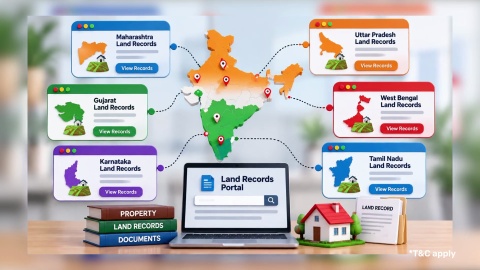
E-services for Land Records in India - Benefits and How to Access in 2026
Last updated: Sept 2026
"E-service" describes a category of government digitisation, not one single national system — searching for "e-service of land records" without your specific state in mind sends you nowhere useful.
- Core meaning: digitised land records made accessible online, rather than only through in-person office visits
- Common services covered: ownership verification, mutation status, cadastral maps, encumbrance checks
- State-specific: each state runs its own portal under its own name (Bhulekh, Banglarbhumi, Mahabhumi, and others)
- Central initiative: the Digital India Land Records Modernization Programme (DILRMP) has driven much of this digitisation nationally
Digitisation completeness varies by state and even by district within a state
Identify your specific state's land record system by name before searching, since "e-service of land records" as a generic phrase doesn't point to one specific portal.
Is there one national e-service portal for Indian land records?
No, and this is the most common misunderstanding behind this search term. Despite a central coordinating initiative (DILRMP) pushing digitisation nationally, each state maintains its own separate portal, terminology, and record structure — there's no single national land records website covering the whole country.
The realistic starting points once you understand this are:
- Identify your specific state, since land records are a state government function, not a central one
- Search for that state's specific portal by name — Bhulekh for several northern states, Banglarbhumi for West Bengal, Mahabhumi for Maharashtra, and others
Use DILRMP's national framework only as background context for understanding why this digitisation happened, not as a search destination itself
Approaching this as "which state, then which portal" rather than searching generically for "e-service of land records" gets to a useful result considerably faster.
Show more
Show less
What services does e-service of land records usually cover?
| Service category | What it provides |
|---|---|
| Ownership verification | Current recorded owner, land area, and classification |
| Mutation tracking | Status of ownership-transfer updates following a sale or inheritance |
| Cadastral/ survey maps | Visual plot boundaries and survey numbers |
| Encumbrance information | Registered mortgages or claims against a specific parcel |
| Certified copy download | Official, often digitally signed, copies of land records |
Not every state's portal offers every one of these services with equal depth — some states have more mature digitisation than others, which is worth checking specifically for your state rather than assuming uniform national coverage.
Show more
Show less
Why does digitisation completeness vary so much between states and districts?
- States began their digitisation efforts at different times, with some starting well before DILRMP's national push and others catching up more recently.
- Historical record-keeping quality varies — states or districts with better-maintained physical records digitised more completely and accurately.
- Urban areas saw digitisation prioritised over remote rural districts as a rule, given administrative capacity constraints.
Ongoing resurveys in some states have temporarily complicated digital records during the transition period.
Where your specific district's online records seem incomplete or inconsistent, this often reflects a genuine digitisation gap rather than an error in your search — the local revenue office remains the fallback for records not yet fully online.
Show more
Show less
A worked example: finding the right portal from a generic starting point
Consider Farhan, a 37-year-old shop owner with a household income of Rs. 1.1 lakh a month and a CIBIL Score of 744, searching generically for "e-service of land records" before realising he needed his specific state's system.
| Step | What Farhan did |
|---|---|
| Initial search | Searched "e-service of land records" generically, found no specific useful result |
| Identified his state | Confirmed the property was in Uttar Pradesh |
| Found the correct portal | Located Bhulekh UP, the state's specific land record system |
| Completed his search | Found the Khatauni record using the state-specific portal directly |
Farhan's initial generic search wasted time precisely because no single national portal exists — narrowing to his specific state immediately got him to a useful result.
Show more
Show less
Home loan for professionals
Why state-specific land records matter for your home loan
| Loan feature | Detail |
|---|---|
| Interest rate | From 7.25% p.a.* |
| Loan amount | From 7.25% p.a.* |
| Tenure | From 7.25% p.a.* |
Bajaj Finance verifies land records through the correct state-specific e-service system as part of standard legal due diligence, regardless of which portal or terminology your specific state uses. Check your home loan eligibility once your property's records are confirmed on the correct state portal.
Show more
Show less
Frequently Asked Questions
Understanding the concept
Practical searching
Is DILRMP itself a portal I can search land records on?
No. DILRMP (Digital India Land Records Modernization Programme) is a central government initiative that funds and coordinates digitisation efforts — it isn't itself a searchable land records portal. Your actual search happens on your specific state's own system.
Why do some states call their system "Bhulekh" and others use a completely different name?
Each state built its own digitisation system independently, often before any coordinated national naming convention existed, resulting in different names (Bhulekh, Banglarbhumi, Mahabhumi, and others) for functionally similar systems. There's no requirement for uniform naming across states.
What should I do if my state's e-service portal doesn't show my expected record?
Visit your local revenue office or the equivalent local authority, since digitisation completeness varies and older or more remote records sometimes remain available only in physical form.
Does e-service land record data carry the same legal weight as a physical certified copy?
This depends on the specific state and document — many states offer digitally signed versions with full legal standing, while unsigned online versions may serve reference purposes only. Confirm your specific state's distinction between signed and unsigned versions before relying on either for a formal transaction.
Home Loan in Different Cities

Home Loan in Mumbai

Home Loan in Ahmedabad

Home Loan in Bangalore

Home Loan in Chennai

Home Loan in Delhi

Home Loan in Hyderabad

Home Loan in Cochin

Home Loan in Noida

Home Loan in Pune
Home Loan for different budget
Check your pre-approved offer now
Our Calculators


What do our customers say about us
customers
Play Store rating
reviews
Amit Shiva
Reviewed on
Smooth and transparent home loan process. The interest rates were competitive, and documentation was minimal. The team guided me clearly at every step, making my first home purchase stress-free. Highly recommended for quick approvals.
Sandeep Kulkarni
Reviewed on
The loan disbursal was fast, and the customer support team was extremely patient with all my queries. Flexible EMIs helped me manage my monthly expenses easily. A great experience for salaried homebuyers.
Ritika Agarwal
Reviewed on
I had a great experience while transferring my existing home loan. The process was quick, and I saved significantly with the lower interest rate. Customer service was helpful throughout. Highly recommended for balance transfers.
Manoj Verghese
Reviewed on
Clear guidance, quick approval, and flexible repayment options made buying my new house easier than expected. The team handled everything professionally. Very satisfied and would definitely recommend their home loans
Find your nearest branch

More Articles




Watch our videos
Documents required to get a Bajaj Finserv Home Loan

Tips to increase your Home Loan eligibility
Things you need to know about pre-approved home loan

Things you need to know before applying for a Home Loan

How does Repo Rate affect your Home Loan

Download App
Now request money from your friends and family and make instant payments.

- Choose from personal, business, gold loans and more
- Pay utility bills, use UPI, get FASTag and more
- Buy over 1 million products on No Cost EMI
- Buy stocks, mutual funds and invest in FD
Disclaimer
1. Bajaj Finance Limited (“BFL”) is a Non-Banking Finance Company (NBFC) and Prepaid Payment Instrument Issuer offering financial services viz., loans, deposits, Bajaj Pay Wallet, Bajaj Pay UPI, bill payments and third-party wealth management products. The details mentioned in the respective product/ service document shall prevail in case of any inconsistency with respect to the information referring to BFL products and services on this page.
2. All other information, such as, the images, facts, statistics etc. (“information”) that are in addition to the details mentioned in the BFL’s product/ service document and which are being displayed on this page only depicts the summary of the information sourced from the public domain. The said information is neither owned by BFL nor it is to the exclusive knowledge of BFL. There may be inadvertent inaccuracies or typographical errors or delays in updating the said information. Hence, users are advised to independently exercise diligence by verifying complete information, including by consulting experts, if any. Users shall be the sole owner of the decision taken, if any, about suitability of the same.