











An OTP will be sent to this number for verification

You may have a pre-approved offer
Enter required home loan amount
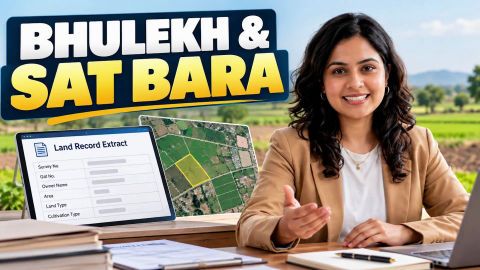
Land Records Explained- Bhulekh & 7-12 Extract
In summary
Bhulekh Tamil Nadu is the common search term for Tamil Nadu's online land-record services, available through the government e-Services portal. Buyers and owners can access records that identify land parcels and their recorded details.
- Patta contains revenue-record information relating to a landholding.
- Chitta records include land-related particulars and classification.
- Field Measurement Book (FMB) sketches show surveyed parcel measurements and boundaries.
- Town Survey Land Register (TSLR) extracts provide relevant urban survey details.
- The portal supports Patta verification, A-Register extracts and government Poramboke land checks.
- Rural searches use survey and subdivision details, while urban searches require the applicable town, ward, block and survey information.
These records support preliminary verification but do not replace registered title deeds or legal due diligence. Confirm the parcel details and approved property use before proceeding with a purchase.
What is Bhulekh Tamil Nadu?
Bhulekh Tamil Nadu refers to the Tamil Nadu government's digital land-record facilities. The official service is the Tamil Nadu e-Services of Land Records portal, which provides access to Patta, Chitta, FMB, TSLR and A-Register information, along with land-verification services. The portal also offers an Integrated Land Record (ILR) service that combines key land-record details in a single digital document.
For example, a person evaluating land near Coimbatore can use the relevant district, taluk, village and survey number to locate available rural records. These details help establish how the parcel is recorded in the government's revenue and survey systems. However, a land-record extract is not, by itself, conclusive proof of legal ownership. A buyer must also examine the registered transaction documents and applicable property permissions.
Source: National Government Services Portal, Tamil Nadu Land Records.
Show more
Show less
Which land records are available online in Tamil Nadu?
Tamil Nadu's land-record system contains different records for revenue entries, land classification, measurements and urban property identification.
| Record | Main purpose |
| Patta | Identifies the recorded landholder and relevant land particulars |
| Chitta | Provides landholding and related land particulars |
| FMB sketch | Shows surveyed measurements and parcel boundaries |
| A-Register extract | Provides village-level land and revenue particulars |
| TSLR extract | Provides urban town-survey and land-register details |
| Integrated Land Record (ILR) | Combines key land-record details, including textual records and FMB or map information, in a single digital document |
| Poramboke verification | Helps check whether land is recorded as government Poramboke land |
These records should be used together where applicable. For example, a Patta record can identify the recorded landholding, while the FMB sketch helps examine the parcel's surveyed shape and dimensions. Neither document independently establishes that every building on the land has the required construction permission.
Source: Cuddalore District Administration, Tamil Nadu Land e-Services.
Show more
Show less
Am I eligible for a home loan?
To qualify for a Bajaj Finance Home Loan, you must meet the following conditions:
- Nationality: Indian citizen residing in India
- Age: Salaried applicants: 23 years to 67 years; Self-employed applicants: 23 years to 70 years (upper age limit is at the time of loan maturity)
- CIBIL Score: 725 or above is recommended for the best approval outcomes
- Employment: Salaried employees, self-employed individuals, and professionals, are all eligible
Income stability: Your debt-to-income ratio and repayment capacity are assessed — no fixed minimum income applies, but your income must comfortably cover EMIs
Skip the guesswork. Enter your mobile number and check your pre-approved loan amount in under 2 minutes — based on your actual profile, not estimates.
How much loan can you get on a Rs. 60,000 monthly salary? On a monthly salary of Rs. 60,000, you may typically qualify for a home loan of approximately Rs. 45 lakh to Rs. 50 lakh, depending on your CIBIL score, existing obligations, and chosen tenure.
Pro-tip: A lot of applicants are surprised by their actual eligibility — either they qualify for significantly more than expected, or a small tweak like clearing an existing credit card balance makes a meaningful difference to the offer.
Show more
Show less
How can you view Patta and Chitta online?
Use the Tamil Nadu e-Services portal to retrieve the available rural land-record extract. The government service identifies records using location and survey information.
Follow these steps:
- Visit the Tamil Nadu land-records e-Services portal.
- Select the relevant service to view Patta, Chitta or FMB details.
- Choose the district and rural-area option.
- Select the relevant taluk and village.
- Enter the required survey number and subdivision number.
- Complete any verification displayed by the portal.
- Review the available extract and identify the recorded parcel details.
The portal's options may vary depending on the selected record and location. For urban properties, the required details may include the town, block and ward instead of the rural taluk and village. Before relying on the result, match the survey number and subdivision against the registered property documents. A name match alone is insufficient to establish that the correct parcel has been located.
Source: Government of India, View Tamil Nadu Patta/Chitta/FMB.
Show More
Show Less
What information should you check in a Patta extract?
Review the recorded landholder, survey identifier, subdivision, extent and other particulars displayed in the extract. The purpose is to confirm that the revenue-record details correspond with the property being examined.
For example, a sale deed may refer to Survey No. 120/2A, while the seller supplies a Patta extract for Survey No. 120/2B. This difference must be investigated before proceeding, as it can indicate a different parcel, a subdivision issue or a record requiring clarification. Do not assume that similar survey numbers refer to the same property.
Compare the extract with the registered title document, relevant survey records and official subdivision details. If the particulars do not match, seek clarification from the relevant revenue authority.
Show more
Show less
Home loan for professionals
What is the difference between Patta and Chitta?
Patta and Chitta provide related information within Tamil Nadu's revenue-record system. Patta identifies the recorded landholding and associated particulars, while Chitta contains landholding details, including information related to the land's classification. The state's online system provides access to relevant Patta and Chitta information through its land-record services.
For a buyer, the important question is whether the records are consistent with the registered property details. For example, if the intended purchase concerns land represented as suitable for residential development, the recorded classification must be checked against the required land-use approvals. A revenue classification is not a substitute for planning permission.
Source: Tamil Nadu Government, Land e-Services.
Show more
Show less
How do you check land boundaries using FMB?
The Field Measurement Book (FMB) contains survey information used to identify parcel measurements and boundaries. An FMB sketch helps a buyer compare the surveyed land parcel with the physical site and registered documents.
To review it:
- Open the official Tamil Nadu land-records portal.
- Select the available FMB viewing service.
- Enter the required district and rural survey details.
- Retrieve the relevant sketch.
- Compare the survey and subdivision identifiers with the property documents.
- Arrange a qualified site survey if the physical boundaries are disputed or unclear.
For example, a land parcel described as 2,400 sq. ft. in a sale agreement must be checked against its relevant survey and title records. If the measured extent differs, the issue must be resolved before the buyer relies on the proposed area. The online sketch supports this check but does not replace an official boundary survey where required.
Source: Cuddalore District Administration, FMB and Land Record Services.
Show more
Show less
How can you check urban land records through TSLR?
Town Survey Land Register (TSLR) extracts provide relevant survey information for urban properties covered by the town-survey system. The government portal distinguishes rural and urban searches. Urban records may require information such as the town, ward, block, survey number and subdivision.
For example, a purchaser checking an urban parcel in Chennai should identify the relevant town-survey details from the property's documents. They should not rely on a rural village survey search when the property belongs to a town-survey area.
After locating the extract, compare the identifiers and recorded extent with the registered title. A TSLR record assists identification and verification but does not establish that the building has all the required planning approvals.
Source: National Government Services Portal, Tamil Nadu Rural and Urban Land Records.
Show more
Show less
What is an A-Register extract?
The A-Register contains village-level land and revenue particulars used in Tamil Nadu's record system. The e-Services portal provides a facility to view the available A-Register extract. This record helps users examine the parcel's revenue and survey information alongside the Patta, Chitta and FMB details.
For example, an investor considering land near Madurai can compare the A-Register entry with the survey number supplied by the seller. If the recorded details differ from the registered sale deed, the buyer should seek an explanation and supporting official documents. The A-Register is an additional verification resource, not a replacement for establishing the legal chain of title.
Source: National Government Services Portal, Tamil Nadu e-Services.
Show More
Show Less
How do you check Poramboke land status?
Tamil Nadu's e-Services portal includes a facility to verify whether land is recorded as government Poramboke land. This check is important when evaluating land that a seller describes as privately owned.
Start by retrieving the relevant survey and subdivision details. Use the portal's Poramboke verification service and compare the result with the available land records. If the parcel is identified as government land, do not proceed on the assumption that a private seller can transfer valid ownership.
A property may require further investigation even if one available extract appears consistent with the seller's documents. The buyer should resolve government-land or classification concerns with the relevant authority before paying an advance.
Source: Tamil Nadu Government, Verify Poramboke Land.
Show More
Show Less
Can you apply for a Patta transfer online?
Tamil Nadu's land-record services include facilities relating to Patta transfer and application-status tracking. A Patta transfer updates the relevant revenue record following a qualifying change in landholding, subject to the prescribed process. The supporting documents and applicable procedure depend on the transaction and the relevant revenue authority.
For example, after completing a registered land purchase, a buyer can check the transfer process and submit the required information through the available official service. The applicant should preserve the acknowledgement and check the status until the relevant record is updated.
A Patta transfer does not replace registration of the legal conveyance. Likewise, a pending transfer should not be treated as proof that the proposed purchaser already holds a complete, undisputed legal title.
Source: Cuddalore District Administration, Apply for Patta Transfer and Track Status.
Show More
Show Less
Does a Patta prove legal ownership?
A Patta is an important revenue record, but it should not be treated as conclusive proof of legal title on its own. Title must be assessed through the registered conveyance and the relevant chain of ownership documents.
For example, a person may be named in a revenue record while a disagreement exists over inheritance, a registered transfer or another legal interest. Checking the Patta alone would not settle that dispute.
A prospective buyer should therefore review the registered sale deed, earlier title documents and relevant encumbrance records. The required scope of verification depends on the transaction and property history. The Patta should support the legal-document review rather than replace it.
Show More
Show Less
What documents should you verify before buying land?
Before purchasing land in Tamil Nadu, compare the revenue and survey records with the seller's registered title documents. A practical document checklist includes:
- Registered sale deed or other relevant ownership document.
- Earlier title documents establishing the chain of transfers.
- Available Patta and Chitta records.
- Relevant FMB sketch or town-survey records.
- A-Register details where applicable.
- Registered encumbrance information for the relevant search period.
- Applicable land-use and planning permissions.
- Building approvals and completion-related records where relevant.
For example, a registered sale deed and a matching Patta can establish consistency between two documents, but they do not automatically establish that construction on the land is approved. Similarly, an encumbrance search identifies relevant registered transactions within its scope; it does not guarantee the absence of every possible legal claim.
Resolve significant discrepancies before making a binding financial commitment.
Show More
Show Less
How can land-record errors affect a property purchase?
Incorrect survey identifiers, mismatched extents or outdated revenue entries can delay a transaction and complicate property verification.
Consider Kavya, a 33-year-old professional in Coimbatore. She earns Rs. 1 lakh monthly and is considering a residential plot. The seller's sale deed identifies a particular subdivision, but the available revenue record displays a different subdivision.
Kavya should not ignore the difference because both documents mention the same village. She must establish the exact parcel through the relevant records and obtain clarification from the appropriate authority. If the discrepancy relates to a subdivision update, the supporting official records should establish that change.
Only after resolving the mismatch should she evaluate the proposed price and financing. This sequence prevents the borrowing decision from getting ahead of the property verification.
Show More
Show Less
How do Tamil Nadu land records affect home loan approval?
Land records form part of property verification, but home loan approval also depends on the borrower's income, credit profile and the property's legal and technical suitability.
For example, Kavya may identify a residential property priced at Rs. 60 lakh and plan a Rs. 15 lakh contribution. Her indicative financing requirement would be Rs. 45 lakh, excluding separately payable transaction costs.
If the relevant property documents are consistent and the property meets the lender's requirements, she can then assess affordability. At an illustrative interest rate of 7.50% p.a. over 20 years, a Rs. 45 lakh loan has an EMI of approximately Rs. 36,252. The estimate does not establish loan approval. The lender must assess Kavya's financial obligations and the property.
Bajaj Finance offers home loans of up to Rs. 15 crore*, with interest rates starting from 7.50% p.a.* for eligible salaried applicants. The maximum tenure is 40 years*, subject to eligibility.
Once the property's records and legal status are clear, Kavya can check her Bajaj Finance Home Loan eligibility before proceeding with the purchase.
What if the land records do not match?
If the Patta, Chitta, FMB, TSLR or registered property documents contain inconsistent details, identify the nature of the discrepancy before taking further action. A survey-number mismatch requires a different investigation from an incorrect recorded name or extent.
Start by collecting the relevant current extracts and registered documents. Then contact the responsible revenue or survey authority for the applicable clarification or correction process. Where the issue concerns the legal title, seek a review of the supporting conveyance and ownership records.
Do not rely on informal assurances that an incorrect entry can be fixed after registration. A lender can also request further documents or decline a property that does not satisfy its legal and technical criteria.
Show More
Show Less
What should you do before relying on Tamil Nadu Bhulekh?
Use the official Tamil Nadu e-Services portal as the starting point for land-record checks. Identify the correct rural or urban record and confirm the relevant survey and subdivision information.
Then compare the extract with the registered title, encumbrance information and required land-use or construction approvals. Where the documents do not agree, resolve the discrepancy with the responsible authority.
If you are purchasing a residential property, establish the full cost and expected EMI only after confirming that the property is suitable for the intended transaction. The correct order is to verify the property first and assess financing next.
Frequently Asked Questions
Accessing Tamil Nadu land records
Ownership and property verification
Financing a verified property
What is Bhulekh Tamil Nadu?
Bhulekh Tamil Nadu is the search term used for Tamil Nadu's online land-record services. The official e-Services portal provides access to Patta, Chitta, FMB, TSLR and A-Register information. Users can also verify Pattas and government Poramboke land records. The available search depends on whether the parcel is in a rural or urban survey area. These records support verification but do not replace registered title documents.
How do I check Patta and Chitta online?
Visit the official Tamil Nadu e-Services portal and select the relevant Patta, Chitta or FMB service. For a rural parcel, choose the district, taluk and village, then provide the required survey and subdivision numbers. Review the resulting extract and compare its identifiers with your registered property documents. If the entries differ, seek clarification from the relevant revenue authority before relying on the record for a transaction.
What is the difference between FMB and TSLR?
FMB stands for Field Measurement Book and contains survey measurements and parcel-boundary information for the relevant land records. TSLR stands for Town Survey Land Register and provides details for properties covered by urban town-survey records. The correct document depends on the parcel's location and survey classification. Both help identify land, but neither independently proves marketable title or confirms that a building has all necessary approvals.
Is a Patta enough to prove ownership in Tamil Nadu?
No. A Patta is a revenue record, not a conclusive title document. A buyer should examine the registered sale deed, relevant earlier transfers and applicable encumbrance records. The Patta should be checked for consistency with those documents. For example, a matching name in the revenue record does not establish that no competing legal claim exists. A proper title review is needed before completing a purchase.
How can I find out if land is government Poramboke land?
Use the government Poramboke verification facility on Tamil Nadu's land-records e-Services portal. Enter the required land identifiers and review the available classification result. If the record indicates government land, do not assume that a private seller has valid transferable rights. Check the relevant official records and obtain clarification from the responsible authority. A private agreement or possession alone does not establish lawful ownership.
Can I transfer Patta after registering a sale deed?
Tamil Nadu provides Patta transfer services through its land administration system, subject to the applicable process. After the relevant registered transaction, the buyer can submit the required transfer information and track its status. The process updates the revenue record and remains separate from registration of the sale deed. Retain the application acknowledgement and verify the updated entry once the authority completes the transfer.
Do Tamil Nadu land records apply to a home loan?
The lender's property-verification process can require applicable revenue and survey documents, alongside registered title and other legal or technical records. A Patta or TSLR extract by itself does not guarantee home loan approval. Bajaj Finance also assesses income, credit history and repayment capacity. Before applying, confirm that the property's survey identifiers, title documents and relevant approvals are consistent and suitable for the proposed financing.
Can I apply for a home loan if the Patta has an error?
You can investigate the applicable home loan requirements, but an unresolved material Patta error can affect the lender's property assessment. For example, a mismatched survey number or recorded extent needs clarification before the property is accepted for financing. Obtain the relevant official records and pursue the appropriate correction process. Once the documents are consistent, assess the required loan amount, affordable EMI and remaining eligibility requirements.
Home Loan in Different Cities

Home Loan in Mumbai

Home Loan in Ahmedabad

Home Loan in Bangalore

Home Loan in Chennai

Home Loan in Delhi

Home Loan in Hyderabad

Home Loan in Cochin

Home Loan in Noida

Home Loan in Pune
Home Loan for different budget
Check your pre-approved offer now
Our Calculators

What do our customers say about us
customers
Play Store rating
reviews
Amit Shiva
Reviewed on
Smooth and transparent home loan process. The interest rates were competitive, and documentation was minimal. The team guided me clearly at every step, making my first home purchase stress-free. Highly recommended for quick approvals.
Sandeep Kulkarni
Reviewed on
The loan disbursal was fast, and the customer support team was extremely patient with all my queries. Flexible EMIs helped me manage my monthly expenses easily. A great experience for salaried homebuyers.
Ritika Agarwal
Reviewed on
I had a great experience while transferring my existing home loan. The process was quick, and I saved significantly with the lower interest rate. Customer service was helpful throughout. Highly recommended for balance transfers.
Manoj Verghese
Reviewed on
Clear guidance, quick approval, and flexible repayment options made buying my new house easier than expected. The team handled everything professionally. Very satisfied and would definitely recommend their home loans
Find your nearest branch

More Articles



Watch our videos
Documents required to get a Bajaj Finserv Home Loan

Tips to increase your Home Loan eligibility
Things you need to know about pre-approved home loan

Things you need to know before applying for a Home Loan

How does Repo Rate affect your Home Loan

Download App
Now request money from your friends and family and make instant payments.

- Choose from personal, business, gold loans and more
- Pay utility bills, use UPI, get FASTag and more
- Buy over 1 million products on No Cost EMI
- Buy stocks, mutual funds and invest in FD
Disclaimer
1. Bajaj Finance Limited (“BFL”) is a Non-Banking Finance Company (NBFC) and Prepaid Payment Instrument Issuer offering financial services viz., loans, deposits, Bajaj Pay Wallet, Bajaj Pay UPI, bill payments and third-party wealth management products. The details mentioned in the respective product/ service document shall prevail in case of any inconsistency with respect to the information referring to BFL products and services on this page.
2. All other information, such as, the images, facts, statistics etc. (“information”) that are in addition to the details mentioned in the BFL’s product/ service document and which are being displayed on this page only depicts the summary of the information sourced from the public domain. The said information is neither owned by BFL nor it is to the exclusive knowledge of BFL. There may be inadvertent inaccuracies or typographical errors or delays in updating the said information. Hence, users are advised to independently exercise diligence by verifying complete information, including by consulting experts, if any. Users shall be the sole owner of the decision taken, if any, about suitability of the same.