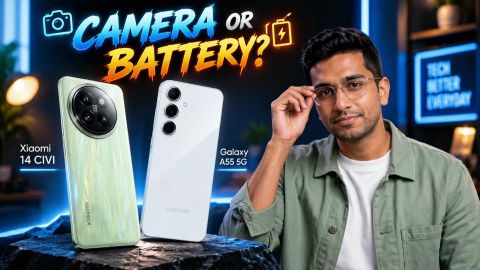
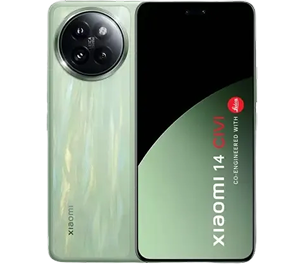
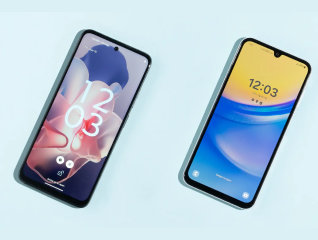
Xiaomi 14 CIVI focuses on its display, camera hardware and charging speed. Samsung Galaxy A55 5G adds expandable storage, a larger battery and IP67 protection.
What are the general differences between the two phones?
Both phones support dual SIM connectivity and 5G. Xiaomi 14 CIVI is lighter and thinner, while Samsung Galaxy A55 5G has IP67 protection.
| Specification | Xiaomi 14 CIVI | Samsung Galaxy A55 5G |
|---|
| Model | Xiaomi 14 CIVI | Samsung Galaxy A55 5G |
| Manufacturer | Xiaomi | Samsung |
| SIM | Dual nano-SIM | Dual nano-SIM |
| Network support | 5G and 4G | 5G and 4G |
| Dimensions | 157.2 x 72.77 x 7.4 mm | 161.1 x 77.4 x 8.2 mm |
| Weight | 177 g | 213 g |
| Water and dust resistance | IP54 | IP67 |
| Warranty | Manufacturer warranty | Manufacturer warranty |
Xiaomi 14 CIVI weighs 177 g, compared with 213 g for Samsung Galaxy A55 5G. The 36 g difference can make Xiaomi easier to hold during long calls or daily travel.
Samsung Galaxy A55 5G has an IP67 rating, while Xiaomi 14 CIVI has an IP54 rating. This gives Samsung stronger protection against dust and water exposure.
Pro tip: If you regularly use your phone outdoors, consider its IP rating alongside weight and battery capacity.
Which display suits your needs better?
Xiaomi 14 CIVI has a 1.5K quad-curved AMOLED display, while Samsung Galaxy A55 5G uses a flat Super AMOLED panel with FHD+ resolution.
| Specification | Xiaomi 14 CIVI | Samsung Galaxy A55 5G |
|---|
| Display size | 6.55-inch | 6.6-inch |
| Display type | 1.5K Quad-Curved AMOLED | Super AMOLED |
| Resolution | 1236 x 2750 pixel | 1080 x 2340 pixel |
| Pixel density | 460 ppi | 390 ppi |
| Refresh rate | 120 Hz | 120 Hz |
| Peak brightness | 3,000 nits | 1,000 nits HBM |
| Colour depth | 68 billion colours | 16 million colours |
| HDR | Dolby Vision, HDR10+ | HDR10+ |
| Colour gamut | DCI-P3 | Not specified |
| Touch sampling rate | Up to 240 Hz | Not specified |
| Screen protection | Corning Gorilla Glass Victus 2 | Corning Gorilla Glass Victus+ |
Xiaomi 14 CIVI provides 460 ppi, while Samsung Galaxy A55 5G provides 390 ppi. The higher pixel density can make text, photos and fine details appear sharper.
Xiaomi also reaches 3,000 nits peak brightness, compared with 1,000 nits High Brightness Mode on Samsung. This can help when you use the phone outdoors in bright conditions.
Choose this if: Choose Xiaomi 14 CIVI if you prioritise its 1236 x 2750 pixel resolution, 3,000 nits peak brightness and Dolby Vision support.
What is the difference in Xiaomi 14 CIVI and Samsung Galaxy A55 performance?
Xiaomi 14 CIVI uses an octa-core Snapdragon 8s Gen 3 with Adreno 735 graphics. Samsung Galaxy A55 5G uses an octa-core Exynos 1480 with AMD Xclipse 530 graphics.
| Specification | Xiaomi 14 CIVI | Samsung Galaxy A55 5G |
|---|
| Processor | Snapdragon 8s Gen 3 | Exynos 1480 |
| Process | 4 nm | 4 nm |
| Processor core | Octa-core, up to 3.0 GHz | Octa-core, up to 2.75 GHz |
| GPU | Adreno 735 | AMD Xclipse 530 |
| RAM | 8GB / 12GB | 8GB / 12GB |
| RAM type | LPDDR5X | LPDDR5 |
| Storage | 256GB / 512GB | 128GB / 256GB |
| Storage type | UFS 4.0 | UFS 3.1 |
| Cooling | Xiaomi IceLoop | Vapour chamber |
Both processors use a 4 nm process, but Xiaomi 14 CIVI uses the Snapdragon 8s Gen 3 with Adreno 735 graphics. Samsung Galaxy A55 5G uses the Exynos 1480 with Xclipse 530 graphics.
Xiaomi also uses LPDDR5X RAM and UFS 4.0 storage, while Samsung uses LPDDR5 RAM and UFS 3.1 storage. These specifications matter when you install large apps, load games or switch between demanding tasks.
Good to know: If you use your phone for gaming, video editing or frequent multitasking, compare the processor, RAM and storage technology rather than RAM capacity alone.
How do the camera setups compare?
Xiaomi 14 CIVI adds a 50MP Leica telephoto camera and two 32MP front cameras. Samsung Galaxy A55 5G uses a 50MP main, 12MP ultra-wide and 5MP macro camera.
| Specification | Xiaomi 14 CIVI | Samsung Galaxy A55 5G |
|---|
| Main camera | 50MP Leica Summilux, OIS | 50MP, f/1.8, OIS |
| Telephoto | 50MP Leica, 2x optical zoom | Not available |
| Ultra-wide | 12MP, 120° | 12MP |
| Macro | Not available | 5MP |
| Front camera | 32MP primary + 32MP ultra-wide | 32MP |
| Rear video | Up to 4K at 60 fps | Up to 4K at 30 fps |
| Front video | Up to 4K at 30 fps | Up to 4K at 30 fps |
| Stabilisation | OIS | OIS on main camera |
Xiaomi 14 CIVI gives you a 50MP telephoto camera with 2x optical zoom, which can help with portraits and distant subjects. Samsung Galaxy A55 5G uses a 5MP macro camera for close-up shots instead.
Xiaomi also has two 32MP front cameras, including a 32MP ultra-wide camera. This gives you a wider view for group selfies and travel photos.
Pro tip: If you often take portraits or group selfies, the Xiaomi 14 CIVI gives you dedicated camera hardware for both uses.
Which phone gives you more storage and connectivity?
Xiaomi 14 CIVI offers up to 512GB internal storage, while Samsung Galaxy A55 5G supports microSD expansion up to 1TB.
| Specification | Xiaomi 14 CIVI | Samsung Galaxy A55 5G |
|---|
| RAM | 8GB / 12GB | 8GB / 12GB |
| Internal storage | 256GB / 512GB | 128GB / 256GB |
| Storage type | UFS 4.0 | UFS 3.1 |
| Expandable storage | No | Yes, up to 1TB |
| 5G | Yes | Yes |
| Wi-Fi | Wi-Fi 6 | Wi-Fi 6E |
| Bluetooth | 5.4 | 5.3 |
| NFC | Yes | Yes |
| USB | USB Type-C 2.0 | USB Type-C 2.0 |
| IR blaster | Yes | No |
| Navigation | GPS, Galileo, GLONASS, BeiDou, NavIC | GPS, GLONASS, BeiDou, Galileo, QZSS |
Xiaomi 14 CIVI gives you up to 512GB UFS 4.0 storage. Samsung Galaxy A55 5G gives you up to 256GB internal storage and supports a microSD card up to 1TB.
Samsung can suit you if you prefer to add storage later. Xiaomi provides faster UFS 4.0 internal storage and an IR blaster for compatible home appliances.
Buy this if: Choose Samsung Galaxy A55 5G if expandable storage matters to you. Choose Xiaomi 14 CIVI if you want 512GB of internal storage.
What about battery and charging?
Samsung Galaxy A55 5G has a larger 5,000 mAh battery, while Xiaomi 14 CIVI offers faster 67 W wired charging with its 4,700 mAh battery.
| Specification | Xiaomi 14 CIVI | Samsung Galaxy A55 5G |
|---|
| Battery | 4,700 mAh | 5,000 mAh |
| Wired charging | 67 W | 25 W |
| Wireless charging | No | No |
| Battery type | Li-polymer | Li-ion |
| Charging port | USB Type-C | USB Type-C |
Samsung Galaxy A55 5G provides a 5,000 mAh battery, which is 300 mAh higher than the 4,700 mAh battery on Xiaomi 14 CIVI.
Xiaomi 14 CIVI supports 67 W charging, compared with 25 W on Samsung Galaxy A55 5G. Faster charging can help you top up the phone during a short break before work or travel.
The PCMark battery-performance test recorded 12h 15m for Xiaomi 14 CIVI and 13h 04m for Samsung Galaxy A55 5G under the respective test conditions.
Things to keep in mind: Battery capacity does not directly determine battery life. Display brightness, network strength, apps and usage patterns also affect how long your phone lasts.
What other differences are there between the two phones?
Xiaomi 14 CIVI focuses on camera and charging features, while Samsung Galaxy A55 5G adds longer software support and Samsung Knox Vault security.
| Specification | Xiaomi 14 CIVI | Samsung Galaxy A55 5G |
|---|
| Operating system at launch | Android 14 with Xiaomi HyperOS | Android 14 with One UI 6.1 |
| Android upgrades | 3 | Up to 4 generations |
| Security updates | 4 years | Up to 5 years |
| Fingerprint sensor | In-display | Optical in-display |
| Face unlock | Yes | Yes |
| Speakers | Stereo | Stereo |
| Audio | Dolby Atmos | Dolby Atmos |
| IR blaster | Yes | No |
| Security platform | — | Samsung Knox Vault |
| Vibration motor | X-axis linear | Not specified |
Samsung Galaxy A55 5G offers up to 4 generations of OS upgrades and up to 5 years of security updates. Xiaomi 14 CIVI offers 3 Android upgrades and 4 years of security updates.
Samsung also includes Knox Vault, which provides hardware-based protection for sensitive information such as PINs, passwords and patterns.
Good to know: If you plan to keep your phone for several years, compare software support with the hardware features you need today.