








Rs. 2 lakh – Rs. 80 lakh
Check your pre-approved doctor loan
Enter mobile and OTP | Check offer | Know your exact loan terms
In summary
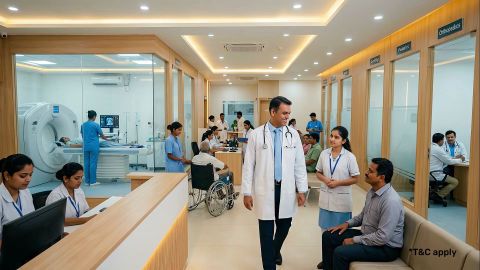
Medical License Renewal Guide
The different types of hospitals in India can be classified by their ownership, size, services and specialisation. Each type serves a different healthcare need, from general treatment to specialised care and medical education.
- General hospitals: Treat a wide range of illnesses and injuries.
- Speciality hospitals: Focus on specific medical fields, such as cardiology, oncology or orthopaedics.
- Teaching hospitals: Provide patient care alongside medical education and research.
- Government and community hospitals: Offer public healthcare, often at free or subsidised rates.
- Hospital size: Hospitals vary in bed capacity, facilities and the range of services they provide.
Planning to establish or expand a hospital? Explore financing options for eligible medical professionals and check your doctor loan eligibility to plan your next steps.
What is a hospital and how is it classified?
A hospital is a healthcare institution that diagnoses and treats patients with medical and surgical care, and India groups hospitals into 4 main types of hospital based on ownership and services. The classification of hospital also uses size, location and specialisation.
Hospitals began as places where religious orders cared for the sick. Today, a hospital runs departments, trained staff and diagnostic equipment under one roof. India broadly classifies hospitals into general, speciality, teaching and government or community hospitals, each serving a distinct role. Doctors who want to build their own facility can fund it with a Bajaj Finance doctor loan.
What departments does a hospital have?
A typical hospital runs 8 core departments, from emergency care to the pharmacy. The list below covers the departments most patients use.
- Emergency department: Handles urgent and life-threatening conditions.
- Intensive Care Unit (ICU): Provides care for critically ill patients who need constant monitoring.
- Radiology department: Uses imaging such as X-rays and MRIs for diagnosis.
- Maternity ward: Specialises in childbirth and postnatal care.
- Paediatrics: Focuses on the health and medical care of children.
- Oncology: Diagnoses and treats cancer.
- Orthopaedics: Treats bone, joint and muscle conditions.
- Pharmacy: Dispenses the medicines doctors prescribe.
The departments a hospital offers depend on its type: a general hospital runs most of these, while a speciality hospital builds deep capacity in 1 or 2.
What differentiates the various types of hospitals?
The classification of hospital in India rests on 5 factors: functionality, size, location, ownership and specialisation. The table explains each factor with an example.
| Basis of classification (different types of hospital) | What it means | India example (types of hospitals in India) |
|---|---|---|
| Functionality | General-purpose care or a specialised role such as teaching, trauma or long-term care | Government hospitals run TB and maternity programmes; private hospitals run elective surgeries |
| Size | Small: fewer than 50 beds; medium: 50 to 300 beds; large: 300 or more beds | District hospitals: medium; AIIMS New Delhi: large |
| Location | Rural, semi-urban or urban | Primary Health Centres (PHCs) in villages; AIIMS campuses in cities |
| Ownership | Government, private, or trust and charitable | AIIMS (government); corporate hospital chains (private); Tata Memorial Centre (government-aided) |
| Specialisation | General, single-speciality or super-speciality | General: KEM Hospital, Mumbai; speciality: Tata Memorial Centre (oncology) |
Rural hospitals focus on primary care, while urban hospitals offer a wider range of treatments and specialists.
Our loan variants
Use our popular calculators




What are the different types of hospitals in India?
There are 12 commonly recognised different types of hospital in India, broadly grouped under the 4 main categories above. The table shows what each type does and where you find it.
| Hospital type | Key focus | Common in India | Suited to |
|---|---|---|---|
| Academic medical centres | Research, patient care and medical education | AIIMS New Delhi, PGIMER Chandigarh | Complex cases and clinical trials |
| Acute hospitals | Short-term emergency and surgical care | Multi-speciality hospitals | Accidents, surgeries and ICU care |
| Ambulatory surgery centres | Same-day minor surgeries | Eye and dental day-care centres | Outpatient procedures at lower cost |
| Children’s hospitals | Paediatric care only | Kalawati Saran Children’s Hospital, New Delhi | Infants, children and adolescents |
| Clinics | Outpatient consultations | Local general practitioner clinics and polyclinics | Minor illness and preventive care |
| Community hospitals | Local primary and secondary care | Community Health Centres and taluka hospitals | Routine care in semi-urban areas |
| District hospitals | Secondary care for a district | State-run district general hospitals | A bridge between primary and tertiary care |
| Federal (central government) hospitals | Care for specific groups | Railway hospitals, Employees’ State Insurance Corporation (ESIC) hospitals, Armed Forces hospitals | Government employees, insured workers and armed forces |
| For-profit hospitals | Private care run as a business | Corporate hospital chains | Insured or self-paying patients |
| Free hospitals | Free or subsidised care | Trust and charitable hospitals | Patients on low incomes |
| General services hospitals | Surgery, obstetrics, paediatrics and general medicine | KEM Hospital, Mumbai; Sassoon General Hospital, Pune | Most everyday medical needs |
| Government-funded hospitals | Care at nominal rates or free | State medical college hospitals | The general public |
Academic, district and government-funded hospitals belong to the government category, while for-profit and free hospitals split by ownership across these types of hospital.
What are the functions of a hospital?
A hospital performs 7 core functions, from patient care to research, whatever the type of hospital. Each function keeps the community healthy.
| Function | What it covers |
|---|---|
| Patient care | Inpatient and outpatient services, including emergency care and treatment |
| Medical diagnosis | Imaging, such as X-rays and MRIs, and laboratory tests |
| Surgical services | Procedures from minor surgeries to complex operations |
| Emergency services | Care for accidents, heart attacks, strokes and other emergencies |
| Specialised care | Departments such as cardiology, oncology, paediatrics and orthopaedics |
| Rehabilitation | Physiotherapy and recovery support after illness or surgery |
| Education and research | Training doctors and nurses, and running medical research |
What types of beds does a hospital have?
A hospital uses 5 main types of bed, each matched to a patient need, and the mix differs by type of hospital. The table lists them.
| Bed type | Used for |
|---|---|
| Hospital bed | General wards |
| ICU bed | Critically ill patients, with added monitoring features |
| Paediatric bed | Children, in a smaller size |
| Gynaecology bed | Childbirth and examinations in maternity wards |
| Bariatric bed | Patients with obesity, with extra support and space |
How do general, speciality, teaching and government hospitals compare?
The 4 main types of hospital differ in focus, strengths and trade-offs. Use this table to match a hospital to your need.
| Hospital type | Primary focus | Key strengths | Trade-offs | Examples |
|---|---|---|---|---|
| General hospitals | Care across many disciplines | Wide treatment range, emergency care and diagnostics under one roof | Fewer super-speciality departments than specialised centres | District general hospitals, KEM Hospital, Mumbai |
| Speciality hospitals | One medical field | Deep expertise, specialised equipment and focused care | Narrow scope outside their speciality | Tata Memorial Centre, Mumbai (oncology) |
| Teaching hospitals | Care plus education and research | Access to specialists and advanced treatments | Longer waits during training activities | AIIMS New Delhi, B.J. Government Medical College, Pune |
| Government and community hospitals | Affordable public care | Lower costs and wide community access | Higher patient volumes | Sassoon General Hospital, Pune; district hospitals |
Each hospital type plays a distinct role in meeting India’s medical, educational and community health needs.
Why does medical malpractice insurance matter for all types of hospitals?
Medical malpractice insurance protects a hospital and its doctors against claims of negligence, and every type of hospital benefits from it. The cover pays legal costs and compensation awarded in a covered claim.
Premiums differ across the types of hospital and rise with a hospital’s size, specialities and patient volume, so a large multi-speciality hospital pays more than a small clinic. Hospitals buy institutional cover, and doctors often add individual professional indemnity cover.
How can a doctor loan help you start or expand a hospital?
A Bajaj Finance doctor loan offers Rs. 2 lakh to Rs. 80 lakh at 11% to 17.50% per annum, with tenures of 12 months to 96 months (8 years). Doctors use it to add beds, buy equipment, renovate wards and fund working capital, whatever the type of hospital they run.
Key takeaway: A Rs. 50 lakh doctor loan at 13% per annum costs Rs. 90,960 per month over 84 months, or Rs. 54,167 per month in interest-only EMIs on the Flexi Hybrid Term Loan.
| Doctor loan parameter | Requirement |
|---|---|
| Nationality | Indian |
| Age | 21 years to 80 years (upper limit at loan maturity) |
| CIBIL Score | 650 or higher |
| Medical registration | Degree registered with the medical council |
| Documents | Know Your Customer (KYC) documents, Permanent Account Number (PAN) card, medical registration certificate |
| Loan variants | Term Loan, Flexi Term Loan, Flexi Hybrid Term Loan |
Here is a worked example. Dr Sameer Joshi, 42, runs a 12-bed nursing home in Indore and wants to grow it into a 25-bed general hospital. His CIBIL Score is 781. He borrows Rs. 50,00,000 for beds, an ICU set-up and renovation, at an indicative rate of 13% per annum for 84 months.
The Equated Monthly Instalment (EMI) formula is EMI = P × r × (1 + r)^n ÷ [(1 + r)^n − 1]. P is the loan amount, r is the monthly rate (annual rate ÷ 12 ÷ 100) and n is the tenure in months. For Sameer, P is Rs. 50,00,000, r is 0.010833 and n is 84.
| Tenure (months) | EMI (Rs. per month) | Total interest (Rs.) | Total payable (Rs.) |
|---|---|---|---|
| 60 (5 years) | 1,13,765 | 18,25,922 | 68,25,922 |
| 84 (7 years) | 90,960 | 26,40,625 | 76,40,625 |
| 96 (8 years) | 84,036 | 30,67,482 | 80,67,482 |
Indicative values for a Rs. 50,00,000 loan at 13% per annum. Totals use the unrounded EMI. The final amount, rate and tenure are subject to Bajaj Finance credit assessment, and fees and charges apply as listed on the doctor loan page.
A longer tenure lowers the EMI and raises the total interest, for any of the types of hospital a doctor plans to build. Compare doctor loan interest rates and charges before you apply, and consider professional loans for working capital needs.
How do you apply for a doctor loan?
You apply for a doctor loan online in 4 steps, and the amount reaches your bank account within 48 hours* of approval. Check these points first, as they decide how fast your application moves.
- Click on the 'CHECK LOAN OFFER’ button on this page.
- Fill in the application form with your basic personal and professional details.
- Once you fill out the form, click on ‘CONTINUE’.
- Update the KYC details.
Note: Keep your medical registration certificate handy to finish the KYC process. Our representative will guide you on the next steps. The loan amount will be transferred to your bank account upon verification of your documents.
Doctor loan for different budget
You can enter the exact loan amount
Get professional loan for your needs
Personal loan for doctors for wedding
Get doctor loan for for wedding

Chartered accountant loan
Get CA loan with minimal documents

CA loan for setting practice
Get CA loan for setting up your practice

CA loan for office renovation
Get CA loan for renovating office

Business loan for lawyer
Get business loan for lawyer today

Business loan for CA
Get business loan for CA today
Medical equipment finance for diagnostic centre
Setup diagnostic centre with medical equipment finance

Personal loan for lawyer
Get a personal loan for lawyer

Personal loan for doctors for wedding
Get a personal loan for wedding

Personal loan for doctors
Get a personal loan for doctor

Personal loan for CA
Get a personal loan for CA
Medical equipment finance
Get a medical equipment finance

Lawyer loan to start firm
Get a lawyer loan to start firm

Lawyer loan for Chamber
Get a lawyer loan for Chamber

Lawyer loan
Get a lawyer loan

Hospital loan
Get a hospital loan

Doctor loan for setting up practice
Get a doctor loan for setting up practice
Doctor loan for clinic renovation
Get a doctor loan for clinic renovation

Doctor loan
Get a doctor loan
Doctor loan in different cities

Loan for doctor in Mumbai

Loan for doctor in Kolkata

Loan for doctor in Pune
Doctor loan for different budgets

Doctor loan for different budgets
Doctor loan for different budgets1
Doctor loan for different budgets2
Doctor loan for different budgets3
Types of doctor loan

Business loan for doctors

Business loan for chartered accountants

Set up a diagnostic centre with medical equipment finance

How to start a law firm in India

Doctor loan for clinic renovation
Frequently asked questions
Overview
How can I renew my medical licence in India?
India commonly recognises 12 types of hospital, grouped under 4 main categories. The 12 are academic medical centres, acute hospitals, ambulatory surgery centres, children’s hospitals, clinics, community hospitals, district hospitals, federal hospitals, for-profit hospitals, free hospitals, general services hospitals and government-funded hospitals. The 4 main categories are general, speciality, teaching and government or community hospitals.
What is the classification of a hospital?
The classification of hospital in India rests on functionality, ownership, funding, size and services offered. Based on these, hospitals fall into general, speciality, government-funded, private and non-profit categories. One hospital fits several labels at once, such as a large, government-owned, general teaching hospital like AIIMS New Delhi. Knowing these labels helps you compare cost and care quickly.
What are the most common types of hospitals?
The most common types of hospital in India are general hospitals, community hospitals, speciality hospitals, government-funded hospitals and for-profit hospitals. General and community hospitals handle most everyday care, while speciality and for-profit hospitals serve patients who need focused or premium treatment. Government-funded hospitals serve large patient volumes, often at nominal rates or free of charge, across both cities and districts.
How many types of hospital administration are there?
There are 3 broad types of hospital administration: public or government, private, and non-profit. Each runs on a different governance and funding model. Government hospitals follow state or central health departments, private hospitals answer to owners or shareholders, and non-profit hospitals are run by trusts or societies. The type of administration shapes fees, staffing and how decisions get made.
What are the 4 types of hospitals?
The 4 main types of hospitals are general hospitals, speciality hospitals, teaching hospitals, and government or community hospitals. General hospitals give broad medical care, speciality hospitals focus on one field, teaching hospitals combine care with education, and government or community hospitals offer affordable public healthcare to local populations. Together, these 4 types of hospital cover most of India’s healthcare needs.
What are the types of hospitals based on ownership?
Based on ownership, hospitals are government, private, or charitable and non-profit. Government hospitals run on public funds, private hospitals are owned by individuals or companies, and charitable hospitals are run by trusts or NGOs offering subsidised or free care. Ownership shapes the cost you pay and the services on offer, so check it before you book a procedure.
What are the types of hospitals based on services offered?
Based on services, hospitals are general, speciality, multi-speciality or super-speciality. General hospitals give broad treatment, while speciality hospitals focus on one area. A multi-speciality hospital offers several disciplines under one roof, and a super-speciality hospital provides advanced, focused care such as cardiac surgery or transplants. Pick the service level that matches the complexity of your condition.
What are the types of hospitals based on size?
Based on size, hospitals are small, medium or large. Small hospitals have fewer than 50 beds, medium hospitals have 50 to 300 beds, and large hospitals have 300 or more beds. Large hospitals are often tertiary centres with advanced infrastructure and high patient intake, while small ones serve local needs. Bed count also decides which departments and equipment a hospital can run.
What are the types of hospitals based on patient category?
Based on patient category, hospitals are adult hospitals, paediatric hospitals, and maternity or women’s hospitals. Some facilities also specialise in elderly care or other specific groups. This split lets each hospital match its staff, equipment and wards to the age, gender or medical needs of its patients. Choose a paediatric or maternity hospital when a child or pregnancy needs specialised care.
What are the types of hospitals based on treatment focus?
Based on treatment focus, hospitals are acute care hospitals, chronic care hospitals, rehabilitation centres and preventive care facilities. Acute care handles emergencies and surgeries, chronic care manages long-term illness, rehabilitation supports recovery, and preventive care covers health screening and early intervention. Many large hospitals run all 4 under one roof, so check which wing handles your treatment.
What are the types of hospitals based on funding?
Based on funding, hospitals are publicly funded, privately funded or insurance-linked. Public hospitals rely on government budgets, private hospitals depend on patient payments and private investment, and insurance-linked hospitals work closely with health insurers through cashless networks. Many hospitals combine more than one funding source. Check a hospital’s insurance tie-ups before admission if you plan a cashless claim.
What are the types of hospitals based on accreditation?
Based on accreditation, hospitals are accredited or unaccredited. Accredited hospitals meet the quality and safety standards of a recognised body, such as the National Accreditation Board for Hospitals and Healthcare Providers (NABH) in India. Unaccredited hospitals still provide care, so check accreditation status when quality certification matters to you. NABH lists accredited hospitals on its website.
What are the types of hospitals based on location?
Based on location, hospitals are urban, semi-urban or rural. Urban hospitals carry advanced facilities and many specialists, semi-urban hospitals offer a moderate range of services, and rural hospitals provide primary healthcare to villages and remote areas. Patients in rural areas are often referred to urban hospitals for complex care, while district hospitals bridge the gap for secondary treatment.
Can a general hospital treat patients who need specialised care?
Yes, a general hospital can treat patients who need specialised care if it has the required doctors, equipment and facilities. However, patients with complex conditions may need referral to a speciality hospital or a larger medical centre for advanced tests, surgery or specialist treatment.
How quickly can a patient be shifted from a government to a private hospital?
A patient can be shifted on the same day once the treating doctor confirms the patient is stable to travel. The family requests a discharge or transfer summary, confirms a bed at the private hospital and books an ambulance with the right support, such as an ICU ambulance. For a cashless insurance claim, inform the insurer before the patient transfer so pre-authorisation is ready on arrival.
What happens if a patient leaves a hospital against medical advice?
The patient signs a Leave Against Medical Advice (LAMA) form and leaves at their own risk. Patients have the right to refuse treatment, and the hospital records the advice given. The National Consumer Disputes Redressal Commission held in January 2017 that doctors carry zero negligence when a LAMA patient was properly advised and documented. The Punjab and Haryana High Court ruled in May 2016 that insurers must still pay a valid claim in such cases.
How can patients negotiate package rates at a multi-speciality hospital?
Yes, package rates are negotiable at a multi-speciality hospital for planned procedures. Follow these 4 steps:
- Ask for a written package quote listing inclusions.
- Compare quotes from 2 or 3 hospitals.
- Confirm room category, stay length and implant costs.
- Request a discount for cash or insurance pre-approval.
Get the final package in writing before admission.
What hidden charges should families check at a private hospital?
The top 3 hidden charges at a private hospital are consumables, room-category-linked fees and extra-day charges. Check these items before admission:
- Registration and admission fees
- Consumables and medicine markups
- Doctor visit fees that rise with room category
- Attendant and food charges
- Charges for stays beyond the package
- Implant and device costs
Doctors running their own hospital can fund transparent pricing systems with a Bajaj Finance doctor loan.
Are hospital room charges taxed differently under GST?
Yes, hospital room charges above Rs. 5,000 per day attract 5% GST, with zero input tax credit, for non-ICU rooms. This rule came into force on 18 July 2022. ICU, ICCU and NICU rooms stay exempt from GST whatever the rent, and rooms at Rs. 5,000 per day or less are also exempt. Patients choosing a premium room at a private hospital pay the 5% on top of the room rent.
What do our customers say about us
Dr. Rohan Mehta
Reviewed on
I applied for a doctor loan to upgrade my clinic infrastructure, and the experience was excellent. The application process was simple, the documentation was minimal, and the approval came through quickly. The team guided me throughout the process and ensured a seamless experience. I would highly recommend this financing option to medical professionals looking for reliable funding support.
Dr. Priya Sharma
Reviewed on
The doctor loan helped me manage my professional expenses without any financial stress. The loan disbursal was fast, and the customer support team was always available to answer my questions. The repayment options were flexible and suited my financial requirements perfectly. Overall, I am very satisfied with the service and support provided.
Dr. Arvind Nair
Reviewed on
I availed a doctor loan to purchase advanced medical equipment for my practice. The entire process was smooth, transparent, and completed within a short time. The competitive interest rates and hassle-free documentation made the experience even better. The support team remained helpful at every stage, making the loan journey convenient and stress-free.
Dr. Neha Kapoor
Reviewed on
I needed financial assistance to expand my healthcare practice, and this doctor loan proved to be the right solution. The approval process was quick, and the team provided clear guidance from application to disbursal. The flexible repayment tenure helped me plan my finances effectively. I am pleased with the overall experience and would recommend it to fellow doctors.
More articles

5 tips for hiring the best front office staff for your clinic
Read More

Step-by-step guide to expand your practice from clinic to polyclinic
Read More

How to Start a Physical Therapy Clinic: 12 Steps Guide
Read More

The essentials of clinic management
Read More
Disclaimer
Bajaj Finance Limited has the sole and absolute discretion, without assigning any reason to accept or reject any application. Terms and conditions apply*.