






Health insurance goes beyond hospitalization—it covers OPD visits, medicines, ambulance charges, preventive checkups, and even alternative treatments, giving you all-around financial security.

Check health insurance plans with comprehensive coverage
Get Quote
Health plans from leading insurers | Comprehensive coverage | Offers multiple optional add-ons to enhance coverage
Section 80D Tax Deductions on Health Insurance
In Summary
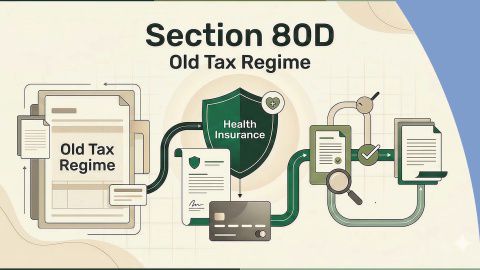
Section 80D provides one of the most generous tax deduction frameworks under Chapter VI-A of the Income Tax Act for taxpayers choosing the Old Tax Regime.
- Self, spouse, and children deduction: Claim up to Rs. 25,000 annually for health insurance premiums paid for your immediate family (all below age 60).
- Parents deduction (Senior citizens): Claim an additional deduction of up to Rs. 50,000 for premiums paid for parents aged 60 and above (Rs. 25,000 if parents are below 60).
- Cumulative deduction of up to Rs. 1 lakh: If both the primary taxpayer and parents are senior citizens (aged 60+), the total annual deduction reaches Rs. 1,00,000.
- Preventive health check-up allowance: Deduct up to Rs. 5,000 for annual preventive check-ups within the overall limits, admissible even when paid in cash.
Maximize your tax savings while protecting your loved ones: view plans on Bajaj Finance to compare premier partner plans with instant 80D tax certificates.
What is Section 80D of the Income Tax Act?
Section 80D is a statutory provision within Chapter VI-A of the Income-tax Act, 1961 (transitioning into Section 126 under the Income-tax Act, 2025) designed to encourage citizens to purchase comprehensive health insurance. Under this provision, premiums paid toward medical insurance policies, critical illness riders, and Central Government Health Schemes (CGHS) can be deducted directly from gross total income, lowering taxable income and net tax liability.
Unlike life insurance deductions under Section 80C which share a combined ceiling of Rs. 1.50 lakh with provident funds and home loan principal repayments, Section 80D provides an independent deduction window dedicated entirely to medical and healthcare protection. Comprehensive insurance protection provides families with robust financial security during medical crises.
Did You Know? (Cash allowance for preventive checkups)
While health insurance premiums must strictly be paid through electronic banking channels (net banking, UPI, debit/credit cards, or cheque) to qualify for Section 80D deductions, the Rs. 5,000 preventive health check-up allowance is an explicit statutory exception that can be claimed even when paid in cash.
Quick Fact: Gross premium includes 18% GST
The tax deduction under Section 80D is calculated on the total gross premium invoice issued by the insurance company, which includes the 18% Goods and Services Tax (GST) component, up to the applicable statutory deduction limit.
Eligibility for tax deduction under Section 80D
Deductions under Section 80D can be claimed by two categories of taxable entities:
- Individual taxpayers: Any resident or non-resident individual paying premiums for policies covering themselves, their spouse, dependent children, or parents.
- Hindu Undivided Families (HUFs): A Karta can claim deductions under Section 80D for medical insurance premiums paid for any member of the HUF, up to Rs. 25,000 (or Rs. 50,000 if the insured member is a senior citizen).
Corporate entities, partnership firms, and associations of persons (AOPs) cannot claim deductions under Section 80D.
Pro tip
What deductions are allowed under Section 80D?
Section 80D encompasses three distinct types of healthcare expenditures:
- Medical insurance premiums: Premiums paid for individual health insurance, family health insurance, and critical illness plans.
- Preventive health check-up costs: Up to Rs. 5,000 per financial year for routine diagnostic health check-ups for self, spouse, children, or parents.
- Medical expenses of uninsured senior citizens: Actual medical, hospitalisation, and prescription drug expenses incurred for senior citizen parents (or senior citizen self) who cannot obtain health insurance coverage, up to Rs. 50,000 per year.
How much tax deduction is allowed under Section 80D?
The total deduction permissible under Section 80D depends on the age of the insured family members:
| Insured Family Composition | Deduction for Self & Family | Deduction for Parents | Total Permissible Section 80D Deduction |
| Self, spouse, children (All below 60) + Parents (Below 60) | Up to Rs. 25,000 | Up to Rs. 25,000 | Up to Rs. 50,000 |
| Self, spouse, children (Below 60) + Parents (Senior citizens 60+) | Up to Rs. 25,000 | Up to Rs. 50,000 | Up to Rs. 75,000 |
| Self (Senior citizen 60+) + Parents (Senior citizens 60+) | Up to Rs. 50,000 | Up to Rs. 50,000 | Up to Rs. 1,00,000 |
| Hindu Undivided Family (HUF member below 60 / senior citizen) | Up to Rs. 25,000 / Rs. 50,000 | Not applicable | Up to Rs. 25,000 / Rs. 50,000 |
Popular plans for you



What are the tax deductions under Section 80D on health insurance premium paid for parents?
Section 80D provides a separate, dedicated deduction allowance for health insurance premiums paid for parents, completely independent of the deduction claimed for self, spouse, and children.
If your parents are below 60 years of age, you can claim up to Rs. 25,000 annually. Once either parent attains the age of 60 during the financial year, the deduction limit increases to Rs. 50,000. This deduction can be claimed whether parents are financially dependent on you or independent, provided you pay the premium from your taxable income.
Did You Know? (Transition to Section 126 under Income-tax Act, 2025)
From Assessment Year 2026-27 onward, the Income-tax Act, 2025 introduces Section 126 to replace Section 80D. The underlying deduction ceilings (Rs. 25,000 / Rs. 50,000 / Rs. 1,00,000) and eligibility conditions remain identical under the Old Tax Regime, maintaining full statutory continuity.
Quick Fact: Senior citizen Rs. 50,000 medical expense rule
If your senior citizen parents (aged 60 and above) cannot secure health insurance due to severe pre-existing illnesses, age caps, or high premium loadings, Section 80D allows you to claim actual medical treatment and hospitalisation bills up to Rs. 50,000 directly as a tax deduction.
Understanding the section 80D tax deductions for HUF
A Hindu Undivided Family (HUF) can claim tax deductions under Section 80D for health insurance premiums paid for any member of the HUF:
- Standard deduction ceiling: Up to Rs. 25,000 per financial year if the covered family members are below age 60.
- Senior citizen member ceiling: Up to Rs. 50,000 per financial year if any insured member of the HUF is a senior citizen aged 60 or older.
- Premium payment mode: The premium must be paid out of the HUF's dedicated bank account via non-cash banking channels.
What are preventive health check-ups under Section 80D?
Preventive health check-ups include routine blood tests, lipid profiles, diabetes screenings, cardiac stress tests, and sonography aimed at early illness detection. Section 80D allows an aggregate deduction of up to Rs. 5,000 per financial year for preventive check-up expenses incurred for self, spouse, dependent children, and parents. This Rs. 5,000 sub-limit is within the overall ceiling of Rs. 25,000 or Rs. 50,000, not an additional deduction over and above it.
Which payment modes are eligible for Section 80D deductions?
To maintain compliance with income tax regulations:
- Health insurance premiums: Must strictly be paid through digital or banking channels, including net banking, UPI, debit cards, credit cards, or account payee cheques. Premiums paid in cash are summarily disqualified.
- Preventive health check-ups: Payments can be made through banking channels or in cash, provided valid payment receipts and diagnostic invoices are retained.
Health Insurance in different cities

Health Insurance in Bangalore

Health Insurance in Jaipur

Health Insurance in Pune

Health Insurance in Mumbai

Health Insurance in Kerala
How are Section 80D deductions applied for multi-year health insurance premiums?
When a policyholder purchases a multi-year health insurance policy spanning 2 or 3 years and pays a consolidated lump-sum premium upfront, Section 80D enforces a proportionate deduction rule.
The total premium paid is divided equally across the number of policy tenure years. The resulting proportionate amount is claimed as a tax deduction in each respective financial year, up to the annual statutory limit of Rs. 25,000 or Rs. 50,000, ensuring consistent tax relief across all years of coverage.
Compare types of Health Insurance Plans
Deduction for medical expenses of senior citizens under Section 80D
Recognizing that very senior individuals often struggle to find comprehensive insurance coverage, Section 80D permits senior citizens aged 60 and above (or their children paying on their behalf) to deduct actual medical expenses up to Rs. 50,000 annually. This deduction covers day-care surgeries, chronic illness medications, diagnostic screenings, and home healthcare nursing, provided the senior individual is not covered by any active medical insurance policy during that financial year.
Difference between Section 80D and Section 80C of the Income Tax Act
Understanding the operational differences between these two fundamental tax sections helps in building a balanced tax plan:
| Evaluation Factor | Section 80D (Medical Insurance) | Section 80C (Investments & Life Insurance) |
| Dedicated purpose | Medical insurance premiums, check-ups, and senior healthcare | Long-term financial investments and life insurance savings |
| Statutory ceiling | Rs. 25,000 to Rs. 1,00,000 (Based on family age demographics) | Fixed aggregate limit of Rs. 1,50,000 across all instruments |
| Eligible instruments | Health insurance floater, critical illness riders, preventive checkups | ELSS mutual funds, PPF, EPF, life insurance premiums, NSC, home loan principal |
| Cash payment eligibility | Premiums disqualified in cash (Check-ups up to Rs. 5,000 allowed) | Strictly non-cash banking payments |
| Coverage beneficiaries | Self, spouse, dependent children, and parents exclusively | Self, spouse, children (and HUF members) |
Brief example scenario: maximizing Section 80D tax deductions
Consider Vivek Nair (age 41), earning Rs. 35 lakh gross taxable salary and falling in the 30% tax bracket (effective 31.2% with cess):
Vivek purchases a comprehensive family floater policy for himself, his spouse, and two children (annual premium: Rs. 27,000) and a separate senior citizen health policy for his parents aged 67 and 64 (annual premium: Rs. 52,000). He also undergoes a family preventive health screening costing Rs. 6,000 paid via UPI:
| Section 80D Deduction Component | Actual Expenditure | Permissible Deduction Limit | Tax Deduction Claimed |
| Self, spouse, and children premium | Rs. 27,000 | Rs. 25,000 ceiling | Rs. 25,000 |
| Preventive health check-up (Family) | Rs. 6,000 | Capped at Rs. 5,000 within self limit | Rs. 0 (Limit of Rs. 25,000 exhausted by premium) |
| Senior citizen parents premium | Rs. 52,000 | Rs. 50,000 ceiling | Rs. 50,000 |
| Total Section 80D deduction | Rs. 85,000 | Rs. 75,000 cumulative ceiling | Rs. 75,000 |
| Net income tax saved (30% + 4% cess) | - | - | Rs. 23,400 net cash saved in taxes |
Key financial insight: By structuring separate policies for his immediate family and senior parents, Vivek claimed Rs. 75,000 in deductions, saving Rs. 23,400 in direct taxes while securing Rs. 35 lakh in family health protection.
Show more
Show less
Tax-savings plans for you
What our customer say about us
+ Customers
Play Store Rating
Reviews
Arjun Mehta
13 Jul 2025
I opted for the Health Infinity plan for my parents. The digital onboarding was incredibly fast with no medical tests required since they are under 50. We had a minor daycare procedure last month, and the cashless approval came through in less than 2 hours. Very impressed with the efficiency.
Priya Sharma
28 Feb 2025
The Bajaj Finance Health app is a lifesaver. I use it for my regular OPD consultations and medicine orders. The 10% discount on pharmacy bills and the easy reimbursement for doctor visits make it much more than just a 'hospitalization' policy. It’s daily health support.
Sneha Kapoor
15 Mar 2025
Switched my family floater to Bajaj General this year. The network of hospitals in my city (Pune) is excellent. The only downside was a slight delay in getting my physical card, but the digital copy on the app works everywhere. The 'Wellness Rewards' for hitting step goals is a cool touch!
Do’s and don’ts for Section 80D tax deductions
| Do | Why it matters | Don’t | Risk to avoid |
| Pay health insurance premiums through online banking, UPI, or cheque. | Mandatory statutory condition to claim Section 80D deductions. | Do not pay insurance premiums in cash. | Cash premium payments are completely disqualified from tax relief. |
| Maintain separate policies for immediate family and senior citizen parents. | Unlocks the higher cumulative deduction bracket of Rs. 75,000 or Rs. 1,00,000. | Do not claim deductions for health insurance paid for parents-in-law. | Claims for in-laws violate Section 80D and trigger tax audit penalties. |
| Retain payment receipts and Section 80D certificates issued by insurers. | Essential documentary proof required during income tax scrutiny. | Do not forget to claim the Rs. 5,000 preventive health check-up deduction. | Overlooking check-ups forfeits legitimate tax relief. |
| Compare health policies on Bajaj Finance to inspect plan benefits. | Ensures optimal medical coverage and immediate digital tax certificates. | Do not default to the New Tax Regime without calculating Section 80D savings. | The New Tax Regime disallows Section 80D deductions entirely. |
| Divide multi-year insurance premiums proportionately across policy tenure. | Accurately reflects annual deduction rules under Income Tax provisions. | Do not let your policy lapse beyond the 30-day grace period. | Policy lapse permanently resets all accumulated waiting periods. |
Step-by-step roadmap to claim Section 80D deductions
- Step 1: Benchmark partner health insurance plans. Review authorized partner insurers on Bajaj Finance to select comprehensive floater covers and senior citizen plans with transparent terms.
- Step 2: Complete digital purchase via non-cash banking. Pay premiums via net banking or UPI, ensuring payment records carry the primary taxpayer's details. You can get quote online to review options.
- Step 3: Download Section 80D certificate and file tax declaration. Download your official Section 80D tax certificate from the portal and submit it to your employer or enter it in ITR Form under Chapter VI-A.
Explore and stay informed
Can you buy health insurance on EMI
Why buy health insurance
Health Insurance for family
Health Insurance Claim settlement ratio
Health Insurance waiting period
Importance of health insurance
Health Insurance for Senior Citizens
Health Insurance tax benefits
Health Insurance for parents
Health Insurance premium calculator
Health Insurance for Other Diseases

Antral Gastritis

Hepatomegaly Symptoms Causes & Treatment

Blood Pressure Range

PCOS Causes and Symptoms

Health insurance for Obesity
Glossary of income tax and insurance terms
| Term | Definition |
| Section 80D | A statutory provision under Chapter VI-A of the Income Tax Act allowing deductions for health insurance premiums and medical costs. |
| Section 126 | The section in the Income-tax Act, 2025 replacing Section 80D, providing identical deductions under the Old Tax Regime. |
| Preventive health check-up | Diagnostic health evaluations deductible up to Rs. 5,000 per year under Section 80D, permissible even when paid in cash. |
| Proportionate deduction | The statutory division of multi-year health insurance premiums across policy tenure years to claim annual deductions under Section 80D. |
| Customer Information Sheet (CIS) | An IRDAI-mandated summary sheet detailing coverage terms, waiting periods, sub-limits, exclusions, and grievance escalation workflows. |
| Senior citizen (Tax definition) | An individual resident in India who is of the age of 60 years or more at any time during the relevant financial year. |
| Chapter VI-A deductions | The group of income tax deductions including Section 80C, 80D, 80E, and 80CCD that lower gross total income. |
| Hindu Undivided Family (HUF) | A distinct legal entity under Indian tax law that can claim Section 80D deductions for medical insurance paid for its members. |
| Non-cash payment mode | Payment made through electronic banking, UPI, debit/credit cards, or cheque, mandatory for Section 80D premium deductions. |
| Form 16 / ITR Schedule | Official tax documents where employers record Chapter VI-A deductions and taxpayers report Section 80D claims. |
Sources and references
| Regulatory Authority / Publication | Document Identifier / Citation | Statutory Subject / Verified Parameter | Official Source Link |
| Income Tax Department, Ministry of Finance | Income-tax Act, 1961 (Section 80D) & Income-tax Act, 2025 (Section 126) | Statutory Limits on Health Insurance Deductions, Preventive Checkups, and Senior Medical Costs | Income Tax India (https://incometaxindia.gov.in) |
| Insurance Regulatory and Development Authority of India (IRDAI) | Master Circular on Operations and Allied Matters of Health Insurance Business (Ref: IRDAI/HLT/CIR/PRO/84/5/2024) | Regulatory Validation of Health Insurance Plans, CIS Disclosures, and Tax Certificate Issuance | IRDAI Official Portal (https://irdai.gov.in) |
| Central Board of Direct Taxes (CBDT) | Explanatory Circular on Provisions Relating to Medical Insurance Deductions | Clarification on Non-Cash Payment Mandates, Multi-Year Premium Amortization, and Senior Medical Bills | Income Tax India (https://incometaxindia.gov.in) |
| General Insurance Council | Industry Standards on Health Insurance Policy Documentation | Standard Operating Procedures for Tax Certificate Issuance and Electronic Premium Receipts | GI Council Portal (https://gicouncil.in) |
Conclusion
Section 80D of the Income Tax Act provides an indispensable dual benefit: it shields your family from the financial devastation of unexpected medical crises while delivering significant, predictable tax savings. By understanding the statutory allowances—up to Rs. 25,000 for immediate family, Rs. 50,000 for senior citizen parents, and Rs. 5,000 for preventive check-ups—taxpayers can legitimately claim up to Rs. 1 lakh in deductions, lowering net tax liability under the Old Tax Regime.
To ensure uninterrupted tax and healthcare benefits, always pay premiums through non-cash banking channels, maintain separate policies for parents, and choose comprehensive policies without restrictive room rent sub-limits. Take charge of your family's financial wellness: apply now on Bajaj Finance today to compare top partner health plans, review Customer Information Sheets, and download instant Section 80D tax certificates.
Frequently Asked Questions
Deduction limits, family coverage, and senior citizen rules
Payment modes, multi-year plans, and tax regimes
What is Section 80D of the Income Tax Act?
Section 80D is a statutory provision under Chapter VI-A of the Income Tax Act allowing individual taxpayers and HUFs to deduct health insurance premiums and medical costs from their taxable income, reducing net tax outgo.
What is the maximum tax deduction allowed under Section 80D?
The maximum cumulative deduction under Section 80D is Rs. 1,00,000 per financial year, applicable when both the primary taxpayer (aged 60+) and their parents (aged 60+) are covered under health insurance policies.
What is the deduction limit under Section 80D for parents?
You can claim up to Rs. 25,000 annually if your parents are below 60 years of age, and up to Rs. 50,000 per financial year if your parents are senior citizens aged 60 and above.
Can medical expenses be claimed under Section 80D without health insurance?
Yes. For senior citizens aged 60 and above who do not have active health insurance coverage, actual medical expenses and hospitalisation costs up to Rs. 50,000 can be claimed directly as a tax deduction under Section 80D.
Can Rs. 5,000 be claimed for preventive health check-ups under Section 80D?
Yes. Up to Rs. 5,000 can be claimed for preventive health check-ups within the overall Section 80D limit of Rs. 25,000 or Rs. 50,000, and this expense is allowed even when paid in cash.
Are health insurance premiums paid in cash eligible for Section 80D deductions?
No. Health insurance premiums paid in cash are strictly disallowed from tax deductions. Payments must be completed via electronic banking channels (UPI, net banking, cards) or cheque.
Is documentation required to claim Section 80D deductions?
Yes. You should retain the official Section 80D tax certificate issued by your insurance company along with premium payment receipts to submit as proof to your employer or during tax verification.
Is Section 80D deduction available under the New Tax Regime?
No. Deductions under Section 80D are available exclusively under the Old Tax Regime. Taxpayers filing returns under the New Tax Regime cannot claim medical insurance deductions.
Can I claim Section 80D deductions for premiums paid for my parents-in-law?
No. Section 80D deductions can only be claimed for biological or adoptive parents; premiums paid for parents-in-law are not deductible.
What expenses qualify for Section 80D?
Is Section 80D available under the new tax regime?
No, Section 80D deductions for eligible health insurance premiums and preventive health check-ups are generally not available under the new tax regime. Taxpayers who opt for the old tax regime may claim these deductions, subject to the applicable eligibility criteria and limits.
Can you claim 80D if your employer pays for your health insurance?
Generally, no. If your employer pays the entire health insurance premium for your group health policy, you cannot claim Section 80D deduction for that amount because you have not paid the premium yourself.
However, under the old tax regime, you may be eligible to claim Section 80D for a separate health insurance policy if you pay the premium yourself and meet the applicable conditions.



Articles and Insights



Disclaimer
*T&C Apply - Bajaj Finance Limited (‘BFL’) is a registered corporate agent of third party insurance products of Bajaj Allianz Life Insurance Company Limited, HDFC Life Insurance Company Limited, Life Insurance Corporation of India (LIC), Bajaj Allianz General Insurance Company Limited, SBI General Insurance Company Limited, ACKO General Insurance Company Limited, HDFC ERGO General Insurance Company, TATA AIG General Insurance Company Limited, ICICI Lombard General Insurance Company Limited, New India Assurance Limited, Chola MS General Insurance Company Limited, Zurich Kotak General Insurance Co. Limited , Star Health & Allied Insurance Co. Limited, Care Health Insurance Company Limited, Niva Bupa Health Insurance Company Limited , Aditya Birla Health Insurance Company Limited and Manipal Cigna Health Insurance Company Limited under the IRDAI composite CA registration number CA0101. Please note that, BFL does not underwrite the risk or act as an insurer. Your purchase of an insurance product is purely on a voluntary basis after your exercise of an independent due diligence on the suitability, viability of any insurance product. Any decision to purchase insurance product is solely at your own risk and responsibility and BFL shall not be liable for any loss or damage that any person may suffer, whether directly or indirectly. Please refer insurer's website for Policy Wordings. For more details on risk factors, terms and conditions and exclusions please read the product sales brochure carefully before concluding a sale. Tax benefits applicable if any, will be as per the prevailing tax laws. Tax laws are subject to change. Tax laws are subject to change. BFL does NOT provide Tax/Investment advisory services. Please consult your advisors before proceeding to purchase an insurance product. Visitors are hereby informed that their information submitted on the website may also be shared with insurers. BFL is also a distributor of other third-party products from Assistance Services providers such as CPP Assistance Services Pvt. Ltd., Bajaj Finance Health Ltd. etc. All product information such as premium, benefits, exclusions, sum insured, value added services, etc. are authentic and solely based on the information received from the respective insurance company or the respective Assistance service provider company.
Note – While we have made all efforts and taken utmost care in gathering precise information about the products, features, benefits, etc. However, BFL cannot be held liable for any direct or indirect damage/loss. We request our customers to conduct their research about these products and refer to the respective product’s sales brochures before concluding their sale.