











An OTP will be sent to this number for verification

You may have a pre-approved offer
Enter required home loan amount
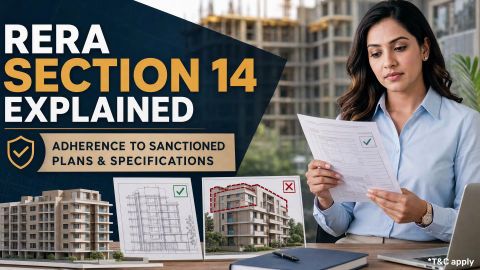
What Section 14 of the RERA Act Means for Homebuyers and Developers
In summary
Section 14 of the Real Estate (Regulation and Development) Act, 2016 requires developers to follow approved project plans and specifications. It also provides safeguards against unauthorised changes and qualifying construction defects.
- Developers must construct projects according to the plans and specifications approved by the competent authority.
- Changes affecting an individual buyer's apartment generally require that buyer's prior consent, subject to specified exceptions.
- Certain changes to building plans or common areas require prior written consent from at least two-thirds of eligible allottees.
- Developers must address qualifying structural, workmanship and other covered defects reported within five years of possession.
- The developer must rectify qualifying defects without additional charges within 30 days after being notified.
- Buyers can seek appropriate remedies through the applicable Real Estate Regulatory Authority when statutory obligations are breached.
Before purchasing an apartment, compare the approved plans with the sale agreement and available project disclosures. Preserve these documents to protect your interests if a dispute arises.
What is Section 14 of the RERA Act?
Section 14 of the RERA Act requires a developer to follow sanctioned plans, layout plans and specifications while developing a real estate project. It also restricts certain changes after the approved details have been disclosed to buyers.
The section has three principal parts.
| Provision | What it covers |
|---|---|
| Section 14(1) | Construction according to sanctioned plans and approved specifications |
| Section 14(2) | Buyer consent requirements for specified alterations |
| Section 14(3) | Rectification of qualifying defects reported within five years of possession |
For example, suppose a buyer books a two-bedroom apartment after reviewing its approved layout and promised fittings. The developer cannot disregard the applicable consent requirements and make substantial changes to that apartment. Similarly, defects covered by Section 14(3) may create a legal obligation to rectify them after possession. These protections help buyers compare the property delivered with the approved and agreed specifications.
Source: India Code – Real Estate (Regulation and Development) Act, 2016
Show more
Show less
Can a builder change an approved apartment layout?
A developer generally needs the concerned buyer's prior consent before making specified changes to the apartment's approved plans, layout, fixtures or amenities. Section 14(2)(i) addresses changes to the particular apartment, plot or building agreed to be purchased.
However, the Act permits certain minor alterations. These include changes requested by the buyer or necessary minor changes for architectural and structural reasons. Such changes must satisfy the prescribed professional verification, declaration and intimation requirements. The law does not classify every physical change as minor.
| Proposed change | What buyers should understand |
| Altering the apartment's agreed layout | Generally requires the concerned buyer's prior consent |
| Replacing agreed fixtures or amenities | Must comply with Section 14 and the agreed specifications |
| Buyer-requested minor alteration | May be permitted under the statutory exception |
| Necessary minor architectural adjustment | Requires the applicable architect or engineer verification |
| Structural changes to walls, columns or beams | Cannot automatically be treated as minor |
| Changes affecting required access | Cannot automatically be treated as minor |
For example, a developer might propose removing a structural wall to change an apartment's design. Such a change is not automatically covered by the minor-alteration exception. The buyer should ask for the revised plan and applicable approvals before consenting.
Show more
Show less
When is two-thirds buyer consent required under RERA?
Section 14(2)(ii) requires prior written consent from at least two-thirds of eligible allottees for specified alterations to building plans, layout plans, specifications or common areas. This requirement applies to changes covered by that provision after the relevant details have been disclosed.
The promoter is excluded from the required allottee count. The Act also provides a counting rule to prevent one buyer or related entity from gaining multiple votes merely through multiple bookings.
Consider a residential building with 90 eligible allottees. If a proposed common-area change falls under Section 14(2)(ii), consent from at least 60 allottees would be required because two-thirds of 90 equals 60. A developer cannot replace the statutory consent requirement with a simple majority vote.
| Number of eligible allottees | Minimum two-thirds consent |
| 30 | 20 |
| 60 | 40 |
| 90 | 60 |
| 100 | 67 |
| 150 | 100 |
Where the result is not a whole number, round up to the next whole allottee. The requirement concerns eligible allottees, not an automatic count of apartments sold. A buyer should also check whether the proposed change requires fresh approval from the competent authority.
Show more
Show less
Which changes are considered major or minor under Section 14?
The legal distinction depends on the nature of the change and the exceptions defined in Section 14. An alteration should not be described as minor simply because the developer considers it inexpensive or convenient.
| Type of alteration | General interpretation |
| Buyer-requested minor modification | May fall within the permitted exception |
| Necessary minor architectural adjustment | Subject to specified professional verification and disclosure |
| Structural wall removal | Excluded from the minor-change definition |
| Addition to building area or height | Excluded from the minor-change definition |
| Changes to columns, beams or supporting structures | Excluded from the minor-change definition |
| Blocking required access or exit routes | Excluded from the minor-change definition |
| Significant changes to common areas | May require two-thirds allottee consent |
For example, a developer may describe a change to a building's access route as a minor design adjustment. However, Section 14 specifically excludes changes affecting required means of access from its minor-alteration definition. The buyer should examine the actual effect of the change rather than rely on its description.
Source: Ministry of Housing and Urban Affairs – RERA Guidance
Show more
Show less
Home loan for professionals
What is the five-year defect liability period under RERA?
Section 14(3) provides a five-year period for reporting qualifying defects after possession is handed over to the allottee. This covers structural defects and certain other defects in workmanship, quality, service provision or the promoter's obligations under the agreement for sale.
The five-year period begins from the date possession is handed over. It is not automatically measured from project registration or the original booking date.
For example, suppose Meera receives possession of her apartment in Kochi on 1 December 2026. If a qualifying structural defect becomes apparent within the following five years, she can notify the developer. She should describe the issue, provide supporting evidence and preserve the complaint record.
However, not every repair or maintenance problem automatically qualifies for relief under Section 14. The defect must fall within the applicable statutory and contractual scope.
The defect must fall within the applicable statutory and contractual scope.
Show more
Show less
How quickly must a builder rectify construction defects?
Under Section 14(3), the developer must rectify qualifying defects without further charges within 30 days after they are brought to the developer's notice. If the developer fails to rectify a covered defect within that period, the affected buyer may be entitled to appropriate compensation under the Act.
Consider Meera discovering a serious water-seepage problem linked to defective construction. She should first document the affected areas and notify the developer in writing. The developer must assess and address the issue according to the applicable statutory obligation.
| Step | What the buyer should do |
| Identify the defect | Record the issue and when it was discovered |
| Collect evidence | Preserve photographs, reports and relevant documents |
| Notify the developer | Submit a clear written complaint |
| Keep acknowledgement | Retain proof of delivery and correspondence |
| Monitor rectification | Check the work completed and the response |
| Escalate if unresolved | Consider the applicable RERA complaint procedure |
For complicated structural issues, an independent engineer's report may help establish the nature of the defect. The 30-day requirement concerns qualifying defects. It should not be treated as a universal deadline for every maintenance request.
Show more
Show less
What can buyers do if a developer violates Section 14?
Buyers can seek appropriate remedies when a developer makes unauthorised alterations or fails to address qualifying defects. The applicable response depends on the violation and available evidence.
For example, Meera may discover that a developer has changed a common amenity without obtaining the necessary consent. She can request the approved plans, relevant consent records and an explanation. If the dispute remains unresolved, she may approach the relevant state Real Estate Regulatory Authority.
The process generally involves:
- Identifying the specific alteration or defect.
- Comparing the property with approved plans and agreed specifications.
- Collecting the sale agreement and supporting records.
- Requesting written clarification or rectification from the developer.
- Checking the project's registration and available disclosures.
- Filing an eligible complaint with the appropriate authority.
- Requesting the appropriate statutory relief.
The available remedy may involve directions, rectification or compensation, depending on the legal findings. Refunds or interest for delayed possession arise under other relevant provisions and should not automatically be presented as Section 14 remedies.
Show more
Show less
What documents should homebuyers check before possession?
Buyers should compare the delivered property with the plans, specifications and contractual promises made during the purchase. This is especially important before accepting possession of an under-construction apartment.
| Document | Why it matters |
| Agreement for sale | Records the agreed property terms |
| Sanctioned building plan | Identifies approved construction |
| Apartment layout | Helps verify the specific unit |
| Project specifications | Describes agreed materials and fittings |
| Approved amendments | Supports verification of authorised changes |
| Buyer consent records | Helps establish whether required consent was obtained |
| Completion or occupancy documents | Supports applicable building compliance checks |
| Possession records | Helps establish the possession date |
| Defect correspondence | Preserves evidence of complaints and responses |
Consider Meera comparing the layout in her sale agreement with the completed apartment. If the developer has changed a wall position or removed an agreed feature, she should seek clarification before accepting the difference. Keeping the documents organised also helps when raising a later defect complaint.
Show More
Show Less
How does Section 14 affect your home purchase decision?
Section 14 helps buyers evaluate construction changes and developer responsibilities before committing to a property. However, the provision does not independently guarantee that a project is free from defects, disputes or delays.
Consider Meera, a 36-year-old salaried professional earning Rs. 1.20 lakh monthly. She plans to purchase a Rs. 60 lakh apartment in Kochi and borrow Rs. 45 lakh.
Before finalising the transaction, she should examine the approved plans, construction progress and relevant project disclosures. She must also calculate the contribution required towards the property and associated transaction expenses.
Bajaj Finance Home Loan offers eligible salaried applicants interest rates starting from 7.50% p.a.*. The final sanction depends on borrower eligibility and the property's legal and technical assessment. For an under-construction apartment, relevant project documentation and approvals form an important part of that assessment.
Once you have verified the property, check your Bajaj Finance Home Loan eligibility before proceeding with the purchase.
Show More
Show Less
What should you remember about Section 14?
Section 14 protects the approved specifications and relevant construction obligations of a real estate project. Buyers should distinguish between changes affecting their own apartment and those affecting shared building areas. The first may require individual consent, while the second may require consent from at least two-thirds of eligible allottees.
The provision also allows buyers to report qualifying defects within five years of possession. Developers must rectify covered defects without extra charges within 30 days after notification.
If you are also arranging financing, explore Bajaj Finance Home Loan after completing the relevant property checks.
Frequently Asked Questions
Buyer consent and construction changes
Defect liability and complaints
Property verification
What is Section 14 of the RERA Act?
Section 14 requires developers to construct real estate projects according to approved plans and specifications. It also restricts specified alterations without the required buyer consent. Changes affecting an individual apartment may need the concerned buyer's consent, while certain common-area changes require consent from at least two-thirds of eligible allottees. The section also establishes obligations concerning qualifying construction defects reported within five years after possession.
Can a builder change the floor plan without buyer consent?
A developer generally cannot make specified changes to an agreed apartment layout without the concerned buyer's prior consent. Section 14 permits certain minor modifications requested by the buyer or necessary for architectural or structural reasons, subject to statutory conditions. Structural alterations cannot automatically be classified as minor. Buyers should examine the revised plans, the purpose of the changes and the relevant approval records before agreeing to them.
What is the two-thirds consent rule under RERA?
Section 14(2)(ii) requires previous written consent from at least two-thirds of eligible allottees for certain changes to building plans, specifications or common areas. The promoter is excluded from the count. The Act also contains rules for counting buyers who hold multiple bookings. For example, where 90 eligible allottees are counted, consent from at least 60 is required. The rule should not be confused with individual consent for apartment-specific changes.
What is the five-year defect liability period under RERA?
Under Section 14(3), buyers can report qualifying structural defects and other covered defects in workmanship, quality, services or specified developer obligations within five years after possession is handed over. The developer must rectify covered defects without additional charges within 30 days after notification. The five-year period does not mean every maintenance issue is automatically covered. The nature of the defect and applicable statutory conditions matter.
What happens if a builder does not repair a defect within 30 days?
If a qualifying defect is reported under Section 14(3) and the developer fails to rectify it within 30 days, the affected allottee may be entitled to appropriate compensation under the Act. Buyers should preserve written complaints, acknowledgements, photographs and relevant technical reports. If necessary, they can pursue the applicable complaint procedure before the state RERA authority. The outcome depends on the evidence and applicable legal provisions.
Can a buyer file a RERA complaint for unauthorised changes?
Yes. Eligible buyers can raise complaints concerning alterations that violate the requirements of Section 14. They should compare the approved plans and agreement with the completed or modified project, collect supporting documents and request clarification from the developer. If the matter remains unresolved, they can approach the relevant RERA authority. Available relief depends on the nature of the violation and the authority's findings.
Does RERA registration guarantee that a building has no defects?
No. RERA registration provides a regulatory framework and access to prescribed project disclosures, but it does not guarantee defect-free construction. Buyers should examine the approved plans, project progress and property documents before purchasing. Section 14 provides a statutory route for addressing qualifying defects discovered after possession. Independent property inspection can help identify problems before a buyer accepts the completed apartment.
Home Loan in Different Cities

Home Loan in Mumbai

Home Loan in Ahmedabad

Home Loan in Bangalore

Home Loan in Chennai

Home Loan in Delhi

Home Loan in Hyderabad

Home Loan in Cochin

Home Loan in Noida

Home Loan in Pune
Home Loan for different budget
Check your pre-approved offer now
Our Calculators






What do our customers say about us
customers
Play Store rating
reviews
Amit Shiva
Reviewed on
Smooth and transparent home loan process. The interest rates were competitive, and documentation was minimal. The team guided me clearly at every step, making my first home purchase stress-free. Highly recommended for quick approvals.
Sandeep Kulkarni
Reviewed on
The loan disbursal was fast, and the customer support team was extremely patient with all my queries. Flexible EMIs helped me manage my monthly expenses easily. A great experience for salaried homebuyers.
Ritika Agarwal
Reviewed on
I had a great experience while transferring my existing home loan. The process was quick, and I saved significantly with the lower interest rate. Customer service was helpful throughout. Highly recommended for balance transfers.
Manoj Verghese
Reviewed on
Clear guidance, quick approval, and flexible repayment options made buying my new house easier than expected. The team handled everything professionally. Very satisfied and would definitely recommend their home loans
Find your nearest branch

More Articles




Watch our videos

Documents required to get a Bajaj Finserv Home Loan

Tips to increase your Home Loan eligibility

Things you need to know about pre-approved home loan

Things you need to know before applying for a Home Loan

How does Repo Rate affect your Home Loan

Download App
Now request money from your friends and family and make instant payments.

- Choose from personal, business, gold loans and more
- Pay utility bills, use UPI, get FASTag and more
- Buy over 1 million products on No Cost EMI
- Buy stocks, mutual funds and invest in FD
Disclaimer
1. Bajaj Finance Limited (“BFL”) is a Non-Banking Finance Company (NBFC) and Prepaid Payment Instrument Issuer offering financial services viz., loans, deposits, Bajaj Pay Wallet, Bajaj Pay UPI, bill payments and third-party wealth management products. The details mentioned in the respective product/ service document shall prevail in case of any inconsistency with respect to the information referring to BFL products and services on this page.
2. All other information, such as, the images, facts, statistics etc. (“information”) that are in addition to the details mentioned in the BFL’s product/ service document and which are being displayed on this page only depicts the summary of the information sourced from the public domain. The said information is neither owned by BFL nor it is to the exclusive knowledge of BFL. There may be inadvertent inaccuracies or typographical errors or delays in updating the said information. Hence, users are advised to independently exercise diligence by verifying complete information, including by consulting experts, if any. Users shall be the sole owner of the decision taken, if any, about suitability of the same.