













An OTP will be sent to this number for verification

You may have a pre-approved offer
Enter required loan against property amount
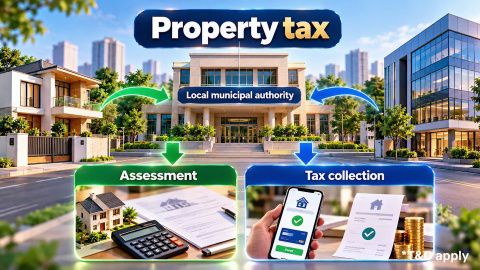
Property tax in your city
In summary
The Department of Local Government, Punjab, oversees the state's urban local bodies, which administer property-tax assessment and collection within their respective jurisdictions. The applicable tax depends on the property category, location, use and municipal assessment rules.
- The Digital-MC House Punjab portal uses identifiers such as a Property ID, assessment number, old assessment number, owner name and house or door number.
- Property tax payment and assessment services are available through the portal for different municipal corporations and councils.
- The 2026–27 rebate period and deadline vary by the concerned municipal body; a common statewide period has not been confirmed.
- Interest applies to delayed payments as per the applicable municipal rules.
- Penalty provisions and their applicable dates depend on the relevant municipal authority.
- A property-tax receipt records tax payment but does not independently establish ownership.
Use the current demand displayed against your property. If the property details, tax assessment or payment status appear incorrect, resolve the discrepancy with the concerned municipal authority before making another payment.
Show More
Show Less
What is Punjab property tax?
Punjab property tax is a municipal tax levied on eligible buildings and land within the jurisdiction of the state's urban local bodies. The Department of Local Government, Punjab, administers the municipal framework. Individual municipal corporations, municipal councils and nagar panchayats handle property-tax assessment, collection and related services within their areas.
The applicable legislation depends on the type of urban local body:
- Municipal corporations: The Punjab Municipal Corporation Act, 1976, and its applicable amendments and government notifications govern property-tax assessment.
Municipal councils and other municipalities: The Punjab Municipal Act, 1911, and applicable amendments and rules provide the assessment framework.
The municipal property-tax record can contain details such as:
- Property identification or assessment number
- Owner's name and property address
- Locality, zone or municipal area
- Property category and usage
- Covered or built-up area
- Rateable value or applicable assessment details
- Current tax demand and previous payments
Outstanding dues, interest and applicable penalties
Source: Municipal Corporation Jalandhar – Property Tax Portal
Show More
Show Less
What are the Punjab property-tax rates for 2026-27?
The rebate period, applicable discounts and payment deadlines for Punjab property tax vary by the concerned municipal corporation or council. A common statewide rebate period for 2026–27 has not been confirmed.
The relevant details are:
| Event | 2026–27 details |
| Rebate period | Varies by municipal body |
| Rebate deadline | Check the latest notification issued by the concerned municipal body |
| First-half interest | As per applicable municipal rules |
| Penalty start date | Depends on the local body's payment rules |
| Second-half interest | As per applicable municipal rules |
The rebate, where available, applies subject to the conditions and payment period specified by the concerned municipal authority. If you are paying now, refer to the current demand shown against your property on the official municipal portal rather than assuming a rebate or manually deducting an amount.
How is Punjab property tax calculated?
The method of property-tax calculation depends on the applicable municipal legislation and government notifications. For properties governed by the Punjab Municipal Corporation Act, 1976, the assessment framework includes rateable value and prescribed tax rates. The calculation can vary according to whether a property is residential or non-residential, self-occupied or rented, and its location classification. The Punjab Municipal Corporation (Second Amendment) Ordinance, 2013, and subsequent legislation and notifications provide for changes to the assessment and tax-rate framework.
For example, the 31 December 2014 government notification prescribes area-based rates for specified residential houses, flats and commercial buildings in municipal corporation cities. The notification also specifies that certain non-residential buildings occupied by tenants attract tax at 7.5% of the annual rent under the stated provision.
The tax calculator uses information including:
- Property group and category
- Old and new zone
- Year of construction
- Built-up area in square feet
- Car-parking area in square feet
- Self-occupied area
Tenanted area
Consider Harpreet, aged 39, who owns a residential house in Ludhiana. His previous property-tax receipt shows Rs. 12,500, while the current municipal portal displays a demand of Rs. 14,000. The difference is: Rs. 14,000 − Rs. 12,500 = Rs. 1,500
| Calculation detail | Value |
| Property location | Ludhiana |
| Property category | Residential |
| Previous tax receipt | Rs. 12,500 |
| Current portal demand | Rs. 14,000 |
| Difference | Rs. 1,500 |
Harpreet should not assume that the additional Rs. 1,500 is incorrect simply because his previous receipt was lower.
He should compare:
- The assessment year on both records.
- The property's municipal area classification.
- The property category and usage.
- The covered or built-up area recorded in the assessment.
- The applicable rate and assessment method.
Any outstanding dues, interest or penalties.
If the assessment details are correct, the current municipal demand should guide his payment. If the property information is incorrect, he should raise a correction or assessment objection with the concerned municipal authority. The Rs. 14,000 demand is illustrative, not Harpreet's actual municipal assessment. Use the verified demand shown by your municipality to determine the amount payable.
How do you pay Punjab property tax online?
You can check and pay Punjab property tax through the relevant municipal corporation or municipal council's online service. The Punjab Government's Digital-MC House portal provides access to municipal corporation information and property-tax services.
Follow these steps:
- Open the Punjab Digital-MC House portal.
- Select your municipal corporation or the relevant local body.
- Open the Property Tax service or the link provided by the municipal authority.
- Select the property-tax return or payment option.
- Enter the requested property identification or assessment details.
- Retrieve the property record.
- Confirm the owner's name, address and property category.
- Check the assessment year and current tax demand.
- Review outstanding dues, interest and any applicable rebate.
- Select an available payment method and complete the transaction.
Download and save the payment receipt and transaction reference.
The payment options can vary by municipal portal. Depending on the local body's online service, you may be able to pay through debit card, credit card, net banking or other available digital payment methods. Some municipal portals also provide challan generation and payment at designated facilitation centres or municipal offices. After completing the transaction, check that the payment appears against the correct property. Keep the receipt and transaction reference with your property documents.
Show More
Show Less
What is a property identification or assessment number in Punjab?
A property identification or assessment number is the municipal reference used to locate a property-tax record. The exact name and format of the identifier can vary between municipal corporations and municipal councils. Some portals use an assessment number or property ID, while others may accept an earlier assessment number or property address.
You may encounter the following details:
| Identifier | What it relates to |
| Property ID | Municipal identification of the property |
| Assessment Number | Property-tax assessment record |
| Old Assessment Number | Earlier municipal tax record |
| House or Door Number | Municipal property address reference |
| Owner's name | Name recorded against the municipal assessment |
| Property Tax Return number | Reference linked to a submitted tax return, where applicable |
For example, the Municipal Corporation Jalandhar property-tax portal provides services for filing a Property Tax Return (PTR), calculating tax, generating a challan and printing an assessment report. Use the identifier accepted by your municipal portal rather than substituting another property reference number. A property ID identifies a municipal tax record. It does not independently establish legal ownership.
What if your Punjab property-tax payment is wrong?
Check the transaction status before paying again if money has been debited but the municipal portal does not show a successful payment.
Different issues need different actions:
| Issue | First action |
| Amount debited but payment not updated | Check the online transaction status |
| Payment awaiting confirmation | Check the bank or challan status |
| Duplicate payment | Keep both transaction references and raise a municipal grievance |
| Incorrect receipt | Raise a payment or receipt grievance |
| Wrong owner name | Use the municipal correction or mutation service with supporting documents |
| Incorrect property details | Compare the tax record with the property documents |
| Unexpected earlier dues | Compare the current demand with previous receipts |
| Incorrect assessment | Submit an objection or revision petition through the relevant municipal authority |
Consider Simran, aged 42, who pays Rs. 18,000 online towards her property tax. Her bank account is debited, but the municipal portal does not immediately show the payment.
Simran should not make another Rs. 18,000 payment immediately.
She should first retain the bank debit confirmation and transaction reference, check the payment status and use the municipal grievance or transaction-verification facility if the payment remains unresolved.
Paying twice could result in Rs. 36,000 being debited before the original transaction is resolved.
Some municipal portals also provide transaction-verification services. For example, the Jalandhar property-tax portal instructs users to verify the transaction if money has been deducted but a receipt has not been generated.
Keep the transaction reference and payment acknowledgement until the municipal record reflects the payment correctly.
Does Punjab property tax prove ownership?
A Punjab property-tax receipt records municipal tax payment but does not independently establish legal ownership.
Consider Meera, aged 38, who purchases a residential property in Punjab for Rs. 65 lakh.
Her registered sale deed records the transfer in her name, but the municipal property-tax record still carries the previous owner's details.
Paying the tax does not replace Meera's registered ownership document. She should also complete the municipal mutation or ownership-record update process with the concerned local authority.
| Record | Main purpose |
| Property-tax receipt | Records municipal tax payment |
| Municipal assessment record | Identifies and assesses the property for tax |
| Mutation record | Updates ownership-related details in municipal records |
| Registered sale deed | Records the documented property transaction |
| Occupancy Certificate | Confirms authorised occupation where required and issued |
| Building plan approval | Records the approved building plan |
The distinction matters when you sell, inherit, transfer or use the property for financing.
Municipal mutation updates ownership-related details in the local tax record. It does not replace the registered document through which the underlying property rights arise.
Can Punjab property-tax records affect a loan against property?
Updated Punjab property-tax records can support the documentation trail for a loan against property, but a tax receipt alone does not determine loan eligibility or the sanctioned amount.
A lender reviews the applicant and property through separate checks.
| Assessment area | What may be reviewed |
| Ownership | Property rights and supporting documents |
| Property records | Municipal and property information |
| Legal assessment | Title and other legal aspects |
| Technical assessment | Property type, location and condition |
| Valuation | Property value for lending purposes |
| Applicant profile | Income, credit profile and repayment capacity |
Consider Gurpreet, aged 43, who lives in Ludhiana, earns Rs. 1.50 lakh per month and has a Credit Information Bureau (India) Limited (CIBIL) Score of 760. Gurpreet is considering a Rs. 50 lakh loan against property for a business requirement. Assume an illustrative interest rate of 10% per annum over 15 years.
The Equated Monthly Instalment (EMI) formula is: EMI = [P × R × (1 + R)^N] ÷ [(1 + R)^N − 1]
Where:
- P = Rs. 50 lakh
- R = 10% ÷ 12 ÷ 100
- N = 180 monthly instalments
The approximate EMI is: Rs. 53,730 per month
If Gurpreet increases the loan amount to Rs. 60 lakh, while the rate and tenure remain unchanged, the approximate EMI rises to Rs. 64,476 per month.
| Illustrative loan amount | Rate | Tenure | Approximate EMI |
| Rs. 50 lakh | 10% per annum | 15 years | Rs. 53,730 |
| Rs. 60 lakh | 10% per annum | 15 years | Rs. 64,476 |
The additional Rs. 10 lakh increases the approximate monthly EMI by: Rs. 64,476 − Rs. 53,730 = Rs. 10,746
Gurpreet's income, CIBIL Score and property records form part of the wider assessment. None of them independently guarantees loan approval.
Bajaj Finance offers Loan Against Property amounts of up to ₹15.50 crore with repayment tenure of up to 15 years, subject to eligibility and property assessment. Bajaj Finance loan against property interest rates currently range from 7.5% per annum to 14.25% per annum. Borrow according to the amount you need and the EMI you can manage rather than selecting the maximum available amount. You can compare loan against property interest rates and use a loan against property EMI calculator to test different loan amounts, rates and repayment tenures.
Planning to use your property for financing? Check eligibility for a loan against property with Bajaj Finance.
Frequently Asked Questions
Payment and property-tax calculation
Payment and property records
Property records and borrowing
What is the property-tax rate in Punjab for 2026-27?
There is no single property-tax rate applicable to every property across Punjab. The rate depends on the municipal jurisdiction, property category, location, usage and applicable government notifications. Check your municipal assessment and current demand to confirm the rate applicable to your property.
How is property tax calculated in Punjab?
The calculation depends on the applicable municipal legislation and assessment method. Municipal corporation assessments can use rateable value and prescribed tax rates, while the applicable rules may differ for other municipal bodies. Property category, location, occupancy, land area and built-up area can affect the amount payable.
What are the Punjab property-tax due dates for 2026-27?
The payment deadline depends on the applicable municipal authority and current government notifications. Check your property-tax demand or municipal portal for the assessment year, payment deadline, interest and any rebate conditions. Do not assume that a deadline announced by one city applies across Punjab.
Is there a property-tax rebate in Punjab for 2026-27?
Official sources reviewed did not confirm a single rebate percentage and deadline for all Punjab municipal areas. Municipal authorities may issue location-specific rebate or settlement announcements. Check the latest notification from your municipal corporation or council before claiming a concession.
How can you check Punjab property tax online?
Open the Punjab Digital-MC House portal or your municipal corporation's official website. Select the relevant Property Tax service and enter the accepted property identification or assessment details. Verify the property record and current demand before proceeding with payment.
What documents should you keep after paying Punjab property tax?
Keep the property-tax receipt, transaction reference, bank payment confirmation and assessment details. If you have raised a grievance or correction request, retain the acknowledgement number as well. These records can help you resolve payment discrepancies and verify earlier dues.
What should you do if an earlier property-tax payment is missing?
Check the payment status and compare the current demand with your earlier receipt. Confirm that the receipt relates to the same property and assessment period. If the payment remains missing, retain the transaction reference and bank confirmation and raise the issue through your municipal authority's grievance or transaction-verification service.
Can you correct the owner's name in a Punjab property-tax record?
You can approach the concerned municipal authority to request a mutation or correction. You may need to provide your registered sale deed, previous property-tax receipt and other supporting documents. The municipal authority will review the request under its applicable procedure.
Does a Punjab property-tax receipt prove ownership?
No. A property-tax receipt records payment against a municipal assessment. It does not independently establish legal ownership. Registered ownership documents, such as a sale deed, are relevant to establishing the underlying property rights.
Can you challenge an incorrect property-tax assessment in Punjab?
Yes. You can approach the relevant municipal authority to submit an objection or revision petition, depending on the applicable municipal law and procedure. Check the assessment notice for the objection period, competent authority and supporting documents required.
Can you get a loan against property using a Punjab property-tax receipt?
A property-tax receipt can form part of the wider property-document trail, depending on the lender and property. It does not independently establish ownership, valuation, eligibility or approval. A lender may separately review ownership documents, municipal records, legal and technical aspects, property valuation, income, credit profile and repayment capacity.
Does a higher loan amount increase your EMI?
Yes. If the interest rate and tenure remain unchanged, a higher principal increases your EMI. At an illustrative 10% per annum for 15 years, a Rs. 50 lakh loan has an approximate EMI of Rs. 53,730, while Rs. 60 lakh increases it to about Rs. 64,476. The Rs. 10 lakh increase raises the illustrative monthly EMI by approximately Rs. 10,746.
Loan Against Property for different budget
Check your pre-approved offer now
Loan Against Property for Professionals




Find your nearest branch

What do our customers say about us
customers
Play Store rating
reviews
Anita Das
04 March 2026
The loan against property process was smooth and transparent. Interest rates were competitive, and the documentation requirements were minimal. The team provided clear guidance at every step, making the entire experience hassle-free. Highly recommended for quick approvals and reliable support.
Aashish
04 March 2026
The loan disbursal was quick, and the customer support team handled all my queries with patience and clarity. Flexible EMIs made it easy to manage monthly expenses. Overall, a great experience, especially for salaried individuals seeking a loan against property.
Prakash
04 March 2026
I had a great experience transferring my existing loan against property. The process was quick and hassle-free, and I saved significantly with the lower interest rate. The customer service team was supportive throughout. Highly recommended for anyone considering a balance transfer.
Yogesh Singh
04 March 2026
Clear guidance, quick approval, and flexible repayment options made purchasing my new house much easier than expected. The team managed the entire process professionally and ensured smooth coordination at every stage. Overall, a very satisfying experience, and I would recommend their home loan services to others.
Related articles


Watch our videos

Know the tax benefits on your loan against property

What are the documents required for a Loan Against Property?

What are the types of property eligible for Loan Against Property

What is the eligibility criteria for a Loan Against Property
Bajaj Finance app for all your financial needs and goals
Trusted by 50 million+ customers in India, Bajaj Finance App is a one-stop solution for all your financial needs and goals.
You can use the Bajaj Finance App to:
- Apply for loans online, such as Instant Personal Loan, Home Loan, Business Loan, Gold Loan, and more.
- Invest in fixed deposits and mutual funds on the app.
- Choose from multiple insurance for your health, motor and even pocket insurance, from various insurance providers.
- Pay and manage your bills and recharges using the BBPS platform. Use Bajaj Pay and Bajaj Wallet for quick and simple money transfers and transactions.
- Apply for Insta EMI Card and get a pre-qualified limit on the app. Explore over 1 million products on the app that can be purchased from a partner store on Easy EMIs.
- Shop from over 100+ brand partners that offer a diverse range of products and services.
- Use specialised tools like EMI calculators, SIP Calculators
- Check your credit score, download loan statements and even get quick customer support—all on the app.
Download the Bajaj Finance App today and experience the convenience of managing your finances on one app.
Disclaimer
1. Bajaj Finance Limited (“BFL”) is a Non-Banking Finance Company (NBFC) and Prepaid Payment Instrument Issuer offering financial services viz., loans, deposits, Bajaj Pay Wallet, Bajaj Pay UPI, bill payments and third-party wealth management products. The details mentioned in the respective product/ service document shall prevail in case of any inconsistency with respect to the information referring to BFL products and services on this page.
2. All other information, such as, the images, facts, statistics etc. (“information”) that are in addition to the details mentioned in the BFL’s product/ service document and which are being displayed on this page only depicts the summary of the information sourced from the public domain. The said information is neither owned by BFL nor it is to the exclusive knowledge of BFL. There may be inadvertent inaccuracies or typographical errors or delays in updating the said information. Hence, users are advised to independently exercise diligence by verifying complete information, including by consulting experts, if any. Users shall be the sole owner of the decision taken, if any, about suitability of the same.