




How Much Electricity Does a Refrigerator Consume

How Much Electricity Does a Refrigerator Consume

Check refrigerator electricity consumption in units and rupees, learn how to calculate usage and save on energy bills with a 5 Star fridge. Get it on Easy EMIs from Bajaj Finance.

Get a loan offer up to Rs. 5 lakh

Quick approval | Flexible tenure options | Zero approval fees

In summary


A standard domestic refrigerator consumes between 1 to 2 units (kWh) of electricity per day under normal household conditions. Choosing a 5-star energy-rated inverter model reduces daily power usage significantly and helps lower monthly utility costs.

  • Prices for household refrigerators range from Rs. 10,000 for single-door models to Rs. 85,000 for premium side-by-side units.
  • A standard household refrigerator uses 1 to 2 units (kWh) of electricity daily.
  • A 5-star rated refrigerator consumes approximately 0.5 to 1 unit per day (~199 kWh per year).
  • Monthly consumption ranges between 15 and 60 units depending on capacity and star rating.
  • Running a standard refrigerator costs roughly Rs. 4 to Rs. 16 per day at Rs. 8 per unit.

You can also buy a new refrigerator on Easy EMIs at over 1.5 lakh partner stores across 4,000 cities, including Reliance Digital, Croma, and Vijay Sales.
How to measure your fridge's electricity consumption?

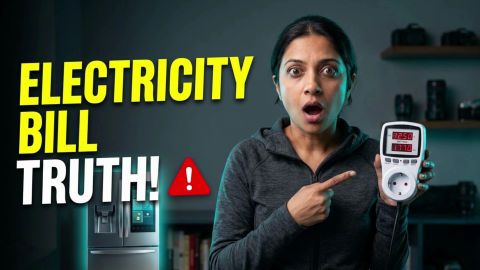
A plug-in power meter is the most accurate way to find your fridge's wattage, typically reading between 100 W and 400 W for standard domestic models.

  1. Plug the meter into the wall outlet: Insert the digital watt meter directly into your wall socket.
  2. Connect your refrigerator: Plug the refrigerator power cord into the outlet port on the watt meter.
  3. Leave running for 24 hours: Allow the meter to record compressor cycles across a full day to view daily kWh consumption.

The table below outlines standard electricity consumption measurements across different refrigerator capacity tiers.

Refrigerator CapacityAverage Daily ConsumptionAverage Monthly Consumption
Direct Cool (190L)~0.8 to 1.0 Units / day~24 to 30 Units / month
Double Door (250L)~1.1 to 1.4 Units / day~33 to 42 Units / month
Side-by-Side (550L+)~1.8 to 2.4 Units / day~54 to 72 Units / month

If you want to replace your refrigerator, visit any of Bajaj Finance's 1.5 lakh partner stores — like Vijay Sales, Croma, Reliance Digital, and more — across 4,000 cities, including Tier 2 cities like Jaipur, Lucknow, Kochi, Bhopal, and more in India. Choose your preferred model, then use the Bajaj Finance Insta EMI Card or Bajaj Finance Easy EMI Loan to finance it. Convert the cost into Easy EMIs that suit your monthly budget and enjoy zero down payment on select models. Check your loan eligibility online in minutes so you know exactly what you can get before you step into the store.

How does refrigerator size affect electricity consumption?

Larger refrigerators draw higher running watts and consume more daily units because they require larger compressors and greater airflow circulation to keep extended storage spaces cool.

The table below outlines how refrigerator capacity and type directly impact typical running wattage and daily electricity draw.

Refrigerator TypeStorage CapacityTypical Wattage (W)Daily Consumption (kWh)
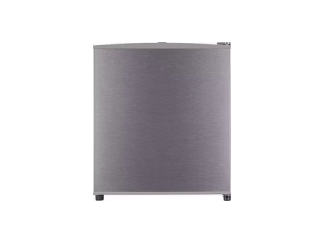
Mini Fridge50–90 Litres60 W to 90 W~0.3 to 0.5 Units / day
Single Door180–210 Litres100 W to 150 W~0.8 to 1.1 Units / day
Double Door230–350 Litres150 W to 250 W~1.2 to 1.6 Units / day
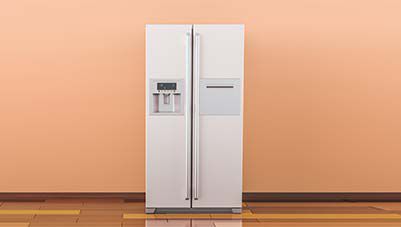
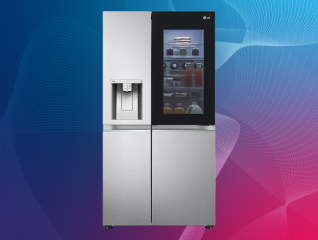
Side-by-Side500–650 Litres250 W to 400 W~2.0 to 2.5 Units / day

What factors affect a refrigerator's energy use?

BEE star rating and ambient room temperature are the top two factors affecting a refrigerator's overall energy use.

  • BEE Star Rating: A 5-star unit uses ~35% less energy than a 3-star model, cutting annual draw from 311 kWh down to 199 kWh.
  • Door Openings: Opening the door raises internal temperatures by 2°C to 3°C, adding ~10 W to 20 W of compressor workload.
  • Food Load Density: Filling cabinet space beyond 80% capacity blocks air vents, increasing cooling time by 15% to 20%.
  • Coil Maintenance: Dust buildup on rear condenser coils increases compressor operating temperatures, raising electricity consumption by up to 10%.

Trade-off note: A refrigerator operating in a 35°C ambient kitchen environment uses ~20% to 30% more electricity than one placed in a cool 25°C room.

How can I reduce my refrigerator's energy bills?

You can reduce your monthly refrigerator running costs by maintaining proper temperature calibrations and clean component airflow.

  • Set optimal temperatures: Keep the fresh food section at 3°C to 4°C and the freezer at -18°C for optimal safety and efficiency.
  • Adjust freezer settings: Raising freezer temperature from -20°C to -15°C reduces total appliance energy consumption by ~5% to 10%.
  • Maintain gasket seals: Replacing damaged door rubber gaskets prevents cold air leaks, saving up to 15% in continuous compressor draw.
  • Defrost regularly: Manual defrosting when frost layer exceeds 5 mm thickness prevents a 10% drop in cooling efficiency.

What are the energy-saving features in modern refrigerators?

Inverter compressor technology is the most impactful energy-saving feature in modern refrigerators, reducing motor speed dynamically rather than cycling completely ON and OFF.

The table below details key energy-efficiency specifications and their direct impact on household power bills.

Energy-Saving FeatureExact Spec ValueEnergy Saving Impact
Inverter CompressorVariable speed (1,000 to 4,000 RPM)Saves 30% to 50% energy vs fixed-speed; reduces running draw from ~200 W to ~100–150 W
Vacuum Insulation PanelsHigh-density thermal insulationRetains internal cold temperatures for up to 12 hours during power outages
Multi-Air Flow CoolingIndependent digital evaporator ventsMaintains uniform 0.5°C shelf cooling, preventing localized compressor overwork
Smart Inverter ControlMulti-sensor ambient temperature trackingAdjusts compressor power automatically across 7 cooling levels to prevent energy waste

What are my financing options to buy a refrigerator?

Bajaj Finance offers two ways to convert an eligible refrigerator purchase into monthly payments at 1.5 lakh+ partner stores across 4,000+ cities.


OptionLimitKey features
Bajaj Finance Insta EMI CardCard loan offer up to Rs. 3 lakh3–60 months tenure; 1.5 lakh+ outlets; 1 million+ eligible products; zero annual fee
Bajaj Finance Easy EMI LoanLoan limit up to Rs. 5 lakh3–60 months tenure; basic KYC; suitable for higher-value purchases

Both options require physical presence at a partner store. The Insta EMI Card suits repeat, multi-category shoppers. The Easy EMI Loan suits a single higher-value purchase. A minimum CIBIL score of 650 applies to the Easy EMI Loan. 


Get a Bajaj Finance Easy EMI Loan of up to Rs. 5 lakh on your next refrigerator purchase. If you are an existing Bajaj Finance Insta EMI Card holder, you may have a loan limit of up to Rs. 3 lakh. Choose repayment tenures of up to 60 months.

Also explore the latest offers. You may find a great deal on a model that matches your needs.

How do I buy a washing machine on EMI at a Bajaj Finance partner store?

The process is simple and typically takes 10 to 15 minutes once you are at the store.

  1. Browse models on Bajaj Mall: Compare options on Bajaj Mall before visiting a store.
  2. Find a partner store near you: Use the Bajaj Finance store locator to find a nearby partner outlet such as Croma, Vijay Sales, or other authorised retailers.
  3. Check the refrigerator in person: Check the key features, specifications, size, and performance to choose the product that best suits your needs and budget.
  4. Choose a suitable EMI option: At checkout, ask the store executive about the Bajaj Finance Insta EMI Card or Easy EMI Loan. Confirm available tenure options and whether your chosen model comes with a zero down payment offer.
  5. Complete payment and schedule installation: The in-store process is quick, and most partner stores offer installation as part of the purchase.

You can also check your loan eligibility online in advance by entering your mobile number and OTP, helping you plan your purchase better before visiting the store.

Save more with Smart Savings Calculator

Combine the best offers, EMI plans, and exclusive vouchers with Smart Savings Calculator to save big.

20k+ people used their offers at the store

Why use the Smart Savings Calculator?

Bajaj Finance’s Smart Savings Calculator helps you unlock maximum savings every time you shop at partner stores. It brings together all available brand, dealer, and scheme offers—so you can see your total savings instantly and shop smarter with Easy EMIs.

  1. Dealer offers - Grab exclusive in-store deals at over 1.5 lakh partner stores across India. Enjoy local discounts and special prices you will not find online.
  2. Brand offers - Access limited-time discounts from top brands across electronics, appliances, and more. Discover brand-specific savings selected just for you.
  3. Bajaj offers - Unlock exclusive Bajaj Finance deals on popular products—available only to our customers. More rewards, more value.­
  4. Scheme offers - Take advantage of time-sensitive offers on select EMI schemes. Get extra benefits after paying just 3 EMIs—visible during EMI selection at checkout.

Calculate your extra savings today!

Frequently asked questions

General

EMI details

How many units of electricity does a refrigerator use per day?

A standard household refrigerator consumes between 1 and 2 units (kWh) of electricity per day under normal operational conditions. Compact 190-litre single-door models draw about 0.8 to 1.1 units daily, whereas larger 300-litre frost-free double-door refrigerators consume approximately 1.2 to 1.6 units per day, depending on the ambient room temperature, usage habits, and star rating.

A standard household refrigerator runs on a rated power draw of 100 W to 250 W during active compressor cycles. However, because inverter compressors adjust motor speed and cycle on and off throughout the day, the average continuous running power drops to roughly 30 W to 80 W, translating into an overall daily electricity consumption of 1 to 2 units (kWh).

Yes, a refrigerator consumes electricity even when you are not opening the door or actively using it. Its internal thermostat continuously monitors temperature drops, causing the compressor, fan motors, and internal sensors to cycle on automatically to maintain safe cooling levels. Even during idle periods, standby electronics draw approximately 1 W to 5 W of continuous background power.

A 5-star refrigerator consumes approximately 0.5 to 1.0 unit (kWh) of electricity per day. Thanks to advanced variable-speed inverter compressors and high-density vacuum insulation panels, a 5-star rated 190-litre model uses as low as 0.5 unit daily (~199 kWh annually), helping reduce monthly household electricity bills by up to 35% compared to lower-rated models.

Yes, you can easily bring home your preferred refrigerator using Bajaj Finance’s Easy EMI options. Whether you already have the Insta EMI card or are new to it, here is how to begin:


If you have the Bajaj Finance Insta EMI card:

  • Explore products on Bajaj Mall: Choose from a wide range of the latest and most popular models.
  • Visit a partner store: Check out the product in person at any of Bajaj Finance’s 1.5 lakh partner stores across 4,000 cities in India.
  • Use your Insta EMI card at checkout: Convert the cost into Easy EMIs that fit your monthly budget.
  • Zero down payment on select models: Take your chosen product home without paying anything upfront.

If you do not have an Insta EMI card:

Check your Insta EMI Card eligibility online using your mobile number and OTP. If you are eligible, apply instantly and enjoy a smarter, more affordable way to buy your favourite fridge on Easy EMIs.

Show More Show Less

Disclaimer

While care is taken to update the information, products, and services included in or available on our website and related platforms/websites, there may be inadvertent inaccuracies or typographical errors or delays in updating the information. The material contained in this site, and on associated web pages, is for reference and general information purpose and the details mentioned in the respective product/service document shall prevail in case of any inconsistency. Subscribers and users should seek professional advice before acting on the basis of the information contained herein. Please take an informed decision with respect to any product or service after going through the relevant product/service document and applicable terms and conditions. In case any inconsistencies observed, please click on reach us.

*Terms and conditions apply