








₹ 2 lakh – ₹ 80 lakh
Check your pre-approved offer and other benefits
Enter mobile and OTP | Check offer | Know your exact loan terms
GST Act and Key Provisions
-
In summary
GST law in India governs the levy, collection and administration of Goods and Services Tax. Businesses must register where required, issue compliant documents, maintain records, file returns and pay the correct tax.
- The framework includes central GST laws, State or Union territory laws, rules, notifications and other authorised measures.
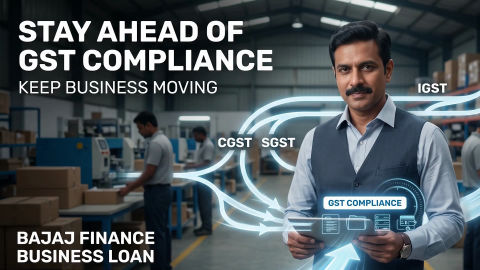
- CGST and SGST or Union Territory GST generally apply to intra-State supplies, while IGST generally applies to inter-State supplies and imports.
- Eligible input tax credit can reduce output tax liability when statutory conditions and documentation requirements are met.
- GST law continues to change through amendments and notifications, including major rate reforms effective from 22 September 2025.
Businesses should verify the applicable provision and effective date before acting on a GST Council recommendation, because recommendations do not automatically operate as enacted law.
What is GST law in India?
-
GST law is the legal framework governing Goods and Services Tax in India. It replaced several indirect taxes at the central and State levels for supplies brought within the GST framework and introduced a destination-based tax system for goods and services.
The framework is not contained in one statute. It includes central legislation, State or Union territory legislation, rules, notifications, circulars, orders and other authorised measures. The exact provision applicable to a transaction depends on factors such as the nature of supply, location of supplier and recipient, classification and applicable exemptions.


Which laws govern GST in India?
-
Several statutes work together to administer GST. The central framework includes the Central Goods and Services Tax Act, 2017, the Integrated Goods and Services Tax Act, 2017, the Union Territory Goods and Services Tax Act, 2017 and the Goods and Services Tax (Compensation to States) Act, 2017.
Law Broad purpose Central Goods and Services Tax Act, 2017 Governs central GST on intra-State supplies and related provisions. State Goods and Services Tax laws Govern State GST on applicable intra-State supplies. Union Territory Goods and Services Tax Act, 2017 Governs Union Territory GST for applicable Union territories. Integrated Goods and Services Tax Act, 2017 Governs inter-State supplies, imports and related place-of-supply rules. GST Compensation legislation Provides the statutory framework for compensation cess on specified supplies, where applicable. The GST Council recommends changes to GST laws, rates and procedures. Parliament and State legislatures, along with the Central Government and authorised authorities acting under the statutes, give effect to changes through the relevant legal instruments.
What are CGST, SGST, IGST, and UTGST?
The type of GST depends largely on whether a supply is intra-State or inter-State and the relevant statutory conditions. A business must determine the place of supply before selecting the tax component.
| Tax | When it generally applies |
| CGST | Charged by the Central Government on eligible intra-State supplies along with applicable SGST or UTGST. |
| SGST | Charged by a State Government on eligible intra-State supplies within that State. |
| IGST | Generally applies to inter-State supplies and imports, subject to the Integrated Goods and Services Tax framework. |
| UTGST | Applies to eligible intra-Union Territory supplies in Union territories covered by the UTGST framework. |
The place-of-supply provisions can produce different outcomes in specific transactions, particularly for services, exports, imports and special categories.
Businesses should not classify a transaction solely by where an invoice is issued.
Check your pre-approved business loan offer
How does GST registration work under GST law?
A person becomes liable for GST registration when the applicable statutory conditions are met, subject to exemptions and special rules. Registration is generally obtained electronically through the GST common portal using the prescribed application process.
The registration framework covers ordinary taxable persons as well as specified categories such as certain persons making inter-State supplies, e-commerce-related cases and persons required to deduct or collect tax at source, subject to the applicable provisions and exemptions.
The registration certificate is made available electronically after registration is granted. A registered person must also keep registration particulars accurate and amend eligible details when changes occur.
What are the GST registration thresholds?
GST registration thresholds are not a single nationwide number for every business or transaction. The applicable threshold depends on the nature of supplies, the State or Union territory, the statutory provision and relevant exemptions.
Certain categories can have compulsory-registration rules even when a general turnover threshold might otherwise apply. Businesses should therefore assess the nature and location of their supplies before deciding that registration is unnecessary.
Because thresholds and compulsory-registration provisions can change through amendments and notifications, verify the current rule for the relevant financial year and business activity before relying on a threshold figure.
What are the main GST compliance requirements?
GST compliance involves more than paying tax. A registered business must maintain appropriate records, issue prescribed tax documents, reconcile transactions, claim input tax credit only where permitted, file applicable returns and pay tax within the relevant timelines.
- Maintain accurate sales, purchase and tax records.
- Issue tax invoices, credit notes, debit notes or other prescribed documents where applicable.
- Determine the correct tax rate and classification for each taxable supply.
- Reconcile outward supplies, purchases and input tax credit with relevant GST records.
- File applicable GST returns and pay tax, interest or other amounts within the prescribed timelines.
- Keep registration details and supporting records current.
- Respond to notices or requests from the tax authorities within the prescribed period.
How does input tax credit work under GST law?
Input tax credit (ITC) allows an eligible registered person to offset qualifying input tax against output tax, subject to the conditions and restrictions in the GST law. ITC is not an automatic deduction merely because GST was charged on a purchase.
The business should hold the prescribed tax document, receive the relevant supply, satisfy the applicable return and payment conditions, and comply with restrictions or reversal requirements. Certain goods, services and circumstances can be subject to blocked or restricted credit.
A strong reconciliation process helps identify mismatches, credit-note adjustments, reversals and other issues before the return is filed.
How do GST invoices and e-invoices work?
GST law prescribes requirements for tax invoices and other documents, including particulars that help identify the supplier, recipient, supply, tax and consideration. Businesses should use the document type appropriate to the transaction.
E-invoicing is a separate electronic reporting framework for notified taxpayers and documents. The current mandate covers taxpayers meeting the prescribed aggregate annual turnover threshold and other conditions, with specified exemptions.
For taxpayers with aggregate annual turnover of Rs. 10 crore or more, a 30-day reporting restriction applies to covered e-invoices from 1 April 2025. The Invoice Registration Portal can reject reporting after the permitted period.
What GST returns must businesses file?
The return or statement required depends on the taxpayer’s registration type, business activity and applicable scheme. Common compliance forms include GSTR-1 for specified outward-supply details and GSTR-3B for summary reporting and tax payment.
Other forms apply to particular taxpayers or transactions, including composition taxpayers, input service distributors, tax deducted or collected at source, non-resident taxpayers and annual compliance.
Businesses should follow the return calendar applicable to their registration and verify any extensions or portal advisories for the relevant tax period.
What happens if a business does not comply with GST law?
GST non-compliance can result in interest, late fees, penalties, recovery proceedings, cancellation or suspension of registration, and other consequences depending on the nature and severity of the default. The applicable consequence depends on the specific statutory provision and facts.
- Late payment can result in interest under the applicable provisions.
- Delayed return filing can attract late fees, subject to applicable waivers or concessions.
- Incorrect reporting can require correction, reversal, additional tax or other action.
- Certain offences or fraudulent conduct can attract statutory penalties and, in specified circumstances, prosecution.
- Failure to comply with registration requirements can create tax and enforcement exposure.
There is no single penalty that applies to every GST mistake. Businesses should identify the specific default and applicable section or rule rather than relying on a generic penalty amount.
What are the latest GST law developments?
GST law has continued to change through legislative amendments, notifications and procedural measures. Major rate reforms recommended at the 56th GST Council meeting took effect for most affected goods and services from 22 September 2025 after the relevant legal instruments were issued.
- The GST rate structure was rationalised, with most supplies moving within a broader 5% and 18% structure and a 40% rate for specified demerit and luxury supplies.
- The Finance Act, 2026 brought the omission of Section 13(8)(b) of the Integrated Goods and Services Tax Act, 2017, concerning intermediary services, into effect from 1 April 2026.
- An amendment to Section 101A of the Central Goods and Services Tax Act, 2017 concerning appeals under the advance-ruling framework took effect from 1 April 2026.
- Other recommended measures concerning post-supply discounts and provisional refunds require the relevant legal provisions and effective dates to be checked before application.
- GSTN has continued to introduce portal and return-process enhancements that affect compliance workflows.
The GST Council’s recommendation date is not necessarily the legal effective date. Businesses should verify the relevant notification, statutory amendment, rule or advisory before changing treatment.
How should businesses manage GST records?
A reliable GST record system should connect invoices, books of account, payment records, returns and supporting documents. The records should allow the business to explain how taxable value, tax liability and input tax credit were determined.
- Retain sales and purchase invoices and other prescribed documents.
- Maintain credit notes, debit notes and adjustment records.
- Keep evidence supporting input tax credit and reversals.
- Retain filed returns, payment challans and reconciliations.
- Track GST registration amendments and correspondence with tax authorities.
- Keep copies of material notifications or professional tax positions relied upon for unusual transactions.
How can GST compliance affect business cash flow?
GST affects cash flow because tax may become payable before a customer settles the related invoice, while eligible input tax credit and refunds may be realised at different times. Businesses should therefore include GST liabilities and receivables in working-capital planning.
For example, a growing distributor may need additional working capital when sales rise faster than customer collections. Separately, a business may incur costs for accounting software, tax support or process upgrades when compliance requirements change.
An established business assessing a funding requirement should compare the expected cash-flow gap, borrowing cost and repayment capacity before taking credit.
Can a Bajaj Finance Business Loan support business expenses?
Eligible established businesses may consider a Bajaj Finance Business Loan for legitimate business expenses such as working capital, technology upgrades or other operational requirements, subject to business loan eligibility, credit assessment and applicable terms.
It offers loan amounts from Rs. 2 lakh to Rs. 80 lakh, repayment tenures from 12 months to 96 months, and interest rates from 14% to 23.50% per annum. Processing fees can be up to 4.72% inclusive of applicable taxes.
Eligibility criteria includes Indian nationality, self-employed status, business vintage of at least 3 years, a CIBIL score of 650 or higher, and age of 21 to 80 years, subject to the applicable maturity condition. Compare the total borrowing cost with projected cash flows before applying.
How to apply for a Bajaj Finance Business Loan?
- Click the 'Check Loan Offer' button to open the online application form.
- Enter basic details, including Name, PAN, Date of Birth, PIN Code, and Business details, and click 'CONTINUE'.
- Complete banking verification and continue.
- View your offer details, select the loan type — Term Loan, Flexi Dropline Loan, or Flexi Hybrid Loan — and choose the repayment tenure.
- Review the details and submit the business loan application.








Select loan by amount
Applicable fees and charges on our business loan

Loans for business needs















Get business loan for your needs

Women Business Loan
Get Women Business Loan upto 80 Lakh

Medical Store Business Loan
Get Medical Store Business Loan upto 80 Lakh

Manufacturer Business Loan
Get Manufacturer Business Loan upto 80 Lakh
Business loan in different cities

Business loan in bangalore

Business loan in mumbai

Business loan in pune

Business loan in Jaipur

Business loan in Kerala
Business loan for different budgets

2 lakh business loan
3 lakh business loan
5 lakh business loan
10 lakh business loan

15 lakh business loan
20 lakh business loan
25 lakh business loan
30 lakh business loan
50 lakh business loan
Types of business loan
Unsecured Business Loan
Secured Business Loan
Term Loan
Cash Credit
Working Capital Loan
Machinery Loan
Line of Credit
Micro Loan
Merchant cash Loan
Frequently asked questions
Overview
What is GST law in simple terms?
GST law is the framework that governs the levy, collection and administration of Goods and Services Tax in India. It covers registration, tax invoices, input tax credit, returns, payment, refunds, assessments and enforcement. The framework includes central and State or Union territory laws, rules, notifications and other authorised measures. The applicable provision depends on the transaction and taxpayer.
What are the main GST laws in India?
The central GST framework includes the Central Goods and Services Tax Act, 2017, Integrated Goods and Services Tax Act, 2017, Union Territory Goods and Services Tax Act, 2017 and GST Compensation legislation. State GST laws also apply to eligible intra-State supplies. Together with rules, notifications and other legal instruments, these laws form the broader GST framework.
What is the difference between CGST, SGST, and IGST?
CGST and SGST generally apply together to eligible intra-State supplies, with CGST collected by the Central Government and SGST by the State Government. IGST generally applies to inter-State supplies and imports. The correct treatment depends on the place-of-supply provisions and the nature of the transaction, so businesses should not classify a supply only from the invoice location.
What happens if a business does not follow GST law?
The consequence depends on the specific default. A business may face interest, late fees, penalties, tax recovery, registration action or, for specified offences and circumstances, prosecution. There is no single penalty for every GST error. The business should identify the applicable statutory provision, correct the issue where permitted and respond to any tax-authority notice within the prescribed time.
Has GST law changed recently?
Yes. GST law continues to change through amendments, notifications, rules and procedural measures. Major rate reforms recommended by the 56th GST Council took effect for most affected supplies from 22 September 2025. During 2026, legislative changes also affected intermediary services and the advance-ruling appeal framework. Businesses should verify the legal instrument and effective date for each change.
How can a small business stay compliant with GST law?
Maintain accurate invoices and books, reconcile sales and purchases, verify applicable tax rates, claim input tax credit only when the conditions are satisfied, file the required returns on time and pay tax within the prescribed period. Keep registration details current and monitor official CBIC, GST Council and GSTN updates. For complex transactions, obtain advice from a qualified tax professional.
More articles


Disclaimer
Bajaj Finance Limited has the sole and absolute discretion, without assigning any reason to accept or reject any application. Terms and conditions apply*.