








Improve CIBIL by clearing overdue
Your CIBIL score deserves better – start by clearing overdue dues
CIBIL score update post EMI clearance may take 30–45 days.
In Summary

CIBIL Impact of Missed EMIs
You can check your CIBIL score using your PAN card on the official CIBIL website by entering your personal details and PAN, then verifying with an OTP sent to your registered mobile number. Checking your own score is a soft inquiry, so it does not affect your score. A missed EMI is reported to credit bureaus as a Days Past Due (DPD) entry and can lower your score, and clearing the overdue amount stops further DPD entries from being added.
- Your PAN is the identifier credit bureaus use to match your credit history across lenders.
- Go to the official CIBIL website, register or log in, enter your name, date of birth, gender, PIN code and PAN, then verify with the OTP.
- A CIBIL score ranges from 300 to 900, and a higher score signals a stronger credit profile.
- Missed EMIs are reported as DPD entries, and the longer an overdue remains unpaid, the greater the impact.
- After you clear an overdue amount, the update appears once the lender's next monthly reporting cycle is processed.
- If an entry looks incorrect, raise a dispute through the official CIBIL process with supporting documents.
Why your PAN card is used to check your CIBIL score
Your PAN card, or Permanent Account Number, is a unique identifier issued by the Income Tax Department of India. It is linked to all your financial accounts, including loans, credit cards, and tax payments. When credit bureaus including TransUnion CIBIL calculate your credit score, they use your PAN to match and aggregate your credit history across all lenders and financial institutions.
This linkage means your CIBIL score reflects every loan you have taken, every credit card you hold, and every EMI payment you have made or missed, across all lenders, all in one place. It is also why your PAN card is the most reliable identifier to use when checking your credit score. Using your PAN ensures the score you see is accurate and complete, with no missing or mismatched records. Checking your own CIBIL score using your PAN card is a soft inquiry, which means it does not affect your score in any way.
How to check your CIBIL score online using your PAN card
You can check your score in a few steps without any charge and without affecting your credit score.
- Go to cibil.com and click on the option to get your CIBIL score.
- Create an account or log in if you already have one. You will need to provide your email address to register.
- Enter your personal details: your name, date of birth, gender, and PIN code, exactly as they appear on your official documents.
- Enter your PAN card number in the identity verification field.
- Provide your mobile number and verify your identity using the OTP sent to your registered mobile number.
- Accept the terms and conditions and submit the form.
- View your score and report. Your CIBIL score and credit report appear on screen and can be downloaded as a PDF.
The process typically takes a few minutes. Your score reflects your credit history as reported by lenders up to the most recent monthly reporting cycle.
Why checking your CIBIL score is the first step in managing your loan
Your CIBIL score is one of the clearest signals of how well you have managed credit in the past, and lenders use it to assess how much risk they are taking by offering you a loan. Before applying for new credit or working on repaying an existing loan, understanding your current score gives you a clear starting point, both for what you are eligible for and for what steps, if any, you need to take to improve it.
What does your CIBIL score range tell you
Your CIBIL score is a three-digit number that ranges from 300 to 900. The higher the number, the stronger your credit profile. According to TransUnion[DG1] CIBIL, a score above 700 is generally considered good.
A higher score signals to lenders that you have managed your credit responsibly, which improves your chances of loan approval and access to better interest rates. A lower score, particularly one affected by missed EMIs or overdue accounts, signals repayment difficulty and can result in loan rejections or higher borrowing costs.
Knowing your score tells you where you stand before you apply for credit, and gives you a clear starting point if you need to take steps to improve your credit profile.
How overdue loan EMIs show up in your PAN-linked CIBIL score
Every loan account linked to your PAN is reported to credit bureaus by your lender on a monthly cycle. When an EMI is missed, the lender reports a Days Past Due entry, or DPD, against that loan account in your credit report. A DPD entry records how many days a payment is overdue.
Even one missed EMI creates a DPD entry on your credit report, and this entry is visible to every lender who checks your CIBIL score. Multiple missed payments, or payments that are significantly overdue, increase the DPD count and reduce your score further. The longer the overdue remains unresolved, the greater the impact on your credit profile. This information stays on your report and is updated each month based on what lenders report.
How to improve your CIBIL score by clearing overdue Bajaj Finance EMIs
Steps to raise your CIBIL score, starting with overdue clearance
Improving your CIBIL score requires consistent action over time. The most important first step is to clear any overdue EMIs, as existing DPD entries stop accumulating only when the overdue amount is paid.
Follow this sequence to begin rebuilding your score:
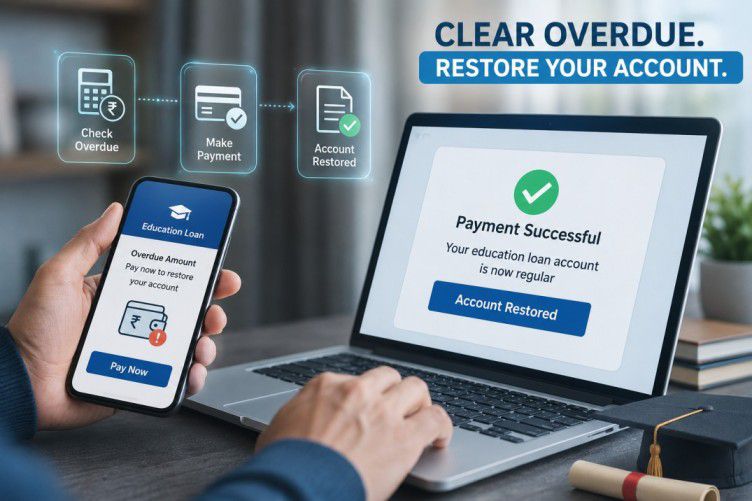
- Clear overdue EMIs first. Paying the overdue amount stops further DPD entries from being added to your credit report. Log in to My Account on the Bajaj Finance website or app to check your total overdue amount and make a payment using UPI, net banking, or debit card.
- Pay all future EMIs on time. Consistent on-time payments after clearing the overdue are the most effective way to gradually rebuild your score. Each on-time payment adds a positive entry to your credit report.
- Avoid applying for new loans or credit cards during the recovery period. Each new credit application results in a hard inquiry on your credit report, which can reduce your score further when it is already low.
- Check your CIBIL report regularly. Review your report at cibil.com to confirm that cleared dues have been updated correctly and that no incorrect entries are present.
Using Bajaj Finance My Account to clear overdue and rebuild credit
My Account on the Bajaj Finance website and app gives you a clear view of all overdue amounts across your active loan accounts. You can pay overdue EMIs directly from the portal without calling customer care or visiting a branch.
To pay overdue EMIs through My Account:
- Sign in using your registered mobile number and OTP
- Go to the Services section and select your loan from Your Relations
- Click on Make Loan Payments and select the Missed Instalments or Other Overdues option
- Select the relevant month or months and proceed to payment
- Pay using UPI, net banking, or debit card and save your confirmation receipt
Once the overdue amount is paid, Bajaj Finance reports the updated account status to credit bureaus in the next monthly reporting cycle. Your CIBIL report will reflect the cleared payment at that point. Consistent on-time payments under your regular EMI schedule from that date forward contribute positively to your credit profile over time.
What affects your CIBIL score and what does not
Understanding what goes into your score helps you take the right actions to protect or improve it.
| Factor | Effect on CIBIL score |
|---|---|
| On-time EMI payments | Positive, improves score over time |
| Missed or late EMI payments | Negative, creates DPD entries on credit report |
| Overdue loan accounts | Significant negative impact, worsens with time |
| High credit card utilisation | Negative, reduces score |
| Multiple loan applications in short period | Negative, each application creates a hard inquiry |
| Checking your own score | No impact, this is a soft inquiry |
| Clearing overdue dues | Positive, stops further DPD entries from accumulating |
| Length of credit history | Longer history with good repayment improves score |
How to dispute an incorrect entry on your CIBIL report
If you find an entry on your CIBIL report that you believe is incorrect, for example an overdue showing for an EMI you have already paid, you can raise a dispute directly with CIBIL.
- Visit cibil.com and log in to your account
- Go to the dispute resolution section
- Identify the entry you believe is incorrect and submit a dispute with supporting documentation
- CIBIL will contact the relevant lender to verify the information
- The dispute resolution process typically takes approximately 30 days, as stated on cibil.com
- If the entry is confirmed as incorrect, it will be updated on your credit report
If you have paid a Bajaj Finance overdue EMI but it is still showing as unpaid on your CIBIL report, contact Bajaj Finance customer care at 8698 010 101 with your payment reference number. Bajaj Finance will verify and submit the corrected information to the credit bureau in the next reporting cycle.
More Guides on Managing Your Bajaj Finance Loan Account
Frequently Asked Questions
CIBIL Score by PAN Card
Score & Overdue Connection
Score Improvement
How do I check my CIBIL score using my PAN card?
Visit the official CIBIL website at cibil.com and select the option to get your free CIBIL score. Register or log in, enter your PAN card number along with your name, date of birth, and mobile number, verify via OTP, and your score and report will be displayed.
Is it free to check CIBIL score by PAN card?
Yes. TransUnion CIBIL offers one free credit score and report per calendar year on its official website at cibil.com, as per RBI guidelines. Additional checks within the same calendar year may require a paid subscription. Several authorised financial platforms also offer free score checks using your PAN card details.
How often can I check my CIBIL score for free?
You are entitled to one free CIBIL score and report per calendar year on the official CIBIL website at cibil.com, as per RBI guidelines. Many authorised financial platforms offer additional free checks. Checking your own score at any frequency does not affect your credit score in any way.
Does checking my own CIBIL score affect it?
No. Checking your own CIBIL score is a soft inquiry and does not affect your credit score. Only hard inquiries, which occur when a lender checks your score as part of a loan or credit card application, can impact your score. You can check your score freely without concern.
What information is needed to check CIBIL score by PAN?
To check your CIBIL score using your PAN card, you will need your PAN card number, full name, date of birth, gender, registered mobile number, email address, and PIN code. You will also need to verify your identity using the OTP sent to your registered mobile number during the process.
How does an overdue EMI affect my CIBIL score?
When an EMI is missed, your lender reports a Days Past Due entry, or DPD, against your loan account to credit bureaus in the monthly reporting cycle. This entry reduces your CIBIL score. The longer the EMI remains unpaid, the higher the DPD count and the greater the negative impact.
By how many points can a missed EMI reduce my CIBIL score?
CIBIL does not publish a fixed point deduction for a single missed EMI, as the impact depends on your overall credit profile. The effect is more significant if your score is already high or if you have a limited credit history. Clearing the overdue promptly limits further damage.
How quickly does CIBIL update after I clear my overdue EMI?
Lenders report updated account status to credit bureaus on a monthly cycle. After you clear your overdue EMI, Bajaj Finance reports the updated status in the next monthly reporting cycle. Your CIBIL score and report will reflect the change after that reporting cycle is processed by the credit bureau.
Can I dispute a wrong overdue entry in my CIBIL score?
Yes. Log in to cibil.com and go to the dispute resolution section. Identify the incorrect entry and submit a dispute with supporting documentation. CIBIL will contact the relevant lender to verify the information. The process typically takes approximately 30 days, as stated on the official CIBIL website.
What CIBIL score is needed to get a loan from Bajaj Finance?
Bajaj Finance does not publish a single minimum CIBIL score requirement applicable to all loan products. Eligibility depends on your loan type, income, repayment history, and overall credit profile. Contact Bajaj Finance customer care or visit the official website to understand the eligibility criteria for the specific loan you are considering.
What is the fastest way to improve my CIBIL score?
The most effective first step is to clear all overdue EMIs immediately, as this stops further DPD entries from accumulating. After that, pay all future EMIs on time consistently. Avoid applying for new loans during the recovery period and check your CIBIL report regularly at cibil.com for accuracy.
How long does it take to improve CIBIL score from 600 to 750?
There is no fixed timeline, as score improvement depends on your repayment behaviour, the number of overdue accounts, and the overall credit profile. TransUnion CIBIL does not publish a standard recovery timeline. Consistent on-time payments over several months, with no new defaults, gradually improve your score over time.
Will loan settlement (vs closure) permanently damage my CIBIL score?
A settled loan is marked as "Settled" on your CIBIL report, which signals to future lenders that the full amount was not repaid. This is different from "Closed," which reflects full repayment. The settled status remains on your credit report and can affect future loan eligibility for several years.
Can part prepayment of my loan improve my CIBIL score?
Part prepayment reduces your outstanding principal, which lowers your overall debt burden. This can have a gradual positive effect on your credit profile over time. However, the most significant factor in score improvement remains consistent on-time EMI payment. Part prepayment alone does not immediately or directly raise your CIBIL score.
What actions should I avoid to protect my CIBIL score?
Avoid missing EMI payments, making only minimum credit card payments, applying for multiple loans or credit cards in a short period, settling a loan for less than the full outstanding amount, and ignoring errors on your CIBIL report. Each of these actions creates a negative entry on your credit record.
More Articles

Disclaimer
While care is taken to update the information, products, and services included in or available on our website and related platforms/websites, there may be inadvertent inaccuracies or typographical errors or delays in updating the information. The material contained in this site, and on associated web pages, is for reference and general information purpose and the details mentioned in the respective product/service document shall prevail in case of any inconsistency. Subscribers and users should seek professional advice before acting on the basis of the information contained herein. Please take an informed decision with respect to any product or service after going through the relevant product/service document and applicable terms and conditions. In case any inconsistencies observed, please click on reach us.
*Terms and conditions apply.