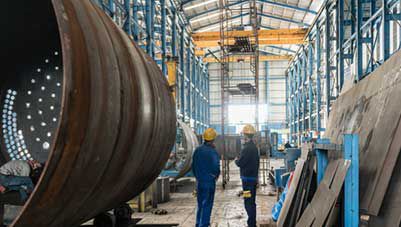





A thermal power plant produces electricity by converting heat energy from coal, gas, oil, or biomass into electrical energy using the Rankine thermodynamic cycle. These plants provide over 60% of India’s electricity, powering industries, cities, and essential services. Whether you are a student studying energy systems, an entrepreneur planning a power project, or an investor assessing infrastructure opportunities, this guide covers all aspects — from how thermal power plants operate and their key components, to types, setup process, environmental challenges, and financing options. Consider Bajaj Finance Business Loans and Machinery Loans to fund your thermal power plant investment effectively.
How does a thermal power plant work?
A thermal power plant generates electricity by converting heat energy into electrical energy through a continuous thermodynamic cycle. The process can be summarised step by step:
| Step | Process | Component involved |
|---|---|---|
| 1 | Fuel (coal, gas, or oil) is burned | Furnace/Boiler |
| 2 | Heat converts water into high-pressure steam | Boiler drum |
| 3 | Steam drives the turbine blades | Steam turbine |
| 4 | Turbine rotation powers the generator | Generator |
| 5 | Electricity is transmitted to the power grid | Transmission lines |
| 6 | Used steam is cooled and condensed back into water | Condenser and cooling tower |
This cycle, called the Rankine Cycle, forms the core thermodynamic principle behind all steam-based thermal power generation.
Core components and functions in a thermal power plant
Understanding the key components of a thermal power plant is essential for accurate planning of procurement, budgeting, and financing.
| Component | Function | Importance |
|---|---|---|
| Boiler | Burns fuel to produce high-pressure steam | Central unit for energy conversion |
| Steam turbine | Converts steam pressure into mechanical rotation | Powers the generator |
| Generator | Converts mechanical energy into electrical energy | Main electricity-producing unit |
| Condenser | Cools steam back into water for reuse | Maintains thermal efficiency |
| Cooling tower | Releases excess heat into the atmosphere | Prevents plant overheating |
| Feedwater pump | Returns condensed water to the boiler | Ensures continuity of the water cycle |
| Electrostatic precipitator | Removes ash and particulates from flue gases | Reduces air pollution |
Types of thermal power plants
Thermal power plants are categorised according to the fuel they use, with each type offering distinct advantages, costs, and regulatory requirements.
| Type | Fuel Used | Key advantage | Best suited for |
|---|---|---|---|
| Coal-based | Thermal coal | High output with well-established infrastructure | Large-scale industrial electricity supply |
| Gas-based (CCGT) | Natural gas | Lower emissions and faster start-up | Urban and industrial areas |
| Oil-based | Diesel or furnace oil | Flexible location setup | Remote or island locations |
| Biomass-based | Agricultural residues, wood | Renewable and carbon-neutral | Rural regions with biomass availability |
| Nuclear thermal | Uranium or thorium | Extremely high efficiency | National grid baseload supply |
Combined Cycle Gas Turbine (CCGT) plants are increasingly favoured in India, offering efficiency of up to 60%, compared with 33–40% for conventional coal-fired plants.
Why is a thermal power plant important?
Despite the growth of renewable energy, thermal power plants remain a cornerstone of India’s energy infrastructure. Their continued importance is highlighted by several factors:
- Baseload power supply: Unlike solar or wind, thermal plants provide round-the-clock electricity, ensuring grid stability.
- Industrial backbone: Supplies uninterrupted high-voltage power to steel, cement, textile, and chemical industries.
- Energy security: Reduces reliance on imported electricity by generating power domestically.
- Employment generation: Large thermal plants create thousands of direct and indirect jobs.
- Urban infrastructure support: Powers hospitals, metro rail systems, water treatment facilities, and telecom networks.
- Rapid scalability: Can quickly increase output during peak demand, unlike most renewable sources.
Thermal power plant vs. renewable energy: key differences
| Factor | Thermal power plant | Solar/Wind energy |
|---|---|---|
| Power availability | 24/7 baseload supply | Intermittent, dependent on weather |
| Setup cost | High (Rs. 5–8 Cr per MW) | Moderate (Rs. 4–6 Cr per MW for solar) |
| Emissions | High CO₂ and SO₂ output | Near zero emissions |
| Land requirement | Large (500–1,000 acres) | Moderate to large |
| Grid stability | Excellent frequency regulation | Needs battery storage for stability |
| Fuel dependency | Requires coal, gas, or oil | No fuel cost once installed |
| Best use case | Industrial baseload power | Peak shaving, rural electrification |
Both energy sources play a vital role in India’s energy mix. Government plans aim to complement, rather than fully replace, thermal power with renewables up to 2040.
Challenges of thermal power plant
Although thermal power plants are highly reliable, they pose considerable operational and environmental challenges that investors and operators must address:
| Challenge | Details | Mitigation strategy |
|---|---|---|
| Air pollution | Emissions of CO₂, SO₂, and NOₓ from fuel combustion | Install scrubbers and electrostatic precipitators |
| High capital cost | Rs. 5–8 crore per MW for setting up a new plant | Finance through Bajaj Finance Business Loans |
| Fuel price volatility | Global fluctuations in coal and gas prices | Enter long-term fuel supply agreements |
| Water consumption | Large volumes of water needed for cooling | Implement dry cooling technology |
| Regulatory compliance | Adherence to MoEF, CPCB, and state environmental regulations | Employ a dedicated compliance team |
| Carbon footprint | Significant greenhouse gas emissions | Transition to hybrid or CCGT systems |
How to start a thermal power plant in India?
Establishing a thermal power plant in India requires regulatory approvals, technical planning, and substantial capital investment. The step-by-step process is outlined below:
Step 1: Feasibility study
Evaluate fuel availability (coal, gas, or biomass), proximity to water sources, land area (typically 500–1,000 acres for large plants), and grid connectivity.
Step 2: Government approvals and clearances
- Environmental Clearance from the Ministry of Environment, Forest and Climate Change (MoEFCC)
- Consent to Establish from the State Pollution Control Board (SPCB)
- Power Purchase Agreement (PPA) with the state DISCOM
- Land acquisition approvals from the relevant state authorities
Step 3: Select plant type and capacity
Decide on coal, gas, or biomass based on fuel availability, budget, and projected demand. Plant capacities generally range from 5 MW (small) to over 1,000 MW (large-scale).
Step 4: Procure technology and equipment
Source boilers, turbines, generators, and auxiliary equipment from certified manufacturers. This is typically the highest-cost phase of the project.
Step 5: Civil construction and installation
Construct plant infrastructure, including cooling towers, transmission lines, control rooms, and staff facilities.
Step 6: Commissioning and grid connection
Perform trial runs, obtain the Commissioning Certificate, and connect the plant to the state or central electricity grid.
Thermal power plant land and location requirements
Choosing the right location is crucial for the viability of a thermal power plant. Key site selection criteria include:
| Requirement | Details |
|---|---|
| Land area | 500–1,500 acres, depending on plant capacity |
| Water source | River, reservoir, or sea within 5 km to supply cooling water |
| Fuel proximity | Located within 100–200 km of a coal mine or gas pipeline |
| Grid connectivity | Access to high-voltage transmission infrastructure |
| Transport links | Rail or road connectivity for fuel and equipment delivery |
| Environmental buffer | Minimum 25 km distance from ecologically sensitive areas |
| State government policy | States with power sector–friendly policies, e.g., Chhattisgarh, Odisha, Jharkhand, Gujarat |
Financing options for thermal power plant
Investing in a thermal power plant requires substantial capital. Financing options include:
- Machinery Loan to fund boilers, turbines, and auxiliary equipment.
- Industrial Equipment Finance for larger plant setups and expansions.
These solutions help manage costs without straining operational cash flows.
Advantages and disadvantages of thermal power generation
| Advantages | Disadvantages |
|---|---|
| Reliable and continuous power supply | Environmental pollution |
| High energy output | High operational costs |
| Supports industrial and urban growth | Dependence on fuel availability |
Future of thermal power plant
The future of thermal power in India is being driven by the twin challenges of rising electricity demand and the imperative to reduce carbon emissions. Key trends include:
- Supercritical and ultra-supercritical technology: New plants operate at higher pressures and temperatures, achieving 45–48% efficiency compared with 33% in older subcritical plants.
- Carbon Capture and Storage (CCS): Emerging technology captures CO₂ before it is released into the atmosphere.
- Coal-to-gas transition: India is gradually shifting new capacity towards gas-based CCGT plants.
- Hybrid renewable-thermal systems: Integration of solar or wind with thermal backup provides near-continuous power supply.
- Digital plant management: AI-driven monitoring systems optimise fuel usage and predict maintenance requirements.
- Green hydrogen co-firing: Pilot projects are testing hydrogen blending in gas turbines to reduce emissions.
Conclusion
Thermal power plants are a vital component of India’s energy infrastructure. Businesses aiming to invest in power generation can explore a business loan, review the business loan interest rate, and assess affordability using a business loan eligibility calculator to make informed investment decisions.