







Health insurance goes beyond hospitalization—it covers OPD visits, medicines, ambulance charges, preventive checkups, and even alternative treatments, giving you all-around financial security.

Check health insurance plans with comprehensive coverage
Get Quote
Health plans from leading insurers | Comprehensive coverage | Offers multiple optional add-ons to enhance coverage
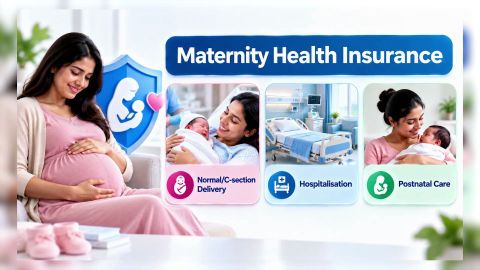
Maternity Health Insurance Plans
In summary
Maternity health insurance pays for inpatient hospitalisation costs arising from childbirth, pre-natal screenings, post-natal care, and neonatal medical emergencies.
- Waiting period: Since standard retail health policies treat pregnancy as a planned event rather than an unexpected illness, insurers mandate a waiting period before maternity claim eligibility activates.
- Pre- and post-hospitalisation: Some policy benefits may allow expenses for up to 30 days before and 60 days after hospitalisation; routine outpatient pregnancy care is not automatically covered.
- Cashless authorisation: IRDAI’s 29 May 2024 health insurance master circular sets a one-hour timeline for initial pre-authorisation and a three-hour timeline for final discharge authorisation after receipt of the relevant request and documents.
- Newborn cover: check when cover begins, the maximum duration, the limit, eligible treatments, vaccination benefits and any enrolment deadline.
If you are planning a pregnancy, compare the waiting period, delivery sub-limits, newborn provisions and exclusions before buying. Compare maternity health insurance plans on Bajaj Finance to review available plans, then verify each benefit in the insurer’s current policy wording and Customer Information Sheet (CIS).
Quick Fact | Cashless timelines
IRDAI’s 2024 health insurance framework specifies up to 1 hour for the initial cashless pre-authorisation decision and up to 3 hours for final discharge authorisation after the relevant request and documents are received. These timelines do not guarantee claim approval.
What is maternity health insurance?
Maternity health insurance can help pay for eligible delivery expenses and certain pregnancy or newborn benefits, depending on the policy’s waiting period and limits. Some plans cover eligible expenses for up to 30 days before hospitalisation and 60 days after it, but the exact time limits vary. Under IRDAI guidelines, maternity insurance covers institutional delivery charges, obstetrician and anesthetist professional fees, labor room charges, operating theater costs for Caesarean sections, pre-natal ultrasound and pathology tests, and post-delivery hospitalisation care for both mother and newborn.
Why do you need maternity insurance?
Welcoming a newborn is a monumental milestone, but the associated healthcare expenses in private hospitals can quickly destabilise family finances if unplanned. Maternity health insurance is essential for several strategic reasons:
- Financial protection against inflationary medical costs: Maternity insurance provides structured financial relief by absorbing room rent, surgeon fees, anaesthetist charges, and nursing care.
- Comprehensive end-to-end maternal protection: A well-structured policy does not merely pay for delivery; it covers routine prenatal screenings, advanced anomaly ultrasounds, non-stress tests (NST), blood work, and postnatal follow-up recovery visits.
- Shielding against unforeseen obstetric complications: Pregnancies do not always follow predictable paths. Emergency caesarean surgeries, premature labour, pre-eclampsia management, and extended ICU hospitalisation require substantial liquid funds that maternity cover absorbs.
- Immediate newborn care and NICU protection: If a newborn requires specialised medical support—such as incubator care for low birth weight or phototherapy for neonatal jaundice—maternity insurance covers these high-cost treatments from Day 1 under the mother's sum insured.
- Preserving long-term family savings: Without maternity insurance, couples often dip into emergency savings, redeem equity investments, or take high-interest personal loans to clear hospital bills. Securing maternity coverage ensures planned family milestones do not disrupt financial goals.
Maternity health insurance may help pay for eligible delivery and hospitalisation expenses. Depending on the plan, it may also cover certain pregnancy-related tests, follow-up care or newborn treatment.
Securing an independent retail health insurance policy with maternity cover through Bajaj Finance ensures you avoid burning into liquid emergency savings. Explore and compare health insurance plans here.
Pro tip
Is maternity cover right for your situation?
| Your situation | What to check next |
| You are planning a pregnancy in the next 1–3 years | Check whether the waiting period will end before the expected delivery admission, and compare delivery and newborn limits. |
| You are already pregnant | Ask whether any policy or employer group plan covers the ongoing pregnancy. Do not assume a newly purchased retail plan will pay for the current pregnancy. |
| You already have employer health insurance | Check the maternity limit, waiting period, newborn terms and whether the cover continues if you change jobs. |
| You want cover mainly for newborn complications | Check the newborn benefit separately: start date, duration, maximum payable amount, covered treatments and enrolment process. |
| You have an existing health policy | Ask the insurer whether maternity cover can be added, when it would become effective and whether a new waiting period applies. |
Pre- and post-hospitalisation: Some policies cover eligible expenses for up to 30 days before and 60 days after hospitalisation. Routine pregnancy check-ups and scans are not automatically included.
A high overall sum insured does not necessarily mean the full delivery bill is payable. A separate maternity limit may apply to normal delivery, C-section or newborn expenses. Check whether the limit is shared or separate.
Cashless authorisation: IRDAI’s health insurance circular dated 29 May 2024 sets a one-hour timeline for the initial pre-authorisation decision and a three-hour timeline for final discharge authorisation, after the required request and documents are received.health insurance add-on covers
Key features of maternity health insurance
Before selecting a policy, reviewing the quantitative specifications ensures you secure adequate coverage aligned with your delivery preferences and family plans:
| Feature | Details |
| Cashless hospital network | 10,000+ Network Hospitals across partner insurers |
| Overall cover amount | Rs. 5 lakh to Rs. 50 lakh+ |
| Normal delivery limit | As per policy terms |
| C-section delivery limit | As per policy terms |
| Newborn cover | As per policy terms |
| Pre-Hospitalisation Window | Up to 30 Days prior to hospitalisation |
| Post-Hospitalisation Window | Up to 60 Days post-discharge |
| Waiting period | Generally, 9 months to 24 months |
| Number of deliveries covered | As per policy terms |
| Tax Deductions | As per the prevalent income tax rules |
Newborn cover: Check when cover starts, how long it lasts, the maximum amount payable, which treatments and vaccinations are covered, and whether there is a deadline to add the baby to the policy.
Specifications reflect offerings across authorized partner insurers on Bajaj Finance as of October 2026. Coverage terms vary by specific product schedule.
What can maternity health insurance cover?
If you are planning a pregnancy, compare waiting periods, delivery limits, newborn benefits and exclusions before buying. You can compare health insurance plans on Bajaj Finance, then check each benefit in the insurer’s latest policy wording and Customer Information Sheet (CIS).
| Expense or benefit | Possible cover | Question to ask the insurer |
| Normal delivery | Eligible hospital stay and delivery expenses | What is the normal-delivery sub-limit? |
| C-section delivery | Eligible surgical delivery and hospitalisation expenses | Is there a separate C-section limit? |
| Pre-natal care | Selected consultations, scans or tests only if included | Are routine outpatient expenses covered, and what time window applies? |
| Post-natal care | Selected follow-up expenses where specified | Which bills qualify and for how long after discharge? |
| Pregnancy complications | May be covered under the base policy or maternity benefit | Which complications are covered, and under which clause? |
| Newborn hospitalisation or NICU | May be covered under a newborn benefit | When does cover start, what is the limit, and how long does it last? |
| Vaccinations | Covered only if the policy includes the benefit | Which vaccines and age window qualify? |
| Medically necessary termination or miscarriage-related care | Depends on policy wording, medical circumstances and applicable law | Which benefit and exclusions apply? |
| Fertility treatment, IVF, surrogacy or stem-cell storage | Do not assume cover; terms vary by product | Is the expense expressly included or excluded? |
Quick Fact | Pre- and post-hospitalisation expenses A policy’s general pre- and post-hospitalisation benefit may not automatically include routine antenatal consultations or scans. Check whether pregnancy-related outpatient expenses are expressly covered, and retain prescriptions, reports and bills. |
Popular plans for you



How does the maternity waiting period work?
The maternity waiting period is the period specified in the policy during which maternity claims are not payable. The duration varies by product, variant and benefit. There is no single waiting period that applies to every health insurance policy in India.
Before buying, ask the insurer when the waiting period starts, how it is counted, whether it applies to each insured member and whether any separate waiting period applies to related conditions. Confirm that it will be completed before the expected hospital admission date; do not calculate eligibility from the conception date alone unless the policy explicitly uses that date.
| Before you buy | What you need confirmed |
| Waiting period | Exact number of months/years stated in the current policy schedule. |
| Benefit trigger | Whether eligibility is based on admission, delivery date or another policy-defined event. |
| Continuous cover | Any renewal, lapse or continuity conditions that could affect eligibility. |
| Number of deliveries | Whether one or more deliveries are covered during the policy term, and whether limits reset. |
| Newborn benefit | Whether it follows the maternity waiting period or has separate eligibility conditions. |
Did You Know? | A shorter waiting period is not the whole comparison A plan with a shorter maternity waiting period may also have a higher premium, lower delivery limit or narrower newborn benefit. Compare the maximum payable amount and exclusions alongside the waiting period. |
For a broader explanation of waiting periods, see waiting period in health insurance.
Inclusions of maternity health insurance
Understanding precisely what expenses qualify for claim settlement ensures smooth hospital discharge. Always refer to your policy terms and policy wording for a detailed list of inclusions:
- IRDAI’s 2024 health insurance framework sets a timeline of up to one hour for the initial cashless pre-authorisation decision and up to three hours for final discharge authorisation, once the relevant request and documents have been received. These timelines do not guarantee that a claim will be approved.
- Caesarean delivery (C-Section): Operating theatre charges, surgeon and anaesthetist fees, surgical consumables, and post-operative monitoring up to the C-section sub-limit and policy terms and conditions.
- Pre-hospitalisation antenatal care: Outpatient consultations, pathology blood profiles, gestational diabetes monitoring, and routine anomaly sonography scans incurred up to 30 days prior to hospital admission. Learn more in our pre and post hospitalisation guide.
- Post-hospitalisation recovery: Prescription medicines, wound dressings, and postnatal clinical consultations incurred up to 60 days following hospital discharge.
- Daycare Treatments: Obstetric daycare surgical interventions requiring specialized monitoring but lasting less than 24 hours due to advanced medical technology.
- Medically necessary pregnancy termination: Medically indicated abortions carried out in compliance with the Medical Termination of Pregnancy (MTP) Act to safeguard maternal health.
- Day 1 newborn hospitalisation: Inpatient incubator care, emergency surgery, phototherapy for jaundice, and neonatal ICU admissions during the first 90 days.
- Emergency road ambulance: Ambulance transport charges from residence to the network hospital during acute labour onset.
Maternity health insurance is a benefit that may help pay for eligible medical expenses related to pregnancy and childbirth. It may be part of a health plan or available as an add-on. The insurer pays only for expenses that meet the policy’s terms, waiting periods, limits and exclusions.
Can you buy maternity health insurance after becoming pregnant?
You may be able to buy a health insurance policy while pregnant, subject to the insurer’s acceptance rules. However, that does not mean the current pregnancy or upcoming delivery will be covered. A maternity waiting period, exclusion or other eligibility condition may apply.
If you are already pregnant, ask your employer’s benefits team and the insurer about any existing group cover, eligible benefits and limits. Disclose the pregnancy accurately and request written confirmation before buying a new policy. Do not rely on a general statement that a plan “covers maternity”.
Quick Fact | Existing pregnancy and new policies
|
Having a baby is an exciting time, but hospital bills can add up quickly. Maternity cover may help with some of these costs, depending on the policy.
How should you compare maternity health insurance plans?
Compare plans against your expected needs and likely out-of-pocket costs. Do not choose a policy based only on the shortest waiting period or a headline sum insured.
| Comparison factor | Questions to ask | Product integration |
| Waiting period | When does the benefit become payable? | Compare available plans through the Bajaj Finance health insurance journey. |
| Delivery sub-limits | What is the maximum payable for normal delivery and C-section? | Check the insurer’s current product brochure and policy schedule. |
| Newborn cover | What is covered from birth, for how long and up to what amount? | Compare the newborn clause across the shortlisted plans. |
| Pre-/post-natal expenses | Are consultations, scans, tests and medicines covered? | Check whether OPD benefits are included or available separately. |
| Co-payment and deductible | What share of eligible expenses must you pay? | Read the policy schedule and co-payment clause. |
| Room rent and non-medical items | Can room choice affect settlement? Which items are excluded? | Check the exclusions and applicable non-medical expense list. |
| Hospital network | Is your preferred maternity hospital currently in-network? | Confirm network status with the insurer and hospital before planned admission. |
| Premium and eligibility | What is the premium for your age, location, cover and add-ons? | Use the quote journey and verify the final quote and conditions before payment. |
Help with delivery costs: A policy may pay eligible hospital charges, such as room rent, doctor fees and nursing care, up to the applicable limits.
Ready to compare? Start with health insurance plans on Bajaj Finance and verify the terms of each shortlisted plan.
Pregnancy and follow-up care: Some plans cover selected pregnancy tests, scans or follow-up visits. Routine antenatal care is not included unless the policy says it is.
How much might you have to pay out of pocket?
Your out-of-pocket cost depends on the admissible bill, the maternity sub-limit, co-payment, room eligibility and non-payable expenses. The following example is illustrative only; it is not a quotation, product benefit or prediction of an actual claim.
| Illustrative example | Amount |
| Eligible delivery bill | Rs. 1,50,000 |
| Assumed maternity sub-limit | Rs. 75,000 |
| Maximum payable against the delivery bill in this simplified example | Rs. 75,000 |
| Delivery bill above the assumed limit | Rs. 75,000 |
Help with complications: Some policies cover eligible hospital treatment for pregnancy or delivery complications. Check which complications are included and what limits apply.
Did You Know? | The overall sum insured may not be the maternity limit A policy with a Rs. 10 lakh overall sum insured could still have a much smaller maternity sub-limit. Check whether the limit applies per delivery, per policy year or across all maternity claims, and whether newborn expenses share that limit. |
Also check whether co-payment in health insurance or a deductible could increase your share of the bill.
Health Insurance in different cities

Health Insurance in Bangalore

Health Insurance in Jaipur

Health Insurance in Pune

Health Insurance in Mumbai

Health Insurance in Kerala
What does the IRDAI framework say about cashless claims?
IRDAI’s Master Circular on Operations and Allied Matters of Health Insurance Business, dated 29 May 2024 (Ref. IRDAI/HLT/CIR/PRO/84/5/2024), sets a one-hour timeline for the initial cashless pre-authorisation decision and a three-hour timeline for final discharge authorisation after the relevant request and documents are received. These are authorisation timelines, not a guarantee that a claim will be approved or that every expense will be payable.
Regulatory Context | IRDAI health insurance master circular — 29 May 2024 The circular sets service timelines for initial cashless pre-authorisation and final discharge authorisation. Coverage remains subject to the policy’s terms, admissibility requirements, limits and exclusions. Cite and recheck the current official circular before publication. |
Official source: IRDAI circulars portal
How do you make a cashless maternity claim?
- Protecting savings: Maternity cover may help you manage eligible hospital bills without using as much of your savings. Compare the premium and likely benefit before deciding whether it suits your needs.
- Provide the policy details, identification, doctor’s advice and medical records requested by the insurer or TPA.
- Wait for the insurer’s authorisation decision. Initial authorisation is not a promise that every final bill item will be paid.
- At discharge, check the final approved amount and ask for an explanation of any deductions or non-payable expenses.
- Keep the discharge summary, original bills, receipts, prescriptions, diagnostic reports and claim communications for any reimbursement or follow-up.
For a wider overview, see health insurance claims and cover options.
A separate retail health policy with maternity benefits may be worth considering if it fits your plans and budget. Compare available health insurance plans and check the exact maternity benefits before you buy.
Who can benefit from maternity health insurance cover?
Maternity health insurance is specifically tailored to protect families during their reproductive years:
- Newly married couples: Couples planning to conceive within the next 2 to 3 years can serve out the mandatory waiting periods early, ensuring zero claim rejection stress at delivery.
- Corporate employees facing low group limits: Working professionals whose employer mediclaim caps maternity at Rs. 40,000 or Rs. 50,000 can purchase an independent retail policy to bridge the hospital cost deficit.
- Self-employed professionals and freelancers: Individuals who do not have access to corporate group health insurance can establish their own primary maternity safety net.
- Couples planning deliveries in private hospitals: Expecting parents seeking private suites, experienced obstetric surgeons, and premium neonatal care in Tier 1 cities benefit significantly from delivery sub-limits and Day 1 newborn shields.
Compare types of Health Insurance Plans
Eligibility criteria for maternity health insurance policy
To qualify for maternity health insurance coverage across partner insurers, applicants must satisfy standard underwriting criteria:
- Entry Age Limits: The adult female applicant (proposer or insured spouse) must typically be between 18 and 45 years of age at the time of policy inception.
- Policy Coverage Type: Maternity benefits are available under individual health policies or family floater plans where both spouses are covered.
- Waiting Period Compliance: Claims are admissible only after the policy has remained continuously active for the full waiting period (9 to 24 months) without premium payment lapses.
- Pre-Existing Health Declarations: Applicants must disclose chronic medical conditions such as hypertension, thyroid disorders, diabetes, or previous obstetric surgeries. Insurers evaluate these under standard medical underwriting rules.
Timely Renewal: The policy must be renewed annually without break. Allowing a policy to lapse resets the accumulated waiting period clock back to zero.
What should you check about exclusions?
Do not treat any benefit as universally covered or universally excluded without checking the relevant product. Potential exclusions or restrictions may include:
- Claims made before the maternity waiting period is completed.
- Amounts above a delivery or newborn sub-limit.
- Routine outpatient consultations or diagnostic tests where no relevant benefit applies.
- Non-medical or administrative expenses not payable under the policy.
- Fertility treatment, IVF, surrogacy-related expenses or stem-cell storage, where excluded.
Specific pregnancy complications, congenital conditions or medical termination claims, depending on policy wording and applicable law.
Quick Fact | Medical necessity and exclusions Claims involving miscarriage, medical termination, ectopic pregnancy or pregnancy complications should not be described as automatically payable or automatically excluded. The medical circumstances, applicable law and policy wording determine the outcome. |
Factors to consider while buying a maternity or pregnancy health insurance policy
- Check your current employer cover first, including delivery limits and newborn benefits.
- Confirm the waiting period and calculate whether it can be completed before the expected admission date.
- Compare the normal-delivery and C-section limits, newborn cover, pre-/post-natal expenses and exclusions.
- Check the network status of your preferred maternity hospital.
- Read the policy wording and CIS; ask the insurer or authorised intermediary to clarify ambiguous clauses.
- Keep a copy of the quote, policy schedule, benefit wording and any written clarification.
Maternity cover is worth evaluating when the benefits match your planning timeline and expected costs. If the waiting period cannot be completed in time, or the sub-limit is small compared with expected expenses, the premium may not materially reduce your out-of-pocket bill for the upcoming delivery.
Compare Health Insurance Plans on Bajaj Finance
Tax-savings plans for you
What our customer say about us
+ Customers
Play Store Rating
Reviews
Arjun Mehta
13 Jul 2025
I opted for the Health Infinity plan for my parents. The digital onboarding was incredibly fast with no medical tests required since they are under 50. We had a minor daycare procedure last month, and the cashless approval came through in less than 2 hours. Very impressed with the efficiency.
Priya Sharma
28 Feb 2025
The Bajaj Finance Health app is a lifesaver. I use it for my regular OPD consultations and medicine orders. The 10% discount on pharmacy bills and the easy reimbursement for doctor visits make it much more than just a 'hospitalization' policy. It’s daily health support.
Sneha Kapoor
15 Mar 2025
Switched my family floater to Bajaj General this year. The network of hospitals in my city (Pune) is excellent. The only downside was a slight delay in getting my physical card, but the digital copy on the app works everywhere. The 'Wellness Rewards' for hitting step goals is a cool touch!
What documents are required to apply for maternity health insurance?
Completing an online application for maternity health insurance requires only standard KYC verification documents:
- Identity Proof: Government-issued photo identification such as an Aadhaar Card, Passport, Voter ID, or PAN Card.
- Before choosing a plan, compare the benefits and limits with the kind of care you may need.
- Age Proof: Birth certificate, school leaving certificate, Aadhaar Card, or Passport verifying age eligibility within the 18–45 year window.
- Proposer Photograph and Medical Self-Declaration: Recent digital passport-size photograph and a completed medical history declaration form detailing pre-existing conditions or prior surgeries.
A step-by-step guide to buying maternity health insurance plans
Follow these four simple steps to compare and buy an optimal maternity policy:
- Step 1: Enter personal details and generate quotes: Enter personal details to view customised quotes from leading partner insurers.
- Step 2: Check policies and compare waiting periods: Check and compare policies offering maternity benefits. Compare waiting periods, hospital network, and other details.
- Step 3: Complete medical declarations and add-ons: Select your preferred base sum insured, add optional riders such as OPD cover or hospital daily cash, and fill out the paperless medical history declaration.
- Step 4: Complete payment and policy issuance: Pay your annual premium securely via UPI, net banking, debit/credit cards. Your policy schedule and digital health cards are issued to your registered email.
Documents required to raise a claim for maternity insurance
Whether settling via cashless hospitalisation or filing for post-discharge reimbursement, maintain a comprehensive claims portfolio containing the below or more as per the policy details:
- Duly Completed & Signed Claim Form: Part A (filled by policyholder) and Part B (filled by hospital billing desk).
- Hospital Discharge Summary: Detailed clinical summary signed by the attending gynaecologist, recording delivery type (normal vs LSCS), gestational age at birth, and newborn vitals.
- Final Itemized Hospital Invoices & Payment Receipts: Original consolidated bill with complete line-item breakdown (room rent, nursing, OT charges, surgeon fees).
- Doctor's Admission Advice & Antenatal Records: Obstetrician admission letter and pre-hospitalisation diagnostic test reports (ultrasound anomaly scans, blood profiles).
- Newborn Birth Certificate & Pediatric Summary: Official birth certificate and pediatric discharge sheet in case of neonatal nursery care.
- Pharmacy Prescriptions & Cash Memos: Doctor prescriptions corresponding to each billed medicine purchased inside or outside the hospital.
- Policyholder KYC & Cancelled Cheque: Copy of health e-card, PAN card, and a cancelled cheque with pre-printed account holder name for NEFT reimbursement.
Explore and stay informed
Can you buy health insurance on EMI
Why buy health insurance
Health Insurance for family
Health Insurance Claim settlement ratio
Health Insurance waiting period
Importance of health insurance
Health Insurance for Senior Citizens
Health Insurance tax benefits
Health Insurance for parents
Health Insurance premium calculator
Health Insurance for Other Diseases

Antral Gastritis

Hepatomegaly Symptoms Causes & Treatment

Blood Pressure Range

PCOS Causes and Symptoms

Health insurance for Obesity
Do's and don'ts for maternity health insurance planning
Follow these critical operational guidelines to safeguard your claims and prevent unexpected out-of-pocket leakage:
| Do | Why it matters | Don’t |
| Purchase your policy at least 24 to 36 months before planned conception. | Completely clears the waiting period before hospital admission for delivery, ensuring 100% cashless clearance. | Do not buy a maternity policy when already pregnant expecting delivery claims to be covered. |
| Compare partner insurer delivery sub-limits for both normal and C-section childbirth. | Selecting higher sub-limits directly reduces out-of-pocket leakage. | Do not assume your overall Rs. 10 Lakh sum insured is fully available for maternity claims. |
| Select a policy featuring built-in Day 1 newborn protection. | Automatically shields the baby under the mother's sum insured for congenital defects and NICU care. | Do not delay endorsing your newborn onto the family floater policy beyond 90 days of birth. |
| Notify the network hospital insurance desk at least 48 hours prior to a planned C-section admission. | Secures initial pre-authorisation sanction within IRDAI's mandated 1-hour window and reserves cashless benefits. | Do not choose a luxury maternity suite that breaches your policy's room rent eligibility cap. |
Authoritative sources and references
All medical statistics, legal mandates, turnaround benchmarks, and tax provisions cited in this guide are directly derived from official government bodies and statutory regulatory frameworks:
| Reference Authority / Publication | Document Identifier / Citation | Regulatory Topic / Data Verified | Official Source Link |
| Insurance Regulatory and Development Authority of India (IRDAI) | Master Circular on Operations and Allied Matters of Health Insurance Business (29 May 2024, Ref: IRDAI/HLT/CIR/PRO/84/5/2024) | 60-Minute Cashless Pre-Auth, 3-Hour Final Discharge Mandate, Newborn Inclusion Rules | IRDAI Official Portal |
| Income Tax Department, Ministry of Finance | Income-tax Act, 2025 (Section 126 Rules & Deductions) | Tax deductions for medical insurance premiums (Rs. 25,000 for family + Rs. 50,000 for senior parents) under the Old Tax Regime | Income Tax India |
Glossary
| Term | Meaning |
| Maternity benefit | A policy benefit for eligible expenses related to pregnancy and childbirth. |
| Waiting period | The time specified in the policy during which a particular benefit is not payable. |
| Sub-limit | A cap on the amount payable for a specific benefit or treatment. |
| Newborn cover | A policy benefit for specified medical expenses of a baby, subject to the policy’s conditions. |
| CIS (Customer Information Sheet) | A summary of key policy features, limits, waiting periods and exclusions. |
| TPA (Third-Party Administrator) | An entity that performs specified servicing functions for an insurer. |
Frequently Asked Questions
Eligibility and Entry Rules
Coverage and Benefits
Can I get maternity health insurance with no waiting period?
Most maternity health insurance policies have a waiting period before you can claim pregnancy and delivery expenses. The length of the wait depends on the insurer and plan, so do not assume a zero-waiting-period option is available. Check the policy wording to confirm when the benefit starts.
Can I buy maternity health insurance if I am already pregnant?
You may be able to buy a health insurance policy while pregnant, but that does not mean it will cover your current pregnancy or delivery. A waiting period or exclusion may apply. Ask the insurer to confirm in writing whether these expenses are covered before you buy.
Does maternity health insurance cover a second delivery?
Some plans cover a second delivery, while others limit the number of deliveries covered. The benefit also depends on the maternity limit, waiting period and other policy terms. Check whether normal and C-section deliveries are covered.
Is a newborn baby covered under maternity health insurance?
Some plans cover a newborn for a set period after birth. This may include eligible treatment or hospitalisation, and some plans may include vaccinations. Check when cover starts, how long it lasts, the limit and whether you need to add the baby to the policy by a certain date.
Is pregnancy considered a pre-existing condition under health insurance?
Whether an ongoing pregnancy is covered depends on the policy. A new policy may not cover the current pregnancy, especially if a waiting period or exclusion applies. If you are planning a pregnancy, check the waiting period and eligibility rules before buying.
Can I add maternity coverage to my existing health insurance plan?
Maternity coverage may be available as an add-on with some health insurance plans, subject to the insurer’s terms. Availability, eligibility, waiting periods, coverage limits, and premium costs can vary. Check whether your existing policy allows maternity benefits to be added and review the applicable terms before opting for the cover.
What expenses are covered under maternity health insurance?
Depending on the plan, maternity cover may pay for eligible delivery and hospitalisation expenses. Some plans also cover selected pre- and post-hospitalisation expenses or newborn care. Check the policy for the exact benefits, limits, waiting period and exclusions.
How is the premium for maternity health insurance calculated?
The premium depends on the insurer, plan benefits, overall sum insured, maternity limit and any add-ons. Compare the premium with the benefits you can actually claim and the expenses you may still need to pay. A higher premium does not always mean a higher payout.
Which health insurance plan is suitable for pregnancy expenses?
Choose a plan that fits your budget and pregnancy-planning timeline. Compare the waiting period, maternity limit, normal and C-section delivery cover, pre- and post-hospitalisation benefits, newborn cover, exclusions and hospital network. Benefits vary by plan, so check the policy wording before deciding.explore health insurance plans
How many deliveries can a maternity health insurance policy cover?
The number of deliveries covered depends on the policy. Some plans cover one delivery, while others may cover more, subject to limits and conditions. Check whether the limit is shared across deliveries and whether the waiting period or benefit changes for a later delivery.
What is the waiting period for maternity health insurance?
The waiting period is the time you must complete before you can claim maternity benefits. It varies by insurer and plan, so there is no single period for every policy. Check the exact duration and when it starts in the policy wording.
How much does insurance cover for maternity?
The amount covered for maternity expenses depends on the policy’s maternity sum insured, coverage limits, sub-limits, and applicable terms. Expenses for normal or C-section delivery may be covered up to specified limits. Check the policy document to understand the maximum amount payable and any applicable out-of-pocket expenses.
Is maternity covered in Mediclaim?
Maternity expenses may be covered under certain mediclaim or health insurance policies that specifically include maternity benefits. Coverage is generally subject to a waiting period, exclusions, sub-limits, and the policy’s terms. Standard health insurance without maternity benefits may not cover pregnancy and childbirth expenses, so check the policy before purchasing.
What is the maternity benefit in a mediclaim policy?
Maternity benefits in a mediclaim policy provide coverage for eligible pregnancy and childbirth-related medical expenses. Depending on the plan, these may include prenatal care, hospitalisation, normal or C-section delivery, postnatal care, and certain newborn expenses. Coverage limits, waiting periods, and exclusions vary, so review the policy terms before making a claim.
What is the ideal insurance for maternity care?
Instead of looking for a “ideal” maternity policy, compare plans based on your specific requirements. Consider the waiting period, maternity coverage limits, delivery and hospitalisation benefits, newborn coverage, network hospitals, exclusions, and premium. A health insurance plan with maternity coverage that suits your needs and offers clear terms can provide appropriate financial support.





Articles and Insights


Disclaimer
*T&C Apply - Bajaj Finance Limited (‘BFL’) is a registered corporate agent of third party insurance products of Bajaj Allianz Life Insurance Company Limited, HDFC Life Insurance Company Limited, Life Insurance Corporation of India (LIC), Bajaj Allianz General Insurance Company Limited, SBI General Insurance Company Limited, ACKO General Insurance Company Limited, HDFC ERGO General Insurance Company, TATA AIG General Insurance Company Limited, ICICI Lombard General Insurance Company Limited, New India Assurance Limited, Chola MS General Insurance Company Limited, Zurich Kotak General Insurance Co. Limited , Star Health & Allied Insurance Co. Limited, Care Health Insurance Company Limited, Niva Bupa Health Insurance Company Limited , Aditya Birla Health Insurance Company Limited and Manipal Cigna Health Insurance Company Limited under the IRDAI composite CA registration number CA0101. Please note that, BFL does not underwrite the risk or act as an insurer. Your purchase of an insurance product is purely on a voluntary basis after your exercise of an independent due diligence on the suitability, viability of any insurance product. Any decision to purchase insurance product is solely at your own risk and responsibility and BFL shall not be liable for any loss or damage that any person may suffer, whether directly or indirectly. Please refer insurer's website for Policy Wordings. For more details on risk factors, terms and conditions and exclusions please read the product sales brochure carefully before concluding a sale. Tax benefits applicable if any, will be as per the prevailing tax laws. Tax laws are subject to change. Tax laws are subject to change. BFL does NOT provide Tax/Investment advisory services. Please consult your advisors before proceeding to purchase an insurance product. Visitors are hereby informed that their information submitted on the website may also be shared with insurers. BFL is also a distributor of other third-party products from Assistance Services providers such as CPP Assistance Services Pvt. Ltd., Bajaj Finance Health Ltd. etc. All product information such as premium, benefits, exclusions, sum insured, value added services, etc. are authentic and solely based on the information received from the respective insurance company or the respective Assistance service provider company.
Note – While we have made all efforts and taken utmost care in gathering precise information about the products, features, benefits, etc. However, BFL cannot be held liable for any direct or indirect damage/loss. We request our customers to conduct their research about these products and refer to the respective product’s sales brochures before concluding their sale.