Understanding the credit appraisal and gold verification process
Before approving a gold loan, lenders follow a structured process to verify your gold and confirm your loan amount. Here's how it typically works:
- KYC and application check — Your identity and application details are verified using a valid KYC document.
- Gold purity testing — Trained valuers assess the karat purity of your gold jewellery, ornaments, or coins.
- Net weight assessment — Stones, enamel, or attachments are deducted to determine actual gold weight.
- Valuation and sanction — The eligible loan amount is calculated using the applicable gold rate and LTV ratio.
How is the valuation of gold decided for a gold loan?
During a gold loan assessment, Bajaj Finance checks the ownership and authenticity of the gold being pledged. The gold valuation for gold loan purposes is based on the lower of the previous day’s closing price or the 30-day average closing price published by IBJA or a SEBI-regulated commodity exchange.
The assessment may also include:
- Credit appraisal: This applies to new gold loans, top-ups and renewals.
- Ownership check: Internal systems are used to verify the ownership of the pledged gold.
- Self-declaration: The borrower must confirm that the pledged gold belongs to them.
- Pledge safeguards: Customer gold is not re-pledged to obtain loans from another institution.
Rules for use of pledged gold
Bajaj Finance does not use customers’ pledged gold as collateral to raise loans from other lenders, entities or individuals. This helps protect the pledged gold and supports transparent lending practices.
What gold purity is accepted for a loan?
Gold purity is an important part of the gold valuation process. It is measured in karats, with 24K being the purest form. Jewellery is often mixed with other metals to make it stronger, which lowers its purity. During assessment, trained experts check the purity before deciding the eligible loan amount.
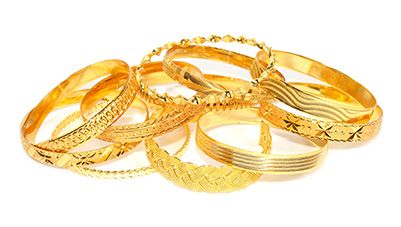
Bajaj Finance offers gold loans from Rs. 5,000 to Rs. 2 crore against 18-22 karat gold jewellery and ornaments. Gold coins up to 24 karat purity are also accepted, subject to policy. For reference, 24K gold is about 99.9% pure, 22K is 91.6%, 20K is 83.3% and 18K is 75%. The valuation of gold today may vary based on its purity and the applicable gold valuation method.
Discover your borrowing potential by checking your gold loan eligibility. It takes just a few clicks and no waiting.
How does the weight of your gold affect the loan amount?
The higher the net weight of eligible gold, the higher the assessed gold value may be, which can increase your eligible gold loan amount, subject to purity, valuation and the applicable Loan-to-Value (LTV) limit.
During valuation, trained valuers assess your gold in grams using appropriate equipment. Only the net weight of eligible gold is considered. The weight of gemstones, pearls, stones and other non-gold materials is excluded from the assessment.
For example, two jewellery pieces may have the same overall weight but different eligible gold content. The piece with more net gold may have a higher assessed value and potentially a higher eligible loan amount.
Therefore, knowing the net gold weight can help you better understand your potential borrowing amount before applying for a gold loan.
How does the current gold price affect loan valuation?
The gold price used for valuation plays an important role in deciding the value of gold offered as security for a loan. The gold rate in India can move up or down regularly because of global demand and supply, inflation, currency fluctuations, geopolitical events, and changes in economic conditions.
For gold loan valuation, Bajaj Finance uses the lower of the previous day’s closing price or the 30-day average closing price for the specific gold purity. The price must be published by the Indian Bullion and Jewellers Association (IBJA) or a SEBI-regulated commodity exchange. The assessed value is then used to determine the eligible loan amount based on the applicable Loan-to-Value (LTV) ratio.
Loan-to-Value (LTV) ratio
The Loan-to-Value (LTV) ratio determines the maximum percentage of your gold's assessed value that can be offered as a loan. After your gold is valued, the applicable LTV is used to calculate the eligible loan amount. The permissible LTV is governed by RBI guidelines and lender policies.
The maximum LTV for consumption loans depends on the loan amount:
- For loans up to Rs. 2.5 lakh = 85%
- For loans between more than Rs. 2.5 lakh to Rs. 5 lakh = LTV 80%
- For loans from more than Rs. 5 lakh up to Rs. 2 crore = LTV 75%
You can use the online gold loan calculator to estimate your eligible loan amount based on your gold weight or the amount you wish to borrow. The calculator provides an estimate of your loan liability and the interest rate for gold loan, while the final loan amount depends on the valuation of your gold and the applicable LTV ratio.
How to increase gold loan valuation
The value of your gold for a gold loan mainly depends on its purity, eligible weight, and the applicable valuation price. You can improve the value considered for your loan by pledging gold with higher purity and a greater amount of eligible gold content.
You can support a better gold loan valuation by:
- Choosing higher-purity gold: Gold with higher purity contains more pure gold, which can increase its assessed value.
- Pledging suitable jewellery: The valuation focuses on the eligible gold content rather than the overall appearance of the jewellery.
- Considering stone-studded jewellery: The weight of gemstones, pearls, and other non-gold materials is not included when assessing the gold value.
- Pledging more eligible gold: A higher eligible gold weight can increase the assessed value, subject to the applicable valuation and LTV limits.
- Checking the applicable gold price: The valuation price used for the gold loan can affect the assessed value of your pledged gold.
Quick tip: Check your gold loan eligibility to get an estimate of how much you may be able to borrow based on the purity and eligible weight of your gold.
Today's gold price valuation guide for investors
Checking the gold valuation today can give you a clearer idea of how the value of your gold may change over time. Gold prices can move regularly because of global demand, inflation, currency movements, geopolitical developments, and changes in economic conditions.
When valuing gold for a loan, lenders look at factors such as its purity and eligible weight. Bajaj Finance uses the lower of the previous day’s closing price or the 30-day average closing price published by IBJA or a SEBI-regulated commodity exchange. This value is then considered when determining the eligible loan amount.
If you are planning to apply for a gold loan, following the gold valuation today can help you understand how the applicable gold price may affect your loan eligibility.
Transaction monitoring and AML checks
Gold loan transactions are monitored in accordance with Anti-Money Laundering (AML) guidelines to ensure regulatory compliance and responsible lending practices.
Monitoring is carried out based on:
- The number of gold loans taken by the borrower.
- The customer's total loan exposure.
These checks help ensure that gold loan transactions comply with regulatory requirements and the lender's internal policies.
Gold assaying and valuation process
Gold assaying is the process of checking the purity and authenticity of the gold pledged for a loan. It helps lenders determine the valuation of gold today by assessing whether the pledged jewellery, ornaments, or coins meet the required standards. Depending on the type of gold item, trained valuers use either machine-based or traditional testing methods to complete the assessment.
1. Gold valuation using machines
Machine-based valuation is commonly used for plain gold items that do not contain gemstones or studded designs.
- A density meter is used to assess the purity of the gold.
- The machine works on Archimedes' principle of density.
- It helps identify spurious or mixed metals.
- It is generally used for plain rings, bangles, kadas, and gold coins.
2. Gold valuation using traditional or manual methods
When machine testing is not suitable, trained valuers use manual methods to verify the authenticity and purity of the gold. These methods are divided into:
- Preliminary tests
- Confirmation tests
Preliminary tests for gold jewellery
The following checks help valuers assess whether the jewellery is likely to be genuine gold:
- Sound test: Genuine gold produces a distinct sound when gently dropped on a glass surface.
- Weight test: Gold has a characteristic weight, while jewellery made from other metals may feel lighter.
- Pointed scratching test: A small portion of the jewellery is scratched to verify that the gold is consistent throughout the item.
- Flexibility test: Gold is naturally malleable and bends slightly without breaking.
- Colour test: Pure gold usually has a bright and uniform colour, while impure gold may appear dull or uneven.
- Smell test: Jewellery with a high copper content may produce a metallic smell.
- Usability test: Practical and well-crafted jewellery is generally easier to identify as genuine.
- Finishing test: Genuine gold jewellery usually has a smooth and consistent finish.
Confirmation tests for gold purity
After the preliminary inspection, valuers may perform additional tests to confirm the purity of the gold.
Acid test
- The gold item is rubbed on a testing stone before a drop of acid is applied.
- Dense fumes may indicate that the purity is doubtful.
- A greenish colour can suggest the presence of copper.
Salt water test
- The gold is first rubbed on a testing stone.
- A drop of salt water is then applied.
- A milky solution may indicate the presence of silver.
These structured testing methods help ensure accurate gold valuation today, allowing lenders to assess the pledged gold fairly and determine the eligible loan amount.
Pro tip: Put your gold to work instead of letting it remain idle. Check your gold loan eligibility and apply for a Bajaj Finance Gold Loan when you need funds.
Risk mitigation
At Bajaj Finance, multiple measures are followed to manage both operational and external risks associated with gold loans. During loan booking, pledged gold is verified through a standard assessment process and undergoes multiple levels of audits by the Risk, Branch, and RCU teams.
If eligible pledged gold is damaged during the loan tenure, the repair cost is borne by Bajaj Finance. To manage the impact of sudden gold price fluctuations, regular Loan-to-Value (LTV) monitoring is carried out, and branches are informed whenever corrective action is required. In addition, all pledged gold is stored securely under CCTV surveillance and is fully insured against theft, burglary, and fire while it remains with the lender.
Credit underwriting
Credit underwriting is carried out for all borrowers applying for a new gold loan, loan top-up, or loan renewal. During this process, various credit parameters are reviewed to ensure proper assessment of the loan application.
The underwriting process applies across all customer exposure levels, including loans below Rs. 2.5 lakh, between Rs. 2.5 lakh and Rs. 5 lakh, between Rs. 5 lakh and Rs. 20 lakh, and above Rs. 20 lakh. For loans exceeding Rs. 2.5 lakh, repayment capacity is assessed through a personal discussion at the branch or the customer's location.
How market conditions impact gold valuation
Gold prices can change regularly because of global economic conditions, inflation, currency movements, geopolitical events, and seasonal demand. These factors can affect the market value used to assess gold.
Key factors that can influence gold prices include:
- Global economic conditions: During periods of economic uncertainty, demand for gold may rise as investors often consider it a relatively stable asset.
- Inflation: Rising inflation can increase interest in gold, which may affect its demand and market price.
- Currency movements: Changes in the value of the Indian Rupee against the US Dollar can influence gold prices in India.
- Geopolitical events: Conflicts, political instability, and other global events can affect investor demand and gold prices.
- Seasonal demand: Gold demand may increase during festivals and wedding seasons, which can influence prices in the local market.