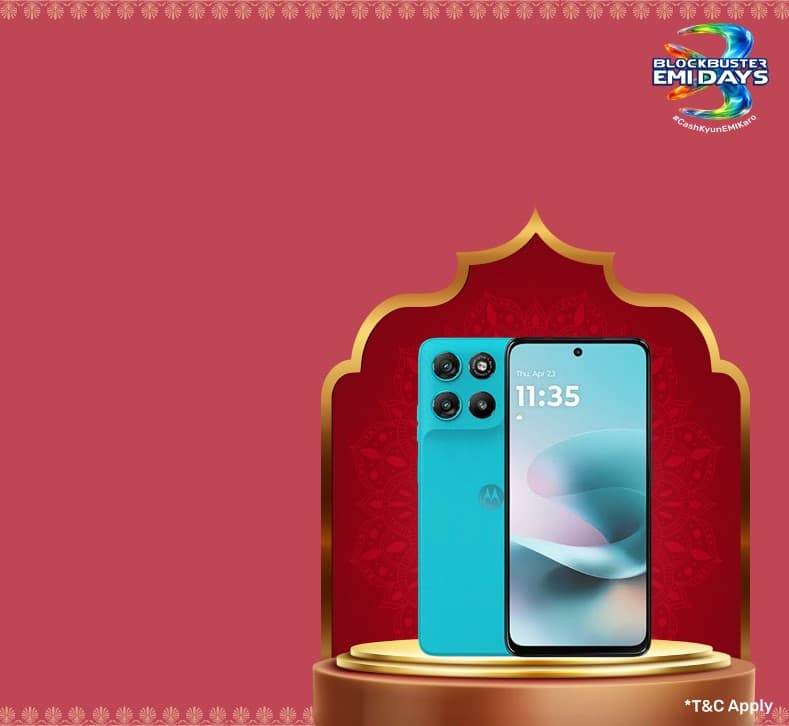
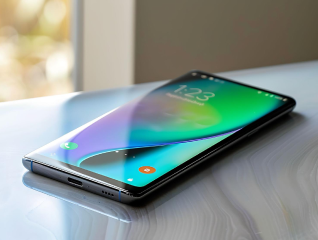
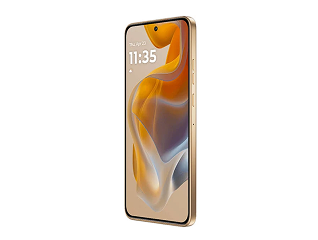
Both phones launched in India in December 2024 and compete in the budget 5G segment. The POCO C75 5G (starting at ₹10,999 on Bajaj Mall) focuses on a large display, Sony camera hardware, and a compact performance chipset, while the moto G35 5G (starting at ₹12,499 on Bajaj Mall) counters with a sharper Full HD+ screen, a wider ultrawide camera, Gorilla Glass 3 protection, and a cleaner near-stock Android experience. Here is how they compare category by category.
General
Both phones were announced within a week of each other and ship with Android 14 and dual nano-SIM support with 5G on both slots. The key difference at a glance is the chipset philosophy: Qualcomm Snapdragon on the POCO vs Unisoc on the moto.
| Spec | POCO C75 5G | moto G35 5G | What it means |
|---|
| Launch date | 17 December 2024 | 10 December 2024 | Both are current-generation budget 5G phones |
| Processor | Qualcomm Snapdragon 4s Gen 2 (4 nm) | Unisoc T760 (6 nm) | Snapdragon's 4 nm node runs cooler and more efficiently under sustained load |
| Operating system | Android 14 (HyperOS) | Android 14 (MyUX / near-stock) | Moto's skin is lighter; POCO's HyperOS adds more customisation |
| SIM slots | Dual Nano | Dual Nano (+ eSIM support) | Moto's eSIM lets you manage a second connection without carrying a physical SIM |
| Network | 5G (both SIM slots) | 5G (12 bands supported) | Moto supports 12 5G bands — broader carrier compatibility across India |
| Price (Bajaj Mall) | ₹10,999 (4GB/64GB); ₹11,499 (4GB/128GB) | ₹12,499 (4GB/128GB) | POCO undercuts by ~₹1,500 at the base; moto ships with more storage as standard |
Also check: Slim and lightweight mobiles
Performance and hardware
The POCO C75 5G pulls ahead on raw benchmark scores thanks to the Snapdragon 4s Gen 2's 4 nm process, which scores ~391,000 on AnTuTu (v10). The Unisoc T760 in the moto G35 5G scores ~628,000 on AnTuTu (v11) — a higher number, but note these are different benchmark versions and not directly comparable. On Geekbench 6, the POCO scores ~842 single-core / ~2,014 multi-core; the moto scores ~744 single-core / ~2,390 multi-core. For day-to-day tasks — social media, streaming, WhatsApp, light gaming — both handle the load comfortably.
| Spec | POCO C75 5G | moto G35 5G | What it means |
|---|
| Processor | Snapdragon 4s Gen 2 (4 nm) | Unisoc T760 (6 nm) | Snapdragon's newer node delivers better thermal efficiency under sustained use |
| GPU | Adreno 611 | Mali-G57 MC4 | Adreno 611 has stronger graphics driver support for gaming titles on Android |
| RAM | 4 GB (LPDDR4X) | 4 GB / 8 GB (LPDDR4X) | 8 GB variant of the moto offers headroom for heavier multitasking |
| AnTuTu score | ~391,000 (v10) | ~628,000 (v11) | Different benchmark versions — not a like-for-like comparison |
| Geekbench 6 (single/multi) | 842 / 2,014 | 744 / 2,390 | POCO leads on single-core; moto leads on multi-core — both adequate for budget use |
| Storage | 64 GB / 128 GB (UFS 2.2) | 128 GB (UFS 2.2) | Moto ships with 128 GB as standard; POCO's 64 GB base variant fills up faster |
| Expandable storage | Up to 1 TB (dedicated slot) | Up to 1 TB (hybrid slot) | POCO's dedicated slot means you don't sacrifice a SIM; moto's hybrid slot does |
| Security | Fingerprint (side) + face unlock | Fingerprint (side) + face unlock | Both offer quick biometric access |
| Audio | Mono speaker | Stereo speakers (Dolby Atmos) | Moto's stereo output is measurably better for media — a meaningful upgrade |
Also check: Qualcomm Snapdragon processor phones
Display
The moto G35 5G has a clear display advantage: Full HD+ resolution (1080 × 2400) at 391 PPI versus the POCO's HD+ (720 × 1640) at 260 PPI. Text and images are noticeably sharper on the moto. The moto also ships with Gorilla Glass 3 and reaches 1,000 nits peak brightness — better for outdoor use. The POCO's larger 6.88" screen suits media consumption, but its lower resolution shows at close range.
| Spec | POCO C75 5G | moto G35 5G | What it means |
|---|
| Screen size | 6.88 inches | 6.72 inches | POCO's larger canvas suits video and gaming; moto is easier to handle one-handed |
| Resolution | 720 × 1640 (HD+) | 1080 × 2400 (FHD+) | FHD+ on moto is a significant visual step up — text, images, and video look sharper |
| Pixel density | 260 PPI | 391 PPI | Higher PPI on moto means finer detail, especially visible in text and social media feeds |
| Display type | IPS LCD | LTPS IPS LCD | LTPS offers faster pixel response, better for 120 Hz scrolling |
| Refresh rate | 120 Hz | 120 Hz | Both deliver smooth scrolling and fluid gaming |
| Peak brightness | 600 nits | 1,000 nits | Moto is significantly more readable under direct sunlight |
| Screen protection | None | Gorilla Glass 3 | Gorilla Glass 3 on moto meaningfully reduces risk from everyday scratches and drops |
| HDR | No | HDR10 | Moto supports HDR10 content from streaming platforms — better colour range on compatible apps |
Also check: Curved display mobile phones
Camera
The POCO C75 5G uses a Sony IMX sensor (50 MP, f/1.8) for its primary camera, which is a notable specification for its price band. The moto G35 5G counters with a dual-camera system: 50 MP primary (f/1.8) + 8 MP ultrawide (f/2.2) that can actually capture wider scenes — a more versatile setup. Neither phone has OIS. The moto also has a significantly better 16 MP selfie camera versus the POCO's 5 MP front shooter.
| Spec | POCO C75 5G | moto G35 5G | What it means |
|---|
| Rear camera setup | Single | Dual | Moto's second ultrawide lens adds real-world versatility for landscapes and groups |
| Primary sensor | 50 MP, f/1.8 (Sony IMX) | 50 MP, f/1.8 | Same resolution; POCO's Sony sensor may deliver better light sensitivity per pixel |
| Secondary camera | Auxiliary depth lens (0.08 MP) | 8 MP ultrawide, f/2.2 | Moto's ultrawide is genuinely functional; POCO's auxiliary lens is effectively decorative |
| OIS | No | No | Neither phone stabilises video optically — expect some shake in handheld video |
| Front camera | 5 MP, f/2.2 | 16 MP, f/2.45 | Moto delivers significantly sharper selfies and video calls |
| Video (rear) | 1080p @ 30 fps | 4K @ 30 fps / 1080p @ 60 fps | Moto supports 4K recording — a meaningful advantage for content creators on a budget |
| Flash | LED | LED | Both support standard flash |
Also check: Camera phones under Rs. 30,000
Connectivity and network compatibility
Both phones cover the essentials for Indian networks — 5G, VoLTE, Wi-Fi 5, and Bluetooth. The moto G35 5G supports 12 5G bands versus 6 on the POCO, which matters if your city or carrier uses less common frequency bands. The moto also ships with eSIM support and NFC (market-dependent). Neither phone has Wi-Fi 6.
| Spec | POCO C75 5G | moto G35 5G | What it means |
|---|
| 5G bands | 6 bands (SA/NSA) | 12 bands (SA/NSA) | More 5G bands on moto = better compatibility across Jio, Airtel, and Vi networks |
| VoLTE | Yes | Yes | Both support HD voice calls over 4G/5G |
| SIM 1 | 5G/4G/3G/2G | 5G/4G/3G/2G | Full network support on both primary SIM slots |
| SIM 2 | 5G/4G/3G/2G | eSIM (5G capable) | Moto's eSIM is convenient for travel or dual-carrier setups |
| Wi-Fi | Wi-Fi 5 (802.11 a/b/g/n/ac) | Wi-Fi 5 (802.11 a/b/g/n/ac) | Both support dual-band Wi-Fi; adequate for home and office use |
| Bluetooth | 5.3 | 5.0 | POCO's newer BT 5.3 offers slightly better range and connection stability |
| NFC | No | Yes (market-dependent) | NFC on moto enables tap-to-pay and fast Bluetooth pairing |
| USB | USB Type-C 2.0 | USB Type-C 2.0 | Both support standard data transfer and charging via USB-C |
Also check: Upcoming 5G mobile phones
Battery
Both phones carry a 5,000 mAh battery and charge at 18W — a tie on paper. The POCO C75 5G's battery is slightly larger at 5,160 mAh, which gives a marginal advantage for light users. Charge times at 18W are broadly similar for both, though neither ships with particularly fast charging by today's standards.
| Spec | POCO C75 5G | moto G35 5G | What it means |
|---|
| Capacity | 5,160 mAh | 5,000 mAh | POCO's slightly larger pack may extend screen-on time by 15–30 minutes under typical use |
| Type | Li-Polymer | Li-Polymer | Both use standard non-removable lithium polymer cells |
| Fast charging | 18 W | 18 W | Both take roughly 2 hours to charge fully from flat |
| Wireless charging | No | No | Neither supports wireless or reverse wireless charging |
| Charger in box | 18 W charger included | 20 W charger included | Moto includes a 20 W adapter in-box, allowing slightly faster charging |
Also check: 6000 mAh battery phones