













An OTP will be sent to this number for verification

You may have a pre-approved offer
Enter required loan against property amount
In summary
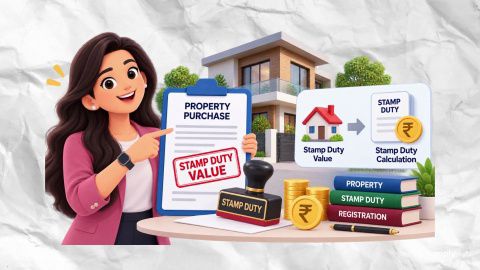
Stamp Duty Value of Property - Meaning, Rates and Calculation Guide
The stamp duty value of a property is the value adopted, assessed or assessable by the relevant state authority for calculating stamp duty on a property transaction. It is an important figure when buying, selling or registering property in India.
- Stamp duty is a state-level charge, so rates and valuation rules differ across states
- Stamp duty value can be referred to by different names, such as guidance value, circle rate, or ready reckoner rate
- The applicable value depends on factors such as location, property type, area and the valuation rules of the state
- The stamp duty value can affect the amount of stamp duty and registration-related costs
- It can also have income tax implications when the transaction value differs from the applicable stamp duty value
Understanding the stamp duty value before completing a property transaction helps you estimate costs and identify valuation differences.
What is the stamp duty value of property?
The stamp duty value is the value adopted or assessed by a state authority for calculating stamp duty on the transfer of immovable property.
It is not necessarily the same as the price agreed between the buyer and seller. State authorities use prescribed valuation methods to determine the value applicable to a property transaction. The terminology can differ across states. For example, it can be called guidance value in Karnataka, circle rate in Delhi and several northern states, ready reckoner rate in Maharashtra, Jantri value in Gujarat and guideline value in Telangana, Andhra Pradesh and Tamil Nadu.
Example: Understanding stamp duty value
Suppose Priya plans to purchase a residential property for Rs. 70 lakh.
The applicable stamp duty value for the property is Rs. 75 lakh.
The two values are different. Priya should check the applicable state rules to determine which value is used for stamp duty and registration purposes and whether the difference has any tax implications.
How to check stamp duty value online?
You can check the stamp duty value of a property online through the official registration or revenue portal of the state where the property is located. The process differs between states, you can follow these steps:
- Visit the official property registration or revenue department website of your state.
- Select the option for property valuation, guidance value, circle rate, ready reckoner or the applicable local term.
- Enter details such as the district, location, property type, survey number or other property details.
- Select the relevant property category and area, if required.
- Review the applicable value displayed on the portal.
The value may vary based on the property's location, type, usage and other factors prescribed by the state authority. Check the latest value applicable to the property before calculating stamp duty or finalising a property transaction.
How to check stamp duty value offline?
You can check the stamp duty value of a property offline by visiting the relevant registration authority and providing the required property details.
- Visit the sub-registrar's office: Go to the office responsible for property registration in the area where the property is located.
- Carry property documents: Keep documents containing the property address, survey number, plot number, property type and area.
- Request the applicable value: Ask the concerned official for the government-prescribed stamp duty value applicable to your property.
- Provide property details: Share the required location and property details so the official can identify the applicable valuation.
- Check applicable charges: Ask about the applicable stamp duty rate and registration charges to estimate the total registration cost.
- Keep the details for your records: Note down the applicable value and charges or retain any document provided by the registration authority.
- Check requirements beforehand: Documents and procedures can differ between states, so confirm the requirements with the relevant registration authority before visiting.
What is the difference between stamp duty and registration charges?
Stamp duty and registration charges are separate costs associated with property transactions. Both can add to the overall cost of purchasing and registering a property.
| Basis | Stamp duty | Registration charges |
|---|---|---|
| Meaning | A government charge payable on certain property transactions and documents. | A fee paid to register the property transaction with the relevant registration authority. |
| Purpose | Validates the property transaction under the applicable stamp law. | Records the transaction in the official property registration records. |
| Calculation | Calculated based on the applicable state rules and the value considered for stamp duty. | Calculated according to the applicable state registration rules. |
| Authority | State government or relevant state authority. | Relevant property registration authority. |
| When paid | During the property transaction and registration process. | As part of the property registration process. |
| Rates | Vary based on the state, property type and transaction. | Vary based on the state and applicable registration rules. |
Understanding the difference between stamp duty and registration charges can help you estimate the total cost of a property transaction. Check the applicable state rules and rates before completing the registration process.
Show More
Show Less
What happens if the sale price is lower than the stamp duty value?
If the agreed sale price is lower than the value adopted for stamp duty purposes, the applicable state rules determine the value used for calculating stamp duty.
A difference between the transaction price and stamp duty value can also have income tax implications. Under the current income-tax provisions, specific rules apply when immovable property is acquired for a consideration below its stamp duty value and the prescribed difference exceeds the applicable threshold.
For this reason, buyers and sellers should check both the agreed transaction price and the applicable stamp duty value before completing the transaction.
Does stamp duty value affect property tax?
Stamp duty value and property tax are related to a property but serve different purposes. Stamp duty value is primarily used to determine stamp duty payable during a property transaction, while property tax is a recurring tax imposed by the local municipal authority.
The stamp duty value does not automatically determine the property tax payable. Property tax is calculated according to the valuation method and rules prescribed by the relevant municipal authority. These rules can consider factors such as the property's location, size, type, usage and applicable municipal rates.
Therefore, an increase in the stamp duty value does not necessarily mean that your property tax will increase by the same amount. The applicable municipal rules determine how property tax is assessed.
Frequently Asked Questions
Overview
How is stamp duty value calculated?
Stamp duty is calculated as a percentage of the higher value between the agreement value and the market value of the property.
What are the documents required for stamp duty calculation?
Documents required include the agreement to sell, property registration document, and the circle rate of the area where the property is located.
Can stamp duty be paid online?
Yes, stamp duty can be paid online in many states in India through the state government’s official website or authorised banks.
Are stamp duty charges different for residential and commercial properties?
Yes, stamp duty charges can vary based on the type of property. Residential properties often attract lower stamp duty compared to commercial properties.
Is stamp duty value applicable for both residential and commercial properties?
Yes, stamp duty value applies to both residential and commercial properties. The applicable rates may differ based on property type, location, and usage, but stamp duty is mandatory for all registered property transactions.
How does stamp duty value affect capital gains tax?
Stamp duty value is used by tax authorities to assess capital gains when the declared transaction value is lower than the circle rate. Any excess difference may be treated as taxable income under applicable tax provisions.
How can buyers avoid penalties related to incorrect stamp duty value?
Buyers should verify the applicable circle rate, ensure accurate property valuation, and declare the correct transaction value. Consulting legal or property experts and using official valuation tools can help prevent penalties.
Is stamp duty value applicable to under-construction properties?
Yes, stamp duty value applies to under-construction properties as well. It is usually calculated on the agreement value or government-notified rates at the time of registration, depending on state regulations.
What is the formula for calculating stamp duty?
The amount of stamp duty payable is generally calculated using the following formula:
Stamp Duty = Higher of (Sale Consideration or Stamp Duty Value) × Applicable Stamp Duty Rate
The applicable rate varies by state and may differ based on factors such as the buyer's category, property type, and location. Registration charges, where applicable, are calculated separately and added to the total amount payable at the time of property registration.
Loan Against Property for different budget
Check your pre-approved offer now
Loan Against Property for Professionals




Find your nearest branch

What do our customers say about us
customers
Play Store rating
reviews
Anita Das
04 March 2026
The loan against property process was smooth and transparent. Interest rates were competitive, and the documentation requirements were minimal. The team provided clear guidance at every step, making the entire experience hassle-free. Highly recommended for quick approvals and reliable support.
Aashish
04 March 2026
The loan disbursal was quick, and the customer support team handled all my queries with patience and clarity. Flexible EMIs made it easy to manage monthly expenses. Overall, a great experience, especially for salaried individuals seeking a loan against property.
Prakash
04 March 2026
I had a great experience transferring my existing loan against property. The process was quick and hassle-free, and I saved significantly with the lower interest rate. The customer service team was supportive throughout. Highly recommended for anyone considering a balance transfer.
Yogesh Singh
04 March 2026
Clear guidance, quick approval, and flexible repayment options made purchasing my new house much easier than expected. The team managed the entire process professionally and ensured smooth coordination at every stage. Overall, a very satisfying experience, and I would recommend their home loan services to others.
Related articles


Watch our videos

Know the tax benefits on your loan against property

What are the documents required for a Loan Against Property?

What are the types of property eligible for Loan Against Property

What is the eligibility criteria for a Loan Against Property
Disclaimer
1. Bajaj Finance Limited (“BFL”) is a Non-Banking Finance Company (NBFC) and Prepaid Payment Instrument Issuer offering financial services viz., loans, deposits, Bajaj Pay Wallet, Bajaj Pay UPI, bill payments and third-party wealth management products. The details mentioned in the respective product/ service document shall prevail in case of any inconsistency with respect to the information referring to BFL products and services on this page.
2. All other information, such as, the images, facts, statistics etc. (“information”) that are in addition to the details mentioned in the BFL’s product/ service document and which are being displayed on this page only depicts the summary of the information sourced from the public domain. The said information is neither owned by BFL nor it is to the exclusive knowledge of BFL. There may be inadvertent inaccuracies or typographical errors or delays in updating the said information. Hence, users are advised to independently exercise diligence by verifying complete information, including by consulting experts, if any. Users shall be the sole owner of the decision taken, if any, about suitability of the same.