








Rs. 100- Rs. 10 crore
Start investing with Rs. 100 | Easy KYC | Expert-managed funds
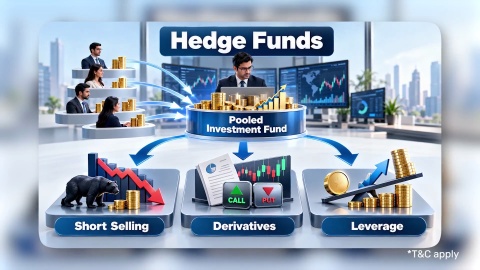
Hedge Funds Explained
In summary
Hedge funds are sophisticated investment vehicles that can use strategies unavailable or less commonly used in conventional mutual funds. In India, hedge-fund-style vehicles generally operate as Category III Alternative Investment Funds (AIFs) under the SEBI AIF framework. Category III AIFs can employ diverse or complex trading strategies and may use leverage, including through listed or unlisted derivatives.
- Structure: Hedge funds pool capital from eligible investors and invest according to a defined strategy.
- Strategies: Common approaches include long/short, arbitrage, macro, event-driven, and relative value.
- Access: Category III AIFs are privately placed and have a high minimum investment requirement.
- Risk: Leverage, derivatives, short positions, concentration, and illiquidity can increase potential losses.
- Costs: Investors may face management fees, performance-related fees, and other fund-level expenses.
- Due diligence: Strategy, manager, valuation, liquidity, fees, and risk controls require careful review.
SEBI's AIF data reported Rs. 2,17,227 crore of funds raised by Category III AIFs as of June 30, 2026, illustrating the scale of this segment.
What is a hedge fund?
A hedge fund is a privately pooled investment vehicle that typically uses active and flexible investment strategies across securities or other permitted assets. Unlike a conventional long-only fund, a hedge fund can potentially take both long and short positions and may use derivatives or leverage, depending on its strategy and regulatory framework.
In India, hedge funds are generally associated with Category III AIFs, which SEBI defines as AIFs employing diverse or complex trading strategies and potentially using leverage, including through listed or unlisted derivatives.
Hedge funds should not be confused with mutual funds or ETFs, which have different structures, accessibility, liquidity, and regulatory requirements.
How do hedge funds work?
Investors commit capital to a privately managed fund. The investment manager then deploys that capital according to the strategy disclosed in the fund's documents.
A hedge fund may seek opportunities by:
- Buying securities expected to increase in value.
- Short selling securities expected to decline.
- Using derivatives to hedge exposures or implement investment views.
- Using leverage to increase exposure relative to the fund's capital.
- Exploiting pricing differences between related securities.
- Taking positions based on macroeconomic or corporate events.
These techniques can increase the range of potential opportunities, but they can also amplify losses. A larger risk appetite does not by itself make a complex strategy suitable.
What are the main types of hedge funds?
Hedge funds can be grouped by their investment approach rather than by a single standard classification.
Equity hedge funds
These funds generally combine long and short equity positions and may use equity derivatives. The manager attempts to benefit from differences in the expected performance of individual securities while managing broader market exposure.
Event-driven hedge funds
These strategies focus on events such as mergers, acquisitions, restructurings, or financial distress that could affect the value of securities.
Global macro hedge funds
These funds take positions based on factors such as interest rates, currencies, inflation, economic growth, or geopolitical developments.
Relative value hedge funds
These strategies attempt to profit from pricing differences between related securities or markets.
Distressed strategies
These funds invest in securities affected by financial distress, restructuring, or bankruptcy, where the manager believes the market price does not fully reflect the potential outcome.
What strategies do hedge funds use?
The strategy determines much of a hedge fund's risk and return profile.
| Strategy | How it works |
|---|---|
| Long/short equity | Combines long positions with short positions in equities |
| Market neutral | Attempts to reduce broad market exposure through offsetting positions |
| Global macro | Takes positions based on macroeconomic and geopolitical views |
| Arbitrage | Attempts to benefit from price differences between related instruments |
| Event-driven | Targets opportunities created by corporate events |
Last updated: October 2026
A strategy described as market neutral does not mean risk-free. Trading, liquidity, model, leverage, counterparty, and execution risks can remain.
What are the key features of hedge funds?
Hedge funds differ from conventional retail investment products in several important ways.
- Private placement: Category III AIFs raise capital privately rather than inviting the general public to subscribe.
- Sophisticated strategies: Managers can employ complex strategies and, subject to applicable requirements, leverage and derivatives.
- High entry threshold: The minimum investment for an AIF is generally Rs. 1 crore, with specified exceptions, including for certain employees or directors and accredited investors.
- Flexible structure: Category III AIFs can be open-ended or close-ended.
- Limited liquidity: Redemption terms depend on the fund structure and its documents.
- Active management: Managers generally have greater discretion than managers of passive investment products.
- Higher complexity: Investors need to understand the strategy, valuation methodology, leverage, fees, and liquidity before investing.
For context, endowments are another type of institutional capital that may invest across different asset classes.
What are the fees charged by hedge funds?
Hedge funds can have multiple layers of costs. These may include management fees, performance-related fees, fund expenses, transaction costs, and other charges specified in the fund documents.
The commonly cited "2 and 20" model refers to a 2% management fee and a 20% performance fee. However, this is not a universal regulatory fee structure. Actual charges vary between funds and should be assessed from the relevant documents.
A performance fee can materially affect an investor's net return, particularly when gross returns are strong but the strategy has substantial costs.
What are the risks of investing in hedge funds?
The flexibility that allows hedge funds to pursue different opportunities also creates significant risks.
Leverage risk
Borrowing or using derivatives can increase exposure beyond the capital invested. Losses can therefore become larger than they would be without leverage.
Market risk
Positions can lose value because of movements in equity, bond, currency, commodity, interest-rate, or other markets.
Liquidity risk
Some funds impose lock-up periods or restrict redemptions to specific windows. Investors may therefore be unable to access capital when required.
Manager risk
A hedge fund's outcome can depend heavily on the investment manager's decisions, models, risk controls, and execution.
Valuation risk
Illiquid or complex investments may be harder to value accurately. Valuation affects reported performance and, in some circumstances, fees.
These risks make risk profile and investment capacity important considerations before investing.
How are hedge funds taxed in India?
Tax treatment for Category III AIFs differs from that of Category I and Category II AIFs because Category III AIFs generally do not receive the same pass-through treatment for their income.
The applicable tax can depend on the nature of income and the legal structure of the AIF, such as a trust, company, or LLP. Capital gains, business income, dividend income, and other income can therefore have different tax consequences.
Investors should review the fund's tax disclosures and obtain professional tax advice where required. The Direct Tax Code provides broader information on India's direct-tax framework.
Hedge funds vs mutual funds
Hedge funds and mutual funds both pool investor capital, but their structures and intended investor bases differ considerably.
| Factor | Hedge funds | Mutual funds |
|---|---|---|
| Access | Primarily sophisticated or eligible investors | Broad retail access |
| Regulation | Governed under the AIF framework | Governed under the SEBI mutual-fund framework |
| Strategies | May use short selling, derivatives, and leverage | Strategy depends on the scheme |
| Liquidity | Depends on fund terms | Generally more accessible, subject to scheme terms |
| Minimum investment | Generally Rs. 1 crore for AIFs, subject to exceptions | Can be much lower |
| Complexity | Generally higher | Varies by scheme |
Last updated: October 2026
For a more detailed comparison, read - Mutual Funds vs Hedge Funds.
What should you check before investing in a hedge fund?
Due diligence is particularly important because a sophisticated strategy can be difficult to evaluate from headline returns alone.
- Strategy: Understand exactly how the fund intends to generate returns.
- Leverage: Check how much leverage is permitted and how it is monitored.
- Manager: Review the manager's experience, investment process, and disclosed conflicts.
- Performance: Examine returns across different market conditions rather than relying on one period.
- Fees: Assess management, performance, transaction, and other applicable costs.
- Liquidity: Understand lock-ups, redemption windows, notice periods, and exit provisions.
- Valuation: Check how complex or illiquid positions are valued.
- Diversification: Assess concentration across securities, sectors, strategies, and counterparties.
- Documents: Read the placement memorandum and other fund documents before committing capital.
Portfolio construction also matters. Portfolio diversification can reduce concentration, but diversification does not eliminate investment risk.
Who may consider hedge funds?
Hedge funds are generally intended for sophisticated investors who can understand complex strategies, tolerate substantial losses, meet applicable investment requirements, and accept potentially limited liquidity.
They may be considered by HNIs, family offices, institutional investors, and other eligible investors as part of a broader portfolio. High-net-worth individuals should still assess whether the strategy adds value relative to its costs and risks.
Hedge funds should not be selected solely because they target high returns. The strategy, portfolio role, downside risk, liquidity, and investor's ability to withstand losses are equally important.
How can hedge fund performance be evaluated?
Performance should be assessed against an appropriate benchmark and in the context of the strategy's risk. Investors can examine absolute returns, volatility, drawdowns, consistency, leverage, and the contribution of fees.
A single period of strong performance may not demonstrate that a strategy is robust across market cycles. Mutual fund performance provides a useful introduction to evaluating investment performance, although hedge-fund analysis requires additional consideration of leverage, liquidity, and strategy-specific exposures.
Investors can also study broader investment strategies when assessing how an investment fits within an overall portfolio.
Conclusion
Hedge funds provide sophisticated investors with access to flexible investment strategies that can include short selling, derivatives, leverage, arbitrage, and macro positioning. In India, hedge-fund-style vehicles generally operate as Category III AIFs under SEBI's regulatory framework.
Their flexibility comes with higher complexity, significant risk, potentially higher costs, and liquidity constraints. Investors should therefore assess the strategy, manager, leverage, fees, valuation methodology, taxation, and redemption terms before committing capital.
Last reviewed: October 2026
Mutual funds are subject to market risk. Please read the scheme-related documents carefully before investing.
Explore Investment Tools
Articles and Insights




Frequently Asked Questions
Hedge fund structure
Hedge fund investment decisions
Hedge fund evaluation
Are hedge funds the same as private equity funds?
No. Hedge funds and private equity funds are both alternative investment vehicles, but their strategies and asset profiles can differ substantially. Hedge funds generally focus on liquid or tradable assets and may use short selling, derivatives, and leverage. Private equity funds typically invest in private companies and often have longer holding periods before realising investments.
Can a hedge fund be open-ended in India?
Yes. Category III AIFs can be structured as either open-ended or close-ended funds under the applicable regulatory framework. However, an open-ended structure does not mean investors can necessarily redeem whenever they choose. The fund's documents specify applicable redemption frequency, notice requirements, liquidity provisions, and other conditions.
Why do hedge funds use short selling?
Short selling allows a fund to take a position that can benefit if the price of a security declines. A manager may use it to express a negative view, hedge another position, or construct a market-neutral strategy. However, short positions carry potentially significant losses if the security's price rises instead of falling.
Can hedge funds lose more than the amount invested?
The potential loss depends on the fund's structure, leverage, strategy, and contractual terms. Leverage can magnify losses, while derivatives and short positions introduce additional risks. Investors should review the fund's risk disclosures carefully rather than assuming that the maximum possible loss is limited to the initial capital contribution.
How often can investors withdraw money from a hedge fund?
There is no single redemption schedule for all hedge funds. It depends on whether the fund is open-ended or close-ended and on the specific terms in its placement memorandum. Some funds may impose lock-up periods, notice periods, or limited redemption windows, so investors should confirm liquidity terms before investing.
Are hedge fund returns guaranteed because managers use hedging strategies?
No. The term "hedge fund" does not mean that investment losses are prevented. Hedging can be one component of a strategy, but funds may also use leverage, short positions, derivatives, and concentrated positions. These techniques can create substantial losses. Returns remain dependent on market conditions, strategy execution, risk management, and other factors.
Disclaimer
Bajaj Finance Limited ("BFL") is registered with the Association of Mutual Funds in India ("AMFI") as a distributor of third party Mutual Funds (shortly referred as 'Mutual Funds) with ARN No. 90319
BFL does NOT:
(i) provide investment advisory services in any manner or form.
(ii) carry customized/personalized suitability assessment.
(iii) carry independent research or analysis, including on any Mutual Fund schemes or other investments; and provide any guarantee of return on investment.
In addition to displaying the Mutual fund products of Asset Management Companies, some general information is sourced from third parties, is also displayed on As-is basis, which should NOT be construed as any solicitation or attempt to effect transactions in securities or the rendering any investment advice. Mutual Funds are subject to market risks, including loss of principal amount and Investor should read all Scheme/Offer related documents carefully. The NAV of units issued under the Schemes of mutual funds can go up or down depending on the factors and forces affecting capital markets and may also be affected by changes in the general level of interest rates. The NAV of the units issued under the scheme may be affected, inter-alia by changes in the interest rates, trading volumes, settlement periods, transfer procedures and performance of individual securities forming part of the Mutual Fund. The NAV will inter-alia be exposed to Price/Interest Rate Risk and Credit Risk. Past performance of any scheme of the Mutual fund do not indicate the future performance of the Schemes of the Mutual Fund. BFL shall not be responsible or liable for any loss or shortfall incurred by the investors. There may be other/better alternatives to the investment avenues displayed by BFL. Hence, the final investment decision shall at all times exclusively remain with the investor alone and BFL shall not be liable or responsible for any consequences thereof.
Investment by a person residing outside the territorial jurisdiction of India is not acceptable nor permitted.
Disclaimer on Risk-O-Meter:
Investors are advised before investing to evaluate a scheme not only on the basis of the Product labeling (including the Riskometer) but also on other quantitative and qualitative factors such as performance, portfolio, fund managers, asset manager, etc, and shall also consult their Professional advisors, if they are unsure about the suitability of the scheme before investing.
Disclosure: Bajaj Finance Limited (BFL) is a distributor of Mutual Funds with ARN - 90319 and distributes mutual funds of Bajaj Finserv Asset Management Limited (BFSAMC). BFL receives commission towards distribution of mutual fund products. BFSAMC is a group company of BFL, carrying business on arm’s length basis without any conflict of interest and in accordance with the prevailing law / regulation.
Disclaimer
Bajaj Finance Limited ("BFL") is an NBFC offering loans, deposits and third-party wealth management products.
The information BFL contained in this article is for general informational purposes only and does not constitute any financial advice. The content herein has been prepared by BFL on the basis of publicly available information, internal sources and other third-party sources believed to be reliable. However, BFL cannot guarantee the accuracy of such information, assure its completeness, or warrant such information will not be changed.
This information should not be relied upon as the sole basis for any investment decisions. Hence, User is advised to independently exercise diligence by verifying complete information, including by consulting independent financial experts, if any, and the investor shall be the sole owner of the decision taken, if any, about suitability of the same.
Disclaimer
Mutual Fund SIP calculator may provide potential investors an approximate estimate on the maturity amount of the monthly SIP, purely based on mathematical calculation of the projected annual return rate selected by investor. However, such calculation does not factor the actual performance by the Asset Management Company (AMC) and should not be treated as any advice or assurance about the actual return of investment. Mutual Funds do not have a fixed rate of return and it is not possible to predict the rate of return. Please note that the SIP calculator are for illustrations only and do not represent actual returns which may vary depending on various factors including but not limited to actual performance, expense ratio, taxation, exit load (if any), etc.