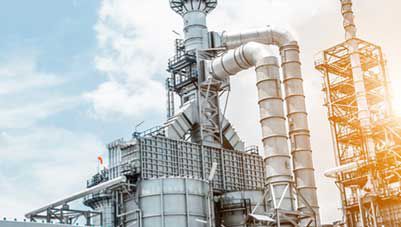







What is a cooling tower?
A cooling tower is a heat rejection system used to remove excess heat from water in industrial processes, power generation, and HVAC systems. It transfers heat to the atmosphere, primarily through evaporation, allowing the cooled water to be reused within the system.
Key characteristics of a cooling tower:
- Removes heat through evaporative cooling or dry heat exchange
- Enables continuous water recirculation, thereby reducing water wastage
- Widely used in power plants, refineries, manufacturing units, and commercial buildings
- Available in various configurations depending on capacity and application
Cooling towers offer a cost-effective and energy-efficient solution for large-scale thermal management, making them essential in industries with high and continuous heat loads.
How does a cooling tower work?
A cooling tower operates on a simple heat exchange cycle to maintain consistent temperature control in industrial systems. The process is as follows:
| Step | Process |
|---|---|
| 1 | Warm water from industrial equipment is pumped into the cooling tower |
| 2 | Water is evenly distributed over fill media to maximise surface area |
| 3 | Air is drawn or forced through the tower to facilitate heat transfer |
| 4 | A portion of the water evaporates, carrying heat away from the system |
| 5 | Cooled water collects in the basin and is recirculated back into the process |
This continuous cycle helps maintain optimal operating temperatures, prevents equipment overheating, and improves overall energy efficiency. The evaporative cooling mechanism makes cooling towers far more effective than simple air cooling in high-load environments.
Cooling tower vs heat exchanger: key differences
Businesses often compare cooling towers with heat exchangers when designing industrial cooling systems. Understanding the differences helps in making the right procurement decision.
| Parameter | Cooling tower | Heat exchanger |
|---|---|---|
| Cooling method | Evaporative cooling with air contact | Fluid-to-fluid heat transfer |
| Water consumption | Moderate (due to evaporative losses) | Low |
| Suitable for | High heat loads and large-scale operations | Moderate heat loads and compact systems |
| Cost | Higher initial investment | Lower initial investment |
| Maintenance | Requires regular water treatment | Relatively lower maintenance |
Cooling towers are typically preferred in power plants, refineries, and large HVAC systems where continuous and high-capacity heat rejection is required. Heat exchangers are better suited for compact, process-specific applications with moderate cooling needs.
Types of cooling towers
Cooling towers are available in various configurations, each designed to meet specific capacity, space, and efficiency requirements. Selecting the appropriate type is important to ensure optimal thermal performance.
Based on air flow mechanism:
- Natural draft cooling towers — Use natural buoyancy to drive airflow; suitable for very large installations such as power plants; do not require fans
- Mechanical draft cooling towers — Use motor-driven fans to regulate airflow, offering greater control and efficiency
- Induced draft cooling towers — Fans located at the top draw air upwards through the tower; commonly used in industrial applications
- Forced draft cooling towers — Fans at the base push air through the system; suitable for sites with limited vertical space
Based on water–air flow direction:
- Crossflow cooling towers — Air flows horizontally across the falling water; allow easier access for maintenance
- Counterflow cooling towers — Air flows upward against the downward water flow; provide higher thermal efficiency
Each type offers distinct advantages in terms of energy consumption, footprint, and maintenance. The choice should be based on specific heat load requirements and operational conditions.
Industrial uses of cooling towers
Cooling towers are a critical part of infrastructure across multiple industries where continuous and reliable heat rejection is required.
| Industry | Application |
|---|---|
| Power generation | Cooling of condensers in thermal and nuclear power plants |
| Chemical and petrochemical | Process cooling for reactors and distillation columns |
| Steel and metal manufacturing | Cooling of equipment in furnaces and rolling mills |
| Pharmaceutical | Temperature control in production and storage facilities |
| Food and beverage processing | Cooling during pasteurisation and packaging |
| HVAC systems | Central cooling for large commercial and institutional buildings |
| Cement and construction | Cooling of cement kilns and grinding machinery |
Their wide-ranging applications make cooling towers one of the most versatile and in-demand pieces of industrial equipment across sectors.
Top factors to consider when choosing a cooling tower
Selecting the right cooling tower requires careful evaluation of operational needs:
- Cooling capacity and heat load requirements
- Space availability and installation constraints
- Energy efficiency and water consumption
- Climatic conditions and ambient temperature
- Maintenance requirements and operating costs
- Compliance with environmental regulations
Considering these factors ensures optimal performance and long-term reliability.
Cooling tower maintenance: best practices
Regular maintenance of a cooling tower is essential to ensure efficient operation, extend equipment life, and maintain water quality. Poorly maintained cooling towers can develop issues such as scaling, biological growth (including Legionella), and reduced thermal efficiency.
Key cooling tower maintenance practices:
- Water treatment: Use biocides, scale inhibitors, and corrosion inhibitors to maintain water quality
- Regular inspection: Check fill media, distribution nozzles, fan blades, and drift eliminators for wear or damage
- Cleaning schedule: Periodically flush and clean the basin, fill, and distribution system
- Performance monitoring: Track approach temperature, range, and efficiency indicators regularly
- Legionella risk assessment: Conduct water testing and risk audits in line with regulatory requirements
Implementing a preventive maintenance schedule helps reduce unplanned downtime and lowers long-term operating costs.
Financing options of cooling tower
Cooling towers often involve significant capital investment, making financial planning an important step in procurement:
- A Machinery Loan helps businesses purchase cooling towers by spreading the cost over affordable instalments
- Industrial Equipment Finance enables industries to invest in large-scale cooling systems without impacting working capital
- Financing allows businesses to upgrade or expand infrastructure while maintaining cash flow stability
These options support efficient asset acquisition and operational continuity.
Conclusion
Cooling towers are indispensable for industries that rely on effective heat management to maintain productivity and equipment efficiency. Understanding their working principles, types, applications, and selection criteria helps businesses make informed investment decisions. Checking your pre-approved business loan offer can be a good starter in this regard.
For organisations planning expansion or equipment upgrades, access to a business loan can support capital requirements. Keeping track of the business loan interest rate helps manage borrowing costs, while using a business loan eligibility calculator allows businesses to assess funding capacity before making financial commitments.