








₹25,000.00 - ₹25 Cr
Loan of up to 80% of policy value| Funding against policies under lock-in period
In Summary
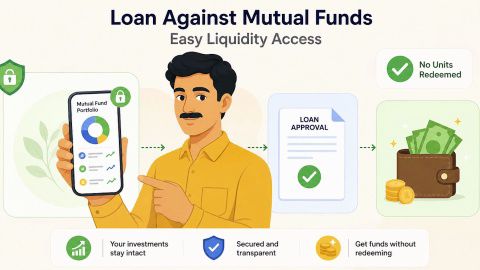
What Is a Loan Against Mutual Funds and How Does It Work
-
Loan against mutual funds means borrowing against pledged, rather than redeemed, fund units.
- LAMF keeps pledged units invested, allowing market-linked returns throughout tenure.
- Eligible loans range from ₹25,000 to ₹25 Cr
- LTV is up to 90% for equity funds and 80% for debt funds.
- Digital processing enables disbursal within hours after lien-marking approval.
- A falling NAV may require extra collateral or partial repayment after a margin call.
Apply with Bajaj Finance to borrow against eligible mutual fund investments.
What is loan against mutual funds?
A loan against mutual funds is a secured loan where your mutual fund units are pledged as collateral to get funds. You do not have to redeem your investments. Instead, the lender marks a lien on your units and offers a loan amount based on their value. Once the loan is repaid, the lien is removed, and you regain full control over your units. This type of borrowing is ideal for immediate needs like medical emergencies, business requirements, higher education, or debt consolidation.
-
How does a loan against mutual funds work?
The process of taking a loan against mutual funds is simple and involves pledging units digitally. Here is how it works:
- You choose mutual fund units that will be lien-marked.
- The lender marks a lien on those units in your mutual fund account.
- Based on the market value, an approved loan amount is fixed.
- Money is disbursed to your bank account, usually within hours.
- You continue to earn returns on your investments during the loan tenure.
- After repayment, the lien is removed, and units are released.
Get instant approval and competitive interest rates by pledging mutual fund units securely online. Get a loan against mutual funds
Benefits of taking a loan against mutual funds
A loan against mutual funds allows borrowers to access funds by pledging eligible mutual fund units as collateral instead of redeeming them. Key benefits include:
- No need to redeem investments: Eligible mutual fund units can remain invested while the borrower accesses funds against their value.
- Faster processing: Digital application and verification processes may enable quicker approval and disbursal, subject to the lender’s terms.
- Potentially lower borrowing costs: As the loan is secured by mutual fund units, the interest rate may be lower than that of some unsecured borrowing options.
- Flexible repayment options: Depending on the lender and loan structure, borrowers may have options such as interest servicing or repayment of the principal as per the agreed terms.
- Continued market exposure: The pledged units remain invested, allowing the borrower to retain exposure to potential market-linked returns. However, the value of these investments can also decline.
- No direct credit-score impact from market movements: A fall in the value of mutual fund units does not, by itself, affect a borrower’s credit score. However, failure to meet repayment obligations can affect credit history.
- Access to liquidity: The facility can provide funds for planned or unexpected expenses without requiring immediate redemption of eligible mutual fund investments.
Types of loans against mutual funds
There are two major categories of loans based on mutual fund investment type:
| Type of mutual fund | Loan availability | Risk level | Typical LTV (Loan-to-Value) |
| Equity mutual funds | Eligible | Higher market volatility | Lower LTV compared to debt funds |
| Debt mutual funds | Eligible | Stable returns | Higher LTV due to low risk |
Pledge equity or debt mutual fund units and access funds instantly with simple eligibility. Apply now
Who can avail loan against mutual funds?

How to Secure a Rs. 2 Crore Loan Against Securities Instantly
A loan against mutual funds is available to a wide set of investors who meet basic requirements. You can apply if you are:
- An Indian resident above 21 years of age.
- A salaried employee, self-employed individual, or business owner.
- A mutual fund investor holding units in their name.
- Someone with an eligible mutual fund portfolio.
- An investor maintaining funds in registered asset management companies.
What is the process of getting a loan against mutual funds?
Applying for a loan against mutual funds is straightforward and mainly online-driven. The steps include:
- Visit the lender’s online portal to initiate the loan request.
- Enter your PAN and mobile number linked with your mutual fund account.
- Select mutual fund schemes to pledge as collateral.
- Approve the lien digitally by approving the request raised with your AMC or registrar.
- Receive the approved loan amount directly in your bank account.
- Repay as per the agreed terms and get your lien released after closure.
What is the interest rate on a loan against mutual funds?
Charges may vary among lenders, but here are typical cost components:
- Interest rate: Usually lower than unsecured personal loans due to collateral.
- Processing charges: May be a small percentage of the loan amount or a fixed fee.
- Renewal charges: Applicable for renewing the facility annually in some cases.
- Penal charges: Charged for delayed repayments.
- Prepayment charges: Many lenders allow prepayment without fees, but it varies.
- Other charges: Can include transaction fees or legal verification fees if applicable.
What are the risks of taking a loan against mutual funds?
Although this type of loan is convenient, there are certain risks and important aspects to consider:
- Market volatility impact: A drop in fund value can trigger a margin call, requiring additional collateral or partial repayment.
- Lien restriction: You cannot redeem your pledged units until full repayment.
- Interest burden: Borrowing without need may create unnecessary liability.
- Additional charges: Check all fees before availing the loan.
- Repayment discipline: Delay in EMI payments can attract penalties.
Conclusion
A loan against mutual funds offers a convenient way to unlock the value of your investments without selling them. It gives you access to quick liquidity, competitive interest rates, and continued investment growth. Whether you are dealing with urgent expenses or planning big goals, pledging mutual funds can be a practical and cost-efficient solution.
Use your mutual fund portfolio smartly to get fast funds without redemption. Get a loan against mutual funds
Loan against your assets


Loan Against Mutual Fund





Related Articles



Frequently asked questions
Generic
Amount
Interest Rate
Can I get a loan against all types of mutual funds?
Yes, loans can be availed against both equity and debt mutual funds. However, lenders usually have a list of eligible schemes, and the loan-to-value (LTV) ratio may differ based on fund type and market risk.
Is it better to redeem mutual funds or take a loan against them?
Taking a loan against mutual funds may be preferable if you need temporary funds and want to continue benefiting from potential market growth. Redeeming mutual funds provides immediate cash but may trigger taxes and end future returns. The better option depends on your financial goals and repayment capacity.
Does the lender sell my mutual fund units if I default?
If you fail to repay the loan, the lender may redeem your pledged units to recover outstanding dues. This usually happens only after reminders, margin calls, and missed payments without resolution.
What is the maximum loan amount I can avail against mutual funds?
The maximum loan amount depends on the value of your pledged units and the lender’s policies. Typically, you can get up to a certain percentage of the fund’s market value as per the applicable loan-to-value ratio.
How quickly can I get the loan amount disbursed?
Loan disbursal against mutual funds is usually fast, with many lenders offering same-day approval and transfer. Once the lien on units is marked digitally and verified, funds can be released within a few hours.
What is the interest rate on a loan against mutual funds?
The interest rate on a loan against mutual funds varies across lenders and depends on factors such as the type of mutual fund pledged, loan amount, and lender policies. Rates are generally lower than unsecured loans because the mutual fund units serve as collateral, reducing the lender’s risk.
What is the loan-to-value (LTV) ratio for a loan against mutual funds?
For a loan against mutual funds, the loan-to-value (LTV) ratio is up to 80% for debt mutual funds and up to 50% for equity mutual funds. The actual LTV may vary based on the lender, fund type, and approved scheme. If the NAV falls below the required threshold, the lender may issue a margin call. Meeting the eligibility for loan against mutual funds may then require you to provide additional collateral or repay part of the outstanding loan.
What documents are needed to apply for a loan against mutual funds online?
To apply for a loan against mutual funds online, you generally need documents that help the lender verify your identity, mutual fund holdings, and eligibility for loan against mutual funds. These may include: PAN card, Aadhaar card, mutual fund statement or folio details, bank account details, and a recent photograph, if required. Bajaj Finance may offer an OTP-based digital application option, allowing eligible applicants to complete the process online.
What does LAMF mean? (Updated)
LAMF means Loan Against Mutual Funds, a secured loan against pledged units. The loan against mutual funds meaning covers Bajaj Finance borrowing from Rs. 10,000 to Rs. 25 crore.
What is lien marking in a loan against mutual funds? (Updated)
Loan against mutual funds lien marking places restrictions on pledged units. You retain ownership but cannot sell or redeem them; release occurs within one to two business days after repayment.
Are debt funds or equity funds better for taking a loan against mutual funds? (Updated)
For a loan against mutual funds, debt mutual funds offer an 80% LTV ratio, versus 50% for equity mutual funds. Both qualify; equity offers growth potential, volatility, and margin-call risk.
Disclaimer
1. Bajaj Finance Limited (“BFL”) is a Non-Banking Finance Company(BAJAJ FINANCE) and Prepaid Payment Instrument Issuer offering financial services viz., loans, deposits, Bajaj Pay Wallet, Bajaj Pay UPI, bill payments and third-party wealth management products. The details mentioned in the respective product/ service document shall prevail in case of any inconsistency with respect to the information referring to BFL products and services on this page.
2. All other information, such as, the images, facts, statistics etc. (“information”) that are in addition to the details mentioned in the BFL’s product/ service document and which are being displayed on this page only depicts the summary of the information sourced from the public domain. The said information is neither owned by BFL nor it is to the exclusive knowledge of BFL. There may be inadvertent inaccuracies or typographical errors or delays in updating the said information. Hence, users are advised to independently exercise diligence by verifying complete information, including by consulting experts, if any. Users shall be the sole owner of the decision taken, if any, about suitability of the same.