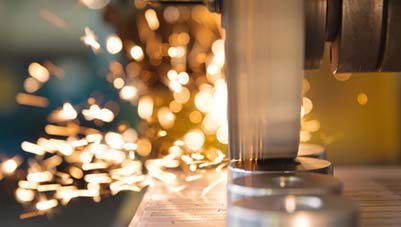







Grinding machines are very important in modern manufacturing, especially when exact measurements and a smooth finish are essential. They use a fast-spinning abrasive wheel to remove small amounts of material, producing precise shapes, fine surfaces, and accurate sizes that other machines cannot achieve. Grinding is often the last step in making parts, from car shafts to aircraft components and cutting tools, and it largely decides the quality and performance of the product. These machines can work with hard materials, keep accuracy down to microns, and are useful for both small workshops and large factories, making them essential in engineering where precision, reliability, and efficiency matter.
What is a grinding machine?
In any workshop, a grinding machine is important for keeping tools smooth and well-finished. It is a strong machine that removes surface flaws by grinding or polishing. The abrasive wheel used for polishing spins at high speed. Grinding is used to finish workpieces that need very smooth surfaces and accurate shapes. Because grinding can be accurate to about 0.000025 mm, it is mainly used as a finishing process. In some roughing jobs, it can also remove large amounts of metal quickly.
A grinding machine is a tool where the grinding wheel is fixed to the machine and the workpiece is held on the table. When the process starts, the machine removes unwanted material to give the correct size, shape, and smooth surface. This process is also called abrasive grinding.
How does a grinding machine work?
Understanding how a grinding machine works is important for anyone in metalworking. Here is a step-by-step guide to the process:
- Setup: First, the machine is set up by choosing the right grinding wheel for the material. Wheel size, abrasive type, and grit are important.
- Securing the Workpiece: The workpiece is fixed on the machine, either on a chuck, between centres, or on a rotary table, depending on the grinder.
- Starting the Machine: The grinding wheel is switched on and spins at the chosen speed, usually powered by an electric motor.
- Grinding: The spinning wheel touches the workpiece, removing material by crushing and cutting. This can be surface grinding or cylindrical grinding.
- Feed Rate and Direction: The workpiece is moved against the wheel at the correct speed and direction, either manually or by CNC.
- Coolant: Coolant is used during grinding to stop the workpiece and wheel from overheating.
- Finishing: The machine makes several passes to reach the desired smoothness and size.
- Inspection: Finally, the workpiece is checked for surface quality, size, and finish.
Key applications of grinding machine across industries
| Industry | Typical Parts | Grinding Needs |
|---|---|---|
| Automotive | Crankshafts, camshafts, gears, engine blocks, bearings | High accuracy, smooth finish, suitable for mass production |
| Aerospace | Turbine blades, landing gear parts, hydraulic components | Very high accuracy, able to grind hard alloys (Inconel, Titanium), no defects allowed |
| Tool & Die | Cutting tools (drills, end mills), dies, moulds, punches | Sharpening, complex shapes, longer tool life |
| General Engineering | Shafts, rollers, bushings, machine slides | Exact sizes, smooth finish after heat treatment |
| Medical Devices | Surgical instruments, implants (hip joints, bone screws) | Very precise, smooth and clean surfaces, safe for the body |
Key components of a grinding machine
A modern grinding machine has several important parts, each with a key role:
- Grinding Wheel: The part that actually grinds the workpiece. It is made of abrasive grains held together with bonding material.
- Wheel Head: Holds the grinding wheel and controls its rotation and position.
- Machine Bed: The strong frame that supports the whole machine and reduces vibrations.
- Work Holding Device: Keeps the workpiece in place. This could be a chuck, centres, or a rotary table, depending on the machine.
- Table: In surface grinders, the table holds the workpiece and moves it under the grinding wheel.
- Coolant System: Applies coolant to stop overheating during grinding.
- Control Panel: Lets the operator control and adjust the machine. Modern machines may use CNC panels.
- Motor: Powers the grinding wheel.
- Feed Mechanism: Controls how fast and in which direction the workpiece moves.
- Dressing Tool: Used to reshape the grinding wheel so it stays sharp and accurate.
Types of grinding machines
Grinding machines are classified based on their construction, operation, and applications. Common types include:
1. Surface grinding machine
Surface grinding machines are used to produce a smooth, flat, and even surface on a workpiece.
Key features & pointers:
- Uses a rotating abrasive wheel to remove material.
- Suitable for both ferrous and non-ferrous metals.
- Commonly used for finishing work on tools and machine parts.
2. Cylindrical grinding machine
Cylindrical grinding machines are designed for grinding cylindrical surfaces of rods, shafts, and tubes.
Key features & pointers:
- Workpiece rotates while the grinding wheel moves longitudinally.
- Can grind external and internal surfaces.
- High precision and suitable for mass production.
3. Centerless grinding machine
Centerless grinding machines remove material from a workpiece without using centres or chucks.
Key features and pointers:
- Workpiece is supported between a grinding wheel and a regulating wheel.
- Ideal for small, thin, or high-volume components.
- Enhances production efficiency and reduces setup time.
4. Tool and cutter grinding machine
Tool and cutter grinding machines are used to sharpen and shape cutting tools.
Key features & pointers:
- Supports grinding of milling cutters, drill bits, and other cutting tools.
- High precision in angles and dimensions.
- Extends tool life and improves cutting performance.
Advantages of grinding machines
- Grinding machines give very precise and accurate results.
- They can produce extremely smooth surfaces and exact sizes that other machines cannot.
- They work on many materials: metals, plastics, ceramics, and composites.
- They are used for surface finishing, sharpening, and cutting.
- They remove material faster than other methods, making them efficient for large production runs.
- Many machines can do several tasks, reducing the need for extra machines and saving costs.
- They can be automated.
- They have safety features like guards and shields to protect the operator from flying debris.
Disadvantages of grinding machines
- Grinding machines use a lot of power, which can increase electricity costs and carbon emissions.
- They can be noisy and produce dust and small particles.
- Some machines run at very high speeds, which can cause chips to fly and may damage the surroundings or injure the operator.
Grinding machine price in India
| Machine Type | Price Range (Rs.) | Typical Use |
|---|---|---|
| Surface Grinding Machine (Manual) | Rs.1,00,000 – Rs.5,00,000 | Small workshops and tool rooms for flat surfaces |
| Cylindrical Grinding Machine (Manual/PLC) | Rs.2,00,000 – Rs.10,00,000 | General engineering and automotive parts |
| Centerless Grinding Machine | Rs.3,00,000 – Rs.15,00,000 | Large-scale production of pins, rollers, and valves |
| Tool & Cutter Grinder (Manual) | Rs.2,50,000 – Rs.8,00,000 | Tool rooms and maintenance shops for sharpening tools |
| CNC Grinding Machines | Rs.15,00,000 – Rs.60,00,000+ | High-precision work in aerospace, medical, and die/mould industries |
.
Factors that influence grinding machine prices
The cost of a grinding machine depends on several things:
- Size and Capacity: Bigger machines that hold heavier workpieces cost more.
- Accuracy: Machines with very precise parts and temperature control are more expensive.
- Automation: CNC controls, automatic wheel dressing, or robot loading add to the price.
- Brand and Country: European or Japanese machines usually cost more than Indian or Chinese ones.
- Extra Features: Special parts like through-feed centerless, internal grinding tools, or fast spindles increase the cost.
How to choose the right grinding machine
When choosing a grinding machine, you need to consider several things to make sure it suits your needs:
- The type of grinding you need, such as surface grinding, cylindrical grinding, or tool and cutter grinding.
- The materials you will work with, like metals, ceramics, or plastics, as some machines are better for certain materials.
- The level of accuracy you need.
- The type, size, and material of the grinding wheel.
- How easy the machine is to use.
- Safety features, such as wheel guards, emergency stops, and safety interlocks.
- Machine specifications, including wheel size, power, speed, control type (manual or CNC), and spindle orientation (horizontal or vertical).
- Automation features for high production, like tool changers, loading aids, closed-loop measurement, or large part capacity.
- A good coolant system to prevent overheating.
- How easy it is to maintain and get spare parts.
- Your budget.
- A reliable supplier or manufacturer with good customer support.
Financing options for grinding machines
Investing in a grinding machine often involves significant capital. Financing options include:
- Machinery Loan – Helps businesses purchase grinding machines with manageable EMIs.
- Industrial Equipment Finance – Enables industries to acquire high-capacity or specialised machines without affecting working capital.
These financing options ensure smooth operations while supporting business expansion and productivity.
Conclusion
Grinding machines are essential for industries that need precision, efficiency, and high-quality surface finishes. Knowing the different machine types, uses, pricing, and selection factors helps you make smart investment choices. Taking a business loan can help fund your purchase, and keeping track of the business loan interest rate, along with using a business loan EMI calculator and a business loan eligibility calculator, can make managing your financing much easier.