











An OTP will be sent to this number for verification

You may have a pre-approved offer
Enter required home loan amount
In summary
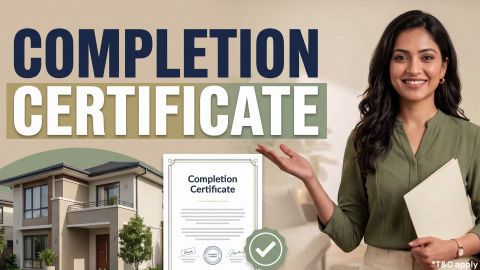
What is Completion Certificate
In most property papers, CC means a commencement certificate. Some papers use CC for a completion certificate, so read the full term on every document.
- Commencement certificate: the local authority's permission to start building on a sanctioned plan
- Completion certificate: proof that the building matches the plan, defined in Section 2(q) of the Real Estate (Regulation and Development) Act, 2016
- Occupancy certificate: permission to live in the building, defined in Section 2(zf)
- Order: commencement first, completion second, occupancy third
Checklist: 4 documents to collect before you book
Ask the developer for the relevant certificates before you pay a booking amount. Bajaj Finance runs legal and technical verification before it disburses a home loan, so a complete paper trail shortens the review.
What does CC mean in real estate?
CC in real estate stands for commencement certificate in most property documents, and for completion certificate in some. The two certificates sit at opposite ends of a project. A commencement certificate comes before the first brick is laid, and a completion certificate comes after the last one.
The abbreviation has no national definition. The Real Estate (Regulation and Development) Act, 2016 (RERA) defines the completion certificate in Section 2(q) and the occupancy certificate in Section 2(zf). The Act has been in force in full since May 2017. Each municipal body or development authority issues the commencement certificate under its own building rules, so the name and the process differ by city.
Show more
Show less
What is a commencement certificate?
A commencement certificate is the written permission from the local authority to start construction on a sanctioned plan. A developer applies for it after the building plan is approved and the statutory fees are paid. The certificate records the sanctioned number of floors, the built-up area and the permitted use of the plot.
Construction that starts without it is unauthorised. The authority can issue a stop-work notice, levy a penalty or order the unauthorised portion to be demolished.
Some municipal bodies issue the certificate in stages, for example up to the plinth first and for the upper floors later. Check which stage your certificate covers, because a plinth-level certificate does not permit the 14 floors a brochure may promise.
Show more
Show less
What is a completion certificate?
A completion certificate is issued by the competent authority after construction ends. Section 2(q) of the RERA Act, 2016 describes it as certifying that the project was developed according to the sanctioned plan, layout plan and specifications. The authority inspects the finished building against the sanctioned plan before it issues the document.
The certificate says the building matches the plan. It does not say the building is ready to live in, because that permission is the occupancy certificate. Section 2(zf) describes the occupancy certificate as permitting occupation of a building that has civic infrastructure such as water, sanitation and electricity.
Some states issue one combined certificate for both purposes. Confirm the name your local authority uses.
Show more
Show less
How do the three certificates differ?
The three certificates differ in timing and in what each one confirms. Commencement comes first, completion second and occupancy third.
| Certificate | Issued | What it confirms | Legal reference |
|---|---|---|---|
| Commencement certificate | Before construction starts | The authority permits work on the sanctioned plan | Local building rules |
| Completion certificate | After construction ends | The building matches the sanctioned plan and specifications | Section 2(q), RERA Act, 2016 |
| Occupancy certificate | After completion | The building can be occupied and has civic infrastructure | Section 2(zf), RERA Act, 2016 |
A buyer of an under-construction flat checks the first certificate. A buyer of a ready flat checks the second and third.
Show more
Show less
Home loan for professionals
Does a CC prove a project is safe to buy?
No. A commencement certificate shows only that the authority allowed construction to start. It does not show that the project is registered, finished or free of disputes.
The buyer's real worry is whether CC in real estate is enough proof to commit money. Three more checks close the gap: the project's RERA registration number on the state portal, the title of the land, and a match between the floors sold and the floors sanctioned. The guide to Section 3 of the RERA Act explains which projects must register.
The certificate also carries a validity period set by the authority. A lapsed certificate needs renewal before work continues.
Show more
Show less
How do I check a commencement certificate before booking?
Collect four documents before you book: the commencement certificate, the sanctioned plan, the RERA registration certificate and, for a ready home, the occupancy certificate. Then run the five steps below.
- Ask the developer for the certificate number, the date of issue and the name of the issuing authority.
- Read the number of floors and the built-up area the certificate covers, and compare both with the brochure.
- Check the validity date printed on the certificate.
- Confirm the certificate with the issuing authority's office or portal.
Look up the project's RERA registration number on the state RERA portal.
Keep a copy of each document. A lender asks for the same papers.
Show more
Show less
A worked example: 14 floors sold, 9 sanctioned
Meera Nair, 34, works in Pune and earns Rs. 1.4 lakh a month, with a CIBIL Score of 762. She wants a 2 BHK flat in an under-construction project and plans to borrow Rs. 55 lakh.
| Item | Brochure | Certificate | Result |
|---|---|---|---|
| Floors in the tower | 14 floors | Plinth plus 9 floors | 5 floors not yet covered |
| Built-up area per flat | 1,050 sq. ft. | Matches the sanctioned plan | Match |
| Validity | Not stated | Valid | Match |
Meera asks the developer for the application covering the upper floors. She books only after the authority's office confirms the stage of the certificate. The check took her 2 working days.
Show more
Show less
Does the CC matter for a home loan with Bajaj Finance?
Yes, for an under-construction flat. Bajaj Finance reviews the sanctioned plan and the construction permissions as part of its legal and technical verification. A flat in a tower with a certificate that covers fewer floors than were sold can slow the review.
| Loan feature | Detail |
|---|---|
| Interest rate | From 7.25% p.a.*, subject to credit assessment |
| Loan amount | Up to Rs. 15 crore* |
| Tenure | Up to 32 years |
Approval timelines can extend where the certificate is missing, has lapsed or covers fewer floors than the project sells, and minimum income thresholds can differ by city. Check your home loan eligibility before you book.
Frequently Asked Questions
Reading the certificates
Home loan questions
Who issues a commencement certificate?
The local planning authority issues it. That is the municipal corporation, the development authority or the town planning office, depending on your city. You can confirm a certificate by asking the same office for a copy or by using its online portal where one exists. Always match the certificate number with the number the developer quotes in the brochure and the agreement.
Is CC the same as OC?
No. In most property papers, CC refers to the commencement certificate, which is issued before construction starts, while OC is the occupancy certificate, which is issued after the building is finished. You need the first to confirm that construction is authorised and the second to confirm that you can live in the flat. A completion certificate sits between the two.
How long does a commencement certificate stay valid?
The validity period is printed on the certificate, and it differs by authority. If work does not start or continue within that period, the developer must renew the certificate. Ask for the latest renewal when you review the papers, and note the date. A lapsed certificate on a project you are funding is a reason to pause the booking.
Does a CC change my home loan eligibility?
No. Your eligibility depends on your income, your existing obligations and your credit score, not on the project's certificates. The certificates affect the property verification, which is a separate step. A project with incomplete permissions can still delay or stop your disbursement, so check them early and share them with Bajaj Finance when you apply.
What should I do if the developer cannot show a certificate?
Pause the payments and ask for the certificate in writing, with its number and date. If the developer does not provide it, check with the local authority's office. You can also ask a property lawyer to review the file. Do not pay beyond the booking amount until the paper is in your hands.
Home Loan in Different Cities

Home Loan in Mumbai

Home Loan in Ahmedabad

Home Loan in Bangalore

Home Loan in Chennai

Home Loan in Delhi

Home Loan in Hyderabad

Home Loan in Cochin

Home Loan in Noida

Home Loan in Pune
Home Loan for different budget
Check your pre-approved offer now
Our Calculators





What do our customers say about us
customers
Play Store rating
reviews
Amit Shiva
Reviewed on
Smooth and transparent home loan process. The interest rates were competitive, and documentation was minimal. The team guided me clearly at every step, making my first home purchase stress-free. Highly recommended for quick approvals.
Sandeep Kulkarni
Reviewed on
The loan disbursal was fast, and the customer support team was extremely patient with all my queries. Flexible EMIs helped me manage my monthly expenses easily. A great experience for salaried homebuyers.
Ritika Agarwal
Reviewed on
I had a great experience while transferring my existing home loan. The process was quick, and I saved significantly with the lower interest rate. Customer service was helpful throughout. Highly recommended for balance transfers.
Manoj Verghese
Reviewed on
Clear guidance, quick approval, and flexible repayment options made buying my new house easier than expected. The team handled everything professionally. Very satisfied and would definitely recommend their home loans
Find your nearest branch

More Articles




Watch our videos

Documents required to get a Bajaj Finserv Home Loan

Tips to increase your Home Loan eligibility
Things you need to know about pre-approved home loan

Things you need to know before applying for a Home Loan

How does Repo Rate affect your Home Loan

Download App
Now request money from your friends and family and make instant payments.

- Choose from personal, business, gold loans and more
- Pay utility bills, use UPI, get FASTag and more
- Buy over 1 million products on No Cost EMI
- Buy stocks, mutual funds and invest in FD
Disclaimer
1. Bajaj Finance Limited (“BFL”) is a Non-Banking Finance Company (NBFC) and Prepaid Payment Instrument Issuer offering financial services viz., loans, deposits, Bajaj Pay Wallet, Bajaj Pay UPI, bill payments and third-party wealth management products. The details mentioned in the respective product/ service document shall prevail in case of any inconsistency with respect to the information referring to BFL products and services on this page.
2. All other information, such as, the images, facts, statistics etc. (“information”) that are in addition to the details mentioned in the BFL’s product/ service document and which are being displayed on this page only depicts the summary of the information sourced from the public domain. The said information is neither owned by BFL nor it is to the exclusive knowledge of BFL. There may be inadvertent inaccuracies or typographical errors or delays in updating the said information. Hence, users are advised to independently exercise diligence by verifying complete information, including by consulting experts, if any. Users shall be the sole owner of the decision taken, if any, about suitability of the same.