








Rs. 100- Rs. 10 crore
Start investing with Rs. 100 | Easy KYC | Expert-managed funds
What Is a Mutual Fund Complete Beginner's Guide
In summary
Mutual funds pool money from many investors and invest it in shares, bonds and money market instruments. A professional fund manager runs the portfolio according to the scheme's stated objective, and every investor gets units that represent their share.
- You receive mutual fund units based on the amount you invest and the applicable NAV.
- You can invest through an SIP or lumpsum, depending on your cash flow and investment approach.
- Mutual funds offer diversification, but they do not eliminate market risk or guarantee returns.
- SEBI requires mutual fund schemes to display a Riskometer showing six levels, from Low to Very High.
- KYC is mandatory before you invest in mutual funds.
For example, if a scheme's NAV is Rs. 20 and you invest Rs. 5,000, you get 250 units. If the NAV later rises to Rs. 22, those units are worth Rs. 5,500.
What is a mutual fund?
A mutual fund is a pooled investment vehicle. Money from many investors is collected and invested in a portfolio of securities according to a scheme’s investment objective.
When you invest, you receive units of the scheme.
The value of each unit is represented by its Net Asset Value (NAV). The NAV can rise or fall as the value of the securities held by the scheme changes.
How NAV is worked out: NAV = (value of the scheme's investments + cash – liabilities) ÷ number of units. For example, if a scheme holds investments worth Rs. 200 lakh and has issued 10 lakh units, its NAV is Rs. 20 per unit. NAV is declared every business day.
The Asset Management Company (AMC) manages the scheme, while the fund manager makes investment decisions according to its stated strategy. AMFI describes mutual funds as collective investment vehicles that pool investors’ money and invest it across securities such as equities, bonds, government securities, and money market instruments.
In India, a mutual fund is set up as a trust and must be registered with SEBI. The sponsor sets it up, trustees oversee it to protect investors, the AMC manages the money, and a separate custodian holds the scheme's securities. This keeps your investments separate from the AMC's own money.
Mutual funds vs fixed deposits vs direct shares
Your best choice depends on your goal, risk appetite and time horizon. Fixed deposits offer safety, mutual funds offer diversified growth, and direct shares offer high potential with high risk.
| Factor | Mutual Funds | Fixed Deposits | Direct Shares |
| Returns | ~10–12% (equity, long term, not guaranteed) | SBI general rates run 3.05%–6.40% p.a. | Market-linked; can be high or negative |
| Risk | Moderate–High | Very Low | High |
| Minimum amount | Rs. 100–₹500 via SIP | ~Rs. 1,000 | Price of one share |
| Liquidity | 1–3 days | Penalty on early exit | Instant |
| Tax | Equity LTCG 12.5% above Rs. 1.25 lakh | Slab rate | Slab rate |
| Best for | Long-term wealth | Short-term goals, safety | Experienced investors |
How do mutual funds work?
The process is straightforward: you invest money in a scheme, receive units, and your investment value changes with the portfolio’s performance and the applicable NAV.
Consider Riya, who wants to invest Rs. 5,000 every month towards a long-term goal. Instead of selecting individual shares herself, she could compare suitable mutual fund schemes and invest through an SIP. She would receive units based on the applicable NAV for each instalment. Her investment value would then fluctuate with the scheme’s underlying investments.
How to earn money from a mutual fund
In two ways. First, when the value of the scheme's investments rises, the NAV rises, and you gain when you redeem your units at a higher NAV than you paid. Second, if you choose the IDCW option (Income Distribution cum Capital Withdrawal), the scheme may pay out part of its value to you from time to time; the NAV falls by the amount paid. In the growth option, nothing is paid out and all gains stay invested.
How does redemption work: When you sell (redeem) units of an open-ended scheme, you get the NAV of that day, minus any exit load. SEBI rules require the money to reach your bank within 3 working days, and most equity schemes pay in 2. Some schemes, such as ELSS, have a lock-in.
You can invest through a lumpsum investment or an SIP. An SIP can also use rupee-cost averaging, although it does not protect you from losses.
What are the types of mutual funds?
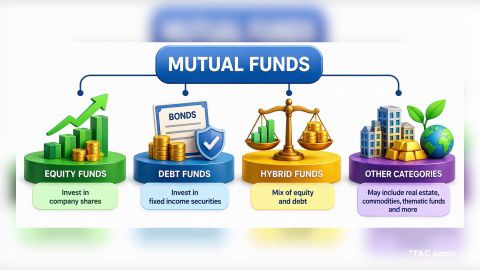
SEBI's circular of 26 February 2026 groups mutual fund schemes into 40 categories under five heads: equity (13 categories), debt (17), hybrid (7), life cycle funds (1) and other schemes (2: index funds and ETFs, and fund of funds). The older solution-oriented category (retirement and children's funds) was discontinued.
The main categories and examples below show how schemes can differ based on their underlying investments.
| Category | Examples | Broad focus |
|---|---|---|
| Equity | Multi-cap, large-cap, mid-cap, small-cap, thematic, ELSS | Primarily equity and equity-related investments |
| Debt | Debt funds, liquid funds | Debt and debt-related instruments |
| Hybrid | Hybrid funds, aggressive hybrid funds | A mix of permitted asset classes |
| Life cycle | Life cycle funds | Goal-based funds with a fixed maturity of 5 to 30 years, whose mix moves from equity towards debt as maturity nears |
| Other | Index funds, ETFs, fund of funds | Passive or fund-of-fund structures |
By structure: Open-ended schemes let you buy and sell units on any business day at NAV and have no fixed maturity. Close-ended schemes have a fixed maturity, accept money only at launch (NFO) and are listed on a stock exchange so you can exit. Interval schemes allow buying and selling only during set windows.
Last updated: September 2026
The category alone does not tell you whether a scheme is suitable. Check its investment objective, portfolio, Riskometer, costs, and your own investment horizon.
What are the benefits of mutual funds?
Mutual funds can make diversified investing more accessible, particularly when you do not want to select and monitor individual securities yourself.
Diversification
Your money can be spread across multiple securities, sectors, or asset classes. This can reduce the impact of poor performance from any single holding, although it cannot remove market risk.
Professional management
A fund manager researches and manages the portfolio according to the scheme’s stated investment strategy.
Flexible investment options
You can invest through an SIP or lumpsum, depending on the scheme and your circumstances. Some schemes also allow redemptions without a lock-in, although exit loads or other conditions can apply.
Access to different investment strategies
You can choose from equity, debt, hybrid, passive, and other scheme structures depending on your goals and risk tolerance.
Low starting amount
Some schemes let you start an SIP with as little as Rs. 100 a month, so you can begin small and increase later.
Liquidity and transparency
You can redeem units of open-ended schemes on any business day. Every scheme declares its NAV daily and publishes its full portfolio regularly, so you can see where your money is invested.
Tax-saving option
ELSS funds qualify for a deduction of up to Rs. 1.5 lakh a year under the old tax regime, with a 3-year lock-in for each investment.
What are the limitations and risks of mutual funds?
Mutual funds do not guarantee profits. Your investment can lose value, and the level of risk varies by scheme.
Market risk
Equity funds can fluctuate significantly with market movements. Debt funds can be affected by interest-rate, credit, and liquidity risks.
Costs can reduce returns
Mutual funds have expenses, including the Total Expense Ratio (TER). Some schemes can also charge an exit load when you redeem units under specified conditions. See expense ratio and exit load.
Limited control over individual securities
The fund manager decides which securities to buy, hold, or sell within the scheme’s mandate. You do not directly choose each security.
The wrong scheme can conflict with your goal
A fund that does not match your risk tolerance or investment horizon may not be appropriate for your objective. Review the scheme’s Riskometer and portfolio before investing.
Every scheme shows its risk on a Riskometer with six levels: Low, Low to Moderate, Moderate, Moderately High, High and Very High (SEBI Master Circular for Mutual Funds, 20 March 2026).
What fees do mutual funds charge?
The main ongoing cost is the expense ratio, which is reflected in the scheme’s NAV rather than usually being collected as a separate payment from you. An exit load may apply when you redeem within the period specified by the scheme.
An entry load is not charged on mutual fund purchases in India; SEBI abolished entry load in 2009.
The actual costs depend on the scheme. Check its applicable documents before investing.
Exit load example
Many equity schemes charge an exit load of around 1% if you redeem within one year. On a redemption of Rs. 50,000, that is Rs. 500. The exact load and period differ by scheme.
Direct and regular plans
Every scheme has a direct plan and a regular plan with the same portfolio. A regular plan is bought through a distributor and includes the distributor's commission in its expense ratio, so its NAV and returns differ slightly from the direct plan.
Expense ratio limits
SEBI sets a maximum expense ratio for each type of scheme, and it falls as the scheme grows larger. The current ratio is shown in the scheme's factsheet.
How are mutual funds taxed?
Tax depends on the type of mutual fund, the nature of the gain, the holding period, and the applicable tax rules.
Equity-oriented funds
Gains on units held for more than 12 months are long-term and taxed at 12.5% on gains above Rs. 1.25 lakh in a financial year. Gains on units held for 12 months or less are short-term and taxed at 20%.
Debt funds bought on or after 1 April 2023
Gains are taxed at your income tax slab rate, however long you hold the units.
IDCW payouts
Any income distributed to you is added to your income and taxed at your slab rate.
SIP instalments
Each instalment has its own holding period, and the oldest units are treated as sold first.
These rates apply for FY 2026-27.
You can read more about short-term capital gains tax and long-term capital gains tax.
How can you calculate mutual fund returns?
Your return depends on the amount invested, cash-flow timing, holding period, and change in the scheme’s NAV.
For a single investment, absolute return measures the percentage change between the purchase and current value. For investments held over multiple years, CAGR can help express the annualised growth rate. For an SIP with multiple cash flows, XIRR is generally more appropriate because it accounts for the dates and amounts of individual investments.
Example: You invest Rs. 1,00,000 and it grows to Rs. 1,50,000 in 3 years. Your absolute return is 50% (Rs. 50,000 ÷ Rs. 1,00,000). Your CAGR is about 14.5% a year, which is the steady yearly growth that would turn Rs. 1,00,000 into Rs. 1,50,000 in 3 years.
You can use the mutual fund calculator, SIP Calculator, step-up SIP calculator, or lumpsum calculator from Bajaj Finance for illustrations. Calculator outputs are estimates, not guaranteed returns.
Common mutual fund terms
Here are some of the common mutual fund terms you need to be aware of:
NAV: The value of one unit of a scheme, declared every business day.
AUM (Assets Under Management): The total value of money a scheme manages.
Expense ratio (TER): The yearly cost of running the scheme, taken from its assets.
Exit load: A charge for redeeming units before a set period.
Benchmark: The index a scheme's performance is compared with.
Folio number: Your account number with a fund house.
IDCW: The option that pays out part of the scheme's value to you; earlier called "dividend".
SID (Scheme Information Document): The official document with a scheme's objective, risks and costs.
Who can consider investing in mutual funds?
Mutual funds can suit investors with different goals and risk levels because schemes have different investment strategies.
You might consider them if you want diversified market exposure, prefer professional portfolio management, or want to invest regularly through an SIP. Your choice should depend on your financial goal, investment horizon, risk tolerance, and the scheme’s characteristics rather than simply whether you are a beginner or experienced investor.
Resident individuals, joint holders, Hindu Undivided Families (HUFs) and companies can invest. A minor can invest through a parent or legal guardian, with the investment held in the minor's name until they turn 18.
How do you invest in mutual funds?
Follow these steps before making your first investment. Each step helps you check whether the scheme fits your circumstances.
- Define your goal, investment horizon, and risk tolerance.
- Complete KYC, which is mandatory before investing.
- Compare schemes based on their objective, portfolio, Riskometer, costs, and performance.
- Choose between an SIP and lumpsum investment.
- Review the Scheme Information Document and other scheme-related documents.
- Invest through a registered platform or fund house.
- Review the investment periodically against your goal rather than reacting to every short-term market movement.
The Bajaj Broking website can help you explore mutual fund schemes and investment information.
What should you check before investing?
Look beyond past returns. Check the scheme’s investment objective, asset allocation, portfolio, Riskometer, expense ratio, exit load, tax treatment, and whether its risk level matches your investment horizon. Also check how the scheme has performed against its benchmark over 3 and 5 years, how consistent that performance has been, the fund manager's experience, and the size of the scheme (AUM).
You can also compare equity mutual funds, NFO mutual funds, and ELSS mutual funds based on your requirements.
Conclusion
A mutual fund lets you invest in a professionally managed portfolio without selecting every security yourself. You can choose from different scheme categories and invest through an SIP or lumpsum.
The key is to match the scheme with your goal, investment horizon, risk tolerance, and expected level of involvement. Diversification and professional management can be useful, but neither removes market risk or guarantees returns.
Last reviewed: September 2026
Mutual funds are subject to market risk. Please read the scheme-related documents carefully before investing.
Explore Investment Tools
Articles and Insights


Frequently Asked Questions
Mutual fund basics
Mutual fund decisions
Can I lose money in a mutual fund?
Yes. Mutual fund returns are not guaranteed, and your investment value can fall when the securities held by the scheme lose value. The level of risk depends on the scheme and its underlying investments. Before investing, check the Riskometer, portfolio, investment objective, and time horizon rather than assuming that diversification makes an investment risk-free.
Can I withdraw my mutual fund investment anytime?
Many open-ended mutual funds allow you to redeem units on business days, but conditions can vary by scheme. An exit load may apply, and some schemes have a lock-in period. ELSS, for example, has a three-year statutory lock-in. SEBI rules require redemption money to reach your bank within 3 working days. Check the scheme documents for the applicable redemption conditions before investing.
Is an SIP safer than a lumpsum investment?
An SIP does not make the underlying mutual fund safer. It spreads your investments across different dates, which can reduce the effect of investing your entire amount at one market level, but the underlying scheme remains exposed to market risk. Choose the investment mode based on your cash flow, goal, and investment approach.
How much should I invest in mutual funds?
There is no single amount that is appropriate for everyone. Start by considering your income, essential expenses, emergency savings, existing investments, financial goals, and risk tolerance. Some schemes allow SIPs from Rs. 100, but the minimum amount does not determine how much you should invest. Your investment amount should fit your overall financial plan.
What is NAV in a mutual fund?
NAV (Net Asset Value) is the value of one unit of a scheme. It equals the value of the scheme's investments and cash, minus its liabilities, divided by the number of units. For example, investments of Rs. 200 lakh across 10 lakh units give an NAV of Rs. 20. NAV is declared every business day.
What happens to my money if the AMC shuts down?
Your money is not lost. The scheme's securities are held by a custodian, not by the AMC. If an AMC closes or is taken over, the trustees can transfer the schemes to another AMC with SEBI approval, or wind them up and pay investors the value of their units.
What is the difference between direct and regular plans?
Both invest in the same portfolio. A regular plan is bought through a distributor and includes the distributor's commission in its expense ratio, so it has a slightly lower NAV than the direct plan of the same scheme.
How much do I need to start investing in mutual funds?
Some schemes let you start an SIP with Rs. 100 a month or a lumpsum with a small amount, while many ask for Rs. 500 or more. The minimum is set by each scheme and shown on its page.
Can I invest in mutual funds online?
Yes. You can complete KYC, choose a scheme and invest through an SIP or lumpsum online on the Bajaj Finserv platform, using your PAN, Aadhaar and bank account.
Is a mutual fund better than an FD?
Neither is better for everyone. An FD gives a fixed rate with low risk; a mutual fund can earn more or less than an FD because returns depend on the market. The right choice depends on your goal, time horizon and comfort with risk.
Disclaimer
Bajaj Finance Limited ("BFL") is registered with the Association of Mutual Funds in India ("AMFI") as a distributor of third party Mutual Funds (shortly referred as 'Mutual Funds) with ARN No. 90319
BFL does NOT:
(i) provide investment advisory services in any manner or form.
(ii) carry customized/personalized suitability assessment.
(iii) carry independent research or analysis, including on any Mutual Fund schemes or other investments; and provide any guarantee of return on investment.
In addition to displaying the Mutual fund products of Asset Management Companies, some general information is sourced from third parties, is also displayed on As-is basis, which should NOT be construed as any solicitation or attempt to effect transactions in securities or the rendering any investment advice. Mutual Funds are subject to market risks, including loss of principal amount and Investor should read all Scheme/Offer related documents carefully. The NAV of units issued under the Schemes of mutual funds can go up or down depending on the factors and forces affecting capital markets and may also be affected by changes in the general level of interest rates. The NAV of the units issued under the scheme may be affected, inter-alia by changes in the interest rates, trading volumes, settlement periods, transfer procedures and performance of individual securities forming part of the Mutual Fund. The NAV will inter-alia be exposed to Price/Interest Rate Risk and Credit Risk. Past performance of any scheme of the Mutual fund do not indicate the future performance of the Schemes of the Mutual Fund. BFL shall not be responsible or liable for any loss or shortfall incurred by the investors. There may be other/better alternatives to the investment avenues displayed by BFL. Hence, the final investment decision shall at all times exclusively remain with the investor alone and BFL shall not be liable or responsible for any consequences thereof.
Investment by a person residing outside the territorial jurisdiction of India is not acceptable nor permitted.
Disclaimer on Risk-O-Meter:
Investors are advised before investing to evaluate a scheme not only on the basis of the Product labeling (including the Riskometer) but also on other quantitative and qualitative factors such as performance, portfolio, fund managers, asset manager, etc, and shall also consult their Professional advisors, if they are unsure about the suitability of the scheme before investing.
Disclosure: Bajaj Finance Limited (BFL) is a distributor of Mutual Funds with ARN - 90319 and distributes mutual funds of Bajaj Finserv Asset Management Limited (BFSAMC). BFL receives commission towards distribution of mutual fund products. BFSAMC is a group company of BFL, carrying business on arm’s length basis without any conflict of interest and in accordance with the prevailing law / regulation.
Disclaimer
Bajaj Finance Limited ("BFL") is an NBFC offering loans, deposits and third-party wealth management products.
The information BFL contained in this article is for general informational purposes only and does not constitute any financial advice. The content herein has been prepared by BFL on the basis of publicly available information, internal sources and other third-party sources believed to be reliable. However, BFL cannot guarantee the accuracy of such information, assure its completeness, or warrant such information will not be changed.
This information should not be relied upon as the sole basis for any investment decisions. Hence, User is advised to independently exercise diligence by verifying complete information, including by consulting independent financial experts, if any, and the investor shall be the sole owner of the decision taken, if any, about suitability of the same.
Disclaimer
Mutual Fund SIP calculator may provide potential investors an approximate estimate on the maturity amount of the monthly SIP, purely based on mathematical calculation of the projected annual return rate selected by investor. However, such calculation does not factor the actual performance by the Asset Management Company (AMC) and should not be treated as any advice or assurance about the actual return of investment. Mutual Funds do not have a fixed rate of return and it is not possible to predict the rate of return. Please note that the SIP calculator are for illustrations only and do not represent actual returns which may vary depending on various factors including but not limited to actual performance, expense ratio, taxation, exit load (if any), etc.